NITI Aayog completed ten years on January 1, 2025. The institution that replaced the Planning Commission has now been in operation for as long as the British East India Company stayed in business as a regulated company under the Charter Act of 1813. That comparison is unfair and arbitrary, but it makes a point. Institutions take time to settle, and a decade is roughly the period in which a new policy body either acquires a distinct constitutional weight or recedes into the background of executive routine. NITI Aayog has done some of both.
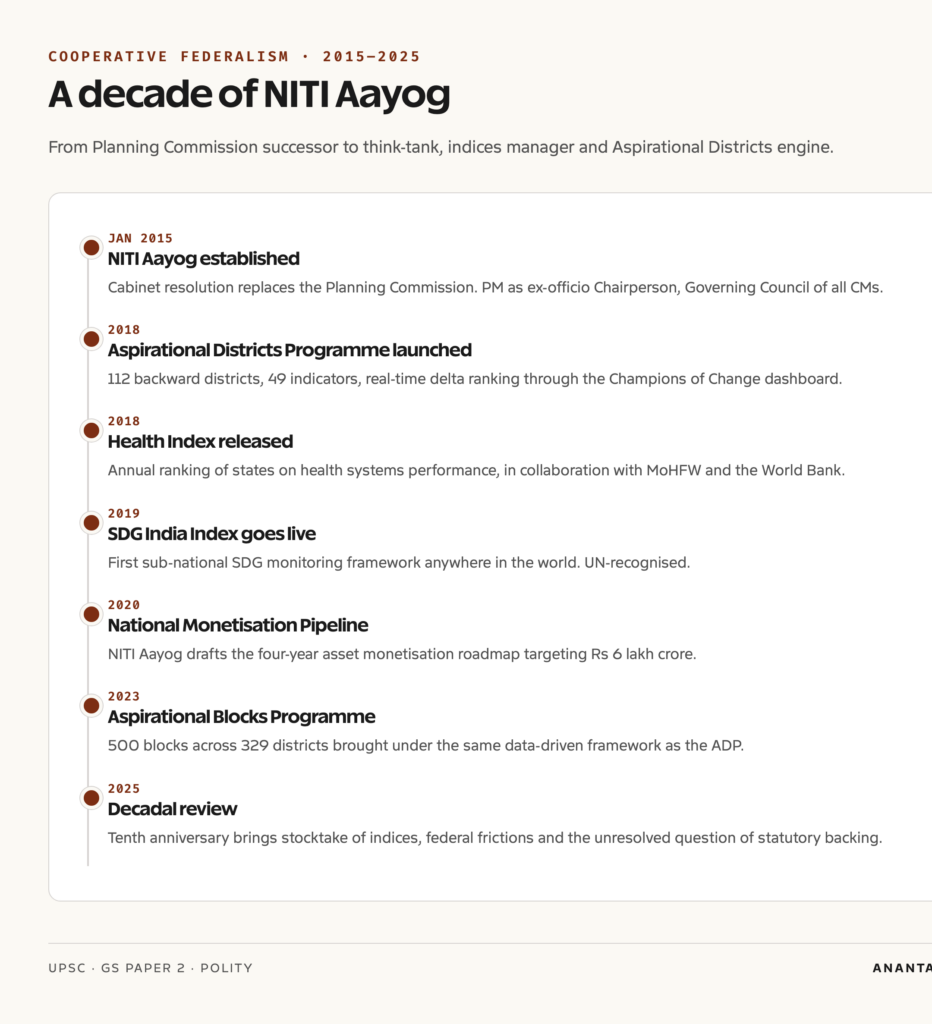
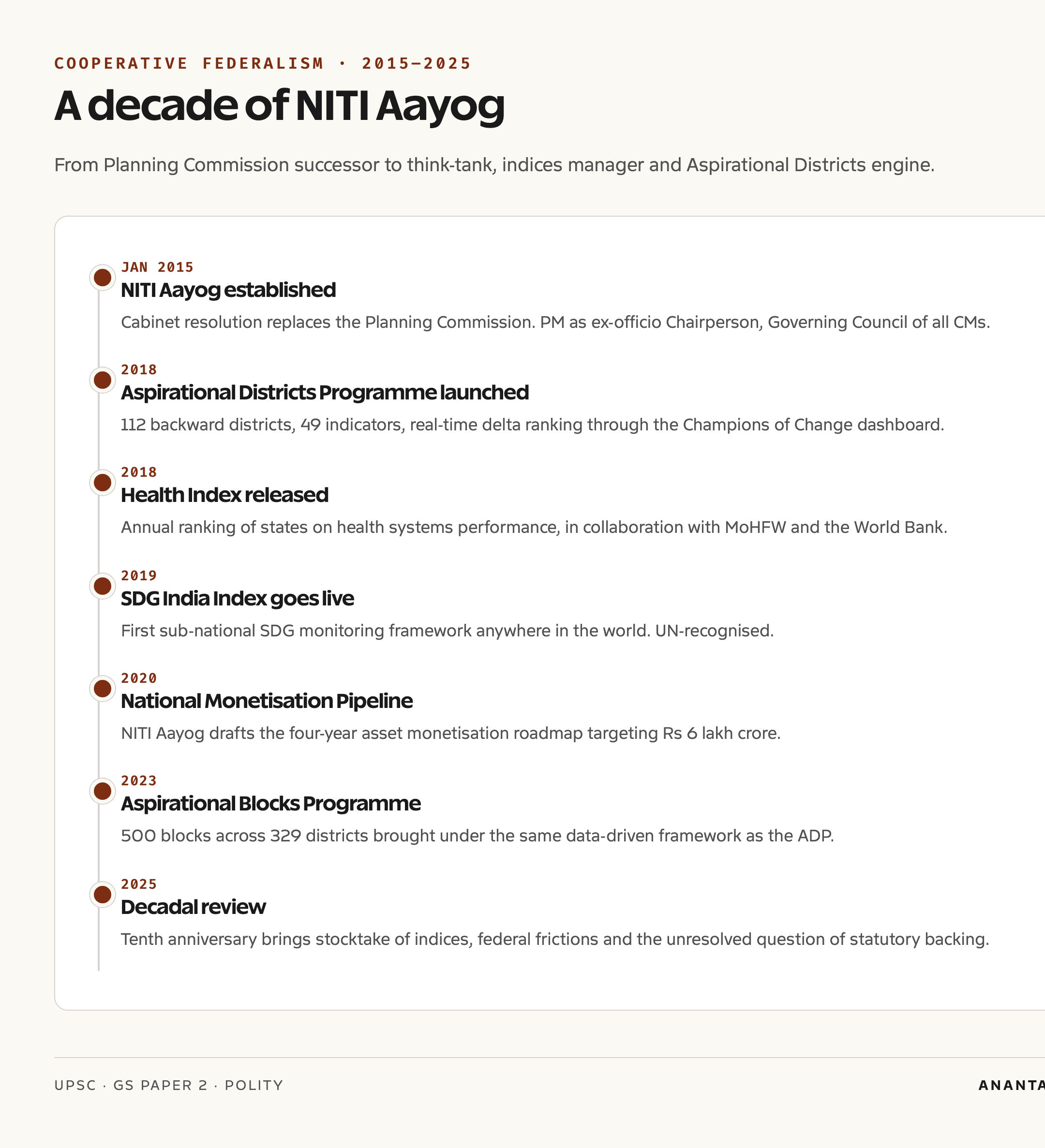
The Aayog was created by a Cabinet Resolution in January 2015 with the explicit intent to break from the Planning Commission’s top-down, allocative model and move toward what the government described as a “bottom-up, evidence-based, cooperative-federal” approach. The Planning Commission had directed five-year plans and disbursed central plan funds to states. NITI Aayog has no fund-allocation power. Its instruments are persuasion, ranking, indices, technical advice, and the periodic Governing Council that brings together the Prime Minister and Chief Ministers. Whether that is enough to drive substantive policy change is the central question of any decadal review.
This guide walks through the structure, the four Cs of the Aayog’s mandate, the major programmes it has anchored, the comparison with the Planning Commission, the open challenges, and the prelims and mains pointers an aspirant should carry into the examination hall.
Quick Facts on NITI Aayog
NITI Aayog stands for the National Institution for Transforming India. It was established on January 1, 2015 through a Union Cabinet Resolution. It is an executive body, neither constitutional nor statutory. The Prime Minister is its ex-officio Chairperson. The Governing Council comprises the Prime Minister, Chief Ministers of all states, Chief Ministers of Delhi and Puducherry, Lieutenant Governors of other Union Territories, and the Vice-Chairperson and full-time members of the Aayog. The Vice-Chairperson is appointed by the Prime Minister and holds the rank of a Cabinet Minister. The CEO is appointed by the Prime Minister for a fixed tenure and holds the rank of Secretary to the Government of India. The Aayog has no powers of financial allocation; its role is advisory, evaluative, and convening. It has anchored major initiatives including the Aspirational Districts Programme, the Atal Innovation Mission, the SDG India Index, the Health Index, the Composite Water Management Index, and the National Monetization Pipeline.
What NITI Aayog Is
NITI Aayog is the policy think tank of the Government of India. It is the principal advisory body that designs strategic and long-term programmes, monitors their implementation through state-level data, and serves as the forum for centre-state policy coordination. The Aayog was created to perform three roles that the Planning Commission, in the government’s assessment, had stopped performing well: deep technical work on complex policy problems, coordination between the Centre and the states in designing programmes that respect regional difference, and benchmarking of state performance through public indices that create competitive pressure to improve.
The Aayog’s most distinctive feature is what it does not do. It does not allocate funds. It does not lay down five-year plans. It does not run schemes from a central headquarters. Funding decisions sit with the Finance Ministry and individual line ministries. Scheme design draws on Aayog inputs but is owned by the relevant ministry. The Aayog’s authority comes from the Prime Minister’s direct chairmanship, the convening power of the Governing Council, and the technical credibility of its indices and reports.
Background and Historical Context
The Planning Commission was set up in 1950 by a Cabinet Resolution of the Government of India. It was modelled on the centralised planning bodies of the post-war era, and for the first three decades it produced India’s five-year plans, allocated central plan funds to ministries and states, and wielded what the political scientist Jaganath Pathy called “extra-constitutional authority over state finances.” From the late 1980s onwards, as India moved toward economic liberalisation, the Planning Commission’s role began to look mismatched with the new policy environment. States were demanding more flexibility, line ministries had built their own technical capacity, and the discipline of five-year plans seemed increasingly out of step with rapid technological and economic change.
By 2014, the case for replacement was bipartisan in substance even if it remained contested in symbolism. The Independent Evaluation Office, set up under the Planning Commission itself, had recommended a comprehensive overhaul. Several Chief Ministers, across party lines, had complained that the Commission imposed uniform programmes on diverse states. The new government, in its first year, abolished the Planning Commission and set up NITI Aayog in its place. The transition was administrative and quick. The substantive break, from a fund allocator to a policy think tank, took time to settle and is still in progress. For the static-current backdrop on the body it replaced and the federal stakes involved, see our notes on the planning commission vs NITI Aayog comparison and the seventh schedule of the Indian Constitution which structures centre-state subjects.
Structure and Composition
The Aayog’s structure has three layers. At the top sits the Chairperson, who is the Prime Minister, and a Vice-Chairperson appointed by the Prime Minister. The Vice-Chairperson functions as the operational head and holds Cabinet Minister rank. Below them sit full-time members and ex-officio members, the latter drawn from senior Cabinet Ministers nominated by the Prime Minister. Special invitees and part-time members provide subject expertise. The CEO heads the secretariat and the technical staff and holds the rank of Secretary to the Government of India.
The Governing Council is the apex deliberative body. Its members are the Prime Minister, the Chief Ministers of all states, the Chief Ministers of Delhi and Puducherry, the Lieutenant Governors of other Union Territories, and the Vice-Chairperson and full-time members of the Aayog. The Council meets periodically. Its discussions are intended to surface centre-state policy disagreements, push forward programme design, and build consensus on contested issues like agricultural marketing, GST compensation, or water-sharing. Beyond the Council sit Regional Councils, formed for specific cross-state issues, and convened by the Prime Minister or a nominee.
The Four Cs of the Aayog’s Mandate
The Aayog’s published mandate distils its work into four cooperative threads. Cooperative federalism is the first. It positions the Aayog as a friend and philosopher to states, working alongside them in scheme design rather than directing them from above. The SATH-E project, which provides technical assistance to selected states for school education reform, is one example. Competitive federalism is the second. The Aayog publishes a series of state-level indices that rank states on health, school education, water management, energy, and the Sustainable Development Goals. The rankings are designed to create reputational pressure on state governments to improve, with the explicit theory that competition between states drives faster reform than directives from the Centre.
Collaborative policymaking is the third thread. The Aayog convenes experts, academics, and private sector practitioners on specific policy problems. The Atal Innovation Mission, which runs Atal Tinkering Labs in schools and Atal Incubation Centres for start-ups, sits in this category. The fourth thread is conflict resolution, where the Aayog acts as a forum for inter-ministerial and centre-state disputes that have not reached the formal arbitration stage. Whether the Aayog has been effective at this last role is debated; the GST Council and the Inter-State Council remain the primary formal forums for centre-state coordination.
Major Programmes and Initiatives
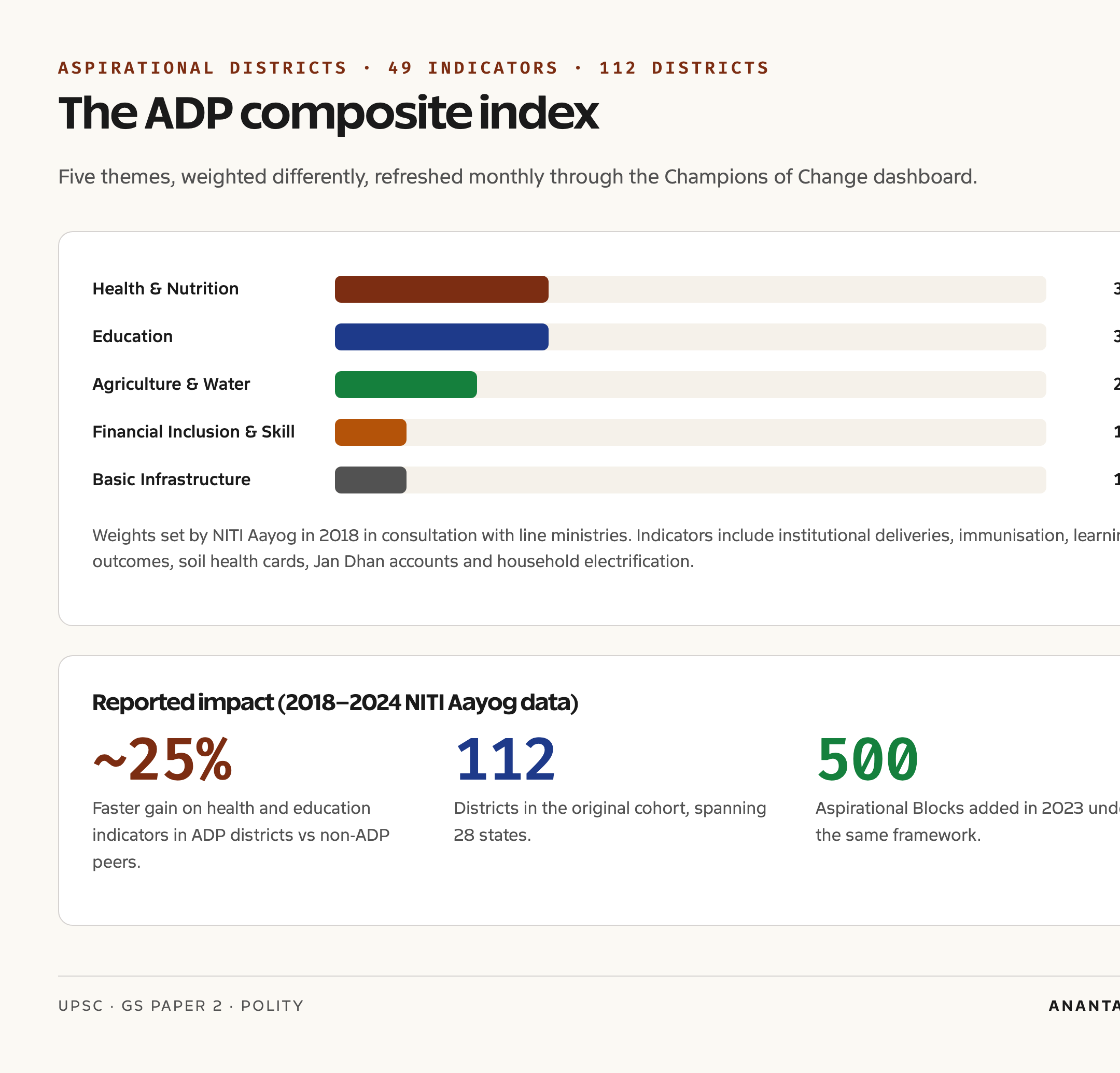
The Aspirational Districts Programme launched in January 2018 and remains the Aayog’s flagship intervention. The programme identified 112 of the most backward districts in the country and committed to lifting them through a structured composite index covering health and nutrition, education, agriculture and water resources, financial inclusion, and basic infrastructure. The composite index uses 49 indicators across the five domains. Districts are ranked monthly, and the rankings are public. The programme expanded into the Aspirational Blocks Programme in 2023, taking the same model down to the block level for 500 blocks. Independent evaluations have been mixed but generally positive, with the strongest gains in health and education indicators in districts that started furthest behind.
The Atal Innovation Mission was set up to seed an innovation ecosystem in Indian schools, colleges, and start-ups. Atal Tinkering Labs are now operational in over ten thousand schools, providing students access to robotics kits, 3D printers, and rapid prototyping tools. Atal Incubation Centres support technology start-ups in tier-two and tier-three cities. The mission’s theory of change is that early exposure to design and engineering, combined with later-stage incubation support, builds an indigenous innovation pipeline.
The National Monetization Pipeline of 2021 was the Aayog’s most ambitious financial planning exercise. It identified core infrastructure assets in roads, railways, power, telecom, and aviation that could be monetised through concessions, leases, and other contractual mechanisms over a four-year horizon. The Production Linked Incentive schemes, designed in close consultation with the Aayog, route fiscal support to manufacturers in fourteen sectors against output and investment commitments. The SDG India Index, the Health Index, the School Education Quality Index, and the Composite Water Management Index together form the analytic backbone of competitive federalism in practice.
NITI Aayog vs Planning Commission
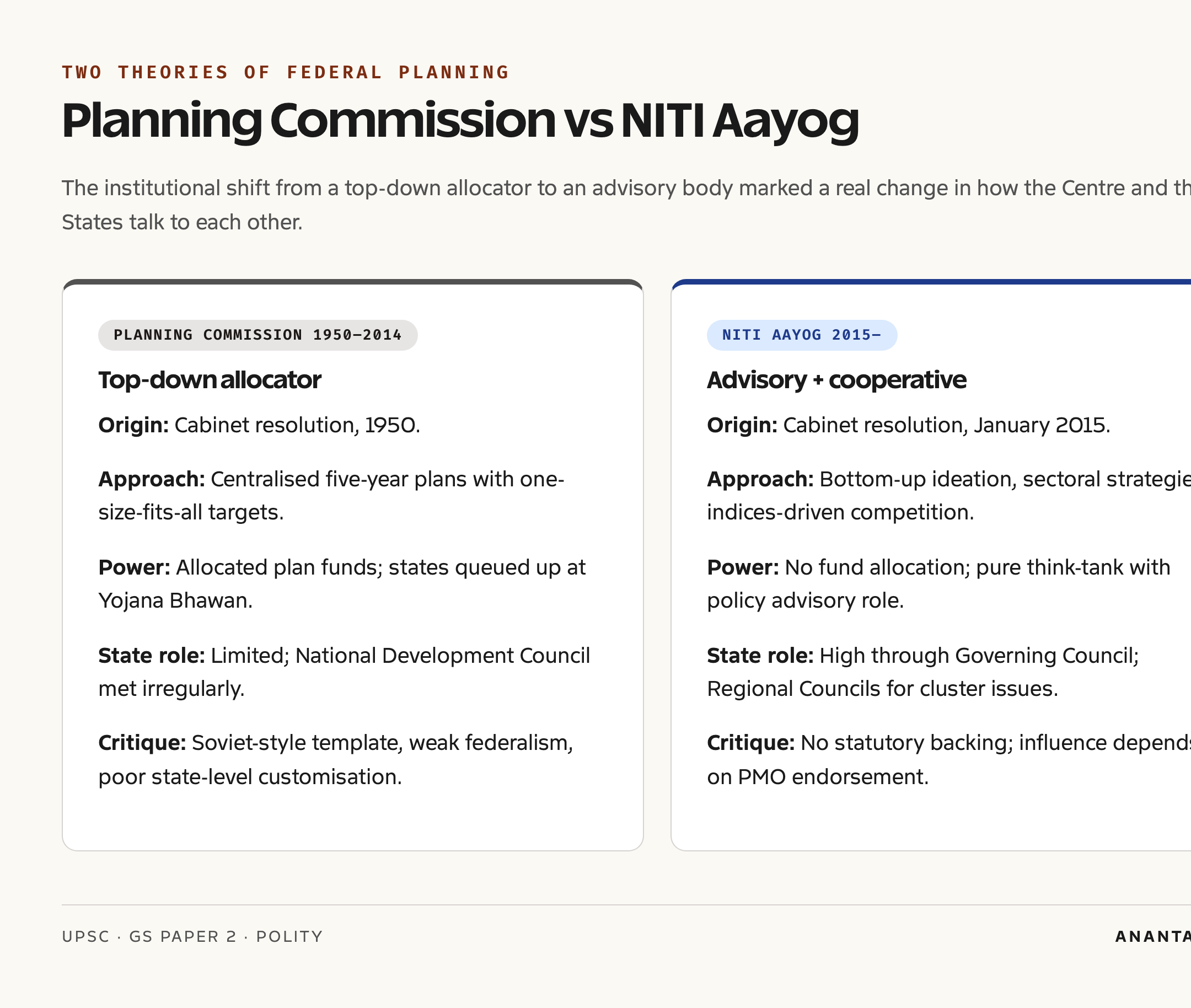
The Planning Commission directed central plan investments through five-year plans and allocated funds to ministries and states. NITI Aayog plays no role in fund allocation. The Planning Commission designed schemes that applied uniformly across states. NITI Aayog designs frameworks and indices that allow states to design their own pathways within a common analytic structure. The Planning Commission was widely seen as a Centre-imposing body. NITI Aayog is positioned as a state-partnering body. The Planning Commission was staffed largely by economists with macro-planning expertise. NITI Aayog draws more broadly from technology, sectoral specialists, and management consultancy.
The trade-offs are real. The Planning Commission’s fund allocation power gave it leverage over states that the Aayog does not have. The Aayog can recommend, persuade, and rank, but it cannot direct. Whether the loss of allocative power has weakened the Centre’s policy reach or strengthened cooperative federalism by removing a coercive instrument is the substantive debate. The current consensus is that the Aayog is better suited to the post-liberalisation policy environment, but that some of the Planning Commission’s coordinating instruments have been missed and partly reinvented in informal forms.
Why It Matters
The institutional shift from Planning Commission to NITI Aayog matters for three reasons. First, it adjusts the federal architecture in line with the post-1991 economic order. A market economy in which states compete for investment, talent, and capital cannot be governed by a central planning body that issues directives. The Aayog’s competitive-federalism toolkit is calibrated for that environment.
Second, it changes the nature of policy expertise that the Centre privileges. The Planning Commission relied heavily on macroeconomic planning. The Aayog relies more on data analytics, sectoral benchmarking, and technical consulting. The shift mirrors the evolution of policy expertise in advanced economies, where think tanks and policy units have replaced central planning bodies.
Third, it changes the institutional culture of centre-state relations. A periodic Governing Council with Chief Ministers in the room is a different forum from a fund-allocating commission to which states submit proposals. The Aayog model assumes that states are partners; the Planning Commission model treated them more as subordinate units. Whether the partnership rhetoric translates into consistent practice remains an open question across successive Union governments.
Challenges and Open Questions
Three challenges sit in the Aayog’s path. The first is the absence of fund allocation power. Without it, the Aayog has to depend on the Finance Ministry, the line ministries, and persuasion to convert its policy recommendations into actual programmes. Recommendations that survive without ministerial support tend to remain on paper. The second is the political economy of state engagement. Governing Council meetings are infrequent, and several Chief Ministers have at various points boycotted or stayed away from meetings on specific issues. A forum that depends on voluntary state participation can be undermined by political conflict.
The third challenge is the data quality and incentive structure of the rankings. State-level indices depend on data submitted by state governments and verified by the Aayog. The risk of strategic data submission, where states report what makes them look good rather than what is true, is non-trivial. Independent verification mechanisms have improved over the decade but remain a work in progress.
Prelims Pointers
NITI Aayog was set up on January 1, 2015 by a Cabinet Resolution. It is an executive body, not a constitutional or statutory one. The Prime Minister is the ex-officio Chairperson. The Vice-Chairperson holds Cabinet Minister rank and is appointed by the Prime Minister. The CEO holds the rank of Secretary to the Government of India and is appointed by the Prime Minister for a fixed tenure. The Governing Council is the apex deliberative body, comprising the Prime Minister, all state Chief Ministers, the Chief Ministers of Delhi and Puducherry, Lieutenant Governors of other Union Territories, and the Vice-Chairperson and full-time members of the Aayog. The Aspirational Districts Programme was launched in 2018 covering 112 districts on a 49-indicator composite index across five domains. The Aspirational Blocks Programme launched in 2023.
A common trap statement: “NITI Aayog is a statutory body established under the NITI Act, 2015.” This is incorrect; it was set up by an executive Cabinet Resolution. Another trap: “The Aspirational Districts Programme is monitored by the Ministry of Rural Development.” This is incorrect; it is anchored by NITI Aayog.
Mains Practice Questions
- NITI Aayog represents a deliberate shift from directive central planning to cooperative federalism. Discuss the institutional design and assess whether the change has delivered on its core objectives. (GS Paper 2, 250 words)
- Compare NITI Aayog with the Planning Commission and bring out the implications of the institutional shift for centre-state relations. (GS Paper 2, 250 words)
- Examine the Aspirational Districts Programme as an instrument of evidence-based policy and assess its impact on the social development indicators of backward districts. (GS Paper 2, 150 words)
- Critically evaluate the role of NITI Aayog’s indices in fostering competitive federalism. (GS Paper 2, 150 words)
Way Forward
A second decade for NITI Aayog will turn on three things. The first is statutory grounding. A statutory base, similar to the GST Council under the Constitution (One Hundred and First Amendment) Act of 2016, would give the Aayog a more durable institutional position and a clearer role in centre-state coordination. The second is data infrastructure. Independent verification, public release of underlying data, and audit-grade transparency would strengthen the credibility of the rankings and the analytic work. The third is the link between Aayog recommendations and ministerial action. A clearer accountability framework, where major Aayog reports are formally taken up by the relevant Cabinet Committee within a specified timeline, would convert advice into traction.
For aspirants, the Aayog story illustrates how Indian governance reform proceeds incrementally. A hard institutional break is followed by years of slow recalibration. The full picture only becomes visible at the decadal mark. For a wider view of the constitutional architecture within which the Aayog operates, see our pieces on the 42nd Amendment of the Indian Constitution and the 44th Amendment of the Indian Constitution.
Frequently Asked Questions
When was NITI Aayog established and what does the name stand for?
NITI Aayog was established on January 1, 2015 by a Union Cabinet Resolution. NITI stands for the National Institution for Transforming India. It replaced the Planning Commission, which had been set up in 1950 by a similar Cabinet Resolution. The Aayog functions as the policy think tank of the Government of India and as the principal forum for centre-state policy coordination.
Is NITI Aayog a constitutional or statutory body?
Neither. NITI Aayog is an executive body, set up by a Cabinet Resolution rather than by a constitutional provision or an Act of Parliament. This means its existence and structure can be modified by another Cabinet Resolution, without requiring a constitutional amendment or parliamentary legislation. Some commentators argue for a statutory base to give the Aayog greater institutional permanence.
How does NITI Aayog differ from the Planning Commission?
The Planning Commission directed central plan investments through five-year plans and allocated funds to ministries and states. NITI Aayog plays no role in fund allocation. The Planning Commission designed uniform schemes for all states. NITI Aayog designs frameworks and indices and lets states design their own pathways. The Planning Commission was a top-down body. NITI Aayog is a bottom-up, state-partnering body. The two share the executive Cabinet Resolution origin but differ substantially in instruments and posture.
Who chairs the Governing Council of NITI Aayog?
The Prime Minister chairs the Governing Council. Its other members are the Chief Ministers of all states, the Chief Ministers of Delhi and Puducherry, the Lieutenant Governors of other Union Territories, and the Vice-Chairperson and full-time members of the Aayog. The Council meets periodically to discuss policy and coordinate centre-state action.
What is the Aspirational Districts Programme?
The Aspirational Districts Programme is the Aayog’s flagship initiative, launched in January 2018. It identified 112 of the most backward districts in the country and committed to lifting them through a structured composite index covering health and nutrition, education, agriculture and water resources, financial inclusion, and basic infrastructure. The composite index uses 49 indicators. Districts are ranked monthly, and the rankings are public. The programme expanded into the Aspirational Blocks Programme in 2023.
What are the four Cs of NITI Aayog’s mandate?
The four Cs are cooperative federalism, competitive federalism, collaborative policymaking, and conflict resolution. Cooperative federalism positions the Aayog as a partner to states. Competitive federalism uses public indices to drive states to improve through ranking. Collaborative policymaking convenes experts and the private sector around specific policy problems. Conflict resolution casts the Aayog as a forum for inter-ministerial and centre-state disputes.
Does NITI Aayog have financial powers?
No. NITI Aayog has no fund allocation powers. Funding decisions sit with the Finance Ministry and the individual line ministries. The Aayog’s authority comes from the Prime Minister’s chairmanship, the Governing Council’s convening power, and the technical credibility of its indices and reports. Some critics view the absence of financial powers as a structural weakness; supporters see it as a feature that enables genuine cooperative federalism.
What is the Atal Innovation Mission?
The Atal Innovation Mission was set up under NITI Aayog to seed an innovation ecosystem across schools, colleges, and start-ups. Atal Tinkering Labs operate in thousands of schools and provide students access to robotics, 3D printing, and rapid prototyping. Atal Incubation Centres support technology start-ups, particularly in tier-two and tier-three cities. The Mission was named after former Prime Minister Atal Bihari Vajpayee.
What rank does the Vice-Chairperson of NITI Aayog hold?
The Vice-Chairperson holds the rank of a Cabinet Minister. The CEO holds the rank of a Secretary to the Government of India. Both are appointed by the Prime Minister. The Vice-Chairperson functions as the operational head of the Aayog, while the CEO heads the secretariat and the technical staff.
What are the major indices published by NITI Aayog?
The major indices include the SDG India Index, which tracks state and Union Territory performance on the Sustainable Development Goals; the Health Index, which ranks states on health system performance; the School Education Quality Index; the Composite Water Management Index; and the Export Preparedness Index. These indices form the analytic backbone of competitive federalism by creating public, comparable benchmarks for state performance.
Tell Google you want more of this.
Add Anantam IAS as a preferred sourceOne tap, and this site shows up more often in your own Top Stories, AI Overviews and AI Mode. Remove it any time.