Online Content Blocking: NITI Aayog Seeks Industry Views on Reform
Why in News?
Government policy think tank NITI Aayog has sought technology-industry views on whether India’s online content-blocking, grievance-redressal and transparency timelines are operationally feasible. The Indian Express reported that a stakeholder meeting was held in New Delhi on June 25, 2026 as part of a wider exercise on simplifying regulation.
The consultation covers laws affecting social-media intermediaries, cybersecurity, data protection and online gaming. It matters because faster removal can limit online harm, but poorly designed blocking can also burden smaller platforms, encourage over-removal and affect the freedom of speech protected by Article 19(1)(a).
- NITI Aayog asked whether existing takedown, grievance and transparency timelines work across different categories and sizes of intermediaries.
- It also asked which intermediary due-diligence duties create the highest recurring compliance burden and what operational simplifications would help.
- Industry bodies reported at the meeting included Nasscom, CII, IAMAI and the Broadband India Forum.
- The exercise is linked to NITI Aayog’s reported Jan Vishwas Siddhant initiative for trust-based regulation and rationalisation of existing laws.
- NITI Aayog is expected to study the responses and send recommendations to the Ministry of Electronics and Information Technology; the consultation itself does not amend any law.
The development matters in the context of:
- The debate sits at the intersection of online safety, state capacity, platform accountability and constitutional liberty.
- A short deadline may be justified for urgent and clearly unlawful material, but the same deadline can be unsuitable for complex speech, satire, journalism or context-dependent claims.
- Reform must distinguish Section 69A blocking orders from the separate due-diligence and grievance obligations imposed on intermediaries under the IT Rules.
UPSC Relevance
Prelims Relevance
- NITI Aayog is the Union government’s apex policy think tank; its recommendations are advisory and do not themselves create binding takedown powers.
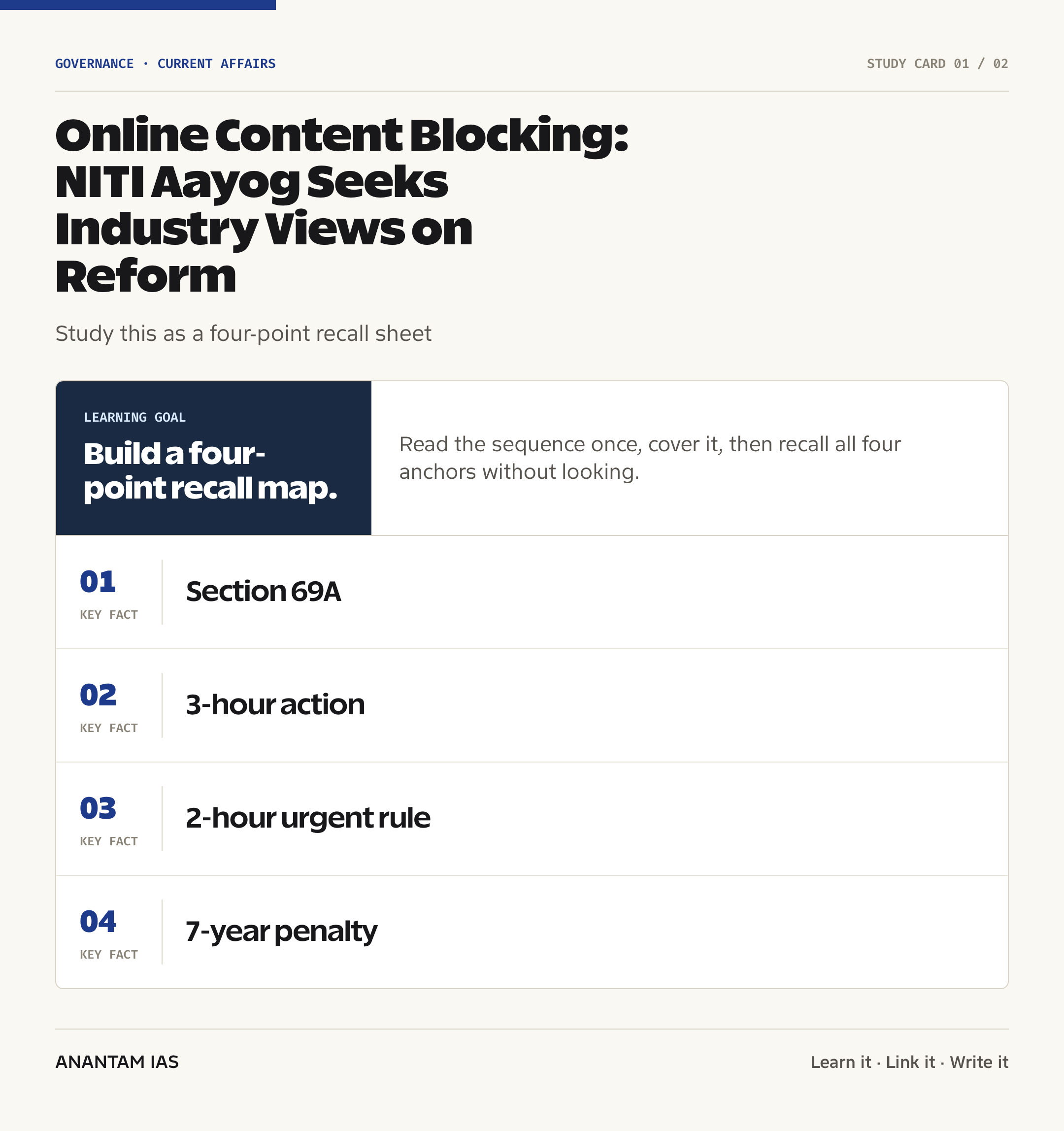
- Section 69A of the Information Technology Act, 2000 empowers the Central Government or a specially authorised officer to direct blocking of public access to online information.
- The statutory grounds include sovereignty and integrity of India, defence, security of the State, friendly relations with foreign States, public order and prevention of incitement to related cognisable offences.
- A Section 69A direction requires reasons to be recorded in writing and operates subject to the procedure and safeguards prescribed by rules.
- The Information Technology (Procedure and Safeguards for Blocking for Access of Information by Public) Rules, 2009 provide the institutional procedure for blocking.
- Section 79 grants conditional safe-harbour protection to intermediaries when they satisfy statutory and rule-based due diligence.
- Under the updated IT Rules, 2021, an intermediary must act within three hours after legally defined actual knowledge of specified unlawful information.
- The rules separately require action within two hours on certain complaints involving nudity, sexual content, impersonation or artificially morphed images of an individual.
- The Shreya Singhal judgment upheld Section 69A while stressing its limited grounds and procedural safeguards; it also linked intermediary takedown duties to a court order or valid government notification.
- Reasonable restrictions on speech must fall within Article 19(2); administrative convenience is not an independent constitutional ground for restricting expression.
Mains Relevance
GS Paper 2
- Balance between Article 19(1)(a) and the reasonable-restriction grounds under Article 19(2).
- Institutional design of executive blocking, procedural fairness, transparency, review and access to an effective remedy.
- Role of NITI Aayog as an advisory reform body and of MeitY as the rule-making ministry for intermediary governance.
GS Paper 3
- Cybersecurity, coordinated online harm, platform-scale risk and the operational capacity needed for rapid response.
- Effect of uniform compliance burdens on start-ups, smaller intermediaries and India’s digital innovation ecosystem.
Essay
- A trustworthy digital state needs both the capacity to act quickly and the discipline to explain, review and correct its actions.
- Regulation by deadline alone can reward speed while weakening judgment, proportionality and public accountability.
Background and Context
What NITI Aayog Is Examining
The present exercise is a regulatory consultation, not a new blocking order or a notified amendment.
- The reported questions examine whether takedown, grievance and transparency deadlines are workable for intermediaries with different functions, risk profiles and user bases.
- The consultation also asks industry to identify the most burdensome recurring due-diligence obligations and suggest specific simplifications.
- Its scope extends beyond social media to cybersecurity, data protection and online gaming, indicating a wider review of technology regulation.
- NITI Aayog can collect evidence and recommend changes, but any amendment to the IT Rules must follow the lawful process led by MeitY under the parent statute.
- Industry input is useful for estimating compliance costs, but reform must also hear users, civil-society groups, journalists, independent experts and affected communities.
Section 69A Blocking Architecture
Section 69A is a specific statutory power to block public access to information through a computer resource.
- The power is limited to enumerated grounds such as national security, public order and sovereignty and integrity; it is not a general power to suppress inconvenient speech.
- The government must record reasons in writing, and the 2009 Blocking Rules prescribe examination through a Designated Officer and a committee of government representatives.
- The ordinary process allows the originator or intermediary an opportunity to submit a representation; an emergency route permits interim blocking before committee consideration.
- A Review Committee examines whether directions comply with Section 69A, while Rule 14 of the 2009 Rules requires confidentiality regarding requests, complaints and actions.
- Failure by an intermediary to comply with a valid Section 69A direction can attract imprisonment of up to seven years and a fine.
- For connected background, see Telegram and Section 69A, which explains the durable statutory framework.
Intermediary Due Diligence and Safe Harbour
Platform liability is also shaped by Section 79 and the IT Rules, which are related to but legally distinct from Section 69A blocking.
- An intermediary receives, stores or transmits third-party information or provides related services; examples include social networks, messaging services, marketplaces and internet-service providers.
- Section 79 safe harbour protects an intermediary from liability for third-party information when it remains within its limited role and observes prescribed due diligence.
- The updated IT Rules define actual knowledge for specified unlawful information through a court order or a reasoned written intimation from an authorised government officer.
- Following the February 2026 amendment, Rule 3(1)(d) requires removal or disabling of access within three hours after such actual knowledge, replacing the earlier 36-hour limit.
- The rules also contain different clocks for grievance acknowledgement, resolution and urgent complaints, so every content action cannot be reduced to a single universal deadline.
- The note on messaging apps and intermediary accountability shows how due diligence can vary with platform design.
Why Short Timelines Are Contested
Speed can reduce exposure to serious harm, but it can also compress the time available for legal and contextual assessment.
- Urgent removal may be necessary for non-consensual intimate imagery, impersonation, incitement or rapidly spreading operational threats.
- Complex posts may require language expertise, contextual review, verification of the issuing authority and assessment of whether the order matches a lawful ground.
- Large platforms can maintain round-the-clock legal and moderation teams, while start-ups and specialised services may face disproportionate fixed compliance costs.
- Very short deadlines can encourage risk-averse over-compliance: a platform may remove lawful speech rather than risk criminal exposure or loss of safe harbour.
- The Indian Express reported industry concern that a three-hour window may be insufficient to investigate and validate some government notices.
- A sound framework should classify requests by urgency, type of harm, evidentiary clarity and reversibility instead of treating every case alike.
Constitutional and Judicial Guardrails
Online speech receives constitutional protection even though the medium makes scale, velocity and anonymity important regulatory concerns.
- Article 19(1)(a) protects freedom of speech and expression, including communication through digital platforms.
- Restrictions must be authorised by law, pursue a ground listed in Article 19(2) and satisfy standards of reasonableness and proportionality.
- In Shreya Singhal v. Union of India, the Supreme Court struck down Section 66A but upheld Section 69A because the latter had specific grounds and procedural safeguards.
- The Court read intermediary actual knowledge narrowly, reducing the risk that private complaints alone would force platforms to decide the legality of speech.
- The discussion in Article 32 and social-media regulation underlines the need to use the proper legal route and implead affected parties.
- A right-compatible system needs notice, recorded reasons, meaningful review and a remedy, subject to narrowly tailored exceptions where prior disclosure would defeat a legitimate purpose.
Transparency and Democratic Accountability
Blocking affects not only a platform and the state but also speakers, readers and the wider information environment.
- Aggregate disclosure should show the number of orders, legal grounds, issuing authorities, compliance rates and outcomes of review without exposing operationally sensitive details.
- Affected speakers should ordinarily receive a notice or a usable statement of reasons so that they can contest mistaken identity, context or legal classification.
- Confidentiality can protect investigations and national security, but blanket secrecy weakens the ability of courts, Parliament and citizens to detect arbitrary or inconsistent blocking.
- Platforms should publish clear transparency reports, while government reporting should be sufficiently standardised to permit year-to-year comparison.
- The Indian Express reported more than 24,000 blocking orders in 2025, compared with over 12,000 in 2024; the sharp reported increase strengthens the case for auditable public data.
- Independent scrutiny is especially important because automated enforcement can reproduce errors at scale and obscure who made the decisive legal judgment.
A Better Regulatory Design
The policy choice is not between an unregulated internet and unchecked executive removal; it is about designing a capable and reviewable system.
- Create differentiated timelines for emergency harm, ordinary illegality and context-heavy disputes, with written criteria for invoking the fastest route.
- Use secure and standardised digital notices containing the legal provision, exact URL or account, reasons, urgency classification and authorised officer details.
- Offer smaller intermediaries common compliance interfaces, verified officer directories and model procedures without diluting their duty to act on lawful orders.
- Separate the functions of requesting, approving and reviewing a restriction so that institutional checks do not collapse into one executive decision.
- Build correction mechanisms for wrongful removal, including prompt restoration, user notification and preservation of records for appeal.
- Periodically review whether a block remains necessary; a lawful order at one moment should not automatically become a permanent and invisible restriction.
Way Forward
Consult Beyond Industry
- Publish a structured consultation paper and invite submissions from platforms, start-ups, users, journalists, researchers and rights organisations.
- Release a reasoned summary showing which proposals were accepted, modified or rejected and why.
Use Risk-Based Timelines
- Reserve the shortest clock for clearly defined and imminent harm, while allowing proportionate time for contextual legal review in other cases.
- Measure both speed and accuracy through restoration rates, successful appeals and repeat errors, not takedown volume alone.
Strengthen Due Process
- Require authenticated, reasoned and machine-readable orders with precise content identifiers and a traceable chain of authority.
- Provide notice, an accessible appeal and periodic review, with narrow exceptions supported by recorded reasons.
Improve Transparency
- Publish standardised aggregate statistics on Section 69A orders, legal grounds, emergency use, review outcomes and restoration.
- Enable parliamentary and independent oversight without disclosing information whose release would create a demonstrable security risk.
Conclusion
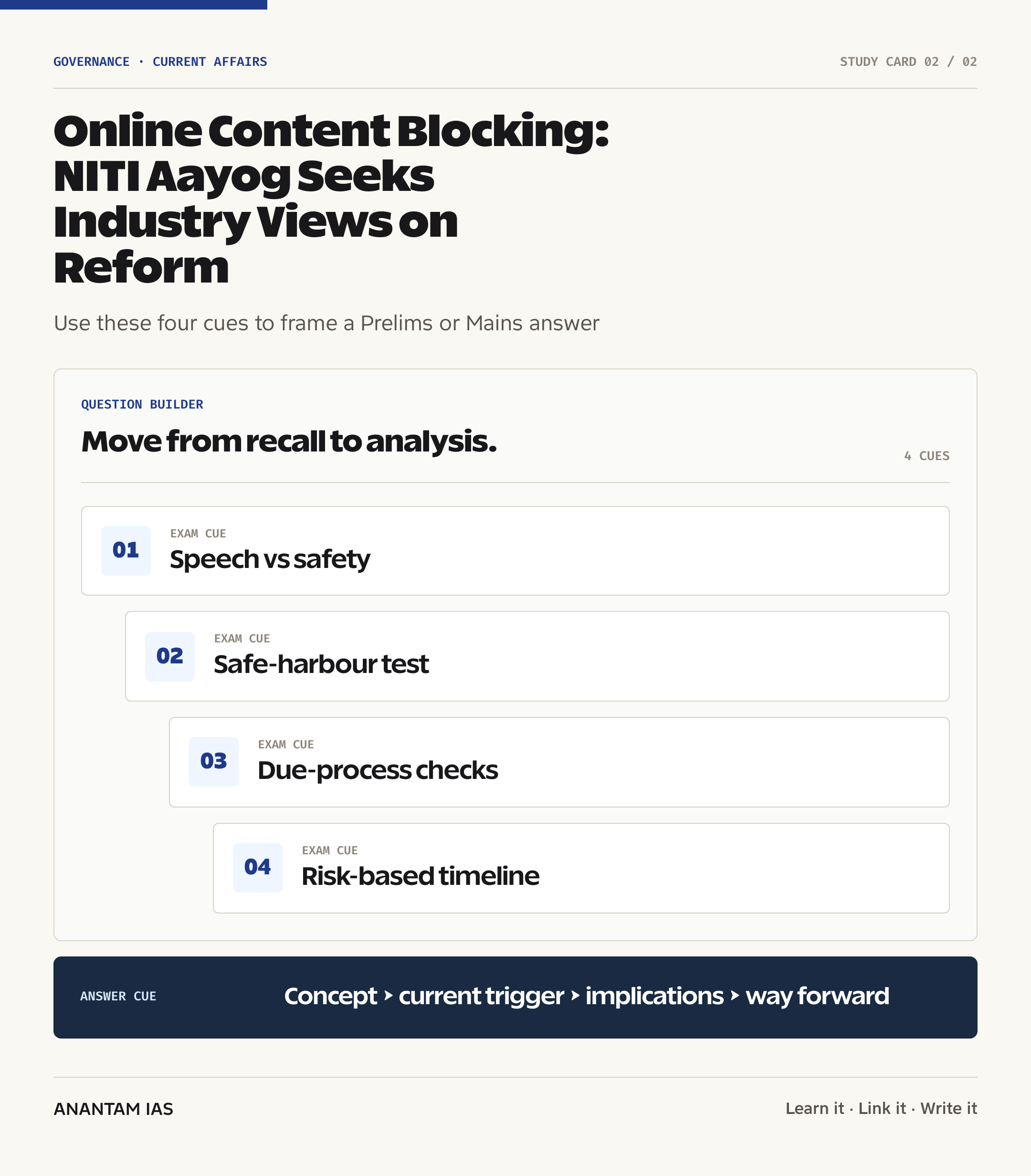
NITI Aayog’s consultation creates an opportunity to test whether India’s online-content rules are fast, clear and workable. But ease of compliance cannot be the only measure of good regulation; the framework must also protect lawful speech, allow correction and make coercive power reviewable.
The durable reform principle is calibrated accountability: urgent action for urgent harm, documented authority for every restriction, proportionate duties for different intermediaries and meaningful remedies when the state or a platform gets the decision wrong.
UPSC Practice Questions
Prelims MCQ 1
With reference to Section 69A of the Information Technology Act, 2000, consider the following statements:
- It permits blocking on grounds that include public order and security of the State.
- Reasons for a blocking direction must be recorded in writing.
- NITI Aayog is the statutory authority that issues all blocking directions under the provision.
How many of the above statements are correct?
(a) Only one (b) Only two (c) All three (d) None
Answer: (b) Only two
Explanation:
Statements 1 and 2 are correct. Section 69A lists specified grounds and requires written reasons. NITI Aayog is an advisory policy think tank, not the authority that issues every blocking direction.
Prelims MCQ 2
Which one of the following best describes intermediary safe harbour under Section 79 of the IT Act?
(a) Absolute immunity from all content-related liability (b) Immunity available only to government-owned platforms (c) Conditional protection linked to the intermediary’s role and due diligence (d) A power to issue blocking directions without written reasons
Answer: (c) Conditional protection linked to the intermediary's role and due diligence
Explanation:
Section 79 provides conditional protection for third-party information. An intermediary must remain within the statutory role and comply with due-diligence and lawful-order requirements.
UPSC Mains Questions
- India’s online content-removal framework must respond quickly to genuine harm without converting short compliance deadlines into a substitute for legal judgment. Examine this statement with reference to Section 69A, intermediary safe harbour and freedom of speech.
- What institutional and procedural safeguards should guide reform of India’s content-blocking regime? Discuss differentiated timelines, reasoned orders, transparency, independent review and remedies for wrongful removal.
Sources: MeitY and India Code and The Indian Express.
Frequently Asked Questions
What did NITI Aayog ask technology firms?
NITI Aayog reportedly asked whether current content-takedown, grievance and transparency timelines are feasible across different kinds and sizes of intermediaries. It also sought views on recurring compliance burdens and possible simplification. The exercise is consultative; it does not itself change the IT Act or the IT Rules.
What is Section 69A of the IT Act?
Section 69A empowers the Central Government or a specially authorised officer to direct blocking of public access to online information on specified grounds. These include sovereignty, national security and public order. Reasons must be recorded in writing, and the action must follow the procedure and safeguards prescribed under the 2009 Rules.
Are all takedown timelines under Section 69A?
No. Section 69A concerns statutory blocking directions, while the IT Rules also prescribe intermediary due diligence, grievance handling and action after legally defined actual knowledge. These mechanisms can interact, but they have different legal bases, triggers and procedures. UPSC answers should avoid treating every platform removal as a Section 69A block.
What is intermediary safe harbour?
Safe harbour under Section 79 is conditional protection from liability for third-party information hosted or transmitted by an intermediary. It depends on the intermediary remaining within its limited role and observing due diligence, including compliance with valid court orders and authorised government notices under the governing legal framework.
Why are very short removal deadlines controversial?
Short deadlines can reduce exposure to urgent harm, but they may leave too little time to verify authority, understand context or assess legality. Large firms may absorb the cost more easily than start-ups. Fear of penalties or lost safe harbour can also cause platforms to remove lawful speech defensively.
What reforms can balance safety and free speech?
India can use harm-based timelines, authenticated reasoned notices, clear emergency criteria, user notice, accessible appeals and periodic review. Standardised public reporting can reveal patterns without exposing genuine security details. Reform should measure the accuracy and reversibility of decisions alongside the speed of platform compliance.