Why in News?
Messaging apps came under fresh regulatory attention after the Centre reportedly asked Meta not to roll out WhatsApp’s username feature in India until consultations were completed.
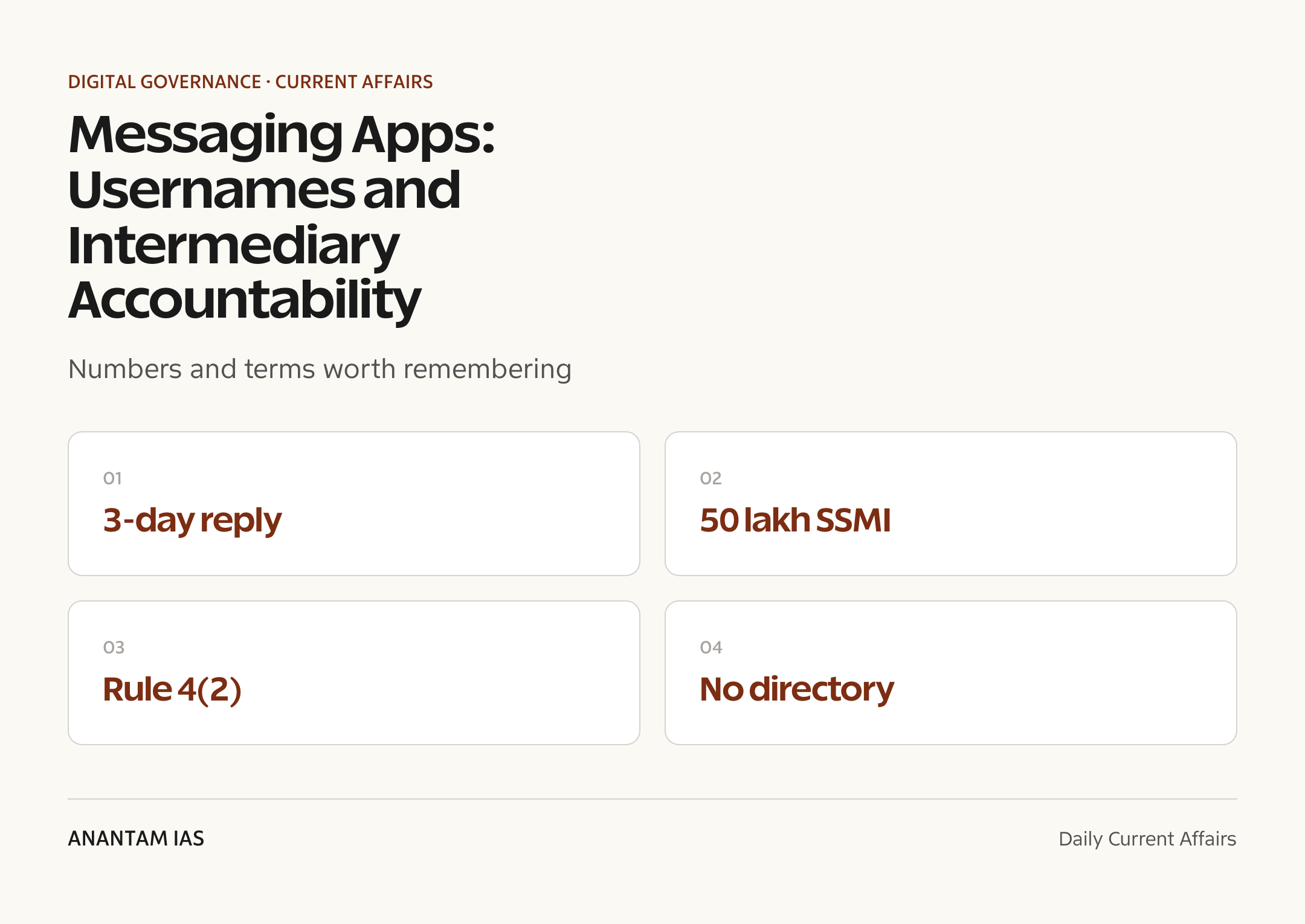
Indian Express reported that the notice sought a detailed explanation within three days, while The Hindu placed the issue beside WhatsApp username reservations and the wider debate on Telegram-style identifiers, platform blocking and online fraud.
- WhatsApp announced username reservations on June 29, 2026, with the feature planned for a gradual launch later in the year.
- Usernames would let people chat without revealing their phone numbers to a new person or business, if the user enables the feature.
- WhatsApp says there will be no public directory, no username suggestions, and an optional username key to control first contact.
- Government concerns focus on impersonation, phishing, digital arrest scams, identity spoofing and lookalike handles for public authorities or financial institutions.
- The Hindu also flagged a parallel legal concern: whether the State can stretch Section 69A blocking powers from specific information to entire intermediary platforms such as Telegram.
The development matters in the context of:
- Digital identity is shifting from phone numbers to handles, business-scoped identifiers and privacy-preserving contact methods.
- Intermediary accountability is moving from content takedown to product-design choices that can either reduce or amplify harm.
- Cyber fraud in India increasingly depends on trust signals, official-looking names, rapid messaging and social-engineering pressure.
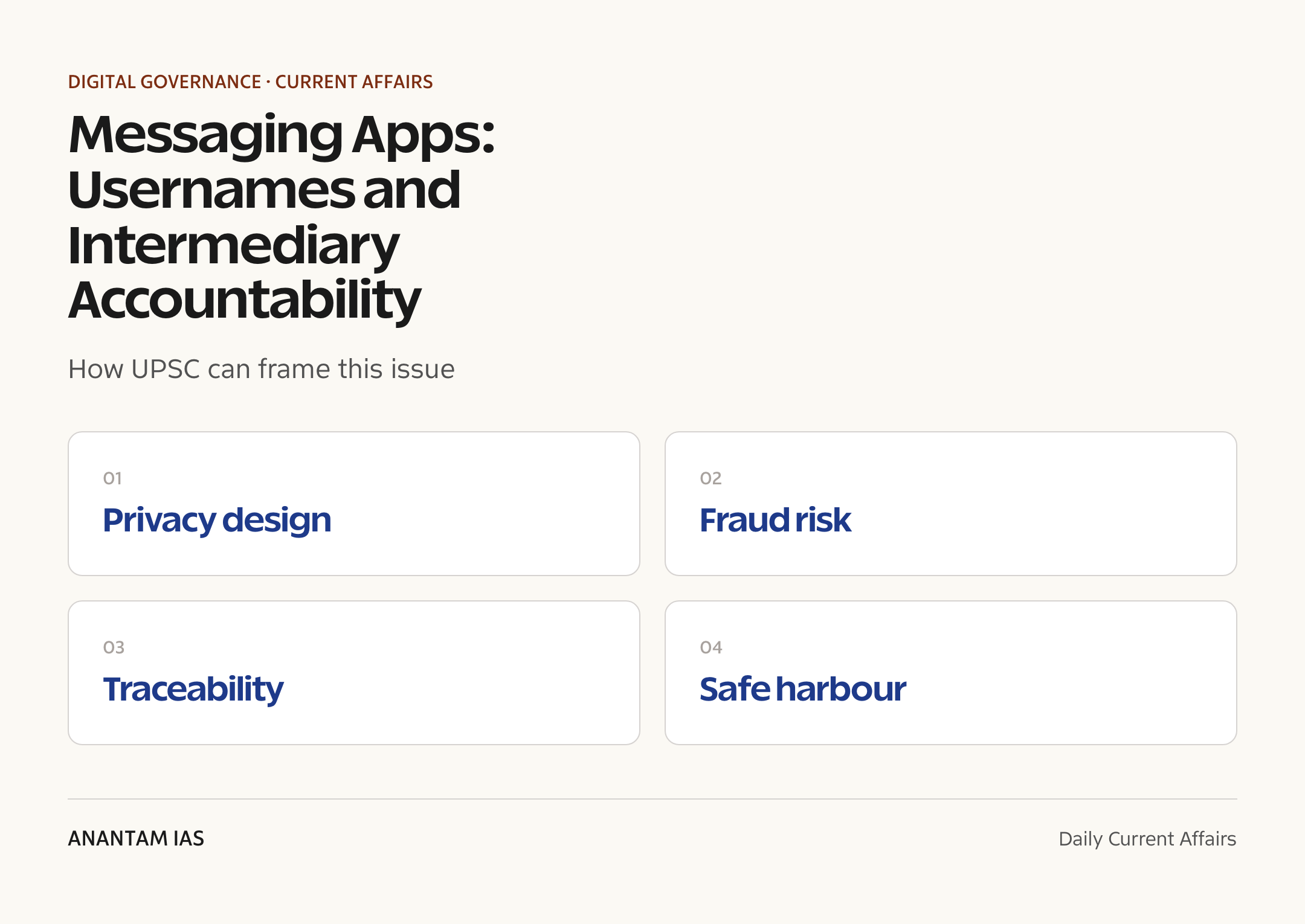
- Privacy and traceability must be balanced because hiding phone numbers can protect citizens while also complicating enforcement.
UPSC Relevance
Prelims Relevance
- Information Technology Act, 2000 is the parent law for intermediary liability, blocking powers and CERT-In functions.
- IT Rules, 2021 prescribe due diligence, grievance redressal and additional duties for significant social media intermediaries.
- Significant Social Media Intermediary status applies above the notified 50 lakh registered users threshold in India.
- Rule 4(2) deals with identification of the first originator for messaging services under limited lawful orders.
- Section 69A permits blocking of public access to information on specified grounds and through prescribed safeguards.
- CERT-In directions are relevant for cyber incident reporting, log retention and coordinated cyber response.
- DPDP Act frames personal data processing duties; revise the privacy layer through Anantam IAS DPDP notes.
- Safe harbour under Section 79 depends on due diligence; revise the legal framework through Anantam IAS IT intermediary notes.
Mains Relevance
GS Paper 2
- Governance: accountability of private platforms performing quasi-public communication functions.
- Rights and regulation: balancing privacy, free speech, due process and citizen safety in digital public spaces.
- Institutional design: role of MeitY, courts, grievance officers and appellate mechanisms in platform oversight.
GS Paper 3
- Internal security: phishing, impersonation, digital arrest scams and cross-platform fraud networks.
- Cyber security: identity verification, abuse detection, incident reporting and evidence preservation.
- Science and technology: privacy-by-design, metadata, encryption and product architecture in messaging systems.
Essay
- Privacy versus safety in a high-trust digital society.
- Technology design as governance: code, law and accountability.
- Digital India and the challenge of trust at population scale.
Background and Context
What the username feature changes
The core design shift is from phone-number discovery to handle-based first contact.
- Phone numbers are both identity markers and contact points; once shared, they can expose users to spam, profiling and unwanted calls.
- Usernames create a separate contact layer, allowing a person to connect without disclosing the underlying mobile number at the start.
- WhatsApp Blog says reservations began in the week of June 29, 2026, with a gradual country-wise launch over the coming months.
- No public directory is important because users cannot browse or guess contacts through a searchable list inside the app.
- Username key is an optional extra control: even if a username leaks, a first-time sender may need the key to start contact.
- Businesses and creators may be able to claim names linked to their existing Instagram or Facebook presence, reducing some brand-impersonation risk.
Why the government is worried
The same design that protects privacy can also create new fraud surfaces if naming and first-contact controls are weak.
- Indian Express reported that the Centre asked Meta to pause the India rollout and provide a detailed explanation within three days.
- Impersonation is the main risk: small spelling changes can make a handle look like a bank, government office, police unit or public figure.
- Digital arrest scams often work by simulating official authority; username-based contact could make fake official identities easier to project.
- Phishing becomes sharper when an attacker combines a familiar display name, a plausible username and urgent financial or legal pressure.
- Network effects matter: WhatsApp’s large Indian user base makes even low-rate abuse significant at population scale.
- Platform safeguards need to be tested before launch, not after harm spikes; this is why consultations and risk assessment matter.
Intermediary law behind the debate
India’s platform rules focus on safe harbour, due diligence and extra obligations for large social media intermediaries.
- Section 79 of the IT Act provides conditional safe harbour to intermediaries for third-party information they host or transmit.
- Due diligence is the price of that safe harbour: platforms must publish rules, act on lawful orders and maintain grievance mechanisms.
- Rule 3 of the IT Rules, 2021 requires intermediaries to secure their systems, retain specified records and report cyber incidents to CERT-In.
- Rule 4 adds duties for significant social media intermediaries, including compliance officers, nodal contact, monthly reports and first-originator capability for messaging services.
- First originator identification is limited to serious grounds such as sovereignty, State security, public order and specified offences, with less intrusive means preferred.
- Encryption concerns arise because traceability demands can collide with private messaging architecture; revise basics through Anantam IAS cyber security notes.
Privacy gains are real
A username system is not automatically anti-privacy; it can reduce exposure of personal numbers in many ordinary situations.
- Phone-number privacy helps students, gig workers, customers, activists, teachers and small businesses communicate with less personal exposure.
- Women and vulnerable users may benefit when joining temporary groups or contacting service providers without revealing a permanent number.
- Data minimisation under modern privacy law supports collecting and exposing only the identity data necessary for a specific purpose.
- DPDP principles push platforms to reduce avoidable personal data circulation; see Anantam IAS right to privacy notes for the constitutional layer.
- Optionality matters: users should be able to keep phone-number contact, enable usernames, use keys and change handles through transparent controls.
- Privacy-by-design means the safety architecture must be embedded in naming, discovery, reporting and abuse throttling from the start.
Telegram and Section 69A angle
The Telegram debate broadens the issue from user handles to State power over entire platforms.
- The Hindu analysed how Telegram raised concerns about reading an entire platform as information for blocking purposes.
- Section 69A is meant for blocking public access to information on specified grounds, not as a casual substitute for platform-wide regulation.
- Proportionality asks whether a narrower measure can solve the problem before a broader restriction affects lawful users.
- Due process requires reasoned orders, prescribed safeguards and a meaningful route to challenge overbroad action.
- Intermediary platforms are legal entities and infrastructure layers; treating them as a single piece of information can blur statutory boundaries.
- Judicial review becomes crucial when blocking, traceability or identity design affects speech, privacy and business continuity at the same time.
The governance problem in one line
The State is not only regulating what users post; it is increasingly asking how platforms design identity, discovery and trust.
- Product design can either prevent harm at source or externalise harm to citizens, police stations and banks.
- Lookalike prevention should reserve sensitive government, banking, law-enforcement and emergency-service names before public launch.
- Abuse throttles should limit high-volume first messages, repeated name changes and newly created accounts contacting many strangers.
- Verified public handles can reduce fraud only if verification is visible, tamper-resistant and not confused with paid vanity features.
- User reporting must be fast enough for scams, because delayed takedown after a payment or disclosure often has little value.
- Regulatory dialogue should ask for design evidence, test results and audit trails rather than relying only on post-harm penalties.
Way Forward
Pre-launch risk assessment
- Meta should share a India-specific risk assessment covering impersonation, fraud workflows, child safety, business names and government identifiers.
- MeitY can require phased rollout, red-team testing and consultation with cybercrime cells, consumer protection bodies and sectoral regulators.
- High-risk handles such as police, court, bank, income tax, UPI, Aadhaar and emergency-service variants should be reserved or subject to stricter verification.
Privacy-preserving safety design
- Username keys should be easy to enable, reset and explain, especially for users who face harassment or spam.
- Exact-match discovery should continue; public search directories and auto-suggestions would expand the attack surface.
- Metadata minimisation should be paired with enough auditability for lawful, targeted investigation under due process.
Fraud response architecture
- Cybercrime reporting should connect platform reports, the 1930 helpline ecosystem and law-enforcement escalation for fast freezing of fraudulent flows.
- Financial institutions should coordinate with platforms on verified identifiers and public advisories against username-based impersonation.
- User education should stress one simple rule: a username is not proof of authority, employment or official status.
Legal clarity
- Section 69A use should remain targeted, reasoned and proportionate, especially when a dispute concerns platform architecture rather than a specific harmful post.
- Traceability orders should follow the narrow grounds in Rule 4(2) and avoid weakening end-to-end encryption for all users.
- Parliamentary oversight can review whether India’s intermediary law needs clearer rules for platform design changes with public-safety effects.
Conclusion
Messaging app usernames are not a simple privacy upgrade or a simple fraud risk. They are both, depending on naming rules, first-contact controls, verification design and law-enforcement safeguards.
India’s regulatory task is to protect phone-number privacy without creating a new impersonation economy. The better path is narrow, evidence-based design review backed by due process, not blanket suspicion of every privacy feature.
UPSC Practice Questions
Prelims MCQ 1
With reference to the IT Rules, 2021, consider the following statements:
- A significant social media intermediary providing messaging services may be required to enable identification of the first originator under specified lawful orders.
- The first-originator requirement allows the government to demand disclosure of the contents of every message in a private chat.
- Significant social media intermediaries have additional due-diligence duties beyond the general duties of intermediaries.
How many of the above statements are correct?
(a) Only one (b) Only two (c) All three (d) None
Answer: (b) Only two
Explanation:
Statements 1 and 3 are correct. Rule 4(2) deals with first-originator identification under limited conditions, while the rule says content of messages need not be disclosed for such compliance.
Prelims MCQ 2
Which of the following best captures the governance issue raised by username-based messaging?
(a) It removes all need for cybercrime investigation. (b) It converts every messaging app into a telecom operator. (c) It requires balancing phone-number privacy with impersonation and fraud-prevention safeguards. (d) It makes Section 69A irrelevant for online platforms.
Answer: (c) It requires balancing phone-number privacy with impersonation and fraud-prevention safeguards.
Explanation:
Username systems can reduce exposure of phone numbers, but they also need anti-impersonation, abuse reporting and lawful investigation safeguards.
UPSC Mains Questions
- Messaging apps are now designing identity systems, not merely carrying messages. Discuss how username-based contact features can affect privacy, cyber fraud and intermediary accountability in India. Suggest safeguards for a rights-respecting rollout.
- Examine the tension between traceability, end-to-end encryption and due process under India’s intermediary regulation. How should the State respond when platform design changes create public-safety risks?
- Section 69A powers must remain targeted even when digital platforms create large-scale risks. Analyse this statement in the context of Telegram-style identifiers, platform blocking and proportionality.
Sources: MeitY IT Rules 2021 and The Hindu, Indian Express and WhatsApp Blog.
Frequently Asked Questions
What is a messaging username?
A messaging username is an optional handle that lets someone contact a user without first seeing the user’s phone number. It separates contact discovery from the mobile number used for registration, but it needs strong safeguards against impersonation and unwanted first contact.
Why did India question the rollout?
The reported government concern is that usernames may increase impersonation, phishing, digital arrest scams and lookalike official identities. The Centre reportedly asked Meta to pause the rollout in India and explain the feature before consultations are completed.
Does a username remove phone numbers completely?
No. WhatsApp’s public explanation says phone numbers still remain necessary for account registration. The change affects what a new person or business sees when first contacting a user, if the user has enabled the username feature.
What is intermediary accountability?
Intermediary accountability means platforms that host, transmit or enable user communication must follow due diligence, grievance redressal, lawful orders and safety obligations. In this case, accountability also covers product design choices that may make fraud easier or harder.
How does privacy fit into this debate?
Privacy supports reducing unnecessary exposure of phone numbers. But privacy cannot mean weak safeguards against fake banks, fake police handles or fake government identities. A rights-based design protects users from both surveillance and fraud.
What should students remember for mains?
Frame the issue as a governance trade-off: privacy-by-design, cyber safety, platform responsibility, proportionality and due process. Avoid treating regulation as a ban-versus-freedom binary; the real answer is calibrated design review.
Tell Google you want more of this.
Add Anantam IAS as a preferred sourceOne tap, and this site shows up more often in your own Top Stories, AI Overviews and AI Mode. Remove it any time.