NITI Aayog DPI@2047 Roadmap: India’s Digital Future Strategy
NITI Aayog’s DPI@2047 roadmap, released in late April 2026, sets out the Centre’s strategic framework for India’s digital public infrastructure over the next two decades. The document organises the journey into two distinct phases. Phase one, running from 2025 to 2035, focuses on completing foundational inclusion across all sectors. Phase two, running from 2035 to 2047, shifts the emphasis from inclusion to livelihood-led productivity growth, with DPI becoming the substrate on which Indian incomes scale toward the Viksit Bharat targets.
That phase distinction matters. India’s first DPI wave was about getting people onto the system. Aadhaar gave a billion plus people a verifiable identity. UPI made instant payments universal. DigiLocker made document storage and verification seamless. ONDC began to democratize digital commerce. The DPI@2047 roadmap argues that the work of inclusion is not done, particularly in agriculture, health and skills, but the next decade also has to start producing measurable productivity gains, otherwise the demographic dividend window closes without delivering the income growth it could have.
This explainer covers what the DPI@2047 roadmap actually proposes, the building blocks of the India Stack, the sectoral applications planned for the next decade, the governance and risk dimensions, and where India’s DPI model now sits globally.
Quick Facts at a Glance
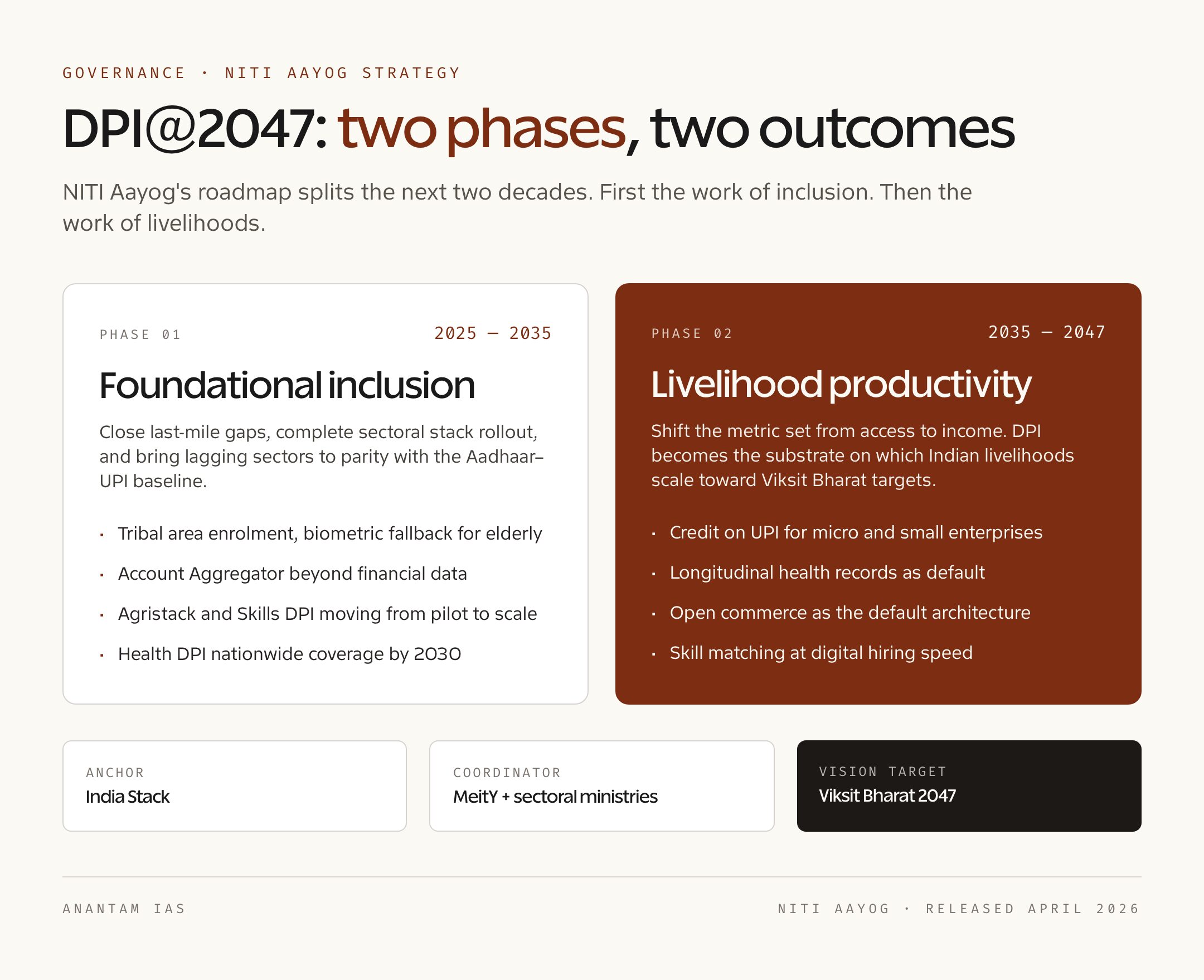
- Document: DPI@2047 roadmap, NITI Aayog strategic framework released April 2026.
- Phase 1: 2025-2035, foundational inclusion across all sectors.
- Phase 2: 2035-2047, livelihood-led productivity growth.
- Existing pillars: Aadhaar (digital identity), UPI (instant payments), DigiLocker (document vault), CoWIN (vaccine delivery), ONDC (open commerce network).
- Emerging pillars: Account Aggregator framework (data sharing), Unified Health Interface (health), Agristack (agriculture), DigiYatra (travel).
- Anchor framework: India Stack.
- Vision target: Viksit Bharat 2047.
- Governance: Ministry of Electronics and Information Technology (MeitY) with sectoral ministries leading domain stacks.
What Just Happened
The April 2026 release is a strategic framework rather than a fresh scheme launch. NITI Aayog has consolidated work that was previously scattered across multiple ministry-level documents and produced a single integrated roadmap covering identity, payments, data sharing, commerce, health, agriculture, education, skills, and credit.
Three things in the roadmap deserve attention.
First, the explicit phase split. NITI Aayog’s view is that India’s DPI conversation has been dominated by use cases that are now mature, particularly Aadhaar and UPI. The next decade cannot just extend those. It must build new stacks for sectors that have lagged.
Second, the productivity framing. Phase two is positioned around livelihood outcomes, not just access. The metric set will track income gains, formalization rates, credit access, and skill matching, not just transaction volumes.
Third, the governance design. NITI Aayog proposes a coordinated approach with MeitY as the cross-cutting authority and sectoral ministries owning their domain stacks. Health DPI sits with the Ministry of Health. Agristack sits with the Ministry of Agriculture. Skills DPI sits with the Ministry of Skill Development. Cross-domain interoperability is the hard problem.
Background and Historical Context
India’s DPI story did not start with Aadhaar, but Aadhaar is where the modern phase began.
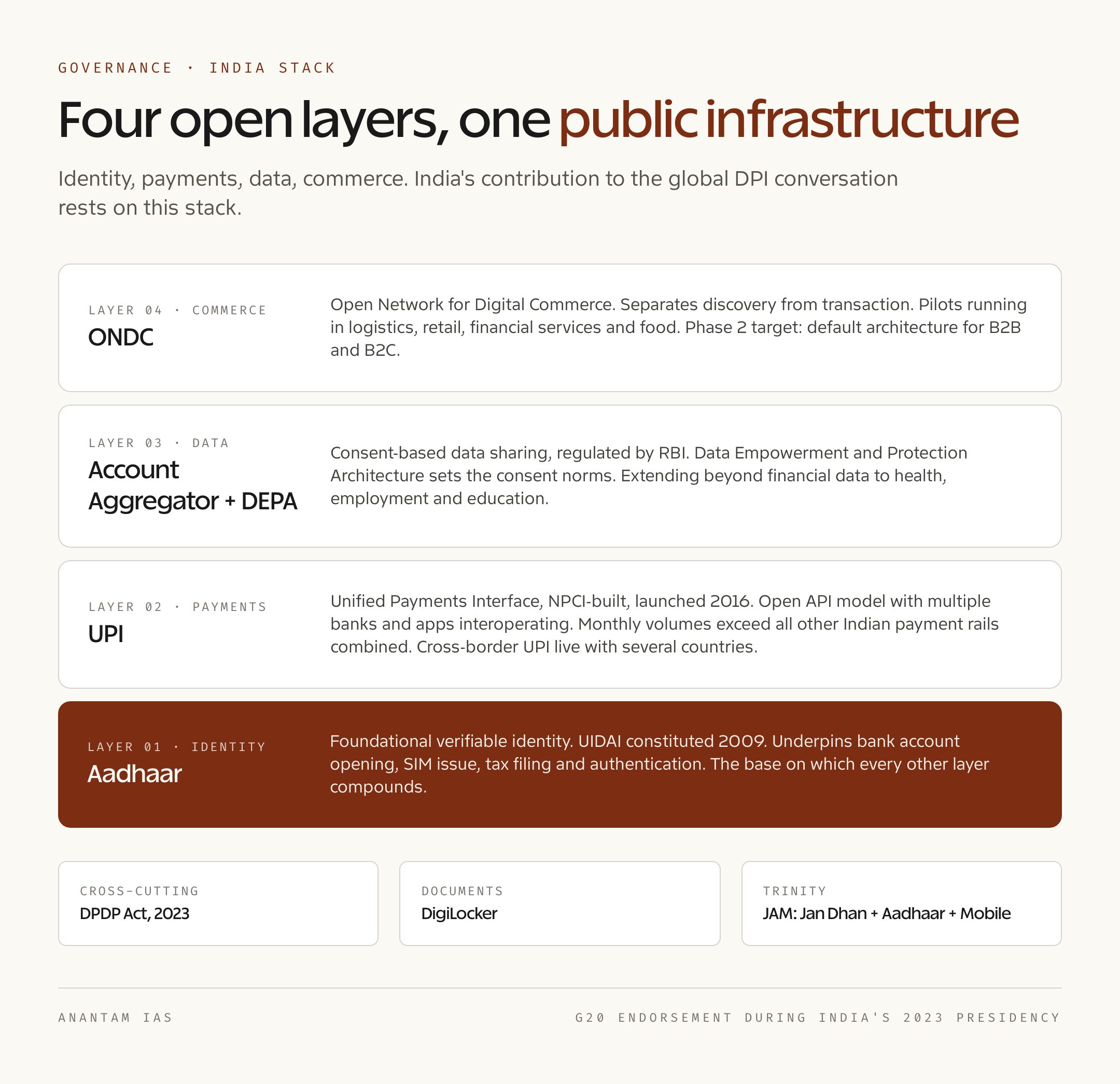
The Unique Identification Authority of India was constituted in 2009 and Aadhaar enrolments started shortly after. The original use case was leakage reduction in welfare schemes. As enrolments scaled past a billion, Aadhaar evolved into a general-purpose verifiable digital identity, used for opening bank accounts, getting SIM cards, filing income tax returns, and authenticating service requests.
The next inflection was the JAM trinity. Jan Dhan accounts created universal banking access. Aadhaar provided the verifiable identity. Mobile penetration provided the channel. The combination enabled direct benefit transfers at scale, replacing fuel subsidies, food entitlements, and pension payments with bank-based transfers.
The Unified Payments Interface, launched in 2016 by the National Payments Corporation of India, took the JAM trinity to instant peer-to-peer and merchant payments. UPI’s open API model, with multiple banks and third-party apps interoperating, became the global reference for retail payments infrastructure. Monthly UPI transaction volumes today exceed all other Indian payment rails combined.
Parallel layers built up. DigiLocker created a verifiable document store. The Account Aggregator framework, regulated by the Reserve Bank of India, set up consent-based financial data sharing. CoWIN handled vaccine appointments and certificates during the pandemic. ONDC began creating an open network for digital commerce, separating discovery from transaction layers.
The DPI@2047 roadmap stitches all of this into a single framework and projects forward. For broader policy context, the explainer on DigiLocker covers the document vault layer, and the analysis of NITI Aayog’s technology services roadmap traces a parallel strategic exercise.
Key Pillars of the DPI@2047 Roadmap
The roadmap organises India’s DPI into seven layers.
Identity layer. Aadhaar remains the foundational identifier. Phase one priorities include closing residual enrolment gaps in tribal areas, completing demographic updates for population shifts, and tightening biometric fallback for the elderly and infants.
Payments layer. UPI continues to scale. Phase two priorities include cross-border UPI connections (already operational with several countries), credit on UPI, and offline UPI for areas with intermittent connectivity.
Data sharing layer. The Account Aggregator framework is being extended beyond financial data to health, employment and education. The Data Empowerment and Protection Architecture (DEPA) sets the consent norms.
Document layer. DigiLocker continues to expand into government services, education certificates, employment records, and health records.
Commerce layer. ONDC moves from pilot to scale. Phase one priorities include logistics, retail, financial services, and food. Phase two is about embedding open commerce as the default architecture for B2B and B2C transactions.
Health layer. Ayushman Bharat Digital Mission and the Unified Health Interface bring health records, providers, payers and patients onto an interoperable stack.
Agriculture and skills layers. Agristack creates a farmer-centric registry with land records, crop data, and weather information. The Skills DPI links training providers, employers and learners.
Cross-cutting all of this is a privacy and governance layer anchored by the Digital Personal Data Protection Act, 2023.
Why the DPI@2047 Roadmap Matters
The DPI@2047 roadmap matters because it explicitly ties India’s digital infrastructure to its income growth trajectory.
The Viksit Bharat 2047 vision sets a target of high-income status by the centenary of independence. Hitting that target requires sustained per-capita income growth above the historical average. DPI is positioned as one of the central productivity multipliers. If formal credit reaches every micro and small enterprise through Account Aggregator pipes, if every farmer gets price discovery through Agristack, if every worker gets skill matching through Skills DPI, if every patient gets continuity of care through Unified Health Interface, productivity gains compound across the economy.
The risk, which the roadmap acknowledges, is that DPI becomes a transaction layer without becoming a productivity layer. UPI processes vast volumes but most of those volumes are everyday spending, not new economic activity. The phase two challenge is to build use cases that translate from access to income.
Detailed Analysis: Sectoral Stacks
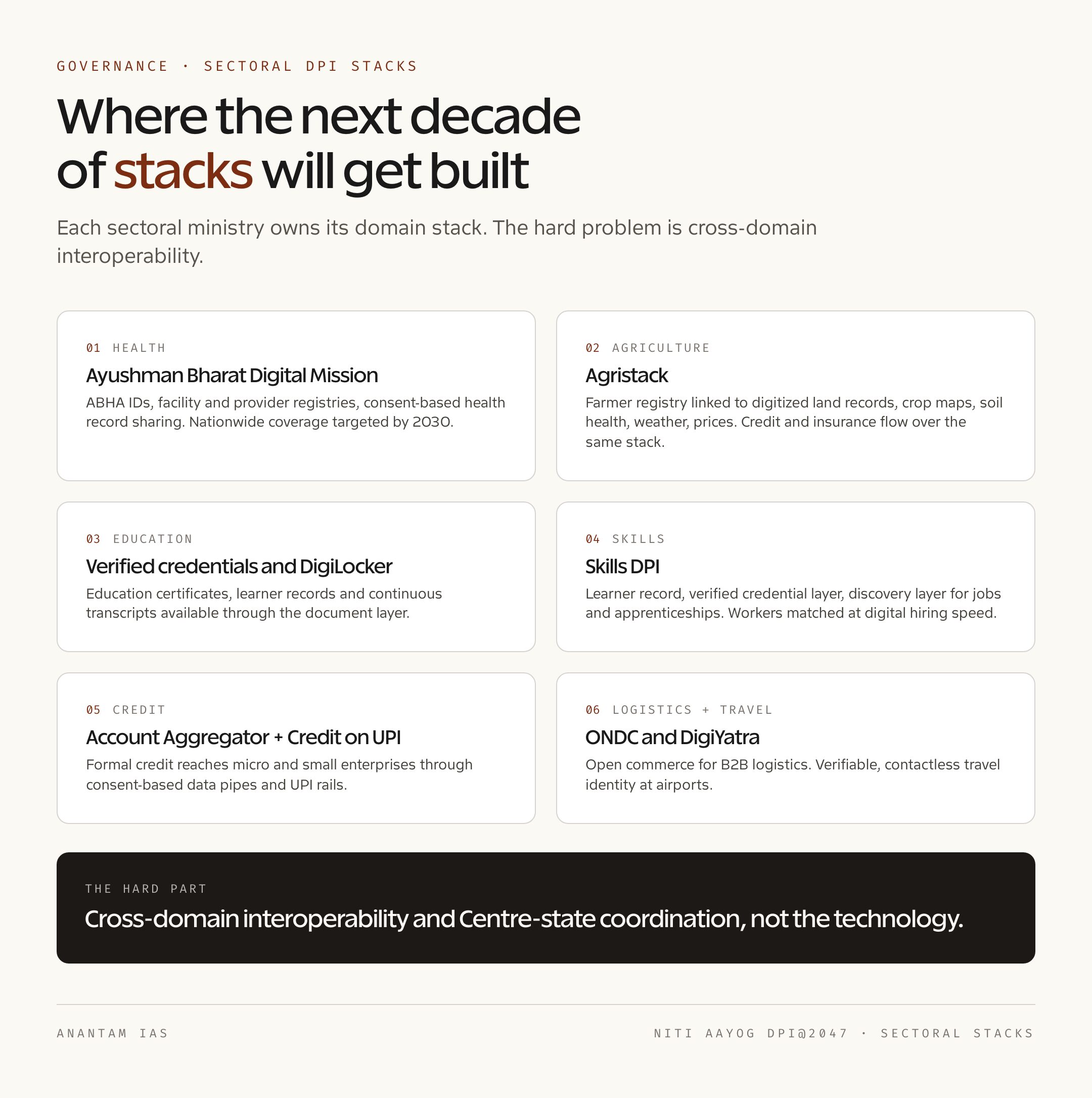
Three sectoral stacks deserve focus.
Health DPI. The Ayushman Bharat Digital Mission creates ABHA IDs for citizens, registries for facilities and professionals, and consent-based health record sharing. The roadmap aims for nationwide coverage by 2030, with longitudinal health records becoming the default by 2035. Productivity gains accrue from reduced duplicate diagnostics, better continuity, and outcome tracking that shifts payments from fee-for-service to value-based models.
Agristack. The roadmap envisages farmer registries linked to digitized land records, crop maps, soil health data, weather forecasts, and market prices. Credit, insurance and extension services flow over the same stack. The productivity story rests on better targeting of inputs, faster credit, and reduced transaction costs in selling produce.
Skills DPI. A learner record, a verified credential layer, and a discovery layer for jobs and apprenticeships create a market that matches workers to opportunities at the speed of digital hiring rather than analog recruitment. The challenge is integrating with the messy reality of vocational training providers and employer practices.
Each of these stacks faces a similar pattern. The technology is buildable. The institutional work, getting ministries to share data, getting standards to converge, getting state governments to plug in, is the harder part.
Comparative Perspective
India’s DPI model has become a global reference. The Modular Open Source Identity Platform (MOSIP), built around the Aadhaar architecture, has been adopted by several countries. UPI-style instant payment systems are being studied in dozens of jurisdictions. The G20 endorsement of digital public infrastructure during India’s presidency in 2023 elevated the India model into a global development conversation.
The contrast is sharpest with the United States, where digital identity remains fragmented across Social Security Numbers, driver’s licenses and commercial credentials, and where retail payments still rely heavily on card networks rather than central bank-backed instant payments. Europe is closer to the Indian approach in spirit but slower in execution. China has built a similar scale of digital infrastructure but with state-controlled rather than open architectures.
India’s distinctive contribution is the open, interoperable, public-good model. Whether that model produces the productivity gains the roadmap projects is the next decade’s test.
Challenges and Critiques
Five challenges sit on the roadmap’s path.
Privacy and surveillance. A DPI stack that touches identity, payments, health, agriculture and skills produces a comprehensive view of individual lives. The Digital Personal Data Protection Act, 2023 sets the legal framework, but operational implementation, particularly consent fatigue and data fiduciary accountability, remains untested at scale.
Inclusion gaps. Last-mile inclusion in tribal areas, urban migrant populations and elderly users continues to be uneven. Biometric fallback failures and connectivity gaps still exclude vulnerable groups.
Cybersecurity. A stack of this scale becomes a high-value target. Sectoral data breaches, credential theft, and authentication abuse are ongoing risks. CERT-In capacity needs to scale with the stack.
Centre-state coordination. Land records, health delivery, agriculture extension, and skill development all operate primarily at the state level. National DPI frameworks succeed only when state governments plug in. Variation across states is significant.
Vendor and platform dynamics. Open architectures attract private intermediaries. The ONDC, UPI and Account Aggregator markets all show concentration tendencies. Maintaining genuine competition is an active regulatory task.
The DPI@2047 roadmap is realistic about these challenges. Whether the institutional response is adequate is the harder question.
UPSC Prelims Pointers
- DPI@2047 roadmap released by NITI Aayog in April 2026.
- Two phases: 2025-2035 (foundational inclusion) and 2035-2047 (livelihood productivity).
- India Stack pillars: Aadhaar, UPI, DigiLocker, ONDC, Account Aggregator, DEPA.
- UIDAI constituted in 2009.
- UPI launched by NPCI in 2016.
- Account Aggregator framework regulated by RBI.
- Digital Personal Data Protection Act enacted 2023.
- ABHA: Ayushman Bharat Health Account, the digital health identifier.
- ONDC: Open Network for Digital Commerce.
- DEPA: Data Empowerment and Protection Architecture.
- Viksit Bharat 2047: India’s vision for high-income status by 2047.
Mains Practice Questions
- NITI Aayog’s DPI@2047 roadmap divides India’s digital public infrastructure journey into a phase of foundational inclusion and a phase of livelihood productivity. Critically examine this framing. (GS Paper III, 15 marks)
- Discuss the building blocks of the India Stack and assess India’s contribution to the global DPI conversation. (GS Paper III, 15 marks)
- The DPI model raises significant privacy and surveillance concerns. Examine the adequacy of India’s data protection framework in addressing these concerns. (GS Paper II, 15 marks)
- Centre-state coordination is critical for sectoral DPI stacks like Agristack and Health DPI. Identify the institutional reforms required. (GS Paper II, 10 marks)
Way Forward
The DPI@2047 roadmap sets out the destination clearly. The execution decisions of the next five years will decide whether the destination is reached.
Three priorities stand out. Sectoral stacks like Agristack, Skills DPI and Health DPI need to move from pilot to nationwide scale, with state governments fully integrated. Privacy and cybersecurity capacity needs to grow at the same pace as the stack itself, because a single high-profile breach could set back trust by a decade. And the productivity framing of phase two needs concrete metrics and accountability, not just rhetoric, so that DPI investments produce visible income gains rather than just transaction volumes.
India’s DPI experiment is one of the most ambitious public infrastructure projects in the world. The DPI@2047 roadmap is the country’s bet that this infrastructure becomes the foundation for the next phase of inclusive economic growth.
The bet is reasonable. The execution is everything.
Frequently Asked Questions
What is the DPI@2047 roadmap?
NITI Aayog’s strategic framework for India’s digital public infrastructure over 2025-2047, organised into a foundational inclusion phase and a livelihood productivity phase.
What is digital public infrastructure?
Open, interoperable digital systems built as public goods, including identity, payments, data sharing, document and commerce layers. India Stack is the leading example.
What are the two phases of the DPI@2047 roadmap?
Phase 1 (2025-2035) focuses on completing foundational inclusion across all sectors. Phase 2 (2035-2047) shifts to livelihood-led productivity growth.
What is the India Stack?
A layered set of open APIs for identity (Aadhaar), payments (UPI), data sharing (Account Aggregator), documents (DigiLocker) and commerce (ONDC), built as public infrastructure.
Which ministry leads the DPI agenda?
The Ministry of Electronics and Information Technology (MeitY) coordinates cross-cutting DPI policy. Sectoral ministries lead domain stacks like health, agriculture and skills.
What is the JAM trinity?
Jan Dhan accounts, Aadhaar identity, and mobile connectivity. The combination enabled direct benefit transfers at scale.
How does DPI connect to Viksit Bharat 2047?
DPI is positioned as one of the central productivity multipliers required for India to reach high-income status by 2047. Productivity gains in credit, agriculture, health and skills are the key channels.
What protects user data on the DPI stack?
The Digital Personal Data Protection Act, 2023, the consent framework under DEPA, and sectoral regulations like the RBI’s Account Aggregator norms.