Introduction
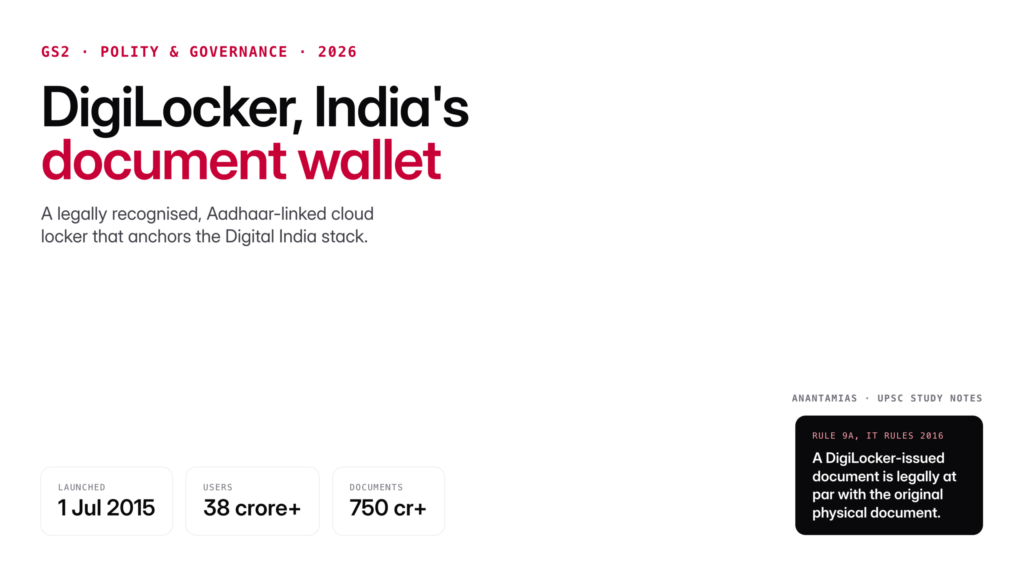
DigiLocker is the Government of India’s flagship digital document wallet, launched under the Digital India programme to give every citizen a secure, lifelong, cloud-based locker for authentic documents. For an aspirant walking into a Prelims hall or writing a Mains answer on e-governance, DigiLocker is one of the cleanest case studies of how technology, law, and administrative reform can come together to reduce paperwork and expand service delivery.
This note sets out what DigiLocker is, how it fits inside the Information Technology Act, how a citizen registers and uses it, what ministries and agencies issue documents through it, and why it matters for questions on transparency, digital inclusion, and administrative efficiency. It also draws comparisons with other national digital identity stacks and addresses the challenges that remain.
Quick Facts at a Glance
| Attribute | Detail |
|---|---|
| Full name | Digital Locker (DigiLocker) |
| Launched by | Ministry of Electronics and Information Technology (MeitY) |
| Launch date | Beta 2015, formally by PM Narendra Modi on 1 July 2015 |
| Parent programme | Digital India |
| Legal backing | Rule 9A, IT (Preservation and Retention of Information by Intermediaries Providing Digital Locker Facilities) Rules 2016; IT Act 2000 |
| Authentication | Aadhaar-based eKYC, mobile OTP |
| Free storage | 1 GB per user (as of 2025) |
| Registered users | Over 38 crore (MeitY, 2025) |
| Issued documents | 750 crore plus across issuer agencies |
| Website and app | digilocker.gov.in, Android and iOS apps |
Background and Historical Context
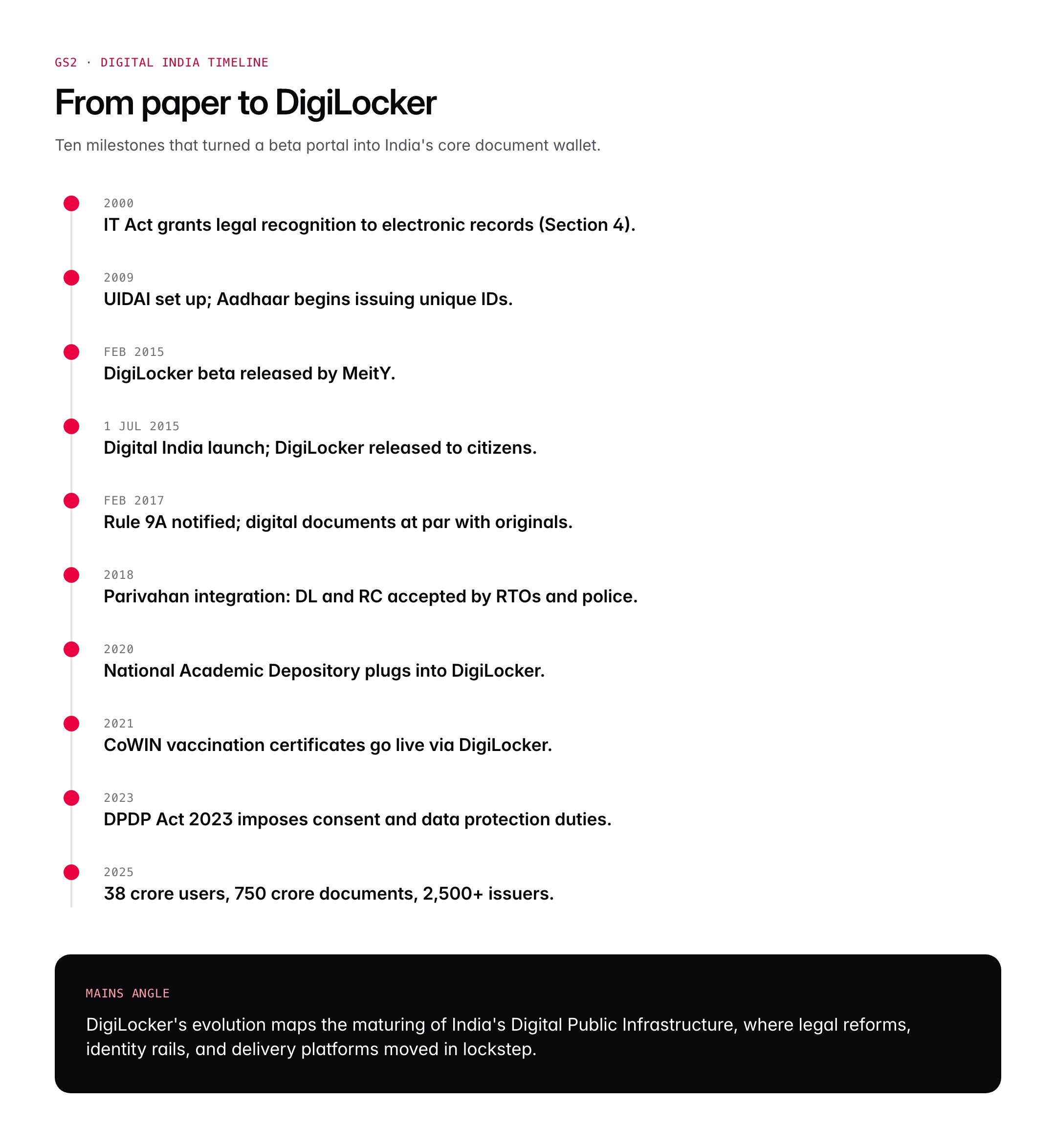
Indian governance has historically been paper-heavy. Until the mid-2010s, citizens routinely carried photocopies of marksheets, driving licences, PAN cards, and ration cards, and lost them just as routinely. Every new application demanded attested photocopies, adding friction and cost. The 2006 National e-Governance Plan (NeGP) had laid out a roadmap for citizen-facing digital services, but lack of a common authentication layer kept most services offline.
The first building block arrived in 2009 when the Unique Identification Authority of India (UIDAI) was set up and Aadhaar began issuing unique 12-digit numbers. The second was the IT Act 2000, which granted legal recognition to electronic records and digital signatures under Sections 4 and 5. The third was the Digital India programme, announced by Prime Minister Narendra Modi on 1 July 2015, with nine pillars that included e-Kranti, electronic delivery of services, and the idea of providing every citizen with a digital locker.
DigiLocker moved from a beta release in February 2015 to full public launch on 1 July 2015. In February 2017, the government notified the Information Technology (Preservation and Retention of Information by Intermediaries Providing Digital Locker Facilities) Rules under Section 87 of the IT Act. Rule 9A clarified that a document issued to a DigiLocker account through a Uniform Resource Identifier (URI) is at par with the original physical document. This single clause settled the question of legal validity and unlocked adoption across state governments, examination boards, and regulators. By 2022, the Digital Public Infrastructure (DPI) framing brought DigiLocker under the India Stack umbrella along with Aadhaar, UPI, e-Sign, and the Account Aggregator network.
Key Features
DigiLocker is built around three pillars: a citizen wallet, an issuer gateway, and a requester gateway. Together they allow documents to be issued, stored, and verified digitally without losing legal sanctity.
Aadhaar-linked registration and eKYC
Every DigiLocker account is tied to an Aadhaar number. At sign-up, the citizen provides a mobile number, verifies an OTP, and then consents to Aadhaar eKYC. Name, date of birth, gender, and address are pulled from the UIDAI database. This ensures that each account maps to a real, unique individual and avoids the duplicate-account problem that plagued earlier e-governance efforts.
Issued Documents section
The Issued Documents section is DigiLocker’s defining feature. When an issuer agency like the Ministry of Road Transport and Highways pushes a driving licence or registration certificate into a citizen’s locker, the document carries a unique URI and a digital signature. Under Rule 9A, this is legally equivalent to the original. Common issued documents include the Aadhaar card (UIDAI), PAN card (Income Tax Department), driving licence and vehicle RC (Parivahan), Class X and XII marksheets (CBSE, state boards), LPG connection (oil marketing companies), and income and caste certificates (state portals).
Uploaded Documents and eSign
Citizens can also upload their own PDFs, JPGs, or PNGs up to 10 MB each within a 1 GB quota. Uploaded documents do not have issuer-level legal weight but can be shared with any requester. The eSign service, based on Aadhaar OTP authentication and backed by Section 3A of the IT Act, lets users apply a legally valid digital signature to these uploaded documents.
Sharing and verification
Documents can be shared using a share link or a QR code. Any requester, whether a university, employer, or bank, can scan the QR code or visit the share URL and pull the document directly from the issuer gateway, eliminating forged marksheets or fake licences.
Mobile and API access
DigiLocker is available as a web portal, Android and iOS apps, and as a set of APIs under Aadhaar-based authenticated sessions. It is also integrated inside the UMANG app, opening access to over 1,700 government services from a single front door.
Significance for UPSC and General Knowledge
- Demonstrates the Digital Public Infrastructure (DPI) model where identity (Aadhaar), payments (UPI), and data (DigiLocker) form the India Stack.
- Operationalises Section 4 of the IT Act 2000 by giving practical meaning to the phrase legal recognition of electronic records.
- Reduces transaction costs in government-citizen interaction, feeding into Second Administrative Reforms Commission recommendations on citizen-centric governance.
- Supports SDG 16 on effective, accountable, and transparent institutions by enabling verifiable document flows.
- Strengthens federal cooperation since state portals, central ministries, and regulators all plug into a shared gateway.
- Provides a concrete example for Mains answers on e-governance, Good Governance Day themes, and Mission Karmayogi.
Detailed Analysis: Ecosystem and Institutional Architecture
DigiLocker is operated by the National e-Governance Division (NeGD) under MeitY. Architecturally, it is a middleware that sits between issuers and requesters. Issuers include central ministries, state governments, universities, regulators, and public sector undertakings. Requesters include admission portals, employers, courts, airports, police departments, and banks.
By 2025, DigiLocker integrated with over 2,500 issuers and more than 230 requesters. Large integrations include the Ministry of Civil Aviation accepting DigiLocker-issued driving licences as identity at airports, the Election Commission of India accepting the voter ID slip for polling booth verification, and the Ministry of Road Transport mandating that state police and RTO officers treat a DigiLocker RC or DL as original under the Motion Vehicles Act 1988.
Education is perhaps the biggest beneficiary. Through the National Academic Depository (NAD), all Class X and XII marksheets from CBSE, CISCE, and most state boards are auto-issued. University Grants Commission regulations push higher education institutions to issue degrees and transcripts into DigiLocker, reducing employer verification cycles from weeks to seconds.
COVID-19 was a turning point. Vaccination certificates from CoWIN were made available through DigiLocker within hours of issuance, and this single integration introduced the platform to hundreds of millions of new users. It also demonstrated how digital health records, under the Ayushman Bharat Digital Mission, can plug into the same wallet.
For regulators like SEBI and RBI, DigiLocker has implications for KYC. The Prevention of Money Laundering Act KYC rules recognise DigiLocker-issued Aadhaar as officially valid document. For insurance and lending, fetching salary slips, Form 16, and ITR summaries through DigiLocker radically shortens onboarding.
The budgetary footprint is modest. DigiLocker is run as shared infrastructure with cost recovery from high-volume requesters like banks and NBFCs on a per-pull model, keeping citizen access free.
Comparative Perspective
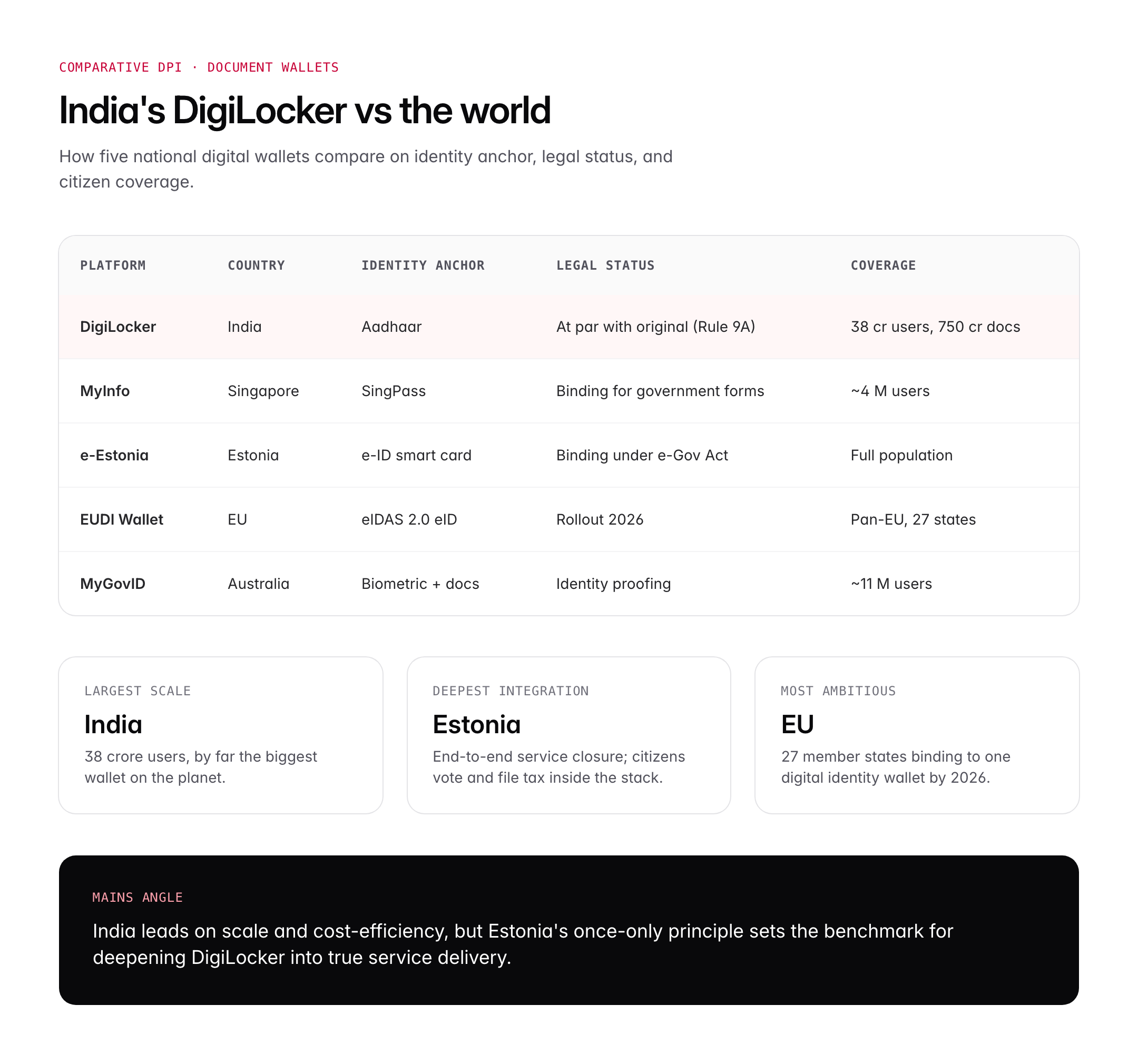
DigiLocker sits inside a global trend of sovereign digital wallets. Estonia’s e-Estonia portal, Singapore’s MyInfo, and the European Union’s eIDAS 2.0 Digital Identity Wallet all share DNA with DigiLocker but diverge in design and scope.
| Platform | Country | Identity anchor | Legal status of stored document | Coverage |
|---|---|---|---|---|
| DigiLocker | India | Aadhaar | At par with original (Rule 9A) | 38 crore users, 750 crore docs |
| MyInfo | Singapore | SingPass | Binding for government forms | About 4 million users |
| e-Estonia | Estonia | e-ID smart card | Binding under e-Government Act | Full population coverage |
| EUDI Wallet | European Union | eIDAS 2.0 eID | Under rollout 2026 | Pan-EU, 27 states |
| MyGovID | Australia | Biometric + docs | Identity proofing standard | About 11 million users |
India’s scale makes DigiLocker unique. No other country has integrated this many issuers and citizens in under a decade, and the cost per transaction is a fraction of comparable systems. However, Estonia remains ahead on end-to-end service delivery, where citizens can finalise actions like voting and tax filing without leaving the portal.
Challenges and Criticisms
DigiLocker’s momentum is real, but critics point to several fault lines. First, the Aadhaar dependency raises privacy and exclusion concerns. The Supreme Court’s Puttaswamy judgement of 2017 read the right to privacy into Article 21 and imposed proportionality tests on Aadhaar-linked services. Though DigiLocker is voluntary, practical exclusion arises when agencies demand a DigiLocker document instead of a physical one.
Second, the Digital Personal Data Protection Act 2023 introduces new obligations on data fiduciaries. DigiLocker, as an intermediary handling sensitive personal data, must align with consent architecture, purpose limitation, and breach notification. A 2020 report by a cybersecurity researcher disclosed a critical authentication flaw that allowed access to any account with just an Aadhaar number and a bypass of OTP. The flaw was patched, but it highlighted the need for continuous auditing.
Third, the digital divide persists. The NFHS-5 and TRAI figures show that rural internet penetration, while rising, trails urban India by roughly 20 percentage points, and smartphone literacy among older women remains low. Until the Common Service Centres network deepens its assisted-access model, millions will rely on intermediaries.
Fourth, the legal equivalence under Rule 9A is still resisted in practice by many lower administrative offices, where clerks insist on physical photocopies even when statutes say otherwise. The answer lies in training, not technology.
Prelims Pointers
- DigiLocker was launched on 1 July 2015 under the Digital India programme.
- Nodal ministry: Ministry of Electronics and Information Technology (MeitY).
- Operated by the National e-Governance Division (NeGD).
- Rule 9A of the IT Rules 2016 grants equivalence with physical originals.
- Free storage quota per user is 1 GB, and each file can be up to 10 MB.
- Registration requires an Aadhaar number and an active mobile number.
- eSign is legally recognised under Section 3A of the IT Act 2000.
- DigiLocker is part of the India Stack alongside Aadhaar, UPI, and Account Aggregator.
- Integrated with UMANG, CoWIN, NAD, Parivahan, and state e-District portals.
- Accepted as valid ID for air travel by BCAS and CISF since 2017.
- Over 2,500 issuers and 230 requesters are integrated by 2025.
- DigiLocker cannot be used by citizens below 18 unless linked to a parent account.
Mains Practice Questions
- Examine how DigiLocker operationalises the vision of Digital India and assess its contribution to citizen-centric governance.
- Link DigiLocker to NeGP and Digital India pillars, especially e-Kranti and universal mobile access.
- Use IT Act Section 4, Rule 9A, and the DPI framing to show legal and architectural foundations.
- Balance with privacy, data protection, and digital divide concerns, citing Puttaswamy and DPDP Act 2023.
- Compare India’s DigiLocker with Estonia’s e-Estonia framework. What lessons can India draw for deepening its digital public infrastructure?
- Set out architectural similarities, especially identity anchoring and document issuance.
- Highlight Estonia’s once-only principle and end-to-end service closure.
- Recommend UMANG integration, inter-state interoperability, and grievance redress as priority reforms.
Conclusion
DigiLocker has moved from a well-intentioned pilot to a core piece of India’s public digital infrastructure. It has given statutory meaning to the electronic record, saved millions of hours of paperwork, and, alongside Aadhaar and UPI, turned India into one of the most cited case studies in the global DPI movement. For the UPSC aspirant, it is a one-stop example of how law, technology, and administrative will can combine to reshape everyday citizen experience.
The next decade will test whether DigiLocker can absorb a stricter data protection regime, widen rural reach, and deliver end-to-end services instead of acting only as a document vault. If it succeeds, it will not just be a locker but the default identity and service layer for a billion-plus citizens, a silent but decisive improvement in the quality of Indian democracy.
Frequently Asked Questions
What is DigiLocker?
DigiLocker is a cloud-based digital document wallet launched by the Government of India in July 2015 under the Digital India programme. Operated by MeitY’s National e-Governance Division, it lets every Aadhaar-holder store, access, and share government-issued documents like Aadhaar, PAN, driving licence, and marksheets with full legal validity under Rule 9A of the IT Rules 2016.
Why is DigiLocker important for UPSC?
DigiLocker is a core GS2 case study in e-governance, digital public infrastructure, and citizen-centric administration. It operationalises Section 4 of the IT Act 2000, connects to Aadhaar and UPI in the India Stack, and illustrates federal cooperation between MeitY, state governments, and regulators. It routinely appears in Prelims factual questions and Mains answers on Digital India.
How is DigiLocker related to Aadhaar?
DigiLocker registration is anchored in Aadhaar-based eKYC. The UIDAI database supplies the citizen’s name, date of birth, gender, and address during sign-up, ensuring that each account maps to a unique individual. Aadhaar also powers the eSign facility, which allows legally valid digital signatures under Section 3A of the IT Act 2000.
How do I register for DigiLocker?
Visit digilocker.gov.in or download the app, enter your mobile number and verify the OTP, set a six-digit security PIN, and provide your 12-digit Aadhaar number. Complete the Aadhaar OTP verification to finish eKYC. Your account is created instantly with 1 GB of free storage and access to issued documents from integrated agencies.
Are DigiLocker documents legally valid?
Yes. Rule 9A of the IT (Preservation and Retention of Information by Intermediaries Providing Digital Locker Facilities) Rules 2016 states that documents issued to a DigiLocker account through a URI are at par with the original physical document. BCAS accepts DigiLocker driving licence as ID at airports, and police officers accept DigiLocker RC under the Motor Vehicles Act.
What documents can I store in DigiLocker?
The Issued Documents section pulls authentic documents from over 2,500 issuers including Aadhaar, PAN, driving licence, vehicle RC, Class X and XII marksheets, CoWIN vaccination certificates, income and caste certificates, LPG connection, and higher-education degrees through the National Academic Depository. Users can also upload personal PDFs, JPGs, or PNGs within a 1 GB quota.
Is DigiLocker safe and private?
DigiLocker uses 256-bit SSL, Aadhaar-based authentication, and a six-digit security PIN. All documents sit on government cloud infrastructure audited by CERT-In. However, critics note that it falls under the Digital Personal Data Protection Act 2023, and past vulnerabilities disclosed in 2020 remind users to enable two-factor login. Sharing is always consent-based through time-limited share links or QR codes.
What is the difference between DigiLocker and UMANG?
DigiLocker is a document wallet for storing and sharing authentic records, while UMANG is a unified services app that gives access to over 1,700 central and state government services like EPF balance, passport, and income tax. UMANG embeds DigiLocker so users can authenticate through documents, but the two serve distinct roles inside the larger India Stack.
Tell Google you want more of this.
Add Anantam IAS as a preferred sourceOne tap, and this site shows up more often in your own Top Stories, AI Overviews and AI Mode. Remove it any time.