NTA Removes 600 Exam Experts and Rebuilds Confidential Operations
Why in News?
A day after the Union Education Ministry sought a detailed reform report, NTA told The Hindu it is removing 600 examination-team experts and remaking confidential operations.
- NTA is revamping the examination team by removing 600 experts and onboarding new experts, The Hindu reported after the 17 August ministry meeting.
- A four-tier question-paper checking system will be put in place to strengthen scrutiny of examination papers.
- Twenty to 25 new officials will be inducted over two to three weeks, while offices shift to new premises with CISF cover.
- Separately, more than fifty staffers have been removed. That cut is not the same as the 600 examination-team experts.
- Ten professional leadership posts, including CTO, CISO and psychometrics, are being advertised or onboarded, with private-sector specialists for cyber security and paper design.
- After two testing failures this year, the live question is who writes papers and how confidential operations stay isolated.
- A criminal statute can punish a leak after it happens. Isolation of setters, devices and networks is what stops a paper from walking out.
- The fast-track court track is for prosecution. This note is about the testing shop: personnel, four-tier checks and CONOPS.
UPSC Relevance
Prelims Relevance
- The National Testing Agency is an autonomous organisation under the Department of Higher Education, Ministry of Education, set up in November 2017 as a society.
- In this story, CONOPS means Confidential Operations around question-paper setting, not a military planning term.
- An air-gapped system has no Wi-Fi, Bluetooth or wired link to unsecured networks, including the internet.
- CISF, the Central Industrial Security Force, is to reinforce security at NTA’s new premises.
- A four-tier question-paper check is a scrutiny design. It is not the candidate’s post-test answer-key challenge.
- The Public Examinations (Prevention of Unfair Means) Act, 2024 covers NTA-conducted exams. It is a criminal statute, not an operations manual.
Mains Relevance
GS Paper 2
- Institutional design of a testing agency: who sees a live paper, who checks it, and who is excluded.
- Equality of opportunity: a leak or a defective paper both convert a public exam into a lottery.
GS Paper 4
- Public-service ethics after a known isolation failure: candour, process audit, and refusing undivided setter access.
Essay
- A public examination tests the candidate. Its isolation architecture tests the State.
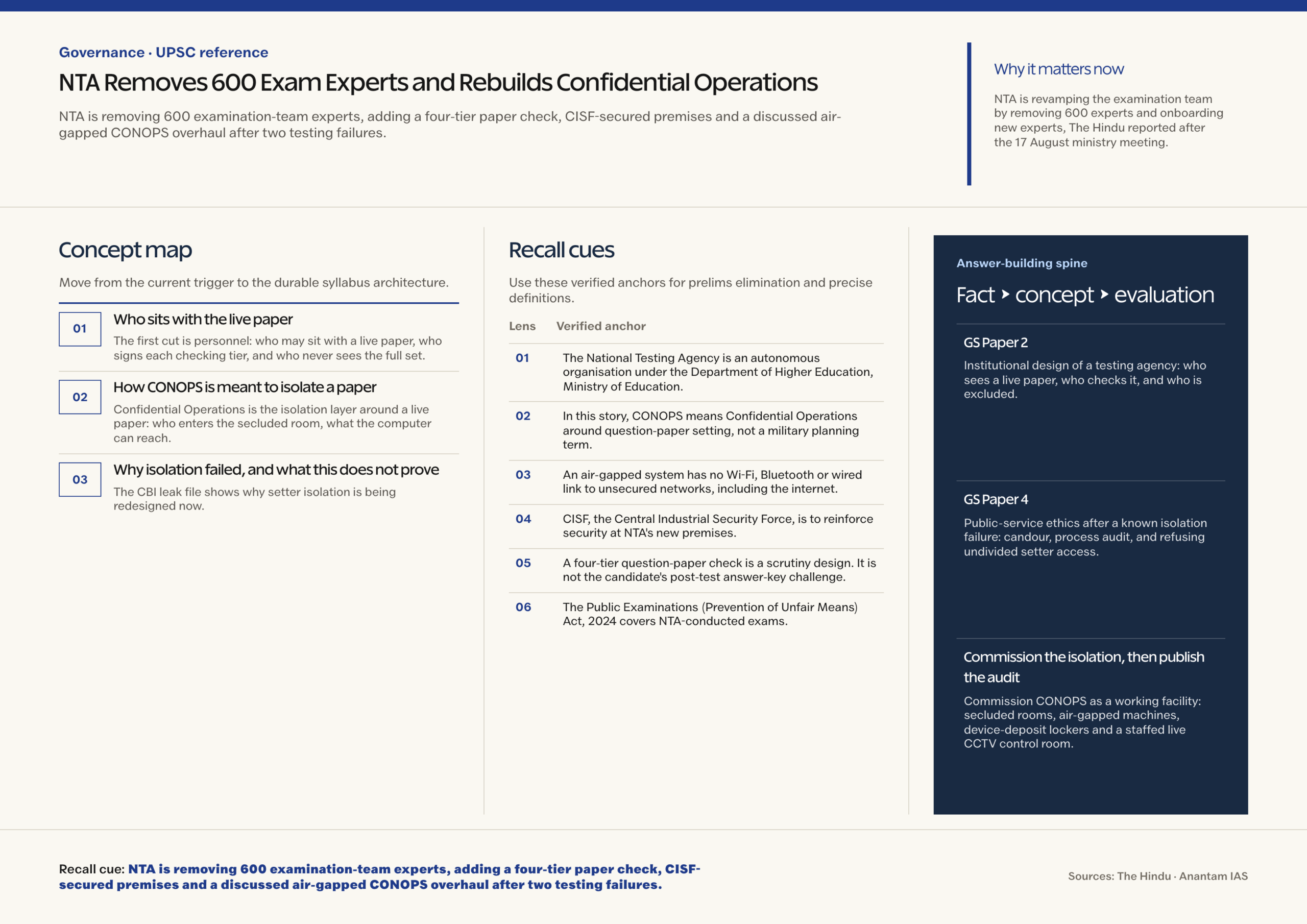
Background and Context
Who sits with the live paper
The first cut is personnel: who may sit with a live paper, who signs each checking tier, and who never sees the full set.
- NTA is revamping the examination team by removing 600 experts and onboarding new ones, a reset of who can sit with a live national paper after the old panel’s access failed.
- Sources also said more than fifty staffers have been removed. Keep that number apart from the 600, because staff corridors and expert panels are different leak paths and must not be added.
- Twenty to 25 new officials will be inducted over the next two to three weeks, while NTA offices move swiftly to new premises where CISF teams will reinforce security of the campus.
- Ten professional leadership posts, including CTO and CISO and a psychometrics lead, plus test-security and research heads, have been advertised and are being onboarded so security and item science share one table.
- Domain specialists from the private sector are being brought in for cyber security, psychometrics and question-paper design, skills a leak or a defective item exploits and a purely academic panel often lacks.
How CONOPS is meant to isolate a paper
Confidential Operations is the isolation layer around a live paper: who enters the secluded room, what the computer can reach, and which device stays outside.
- Sources said a complete overhaul of Confidential Operations (CONOPS) was discussed, covering rooms, networks and devices. Treat that as a design on the table, not a facility already built.
- The discussed design uses secluded rooms for people who handle paper-setting and other confidential material, so a live item is not assembled in an open office, corridor or shared workstation.
- An air-gapped system is a computer or network physically and wirelessly isolated from unsecured networks such as the internet, with no Wi-Fi, Bluetooth or wired link that a remote attacker could use.
- Device-deposit protocols would force phones and other gadgets out of the room before a setter touches a live item, closing the simplest path for a photographed paper to walk out.
- A four-tier question-paper checking system is to strengthen scrutiny before a paper becomes a national result. Isolation stops a leak; independent tiers, not the original setter, catch a defective item.
Why isolation failed, and what this does not prove
The CBI leak file shows why setter isolation is being redesigned now. It does not prove that secluded rooms, air-gaps and cameras already exist.
- In the CBI chargesheet on the summer paper leak, Biology, Chemistry and Physics setters had full access to the questions they then leaked. That undivided access is what CONOPS is meant to break.
- Those experts faced no physical checking or frisking on the way in or out of restricted confidential zones, so a printed or photographed paper could leave unchecked with the setter.
- The same facility lacked a dedicated live CCTV monitoring control room, so there was no staffed real-time watch on who entered a confidential zone and what left it with them.
- After two testing failures this year, the ministry has asked NTA for a thorough process audit and a detailed reform report, not only a change of names on the expert list.
- A discussed overhaul is not proof that air-gaps, device-deposit, frisking or a live CCTV room already exist. Ask what is commissioned and staffed, not what was said in a meeting.
Way Forward
Commission the isolation, then publish the audit
- Commission CONOPS as a working facility: secluded rooms, air-gapped machines, device-deposit lockers and a staffed live CCTV control room, not a slide.
- Split paper-setting so no single expert holds a full subject paper, the undivided access the CBI file showed.
- Keep the four-tier check independent of the original setters, with a written trail of who drafted, who checked and who signed.
- Publish the process audit the ministry has demanded, with enough operational detail that the isolation claim can be tested.
Conclusion
- Today’s news is institutional redesign: who sits with a live paper, how many independent times it is checked, and how the room is isolated from the open network.
- Hold the two personnel numbers apart: 600 experts and more than fifty staffers. Hold CONOPS as discussed until secluded rooms, air-gaps, device-deposit and a live CCTV watch exist.
- For Mains, treat NTA as a testing institution whose credibility rests on setter isolation and independent four-tier scrutiny, not on another circular issued after a public failure.
UPSC Practice Questions
Prelims MCQ 1
With reference to the recent NTA revamp, consider the following statements:
- NTA has said it is removing 600 experts from its examination team and onboarding new experts.
- A four-tier question-paper checking system is to be put in place to strengthen scrutiny.
- The complete overhaul of CONOPS, including air-gapped systems, has already been implemented and certified.
How many of the above statements are correct?
(a) Only one (b) Only two (c) All three (d) None
Answer: (b) Only two
Explanation:
Statements 1 and 2 match NTA’s account. CONOPS, including air-gaps, was discussed, not shown as already built or certified.
Prelims MCQ 2
In the context of NTA’s Confidential Operations discussion, an air-gapped system is best described as:
(a) A computer connected only to a government email server (b) A computer or network with no Wi-Fi, Bluetooth or wired link to unsecured networks (c) A question paper stored on an encrypted cloud drive (d) A CCTV feed uploaded in real time to a central command
Answer: (b) A computer or network with no Wi-Fi, Bluetooth or wired link to unsecured networks
Explanation:
Air-gapped systems are physically and wirelessly isolated from unsecured networks such as the internet, with no Wi-Fi, Bluetooth or wired link.
UPSC Mains Questions
- High-stakes testing fails when a single setter holds a full paper and can walk it out. Examine NTA’s proposed CONOPS redesign as an institutional response. (250 words)
- Changing experts without commissioning isolation will not restore trust in public examinations. Discuss. (150 words)
Source: The Hindu.
Frequently Asked Questions
What did NTA say it is changing?
NTA said it is removing 600 examination-team experts and onboarding new ones, adding a four-tier paper check, inducting 20 to 25 officials, and shifting offices under CISF cover.
What is CONOPS in this note?
In this NTA story, CONOPS means Confidential Operations around question-paper setting. Officials discussed secluded rooms, air-gapped systems and device-deposit protocols, not a facility already certified.
What is an air-gapped system?
A computer or network physically and wirelessly isolated from unsecured networks such as the internet, with no Wi-Fi, Bluetooth or wired link that would let a remote attacker in.
Did NTA remove 650 people in one cut?
No. It removed 600 examination-team experts and, separately, more than fifty staffers. The two numbers are different access paths. Do not add them into one headline.
Has the CONOPS overhaul been implemented?
Not yet. This report shows a discussed overhaul of secluded rooms, air-gaps and device-deposit. It does not show those controls already commissioned, staffed and certified.