Why in News?
The National Testing Agency announced on 16 August 2026 that it would reconduct the UGC-NET June 2026 papers in English, Commerce and Sociology .
- UGC-NET June 2026 was conducted from 22 to 30 June across 87 subjects for Junior Research Fellowship, eligibility for Assistant Professor and admission to PhD programmes.
- NTA said it received several complaints concerning the three papers and formed a committee to examine the reported errors.
- The committee recorded misspelt scholars’ names, garbled book titles, defective question stems, grammatical and translation errors, non-standard terms and significant question repetition.
- The official schedule places English and Commerce on 9 September 2026 in separate shifts and Sociology on 10 September 2026. City, centre and admit-card details are to be notified separately.
- NTA stated that affected candidates will pay no additional examination fee. Results for the other 84 subjects are to proceed separately.
- A national eligibility test affects access to research fellowships, teaching eligibility and doctoral admissions. Poor questions can alter candidate ranking even without cheating or a security breach.
- The earlier public-examinations reform debate centred on paper leaks, criminal deterrence and secure delivery. This case concerns validity, reliability, moderation and post-test remedies before a compromised question set becomes a result.
- Reconduct can restore comparability when defects are pervasive, but it imposes new costs of preparation, travel, accessibility arrangements and uncertainty on candidates who did not cause the failure.
UPSC Relevance
Prelims Relevance
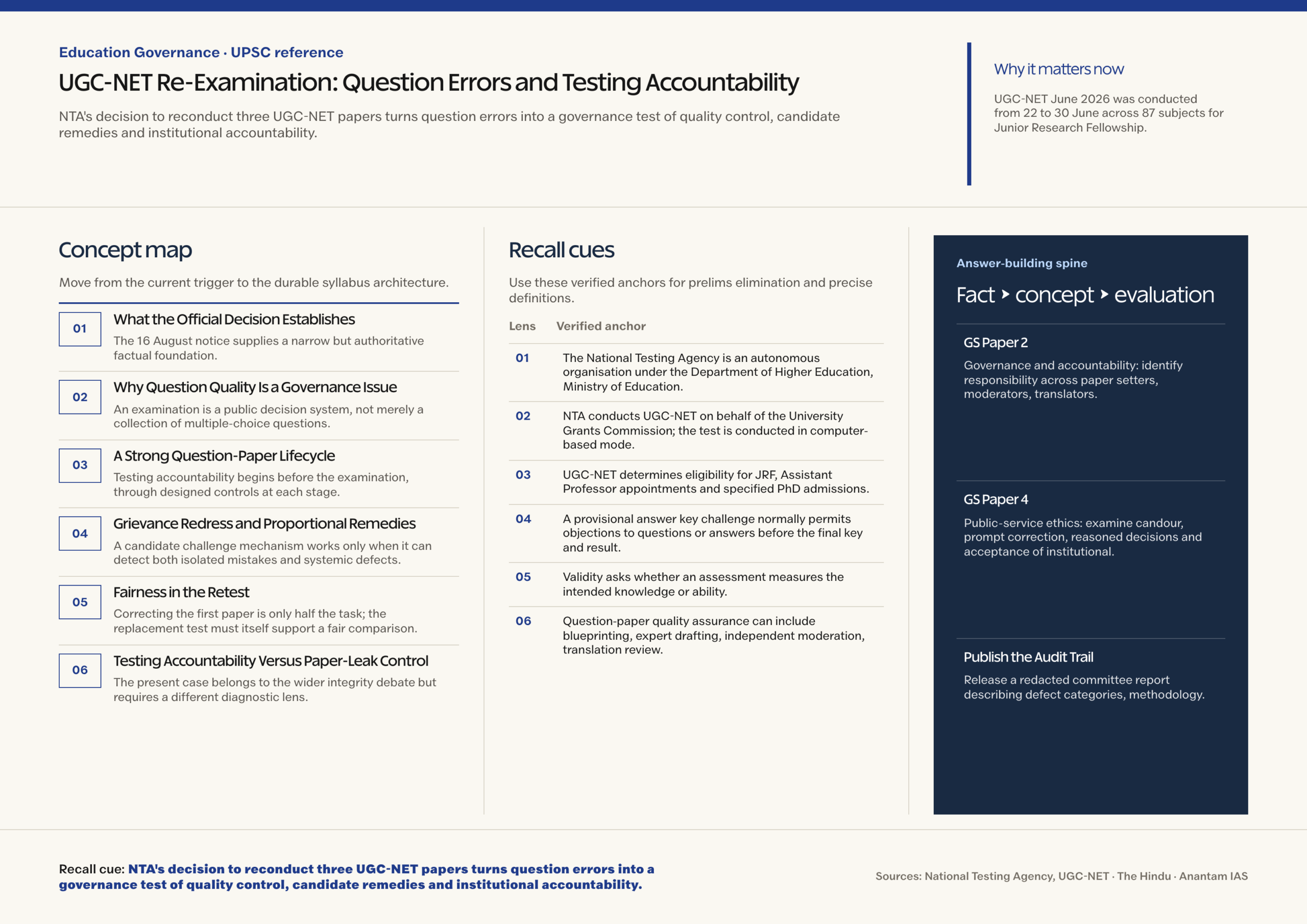
- The National Testing Agency is an autonomous organisation under the Department of Higher Education, Ministry of Education.
- NTA conducts UGC-NET on behalf of the University Grants Commission; the test is conducted in computer-based mode.
- UGC-NET is used for the award of Junior Research Fellowship, eligibility for appointment as Assistant Professor and specified categories of admission to PhD programmes.
- A provisional answer key challenge normally permits objections to questions or answers before the final key and result. It is a post-test correction tool, not a substitute for pre-test moderation.
- Validity asks whether an assessment measures the intended knowledge or ability; reliability asks whether it produces sufficiently consistent measurement across candidates and test forms.
- Question-paper quality assurance can include blueprinting, expert drafting, independent moderation, translation review, psychometric review and final technical proofing.
Mains Relevance
GS Paper 2
- Governance and accountability: identify responsibility across paper setters, moderators, translators, technical vendors and the examination authority.
- Social justice: assess how a reconduct shifts repeat costs onto rural, low-income, working and disabled candidates.
GS Paper 4
- Public-service ethics: examine candour, prompt correction, reasoned decisions and acceptance of institutional responsibility after an avoidable error.
- Procedural fairness: compare the interests of affected candidates, candidates in other subjects and the need for a credible result.
Essay
- Institutional trust depends not on the absence of every error, but on the ability to detect, disclose and remedy error without making citizens bear the full cost.
Background and Context
What the Official Decision Establishes
The 16 August notice supplies a narrow but authoritative factual foundation.
- NTA acknowledged several complaints about English, Commerce and Sociology and said an internal committee examined them.
- The committee found multiple categories of defects, including factual errors, misspelt scholars’ names, garbled titles, faulty stems, translation and grammar failures, and repeated questions.
- NTA accepted the committee’s view that dropping individual questions through the challenge process would not adequately cure defects of this extent. It chose reconduct in the interest of a fair and error-free examination.
- The notice protects continuity for the other subjects by allowing their result processing, JRF allocation and e-certificates to proceed without waiting for the three retests.
- The decision does not publish the committee’s membership, its full report, the number of defective questions, the original paper-development trail or a root-cause finding. Those remain legitimate subjects for further disclosure and audit.
Why Question Quality Is a Governance Issue
An examination is a public decision system, not merely a collection of multiple-choice questions.
- A high-stakes test must produce decisions that are valid, reliable and comparable. A malformed stem can test interpretation of an error instead of knowledge of the subject.
- Translation defects can create unequal test forms when one language version is clearer than another. This raises an equality concern, not just a proofreading concern.
- Large-scale repetition from earlier papers may reward access to a narrow recall bank rather than broad syllabus mastery. Repetition is not automatically unlawful, but its scale and pattern can weaken the intended content coverage and comparability.
- Errors in scholars’ names and established concepts are especially damaging in a subject eligibility test because they undermine construct validity: the question no longer cleanly measures the knowledge it claims to assess.
- Since results affect fellowships and academic opportunities, quality control must be auditable. Outsourcing drafting, translation or delivery cannot outsource the authority’s final accountability.
A Strong Question-Paper Lifecycle
Testing accountability begins before the examination, through designed controls at each stage.
- A test blueprint should map every item to the published syllabus, cognitive level, topic weight and intended difficulty before questions are assembled.
- Item writers should record the source basis, correct answer, explanation and distractor logic. This gives moderators enough evidence to reject ambiguity rather than merely checking grammar.
- Independent subject experts should review factual accuracy and content balance, while separate language specialists review each translation against the source version.
- A controlled question bank needs version history, duplicate detection, retirement rules and access logs. Similarity software may flag repeated items, but expert judgment must decide whether a repeat distorts the paper.
- A final pre-release review should test the assembled form, not only individual items, because duplication, uneven syllabus coverage and shift-level difficulty emerge at the paper level.
Grievance Redress and Proportional Remedies
A candidate challenge mechanism works only when it can detect both isolated mistakes and systemic defects.
- The provisional-key process is suited to a wrong answer key or a small number of ambiguous items. It becomes inadequate when complaints concern paper-wide quality, translation patterns or extensive repetition.
- Candidates need a no-cost route to report systemic defects separately from paid item-by-item objections. Otherwise, the cost of documenting institutional failure falls on those already affected by it.
- Remedies should be graduated: correct a key where the key alone is wrong; drop or award marks for an isolated defective item; use moderation where forms differ; reconduct when defects prevent a defensible common score.
- The authority should publish a reasoned remedy matrix explaining why the selected measure protects comparability better than the alternatives. It should also state how qualifications, cut-offs and earlier attempts will be treated.
- Reconduct creates fresh burdens. Advance notice, the same or nearby city where feasible, renewed disability accommodations, free admit cards and a reliable helpdesk are part of the remedy, not administrative extras.
Way Forward
Publish the Audit Trail
- Release a redacted committee report describing defect categories, methodology, scale and the reasons reconduct was preferred over item-level correction.
- Publish a root-cause and corrective-action report after the retest, with named institutional owners and completion dates.
- Use independent subject moderation, language review, duplicate detection and assembled-paper review as distinct gates with recorded sign-off.
- Rotate and evaluate experts while protecting confidentiality, and audit whether rejected items or known errors re-enter the bank.
Conclusion
- NTA’s decision recognises a basic limit of post-test correction: when defects are widespread, deleting a few questions cannot rebuild a defensible examination.
- The durable reform is testing accountability : clear ownership, independent moderation, accessible grievances, proportionate remedies and public evidence that corrective action was completed.
UPSC Practice Questions
Prelims MCQ 1
With reference to UGC-NET, consider the following statements:
- It is conducted by the National Testing Agency on behalf of the University Grants Commission.
- It is used only to determine eligibility for appointment as Assistant Professor.
- The National Testing Agency is an autonomous organisation under the Department of Higher Education.
How many of the above statements are correct?
(a) Only one (b) Only two (c) All three (d) None
Answer: (b) Only two
Explanation:
Statements 1 and 3 are correct. UGC-NET also serves the award of Junior Research Fellowship and specified PhD-admission categories, so it is not confined to Assistant Professor eligibility.
Prelims MCQ 2
Which one of the following best describes construct validity in a high-stakes examination?
(a) The physical security of examination centres (b) The extent to which a test measures the knowledge or ability it is intended to measure (c) The speed with which results are declared (d) The percentage of candidates who qualify
Answer: (b) The extent to which a test measures the knowledge or ability it is intended to measure
Explanation:
Construct validity concerns whether the assessment actually measures its intended construct. Security, result speed and qualification rates may matter to governance but do not define validity.
UPSC Mains Questions
- Question-paper quality is as important to examination integrity as protection against leaks. Discuss with reference to validity, moderation and institutional accountability. (150 words)
- Re-examination can restore fairness but can also transfer the cost of administrative failure to candidates. Suggest a proportional remedy framework for high-stakes public examinations. (250 words)
Sources: National Testing Agency, UGC-NET and The Hindu.
Frequently Asked Questions
Why will NTA reconduct three UGC-NET June 2026 papers?
NTA said its committee found many factual, typographical, translation, grammar and question-stem errors in English, Commerce and Sociology, plus significant repetition of earlier questions. It concluded that defects of this extent could not be cured merely by dropping questions after.
When are the three UGC-NET papers being reconducted?
The official notice schedules English for 9 September 2026 in the morning shift, Commerce for 9 September in the afternoon shift and Sociology for 10 September in the morning shift. NTA said city, centre and admit-card details would be notified.
Does the reconduct decision prove that a paper leak occurred?
No. The 16 August notice confirms extensive question-paper defects and significant repetition, followed by a committee recommendation to reconduct. It does not make a finding that the three papers were leaked or that a criminal offence occurred. Quality-control failure and.
Why was the answer-key challenge process considered insufficient?
An answer-key challenge can correct a wrong key or help identify a limited number of ambiguous items. NTA said the defects across these papers were too extensive for a cure based only on dropping questions. Paper-wide translation, wording, validity or.
Will candidates have to pay again for the UGC-NET retest?
No additional examination fee will be charged to candidates in English, Commerce and Sociology, according to NTA. The notice also says results and certificates for the other 84 subjects should proceed without waiting for the three reconducted papers.
Tell Google you want more of this.
Add Anantam IAS as a preferred sourceOne tap, and this site shows up more often in your own Top Stories, AI Overviews and AI Mode. Remove it any time.