Nuclear weapon technologies


UPSC Relevance:
Science and technology
PYQ:
Q: Give an account of the growth and development of nuclear science and technology in India. What is the advantage of fast breeder reactor programme in India?
About Nuclear weapons:
- Nuclear weapon are devices designed to release energy in an explosive as a result of nuclear fission, nuclear fusion, or a combination of two processes.
Fission weapon:
- Commonly referred to as atomic bombs
- U-235 isotope of uranium serves as the primary fuel for the weapon.
- Neutron absorption splits atom, releasing energy and neutrons for explosions.
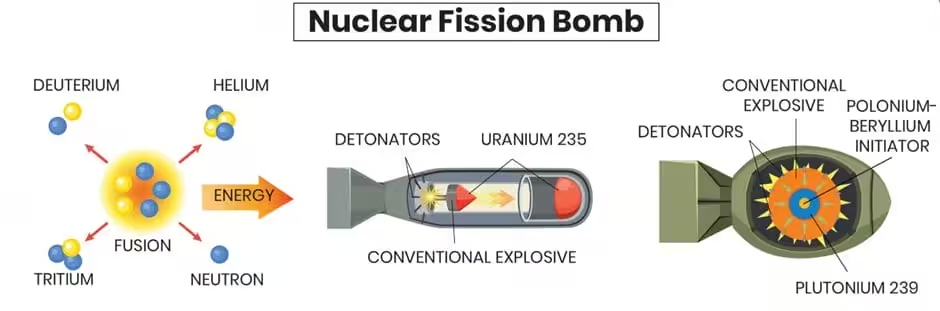
Fusion weapon:
- Referred to as thermonuclear bombs or more commonly as hydrogen bomb
- Fission reaction initiates fusion of hydrogen, potentially causing more fission, releasing huge amount of energy.
- Deuterium and tritium which are the isotopes of hydrogen, are used for the fusion process.
- Releases more energy than fission weapons.

| Parameter | Nuclear Fission | Nuclear Fusion |
|---|---|---|
| Definition | Fission is the splitting of a large atom into two or more smaller ones. | Fusion is the combining of two or more lighter atoms into a larger one. |
| Natural Occurrence of Process | Fission reaction does not normally occur in nature. | Fusion occurs naturally in stars, such as the Sun. |
| By-products of Reaction | Produces many highly radioactive particles. | Produces few radioactive particles. |
| Conditions | Requires high-speed neutrons to initiate the reaction. | Requires extremely high density and temperature to overcome electrostatic repulsion between nuclei. |
| Energy Requirement | Takes relatively little energy to split heavy nuclei. | Requires extremely high energy to fuse light nuclei. |
| Energy Released | Energy released is millions of times greater than in chemical reactions but less than fusion. | Energy released is 3–4 times greater than that from fission. |
| Nuclear Weapon | Used in atomic bombs (fission bombs). | Used in hydrogen bombs (fusion bombs) — often triggered by a fission reaction. |
| Energy Production | Used in nuclear power plants for controlled energy production. | Still experimental; under research for clean power (e.g., ITER Project). |
| Fuel Used | Uranium-235 or Plutonium-239. | Hydrogen isotopes — Deuterium (²H) and Tritium (³H). |
| Waste Generation | Produces long-lived radioactive waste. | Produces minimal waste (mostly Helium). |
| Environmental Impact | Potential radiation hazards and waste disposal issues. | Clean energy source with no greenhouse gas emission. |