Odisha PVTG Nutrition: Anaemia and Adolescent Stunting Gaps
Why in News?
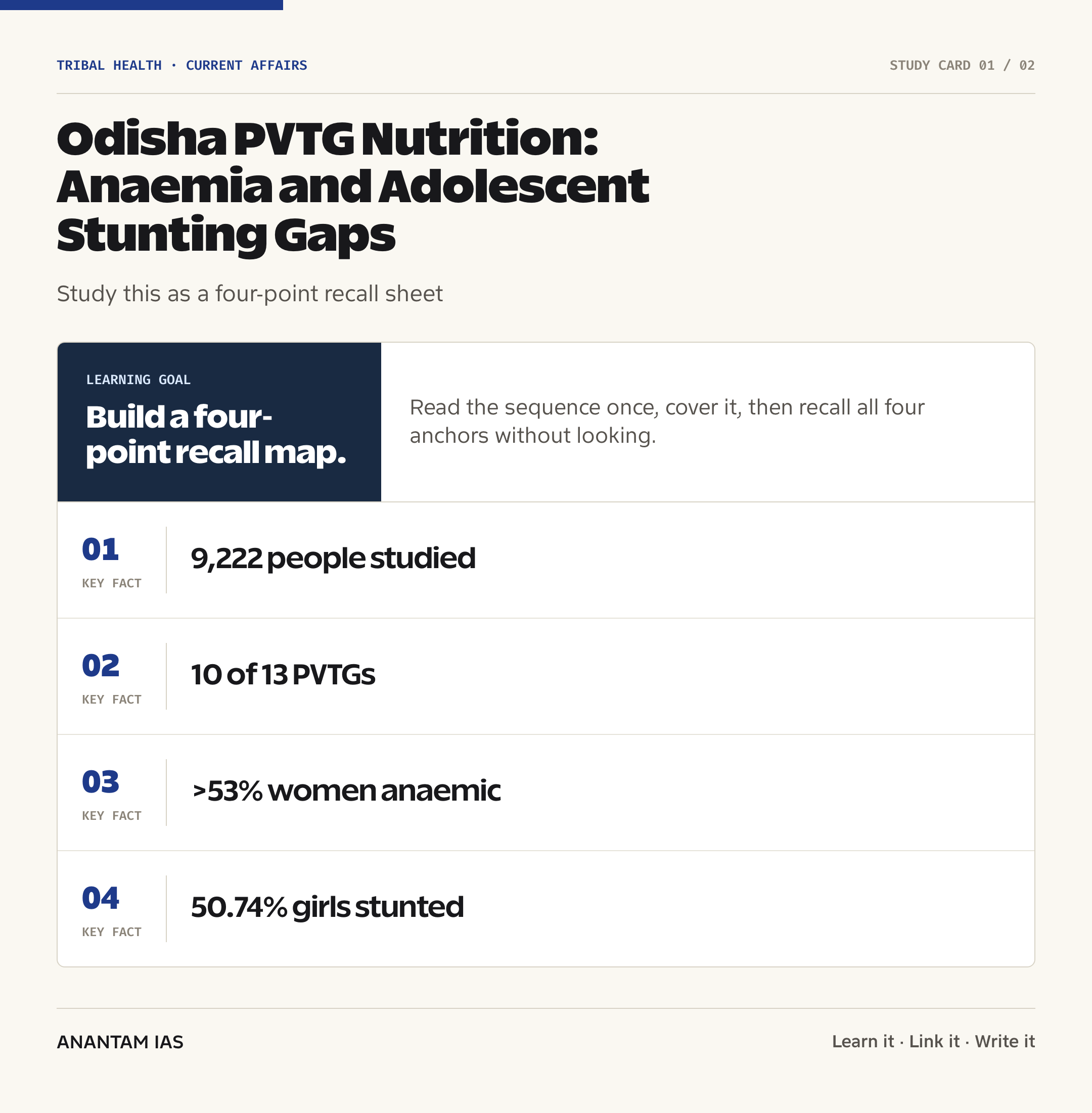
A Utkal University study released on 20 July 2026 found serious Odisha PVTG nutrition gaps, including anaemia among more than half of the adult women studied and stunting among just over half of the female adolescents assessed.
The evidence comes from 10 of Odisha’s 13 PVTGs. It is a large field study, but it isn’t an Odisha-wide nutrition survey. That distinction matters because each percentage describes a defined study group, age band and indicator.
- The Hindu reported that researchers covered 9,222 individuals from 2,041 households in seven districts: Malkangiri, Rayagada, Kandhamal, Keonjhar, Deogarh, Mayurbhanj and Gajapati.
- The released study covered the Bonda, Didayi, Dongria Kandha, Kutia Kandha, Juang, Paudi Bhuiya, Hill Kharia, Mankidia, Lodha and Lanjia Saora communities.
- Among the adult women studied, more than 53% were anaemic. Among 1,015 adult men, the reported anaemia prevalence was 36.95%.
- Stunting affected 50.74% of female adolescents assessed. The reported group rates were highest among Hill Kharia, 82.76%, followed by Paudi Bhuiya, 72.73%, and Juang, 53.49%.
- Among male adolescents assessed, 30.88% were thin. The study also reported a 59% home-delivery rate and signs of emerging blood-pressure and random-blood-sugar risks.
The development matters in the context of:
- The study links tribal welfare with the nutrition continuum: an adolescent girl’s nutrition affects her present health and can shape pregnancy outcomes and the next generation’s growth.
- The figures support differentiated planning. A single state average can hide sharp intra-PVTG variation, such as the spread in adult male anaemia across Mankidia, Bonda, Lodha and Lanjia Saora participants.
- Related notes on counting PVTGs explain the data problem, while the nutrition survey gap shows why age group and denominator must travel with every percentage.
- The policy test isn’t only whether food or tablets exist. It is whether ASHA, ANM and Anganwadi services reach remote habitations regularly, in a language and form that communities can use.
UPSC Relevance
Prelims Relevance
- Particularly Vulnerable Tribal Groups are an administrative sub-category within Scheduled Tribes, not a separate category named in the Constitution.
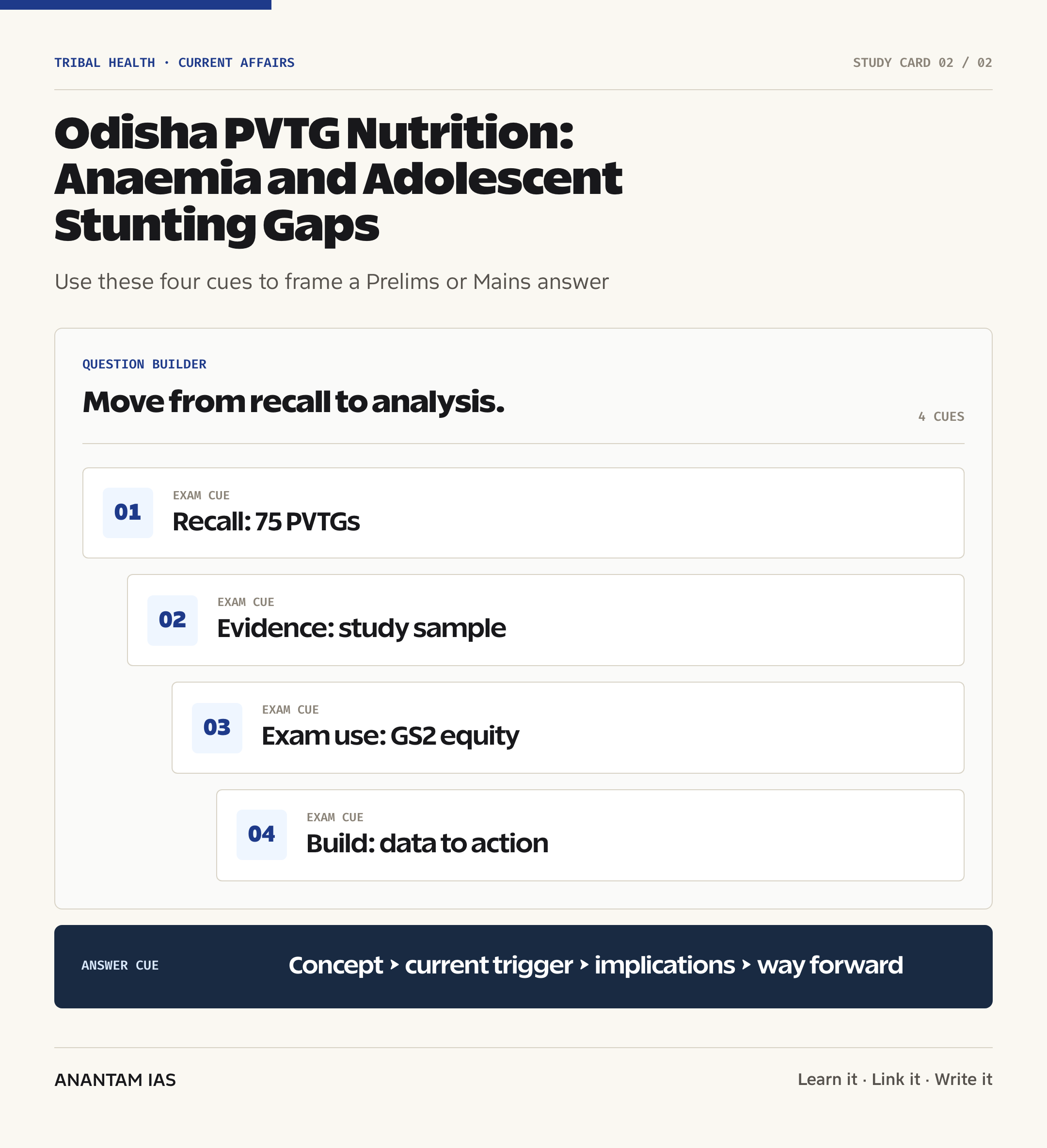
- India has 75 PVTG communities across 18 States and one Union Territory, according to the Ministry of Tribal Affairs.
- Odisha has 13 PVTGs, the highest number for any State; the Utkal University study covered 10 of them.
- Stunting means low height for age and indicates chronic or repeated undernutrition. Thinness in adolescents is commonly assessed through age-specific body-mass measures.
- Anaemia is low haemoglobin, but iron deficiency isn’t its only cause. Infection, malaria, parasitic infestation, haemoglobinopathies and other micronutrient deficiencies can contribute.
- PM-JANMAN seeks saturation of basic services for PVTG families and habitations through 11 interventions by nine ministries.
- The updated Anaemia Mukt Bharat Abhiyaan uses a life-cycle approach covering children, adolescents, pregnant and lactating women, women of reproductive age and low-birth-weight infants.
- Article 46 directs the State to promote the educational and economic interests of weaker sections, especially Scheduled Castes and Scheduled Tribes, and protect them from social injustice and exploitation.
Mains Relevance
GS Paper 2
- Welfare schemes for vulnerable sections, mechanisms and institutions for their protection and betterment, with PVTGs as the most vulnerable segment within Scheduled Tribes.
- Issues relating to development and management of health and human resources, especially last-mile maternal, adolescent and nutrition services in remote habitations.
- Government policies and implementation problems, including the gap between scheme eligibility and effective service saturation.
GS Paper 1
- Salient features of Indian society and diversity, including how language, livelihood, terrain and food systems shape health-seeking behaviour.
- Role of women and population issues, especially the intergenerational cycle connecting adolescent nutrition, maternal health and child growth.
Essay
- A welfare state is measured not by the number of schemes announced, but by whether its hardest-to-reach citizens can use them.
- Equality offers the same service; equity redesigns delivery around unequal distance, language, nutrition and social constraints.
Background and Context
How to Read the Study Evidence
The percentages are valuable only when the sample, age group and indicator stay attached to them.
- The released-study account reports 9,222 people, 2,041 households and 10 PVTGs. It doesn’t cover all 13 Odisha PVTGs, so its findings shouldn’t be converted into a prevalence estimate for every PVTG person in the State.
- Utkal University’s project page lists 2,051 households for its ethnographic data collection, while The Hindu’s account of the released study gives 2,041. The two figures may reflect different project stages or components and shouldn’t be merged.
- The NFHS-5 Odisha State Fact Sheet, 2019-21, reported 64.3% anaemia among all women aged 15-49 and 31.0% stunting among under-five children. Those state-representative groups differ from this study’s adult women and female adolescents, so direct ranking is unsound.
- A fair comparison also needs the same laboratory method, threshold and survey period. Without those details, a higher or lower percentage may reflect measurement and sampling differences rather than a proven change in underlying health.
What the Nutrition Indicators Mean
Anaemia, stunting and thinness describe different biological problems, not three labels for the same condition.
- Anaemia describes haemoglobin below the relevant threshold. It can reduce work capacity and, during pregnancy, raise risks of prematurity and low birth weight, but diagnosis must also examine non-iron causes.
- Stunting, low height for age, reflects long-duration growth restriction. Among adolescents it can carry childhood deprivation forward and signal that nutrition recovery hasn’t caught up with the growth spurt.
- Thinness captures low body mass relative to age among adolescents. The study’s 30.88% figure concerns male adolescents assessed, not all children and not the same measure as under-five wasting.
- None of these indicators identifies a single cause on its own. Diet, infection, sanitation, workload, puberty, pregnancy and inherited blood disorders can overlap, so screening must lead to clinical assessment rather than an automatic one-cause conclusion.
Variation Within the Study Population
The most policy-relevant finding is the variation between communities, not a single pooled headline.
- Adult male anaemia was 59.18% among Mankidia and 56.30% among Bonda participants, compared with the study’s pooled adult male prevalence of 36.95%.
- The corresponding reported rates were 47.32% among Lodha and 39.26% among Lanjia Saora men. Different local burdens call for local diagnosis, food mapping and follow-up.
- Male-adolescent thinness was reported at 48.15% among Didayi, 44.74% among Lodha, 40% among Hill Kharia and 36% among Bonda participants. Pooling can hide precisely the communities needing the earliest response.
- The report also notes emerging blood-pressure and random-blood-sugar risks. This possible double burden, undernutrition alongside metabolic risk, means programmes shouldn’t assume that every adult health problem is explained by calorie shortage alone.
Why a Life-Cycle Lens Matters
Nutrition risk accumulates across adolescence, pregnancy, infancy and childhood, so one age-specific intervention can’t break the cycle.
- An adolescent girl enters pregnancy with the nutrition built during childhood and puberty. Stunting and anaemia can sit in the same life history even though they measure different outcomes.
- A reported 59% home-delivery rate in the study points to continuity-of-care gaps, but it shouldn’t be compared casually with statewide institutional-birth data because the populations and study designs differ.
- The service chain runs through Anganwadi centres, schools, ASHAs, ANMs, Ayushman Arogya Mandirs and referral facilities. A missed link can mean no screening, irregular supplements or delayed treatment.
- A life-cycle response follows the person, not the scheme calendar: adolescent screening, preconception nutrition, antenatal testing, safe delivery, breastfeeding support and child growth monitoring must connect through shared referral and follow-up records.
Policy Architecture for PVTG Health
India already has schemes for nutrition and tribal development; the hard part is convergent delivery at habitation level.
- PM-JANMAN, launched in 2023-24, targets 75 PVTG communities with housing, drinking water, education, health and nutrition, connectivity, electrification and livelihoods.
- Anaemia Mukt Bharat combines supplementation, testing and treatment, deworming, food fortification, diet communication and attention to non-nutritional causes.
- The National Sickle Cell Anaemia Elimination Mission matters in tribal areas because a haemoglobinopathy can cause anaemia that food advice or iron tablets alone won’t correct.
- The child-health and anaemia continuum works only when screening results lead to treatment, repeat testing and referral rather than a one-day camp.
- The 2026 Anaemia Mukt Bharat Abhiyaan guidelines expand the earlier 6x6x6 design to a 7x7x7 framework, adding low-birth-weight babies, stronger therapeutic management, locally available iron-rich foods and digital monitoring.
Rights, Culture and Last-Mile Delivery
Culturally responsive care changes the delivery method without lowering the medical standard.
- Article 46 supplies the social-justice direction, while Article 244 and the Fifth Schedule frame administration of Scheduled Areas in States such as Odisha.
- Language support, women community workers, seasonal outreach and respect for local food knowledge can improve trust. But cultural sensitivity can’t become an excuse for absent diagnostics, unsafe delivery or untreated severe anaemia.
- Gram Sabhas and PVTG institutions should help identify access barriers and suitable timings. Clinical protocols, consent, privacy and referral standards must remain uniform.
- The Panchayats (Extension to Scheduled Areas) Act, 1996 gives Gram Sabhas a central role in Scheduled Areas. That participation can make nutrition planning locally grounded, but departments remain accountable for staff, supplies, diagnostics and emergency transport.
Determinants Behind the Health Gap
A nutrition programme misses the problem when it treats food intake as the only variable.
- Remote settlements can face long travel times, seasonal road breaks and weak phone networks. For a pregnant woman or severely anaemic adolescent, distance becomes a clinical risk when screening, referral or emergency transport is delayed.
- Dietary diversity depends on forest access, cultivation, wages, markets, the Public Distribution System and seasonal availability. A calorie entitlement may prevent hunger while still leaving gaps in iron, protein, folate, vitamin B12 or vitamin C.
- Unsafe water, malaria and intestinal parasites can repeatedly drain nutritional gains. Convergence must connect Jal Jeevan Mission, sanitation, vector control, deworming and primary care with food and supplementation programmes.
- Women and girls may eat last, carry heavy work burdens or lack control over travel and care-seeking. These gendered constraints can’t be corrected by counselling the individual while household and service barriers remain unchanged.
- Traditional foods and ethnomedicinal knowledge can support programme design when communities choose to share them. But clinical safety and informed consent require testing claims rather than treating every customary practice as either automatically effective or automatically backward.
Turning Local Evidence Into Administration
The study is most useful as a targeting tool and baseline for follow-up, not as a label attached permanently to a community.
- District teams should convert group-level findings into habitation micro-plans: who needs repeat haemoglobin testing, which adolescents missed school-based services, where transport fails and which facility receives referrals.
- Process counts such as tablets issued or camps held are easy to inflate. Better indicators include screening coverage, treatment completion, haemoglobin recovery, growth follow-up, referral arrival and respectful-care feedback from women and adolescents.
- Small PVTG populations create privacy risks. Public dashboards should show enough disaggregation to reveal inequity while suppressing cells that could expose an individual’s health condition, pregnancy or genetic status.
- Independent evaluation should compare like with like across time. Use the same age bands, anthropometric standards, haemoglobin method, season and sampling frame, then report confidence limits and attrition instead of presenting a lone percentage as proof of success.
- Financing should follow the diagnosed bottleneck. A district with repeated IFA stock-outs needs supply-chain repair; a habitation with high home delivery may need transport and trusted birth planning; a community with persistent stunting needs years of child and adolescent follow-up, not a short nutrition drive.
- This is the larger governance lesson: evidence must travel into budgets, rosters, supply chains and review meetings. Research has little public value if its sharpest findings stop at a release ceremony.
Way Forward
Create Group-Specific Nutrition Dashboards
- Disaggregate anaemia, adolescent growth, pregnancy and service-use data by PVTG, sex, age, habitation and season while protecting small-community privacy.
- Publish the denominator and measurement method beside every rate so administrators don’t mistake a local sample for a state estimate.
Diagnose Before Treating
- Pair haemoglobin testing with protocols for malaria, helminths, sickle-cell disease, dietary gaps and referral of moderate or severe cases.
- Track IFA receipt, consumption, adverse effects, repeat testing and recovery, not tablet distribution alone.
Reach Adolescents Beyond School
- Combine school and community outreach so out-of-school girls and boys receive growth assessment, WIFS, deworming, counselling and referral.
- Use locally available pulses, millets, greens, animal-source foods where accepted, and vitamin-C combinations rather than a generic menu detached from local seasons.
Make Maternal Care Continuous
- Map pregnancy early, plan transport before labour and connect ASHA, ANM, Anganwadi and referral facilities for antenatal care, safe delivery and postnatal follow-up.
- Measure travel time, stock-outs, language access and failed referrals as service-quality indicators under PM-JANMAN.
Co-Design and Independently Evaluate
- Let PVTG women, adolescents and Gram Sabhas shape outreach timings, counselling language and acceptable foods while trained health teams retain diagnostic responsibility.
- Commission repeat surveys with clear sampling and comparable age groups to test whether community-specific action reduces gaps over time.
Conclusion
The Utkal University study provides a warning and a map for action: anaemia and impaired growth are substantial in the surveyed communities, but their intensity varies sharply. Policy loses that signal when it treats Odisha’s 13 PVTGs as one uniform population.
The workable response is convergence with precision: diagnose the cause, follow the same person across the life cycle, adapt delivery to each habitation and publish denominators honestly. PM-JANMAN can close the access gap only when saturation means care received and completed, not services listed on paper.
UPSC Practice Questions
Prelims MCQ 1
With reference to Particularly Vulnerable Tribal Groups (PVTGs), consider the following statements:
- India has 75 PVTG communities across 18 States and one Union Territory.
- PVTGs form a separate constitutional category distinct from Scheduled Tribes.
- Odisha has 13 PVTGs.
How many of the above statements are correct?
(a) Only one (b) Only two (c) All three (d) None
Answer: (b) Only two
Explanation:
Statements 1 and 3 are correct. PVTG is an administrative sub-category within Scheduled Tribes, not a separate category created by the Constitution.
Prelims MCQ 2
Which is the most methodologically sound reading of the Odisha PVTG study?
(a) Its female-adolescent stunting rate is directly comparable with NFHS under-five stunting (b) Its adult-women anaemia rate represents every PVTG woman in Odisha (c) Its 36.95% adult-male anaemia rate refers to the 1,015 men studied (d) Its findings cover all 13 PVTGs in Odisha
Answer: (c) Its 36.95% adult-male anaemia rate refers to the 1,015 men studied
Explanation:
The study covered 10 PVTGs and defined participant groups. Different ages, samples and indicators can’t be treated as directly comparable population estimates.
UPSC Mains Questions
- The coexistence of anaemia, adolescent stunting and emerging metabolic risk among Particularly Vulnerable Tribal Groups shows why tribal health can’t be reduced to food supplementation alone. Examine the social determinants and institutional gaps involved, and suggest a convergent life-cycle response. (15 marks, 250 words)
- A uniform welfare scheme may produce unequal outcomes across culturally and geographically distinct PVTG communities. Discuss how disaggregated evidence, community participation and habitation-level service saturation can improve nutrition policy without weakening common standards of clinical care and accountability. (15 marks, 250 words)
Sources: Utkal University Centre of Excellence in Studies on Tribal and Marginalised Communities and The Hindu.
Frequently Asked Questions
What did the Odisha PVTG study find?
The Utkal University study reported anaemia in more than 53% of adult women studied, 36.95% of 1,015 adult men, stunting in 50.74% of female adolescents assessed and thinness in 30.88% of male adolescents assessed. These are study findings from 10 PVTGs, not statewide estimates for every PVTG person.
How large was the study sample?
The Hindu’s account of the released study reports 9,222 individuals from 2,041 households across 10 PVTGs and seven Odisha districts. Utkal University’s broader project page lists 2,051 households for an ethnographic component, so the two household counts shouldn’t be combined or treated as the same denominator.
Is stunting the same as thinness?
No. Stunting is low height for age and usually signals chronic or repeated growth restriction. Adolescent thinness reflects low body mass relative to age. The study reported stunting for female adolescents and thinness for male adolescents, so swapping the labels would change both the biological meaning and the population described.
Can these figures be compared directly with NFHS-5?
Not directly. NFHS-5 is a state-representative household survey with specified age groups, including women aged 15-49 and children under five. The Utkal study covers selected participants from 10 PVTGs and reports some adolescent indicators. A comparison must align age, sex, indicator, sampling frame and measurement method.
What is PM-JANMAN’s role in tribal health?
PM-JANMAN targets 75 PVTG communities across 18 States and one Union Territory. Its 11 interventions, implemented through nine ministries, seek to saturate PVTG families and habitations with housing, water, education, health and nutrition, connectivity, electricity and livelihood services. Health outcomes depend on whether that convergence reaches each habitation.
Why isn’t iron supplementation alone enough?
Iron deficiency is one cause of anaemia, but malaria, intestinal worms, sickle-cell disease, other haemoglobin disorders, infection and micronutrient deficiencies can also lower haemoglobin. Effective control needs testing, cause-specific treatment, diet diversity, deworming where indicated, repeat measurement and referral, alongside reliable iron and folic acid delivery.