Why in News?
A recent editorial in The Hindu, analysing fresh findings from the sixth round of the National Family Health Survey (NFHS-6), argues that India has won the battle on the supply side of maternal and child health but is losing it on the feeding side. Institutional deliveries, antenatal contact and full immunisation are now near-universal, yet the practices that actually build a child’s nutrition in the first two years remain weak.
The editorial frames the gap through the lens of maternal time poverty — the idea that mothers, especially those in informal and unpaid work, simply do not have the time, rest or support to feed infants on the schedule that science demands. The data turns nutrition from a purely clinical question into one of gender, care work and welfare delivery, placing it squarely in GS2.
- NFHS-6 (conducted by IIPS, Mumbai under the Health Ministry) shows near-universal institutional delivery and immunisation but poor infant and young child feeding (IYCF) outcomes.
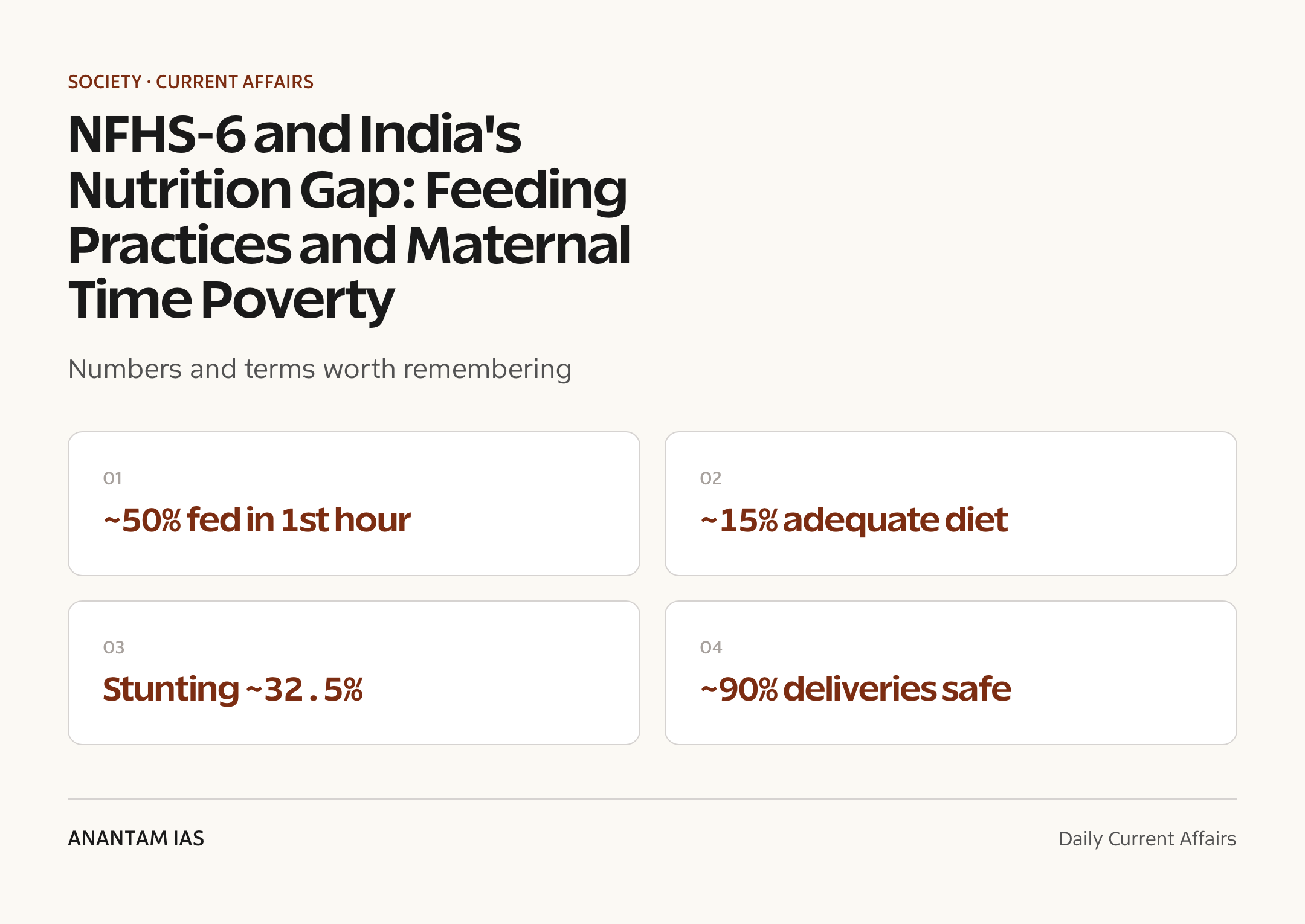
- The editorial cited that only about half of newborns are put to the breast within the first hour, and only roughly 15% of children aged 6–23 months get an adequate diet.
- It attributes much of the feeding deficit to maternal time poverty in informal and unpaid work, not to a lack of clinics or vaccines.
- Stunting has fallen only modestly (about 35.5% in NFHS-5 to roughly 32.5% in NFHS-6 as cited), signalling a stalled nutrition transition.
The development matters in the context of:
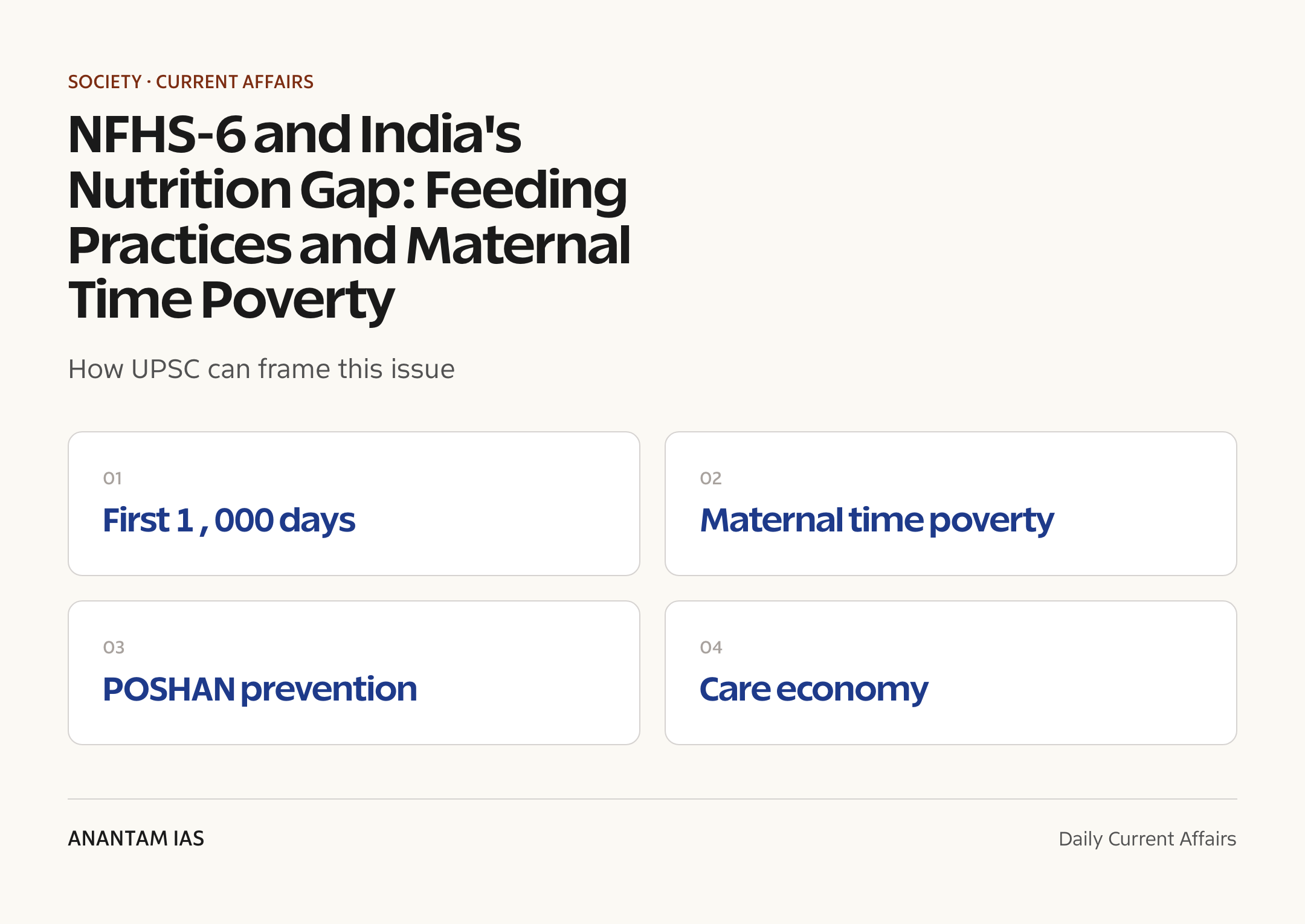
- The first 1,000 days (conception to age two) is the window when most stunting becomes irreversible, making IYCF the decisive lever.
- India’s flagship response runs through POSHAN Abhiyaan, Saksham Anganwadi and the ICDS network, which the editorial says still leans toward treatment over prevention.
UPSC Relevance
Prelims Relevance
- NFHS is conducted by the International Institute for Population Sciences (IIPS), Mumbai, the nodal agency, under the Ministry of Health and Family Welfare.
- NFHS is a large-scale, multi-round sample survey giving district- and state-level estimates on health, nutrition, family welfare and population.
- Key IYCF indicators: early initiation of breastfeeding (within 1 hour of birth) and exclusive breastfeeding for the first 6 months.
- Minimum Dietary Diversity (MDD), Minimum Meal Frequency (MMF) and Minimum Acceptable Diet (MAD) measure the quality and adequacy of complementary feeding for 6–23-month-olds.
- Undernutrition is measured as stunting (low height-for-age, chronic), wasting (low weight-for-height, acute) and underweight (low weight-for-age).
- POSHAN Abhiyaan (2018) is the National Nutrition Mission; Saksham Anganwadi and Poshan 2.0 is its restructured form.
- ICDS delivers services through Anganwadi centres: supplementary nutrition, immunisation, health check-ups, pre-school education and referral.
- ‘Time poverty‘ refers to a chronic shortage of discretionary time, here driven by women’s combined paid, informal and unpaid care burden.
Mains Relevance
GS Paper 2
- Welfare delivery: why near-universal health-service coverage has not translated into nutrition outcomes, and how POSHAN Abhiyaan/ICDS must pivot from rehabilitation to prevention.
- Government interventions for vulnerable sections (children, mothers) and the gap between scheme inputs and behavioural outcomes.
GS Paper 1
- Role of women and the gendered care economy: how unpaid care work and informal employment shape child nutrition and women’s well-being.
Essay
- A society is judged by how it feeds its youngest — nutrition as the meeting point of economic growth, gender equity and the care economy.
Background and Context
What NFHS-6 actually measures
The survey is the backbone of India’s health and nutrition evidence.
- NFHS is a periodic, large-sample household survey run by IIPS, Mumbai under the Ministry of Health and Family Welfare, with international technical support.
- It produces representative estimates down to the district level on fertility, mortality, immunisation, anaemia, nutrition and access to services.
- Because it is repeated in rounds, NFHS lets policymakers track change — NFHS-5 (2019–21) to NFHS-6 — and is the data source most cited for stunting, wasting and IYCF indicators.
The good news: a strong supply side
On reach and infrastructure, India has genuinely delivered.
- The editorial cited that roughly 9 in 10 deliveries are now attended by trained personnel and a similar share of children are fully vaccinated.
- Almost all pregnant women now receive at least one visit from a health worker, reflecting the reach of ASHAs, ANMs and Anganwadi workers.
- These gains show that mission-mode service delivery works when the intervention is a one-off clinical event — a delivery, a vaccine, a check-up.
The feeding gap that won't close
The crisis is in everyday practice, not access.
- Despite high institutional delivery, only about half of newborns are breastfed within the first hour — a free, high-impact practice.
- Timely introduction of solid and semi-solid food around six months reaches only a minority of children, as cited.
- Crucially, only roughly 15% of 6–23-month-olds receive a minimum acceptable diet — the right mix of frequency and diversity.
- The result is a stalled stunting decline: better than before, but far too slow to meet national targets. For the wider picture see child malnutrition and stunting in India and the typology of undernutrition, overnutrition and micronutrient deficiency.
Maternal time poverty: the hidden driver
Feeding an infant well is, above all, time-intensive labour.
- Exclusive breastfeeding and frequent complementary feeding demand a mother’s time, rest and proximity through the day — resources that time-poor women lack.
- Women in informal, daily-wage and unpaid family work rarely get maternity protection, paid leave or crèche support, forcing an early return to work.
- The editorial flags that headline ‘women in paid work’ figures mask unpaid care burdens, and that NFHS lacks disaggregated data on the work status of mothers of under-twos.
- This is a gender-justice problem as much as a health one — explored in women, work and the care economy and social security for informal and gig workers.
Why schemes underperform on prevention
The policy architecture tilts toward treatment, not behaviour change.
- POSHAN Abhiyaan and ICDS remain strong at rehabilitating severely malnourished children once identified, but weaker at preventing faltering in the first place.
- Anganwadi centres are well placed for counselling on breastfeeding and complementary feeding, yet are stretched by data-entry and supplementary-food duties.
- Without time, counselling and family support reaching the mother, supplementary nutrition alone cannot fix what is fundamentally a care-and-feeding-practice deficit.
Way Forward
Make feeding practices the headline metric
- Shift POSHAN Abhiyaan’s emphasis from treating wasting to preventing it, with early initiation, exclusive breastfeeding and MAD as core targets.
- Add IYCF counselling at every antenatal and immunisation contact — using the touchpoints India has already universalised.
Tackle time poverty directly
- Extend maternity protection, paid feeding breaks and crèches to informal and unpaid workers, not just the formal sector.
- Use Anganwadi-linked day care so mothers can work without sacrificing feeding schedules.
Fix the data gap
- Collect disaggregated NFHS data on the work status of mothers of 6–23-month-olds to target time-poor households.
- Track MDD, MMF and MAD at the district level to surface local feeding failures early.
Engage families, not just mothers
- Run behaviour-change campaigns that bring fathers and grandmothers into feeding and care.
- Strengthen Anganwadi worker capacity for home-based counselling rather than only food distribution.
Conclusion
NFHS-6 tells a paradoxical story: India has nearly solved the problems that money and infrastructure can solve — safe deliveries, vaccines, antenatal contact — yet the simplest, cheapest acts of feeding an infant well still elude most households. The bottleneck has moved from the clinic to the kitchen and the workplace.
Closing the nutrition gap now means treating it as a question of women’s time and care, not just calories. A POSHAN strategy that protects a mother’s time, counsels her family and measures feeding practices — rather than only weighing children after they falter — is the route from impressive coverage to genuine nourishment.
UPSC Practice Questions
Prelims MCQ 1
With reference to the National Family Health Survey (NFHS), consider the following statements:
- It is conducted by the International Institute for Population Sciences, Mumbai, under the Ministry of Health and Family Welfare.
- It is a complete enumeration census of all households in India.
- It provides estimates on indicators such as stunting, wasting and immunisation coverage.
How many of the above statements are correct?
(a) Only one (b) Only two (c) All three (d) None
Answer: (b) Only two
Explanation:
Statements 1 and 3 are correct. NFHS is a large-scale sample survey, not a complete census, so statement 2 is wrong.
Prelims MCQ 2
The ‘Minimum Acceptable Diet (MAD)’ indicator used to assess infant and young child feeding best combines which of the following?
(a) Birth weight and length-for-age only (b) Minimum dietary diversity and minimum meal frequency (c) Exclusive breastfeeding and immunisation status (d) Anaemia level and Vitamin A supplementation
Answer: (b) Minimum dietary diversity and minimum meal frequency
Explanation:
MAD for breastfed children combines minimum dietary diversity (variety of food groups) with minimum meal frequency (how often the child is fed), capturing both quality and quantity of complementary feeding.
UPSC Mains Questions
- Despite near-universal institutional delivery and immunisation, India’s infant and young child feeding outcomes remain poor. Examine the role of ‘maternal time poverty’ in this gap and suggest welfare-delivery reforms. (GS2, 250 words)
- “India’s nutrition challenge is increasingly a problem of the care economy rather than of food supply.” Discuss in the light of NFHS-6 findings and the position of women in informal and unpaid work. (GS1, 250 words)
Source: The Hindu (editorial).
Frequently Asked Questions
What is the difference between NFHS-5 and NFHS-6?
Both are rounds of the same National Family Health Survey, run by IIPS, Mumbai under the Health Ministry. NFHS-6 is the latest round and updates indicators like stunting, immunisation and feeding practices first measured in NFHS-5 (2019–21), letting policymakers track how outcomes have changed over time.
What does ‘maternal time poverty’ mean?
It describes the chronic shortage of usable time that mothers face when paid work, informal labour and unpaid care all compete for their day. Because exclusive breastfeeding and frequent complementary feeding are time-intensive, time-poor mothers — especially in informal work — struggle to feed infants on the schedule nutrition requires.
What are early initiation and exclusive breastfeeding?
Early initiation means putting a newborn to the breast within one hour of birth, which provides protective colostrum. Exclusive breastfeeding means feeding only breast milk — no water, formula or food — for the first six months. Both are free, high-impact IYCF practices, yet NFHS data show many infants miss them.
What is a Minimum Acceptable Diet for a child aged 6–23 months?
It is an IYCF benchmark combining minimum dietary diversity (eating from enough food groups) and minimum meal frequency (being fed often enough). A child meeting both is said to receive a minimum acceptable diet. NFHS-6, as cited in the editorial, shows only a small share of 6–23-month-olds clear this bar.
How do POSHAN Abhiyaan and ICDS address child nutrition?
POSHAN Abhiyaan is the National Nutrition Mission; ICDS delivers services through Anganwadi centres — supplementary nutrition, immunisation, check-ups, pre-school education and counselling. The editorial argues they are strong at rehabilitating malnourished children but must shift toward prevention and feeding-practice counselling.
Why has stunting fallen only slowly despite better health services?
Safe deliveries and vaccines are one-off clinical events that mission-mode delivery handles well. Stunting, by contrast, builds up over the first 1,000 days through daily feeding and care, which depend on a mother’s time and family support. Without tackling time poverty and feeding behaviour, coverage gains alone leave stunting high.
Tell Google you want more of this.
Add Anantam IAS as a preferred sourceOne tap, and this site shows up more often in your own Top Stories, AI Overviews and AI Mode. Remove it any time.