OneTag FASTag Portability: Keeping the Tag While Changing Issuers
Why in News?
On 17 September 2026, NHAI announced OneTag FASTag portability on the Rajmargyatra app, enabling users to change issuers while retaining their existing physical tag and FASTag identifier.
- Users must check eligibility, authorise the switch and complete verification and wallet onboarding with the new issuer.
- The previous issuer closes the old wallet after portability and refunds its available balance following applicable adjustments.
- A six-month cooling period applies before the interoperable FASTag can be ported again.
- Provider choice becomes easier when changing a financial relationship no longer requires replacing the identifier attached to the vehicle.
- Wallet settlement still matters: retaining a tag does not mean the old account or its balance automatically becomes the new issuer’s account.
UPSC Relevance
Prelims Relevance
- FASTag: RFID-based electronic toll payment device attached to the vehicle.
- NETC: National Electronic Toll Collection, developed by NPCI.
- Interoperability: common arrangements allowing acceptance across participating toll operators.
- Portability: changing the issuer while retaining the existing tag and ID.
- Mobile Verification Code: authorisation code supplied by the current issuer.
Mains Relevance
GS Paper 3
- Digital infrastructure: common identifiers and competition between service providers.
- Transaction costs: reducing replacement costs while managing financial settlement.
GS Paper 2
- Citizen services: transparent switching, verification and complaint handling.
Essay
- Meaningful choice depends on being able to leave a service provider without rebuilding access to the service.
Background and Context
Separate the tag, the issuer and the payment network
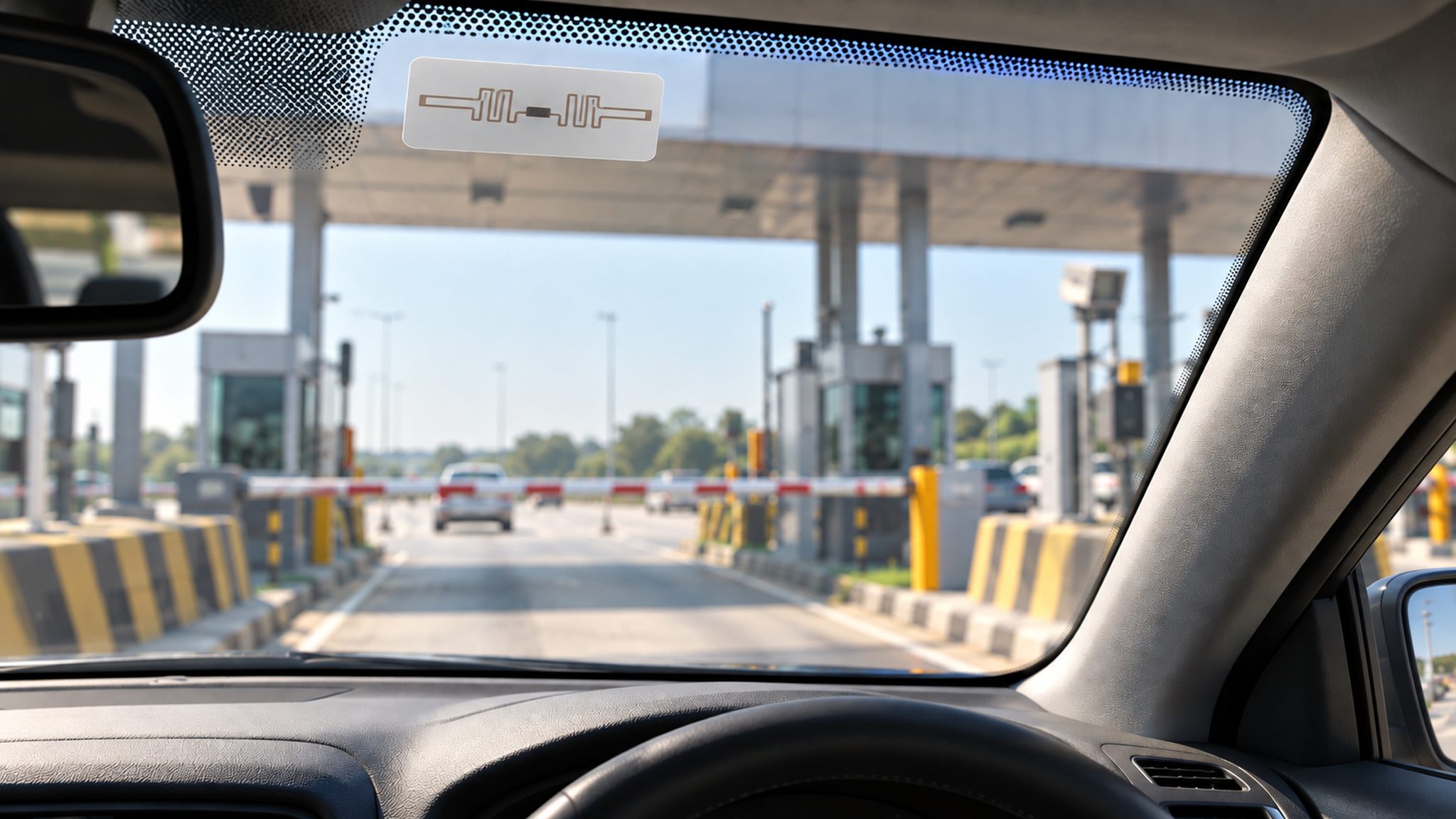
FASTag combines a device on the windscreen with a financial relationship and a shared payment network; portability changes only specified parts of that arrangement.
- FASTag uses radio-frequency identification to support electronic toll payment from a linked account. The tag identifies the payment arrangement; it should not be confused with the wallet where the user’s available funds are recorded.
- The issuer supplies the customer-facing financial relationship. OneTag allows that provider to change while the existing FASTag ID remains linked to the vehicle registration number, avoiding a fresh physical tag solely for an issuer switch.
- NETC interoperability concerns acceptance across participating toll operators through common rules and specifications. As PIB explains, shared payment arrangements support settlement and disputes; this differs from permission to change the bank serving the customer.
- Portability concerns changing the issuer without replacing the retained identifier. A system can accept one tag across operators yet still make switching issuers cumbersome; OneTag addresses that separate source of effort for the user.
- Infrastructure layers also differ: multi-lane free-flow tolling concerns how vehicles are detected and charged on the road. OneTag concerns the issuer relationship behind the tag, so portability does not itself remove toll barriers.
How the issuer switch and wallet closure work
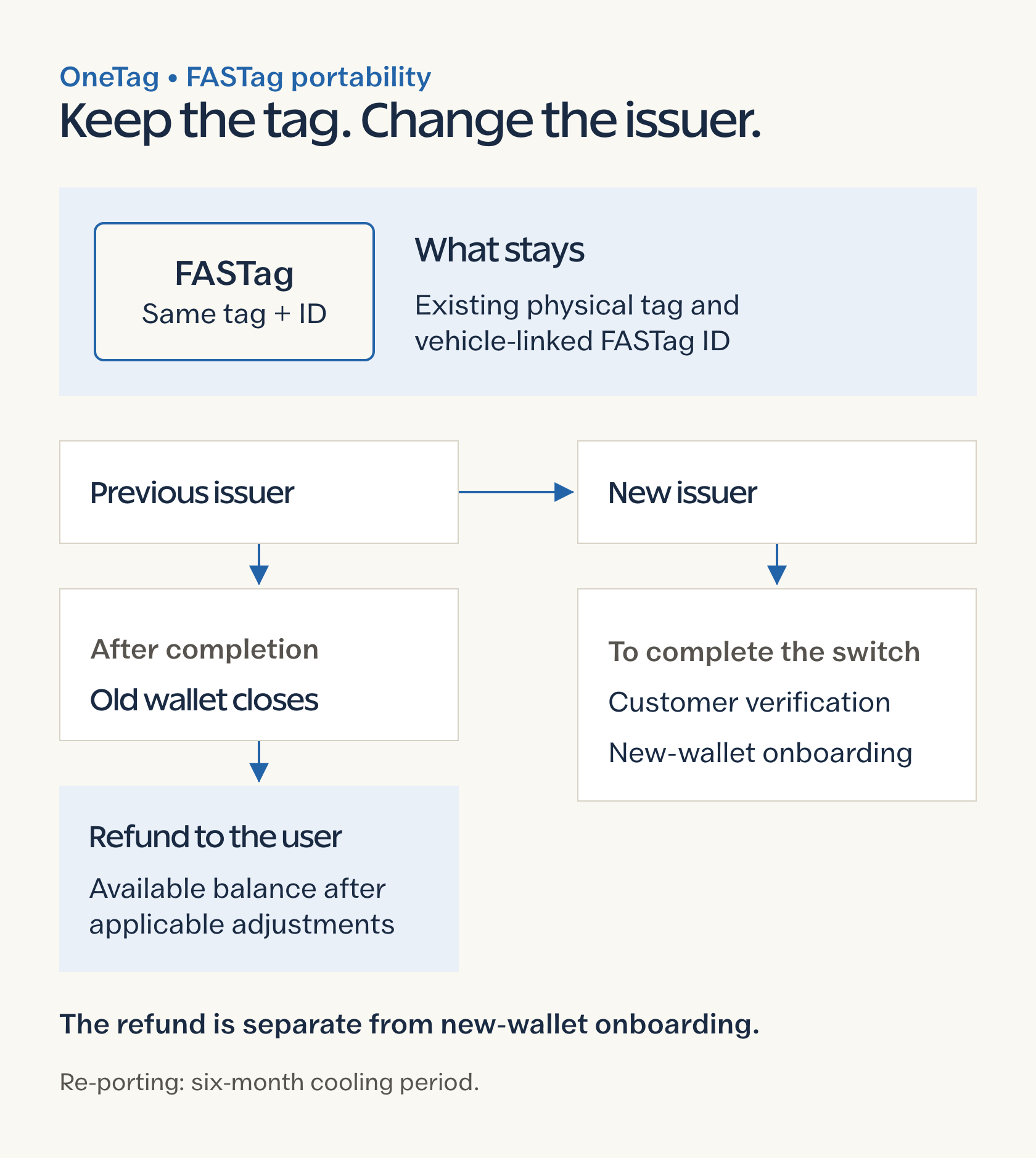
The announced sequence combines eligibility, authorisation and a new financial relationship; retaining the device does not remove the checks needed to establish the receiving issuer’s account.
- Eligibility comes first: the user logs into Rajmargyatra and enters the vehicle registration number. This initiates a check, rather than establishing that every vehicle, account or attempted switch must qualify for the service.
- Authorisation uses a six-digit Mobile Verification Code from the current issuer bank. This connects the request to the existing relationship; receiving the code does not itself complete all the new issuer’s onboarding requirements.
- New-issuer onboarding follows authorisation and issuer selection. Customer verification and wallet onboarding remain required steps, even though the physical tag stays on the vehicle; continuity of the device is different from continuity of the account.
- Old-wallet closure occurs after portability is completed. The previous issuer refunds the available balance after applicable adjustments; the announcement describes refund and closure, not automatic movement of the old balance into the new wallet.
- Cooling period: the tag cannot be ported again for six months. This limits the frequency of subsequent issuer changes; it should not be mistaken for a stated processing time for completing the current request.
Consumer choice needs a clear completion process
Lower switching effort is useful only if users understand which provider serves them, what happens to their money and which conditions still apply after the switch.
- Switching costs include effort and replacement logistics, not only explicit fees. NHAI expects reduced tag production, dispatch and reissuance costs; these are anticipated operational benefits, not evidence that every customer must receive a specified saving.
- Competition may improve when users can change providers with less disruption. Whether that produces better service depends on practical completion, accessible support and informed choices; the announcement alone does not demonstrate a measured competitive outcome.
- Refund transparency requires users to distinguish the old issuer’s settlement from the new issuer’s wallet setup. A completion record should identify deductions and refund status, without implying that an unchanged tag guarantees access to refunded money.
- Pass eligibility addresses different conditions from issuer portability. The digital FASTag local pass concerns a concession framework; OneTag’s announcement does not establish automatic treatment of annual or local passes when a user changes issuers.
- Operational limits remain unspecified in the release: it does not promise instant completion, a fee waiver or approval for every account. Exam answers should retain the stated checks rather than replace them with assumptions about convenience.
Way Forward
Make each stage visible to the user
- Display separate status confirmations for authorisation, new-issuer onboarding, portability completion and old-wallet refund.
- Explain eligibility failures and applicable adjustments clearly, with a route to resolve incorrect vehicle or account information.
- Identify the responsible issuer and support channel for pending refunds and onboarding problems, so users are not passed between organisations.
- Evaluate the service through completed switches and resolved complaints, alongside tag replacement costs, rather than relying only on app availability.
Conclusion
- OneTag separates a stable vehicle-linked identifier from a changeable financial provider. Its practical value lies in reducing replacement effort while preserving authorisation, customer verification and an orderly closure of the previous wallet.
- For exam answers, keep tag continuity, issuer change and wallet settlement distinct. The user retains the tag and ID, establishes the new relationship and receives the old balance through refund after applicable adjustments.
UPSC Practice Questions
Prelims MCQ 1
With reference to OneTag FASTag portability, consider the following statements:
- The existing FASTag ID remains unchanged after successful portability.
- The old-wallet balance automatically transfers into the new issuer’s wallet.
- Customer verification and wallet onboarding with the new issuer remain necessary.
How many of the above statements are correct?
(a) Only one (b) Only two (c) All three (d) None
Answer: (b) Only two
Explanation:
Statements 1 and 3 are correct. The previous issuer closes the old wallet and refunds the available balance after adjustments; automatic wallet-to-wallet balance transfer is not the announced mechanism.
Prelims MCQ 2
Which option correctly distinguishes FASTag interoperability from OneTag portability?
(a) Interoperability enables acceptance across participating toll operators; portability enables an issuer change while retaining the tag. (b) Interoperability removes customer verification; portability removes toll liability. (c) Interoperability requires a new tag at each plaza; portability replaces the vehicle registration number. (d) Interoperability and portability both guarantee automatic transfer of wallet balances.
Answer: (a) Interoperability enables acceptance across participating toll operators; portability enables an issuer change while retaining the tag.
Explanation:
NETC interoperability concerns shared acceptance arrangements. OneTag adds issuer switching with retention of the physical tag and FASTag ID, subject to eligibility, authorisation and onboarding.
UPSC Mains Questions
- How can portability improve consumer choice in digital payment services? Discuss using OneTag, with attention to verification and financial settlement.
- Distinguish interoperability from portability in digital infrastructure. Why must simpler provider switching be accompanied by clear accountability for customer funds?
Sources: PIB, Ministry of Road Transport and Highways and PIB, Redefining India's Highways.
Frequently Asked Questions
What remains unchanged after OneTag portability?
The existing physical FASTag and its identifier linked to the vehicle registration number remain unchanged. The user changes the issuer and must complete customer verification and wallet onboarding with the new provider.
Does the old wallet balance automatically move to the new wallet?
No. After portability completes, the previous issuer closes the existing wallet and refunds the available balance after applicable adjustments. The announcement does not describe an automatic transfer into the new issuer’s wallet.
Is the Mobile Verification Code enough to complete portability?
No. The code from the current issuer supports authorisation. The user must also select a new issuer and complete customer verification and wallet onboarding to complete the portability process described in the announcement.
What does the six-month cooling period mean?
It is the interval before the interoperable FASTag can be ported again. It is not a promised processing duration for the current switch, nor a waiting period announced for the old-wallet refund.
Does OneTag automatically preserve every pass benefit?
The announcement does not specify how annual or local pass benefits are treated during an issuer change. Retaining the physical tag and ID should not be treated as an automatic guarantee about those separate arrangements.