Why in News?
NHAI, on 18 August 2026, extended online FASTag Local Passes to 121 toll plazas, so eligible residents can buy a monthly pass on the Rajmargyatra app.
- Apply on the Rajmargyatra Mobile App. Check the official eligible plaza list.
- Eligibility: residents within 20 km of an eligible plaza. GIS checks the registered address.
- Consent-based pull from DigiLocker, VAHAN and the linked FASTag retrieves address, vehicle and tag.
- The first digital local pass launched in July 2026 at Mundka-Bakkarwala on UER-II, Delhi.
- Indian Express reports MLFF live at six plazas. Unpaid barrier-less travel can attract e-notices.
- With no booth staff, locals who once relied on familiarity now receive e-notices for unpaid user fee.
- Indian Express says unpaid MLFF can mean double the toll. A FASTag-linked digital pass is the compliance path.
- Residents who do not live near these 121 plazas still visit a plaza physically for a monthly pass.
UPSC Relevance
Prelims Relevance
- The National Highways Authority of India (NHAI) functions under the Ministry of Road Transport and Highways.
- A FASTag is an RFID tag used for electronic user-fee collection on national highways.
- A local monthly pass under National Highway user fee rules is for a resident within 20 km of the plaza, for a non-commercial vehicle.
- Multi-lane free flow (MLFF) is barrier-less collection from overhead gantries; the vehicle does not stop.
- Digital local-pass eligibility uses consent-based DigiLocker and VAHAN data, plus GIS on the registered address.
- The first digital local pass was launched in July 2026 at Mundka-Bakkarwala on UER-II, Delhi.
Mains Relevance
GS Paper 3
- Read a local monthly pass as a user-fee concession, not as a new highway tariff.
- Explain why barrier-less MLFF turns an informal booth waiver into e-notices and double-toll risk.
GS Paper 2
- Consent-based DigiLocker-VAHAN-GIS checks as e-governance that cuts plaza discretion.
- The limit: a stale registered address can deny a person who actually lives inside 20 km.
Essay
- When collection becomes automatic, a neighbour is no longer a fee waiver.
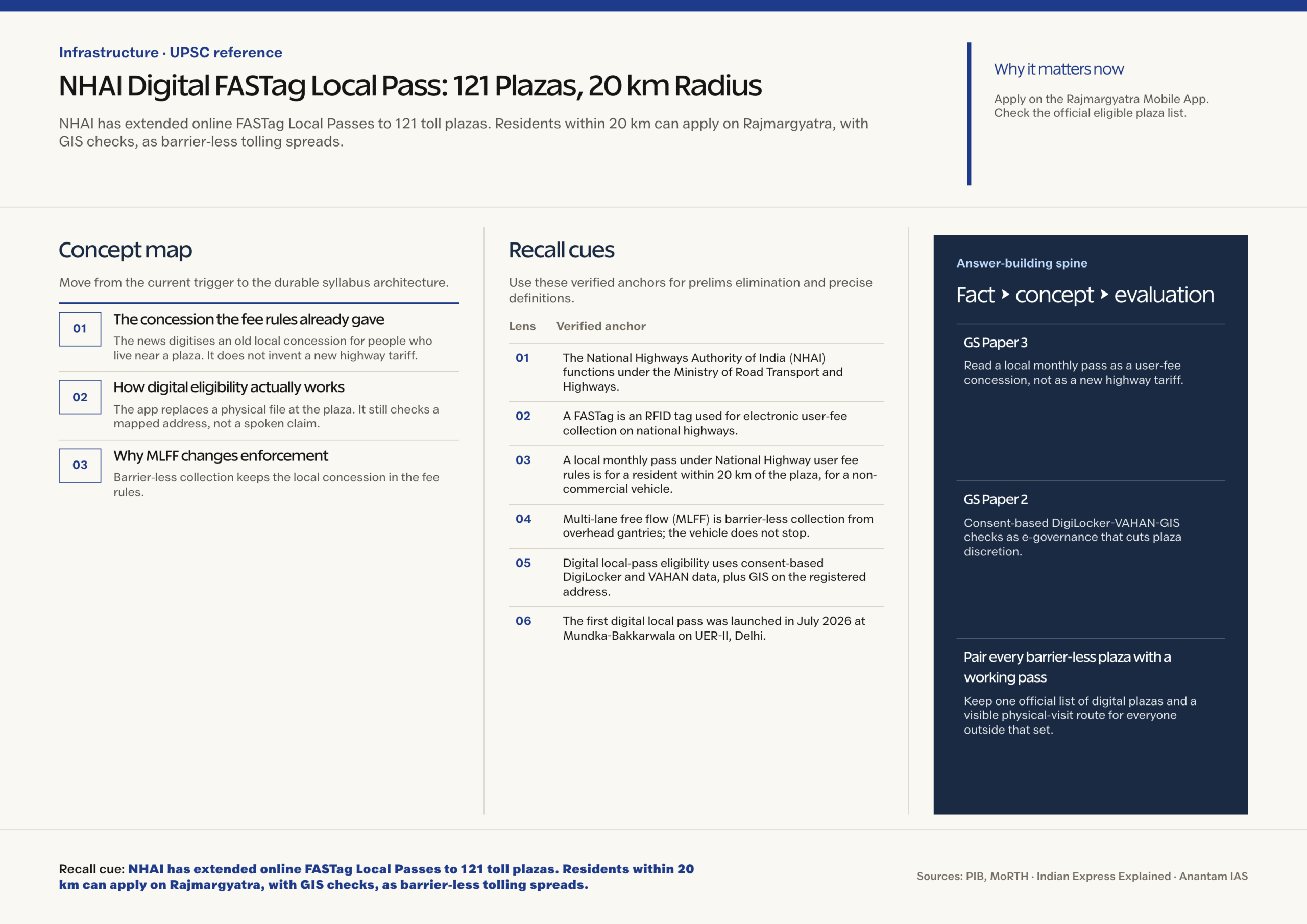
Background and Context
The concession the fee rules already gave
The news digitises an old local concession for people who live near a plaza. It does not invent a new highway tariff.
- National Highway user fee rules already issue a monthly pass at the concerned plaza to a resident for a non-commercial vehicle, which is the legal hook this digital channel now uses.
- Indian Express cites the listed monthly fee as Rs 350 for that resident vehicle. Treat it as the existing rule price, not a tariff born in August 2026.
- The pass is plaza-specific. It allows unlimited travel through that plaza during the month, as per applicable provisions, not a free run across every national highway plaza.
- Eligibility is residency within 20 km of the plaza. A long commute from farther away does not create the same monthly-pass right, even if the driver uses that gate daily.
- Commercial vehicles sit outside this resident monthly-pass design. Do not write the digital channel as a general cut in freight user fee or as a rebate for every repeat crossing.
How digital eligibility actually works
The app replaces a physical file at the plaza. It still checks a mapped address, not a spoken claim.
- Apply on the Rajmargyatra Mobile App. Earlier, the resident visited the plaza and filed papers to prove the 20 km address, which is the queue this channel is meant to cut.
- With the applicant’s consent, the stack retrieves residential address, vehicle details and the linked tag from DigiLocker, VAHAN and the linked FASTag, so the file is not a self-typed claim.
- GIS then tests whether that registered address falls inside the 20 km radius of the chosen eligible plaza. Distance is measured from the record, not from where the driver says home is.
- If the registered address sits outside 20 km, the application can fail even when the person actually lives nearby. That is a data-quality limit, not a small software glitch.
- The eligible-plaza list is on the official Rajmargyatra page. Digital issue today covers 121 plazas; residents outside that set still go to a plaza in person, though PIB said more plazas will follow.
Why MLFF changes enforcement
Barrier-less collection keeps the local concession in the fee rules. It removes the person who once waved a neighbour through.
- Multi-lane free flow (MLFF) reads FASTag from an overhead gantry. The vehicle does not stop, and there is no booth clerk left to recognise a local face and waive the fee.
- Indian Express reports barrier-less MLFF live at six plazas: Choryasi, Mundaka, Daulatpura, Gharaunda, Manoharpur and Shahjahanpur. That six is a collection design, not the 121-plaza digital-pass list.
- Mundka-Bakkarwala on UER-II, Delhi, went MLFF on 11 May 2026. The first digital local pass followed at that same plaza in July 2026, after e-notices showed the gap.
- Officials told Indian Express that residents within 20 km were a large share of e-notices, because many crossed on familiarity with booth staff rather than on a pass.
- Unpaid MLFF can attract double the toll. A monthly pass linked to FASTag is the lawful way to keep the local concession once the barrier is gone, which is enforcement rather than a new tax.
Way Forward
Pair every barrier-less plaza with a working pass
- Keep one official list of digital plazas and a visible physical-visit route for everyone outside that set.
- Build a redress path when GIS rejects a person whose life is inside 20 km but whose registered address is stale.
- Do not switch a plaza to MLFF until a working FASTag-linked local pass exists for that 20 km ring.
- Score the reform on fewer wrongful e-notices and cleaner local compliance, not on app-download counts.
Conclusion
- The 121-plaza roll-out digitises a 20 km resident concession that already lived in National Highway user fee rules, and it is not a new user-fee schedule for the whole network.
- MLFF removes the informal waiver at the booth. Without a FASTag-linked pass, the same local now faces e-notices and a double-toll risk, which is the enforcement point of barrier-less collection.
- In an answer, separate the old concession, the GIS eligibility stack, and the enforcement change at barrier-less plazas; mixing those three is how this topic gets muddled.
UPSC Practice Questions
Prelims MCQ 1
With reference to NHAI’s digital FASTag Local Pass, consider the following statements:
- Residents living within 20 km of an eligible toll plaza can apply for a digital local pass on the Rajmargyatra app.
- The monthly pass for a resident’s non-commercial vehicle is a new NHAI tariff notified with the 121-plaza digital extension.
- Digital eligibility uses consent-based retrieval from DigiLocker and VAHAN, plus GIS verification of the registered address.
How many of the above statements are correct?
(a) Only one (b) Only two (c) All three (d) None
Answer: (b) Only two
Explanation:
Statements 1 and 3 are correct. The monthly pass already existed under National Highway user fee rules; August 2026 digitised the channel at 121 plazas.
Prelims MCQ 2
The first Digital FASTag Local Pass facility in India was launched at:
(a) Choryasi toll plaza in Gujarat, which also hosts barrier-less MLFF (b) Mundka-Bakkarwala toll plaza on Urban Extension Road-II (UER-II) in Delhi (c) All 121 notified plazas, in a single July 2026 launch (d) Every FASTag plaza on the Golden Quadrilateral
Answer: (b) Mundka-Bakkarwala toll plaza on Urban Extension Road-II (UER-II) in Delhi
Explanation:
PIB says the first Digital Local Pass facility was launched in July 2026 at Mundka-Bakkarwala on UER-II, Delhi. Choryasi is among the six MLFF plazas, not that first digital-pass site.
UPSC Mains Questions
- Barrier-less tolling changes how a local user-fee concession is enforced. Discuss with reference to NHAI’s digital FASTag local pass. (250 words)
- Digitising eligibility can shrink booth-level discretion. Examine the governance trade-off in GIS address checks for FASTag local passes. (150 words)
Sources: PIB, Ministry of Road Transport and Highways and Indian Express Explained.
Frequently Asked Questions
What did NHAI announce on 18 August 2026?
NHAI extended online FASTag Local Passes to 121 toll plazas. Eligible residents can buy a monthly pass on the Rajmargyatra app instead of filing papers at the plaza.
Who can apply for the digital local pass?
Residents living within 20 km of an eligible plaza can apply. GIS checks the registered address pulled, with consent, from DigiLocker, VAHAN and the linked FASTag, not a verbal claim.
Is Rs 350 a new NHAI price?
No. Indian Express cites Rs 350 as the existing National Highway user-fee monthly pass for a resident’s non-commercial vehicle. The August 2026 news is the digital channel, not a new rate.
Why does MLFF make the local pass urgent?
Barrier-less plazas have no booth staff. Locals who crossed on familiarity now get e-notices, and unpaid MLFF can mean double the toll. A FASTag-linked pass is the compliance path.
What if a person does not live near these 121 plazas?
That person still visits a plaza physically to obtain a monthly pass. The digital facility is plaza-listed, not a nationwide online pass for every FASTag user.
Tell Google you want more of this.
Add Anantam IAS as a preferred sourceOne tap, and this site shows up more often in your own Top Stories, AI Overviews and AI Mode. Remove it any time.