Paper-Leak Cases: Centre Announces Fast-Track Courts
Why in News?
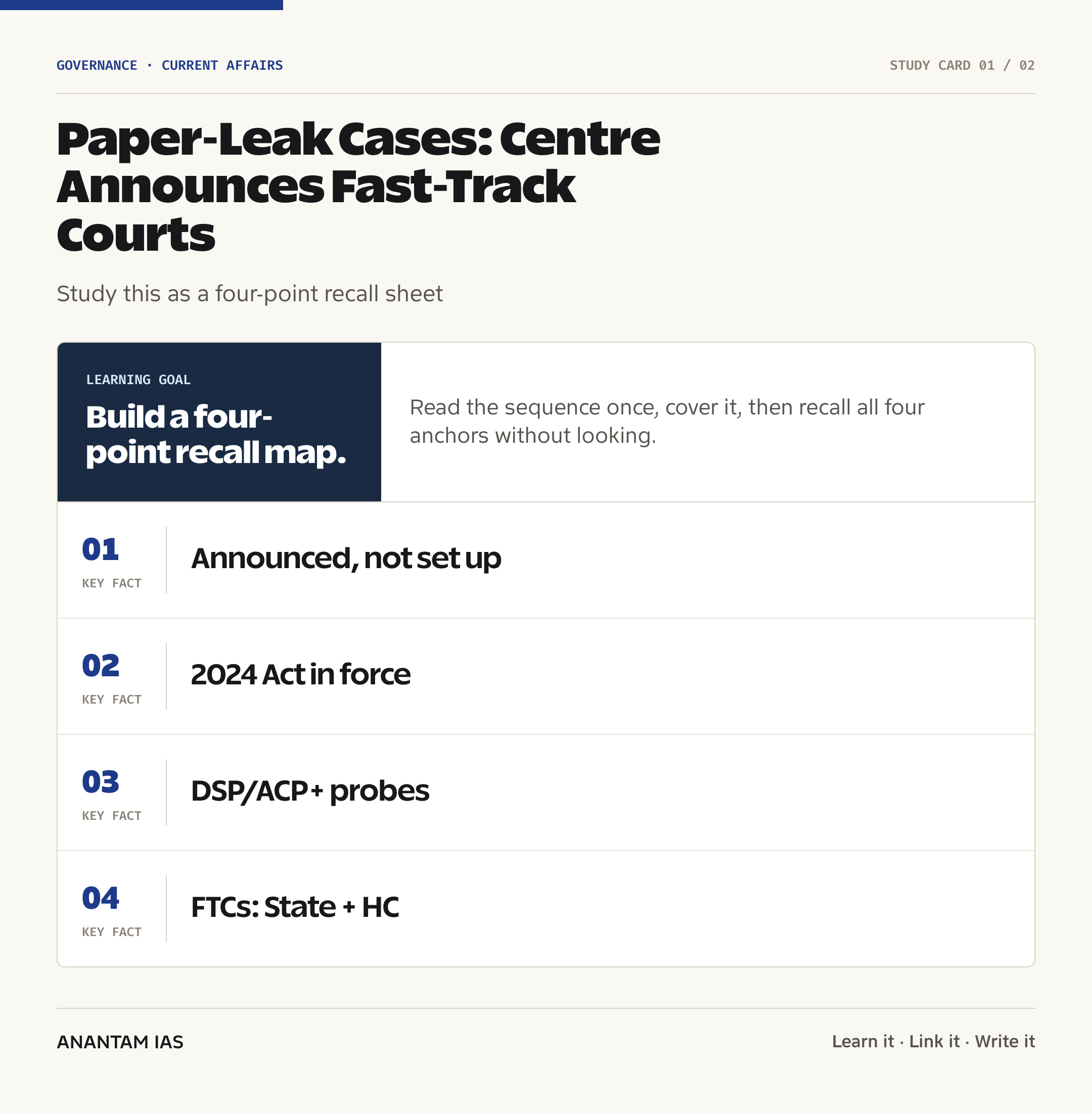
Prime Minister Narendra Modi announced on 23 July 2026 that fast-track courts would be set up for paper-leak cases and said the concerned authorities had been directed to take the necessary steps. The Indian Express reported the announcement amid nationwide protests over examination integrity.
The statement is a policy commitment, not proof that a new court network is already operational. It gave no public detail on the number of courts, territorial allocation, funding, staffing, case-transfer criteria or implementation timetable, so those questions must await formal executive, judicial and State-level action.
- The stated objective is swift and stringent punishment for those involved in paper leaks.
- The announcement concerns the trial stage; it does not by itself cure weaknesses in detection, investigation, prosecution or examination design.
- The durable statutory anchor is the Public Examinations (Prevention of Unfair Means) Act, 2024, in force from 21 June 2024.
- Ordinary fast-track courts are set up by States and Union Territories in consultation with their respective High Courts, according to the Department of Justice.
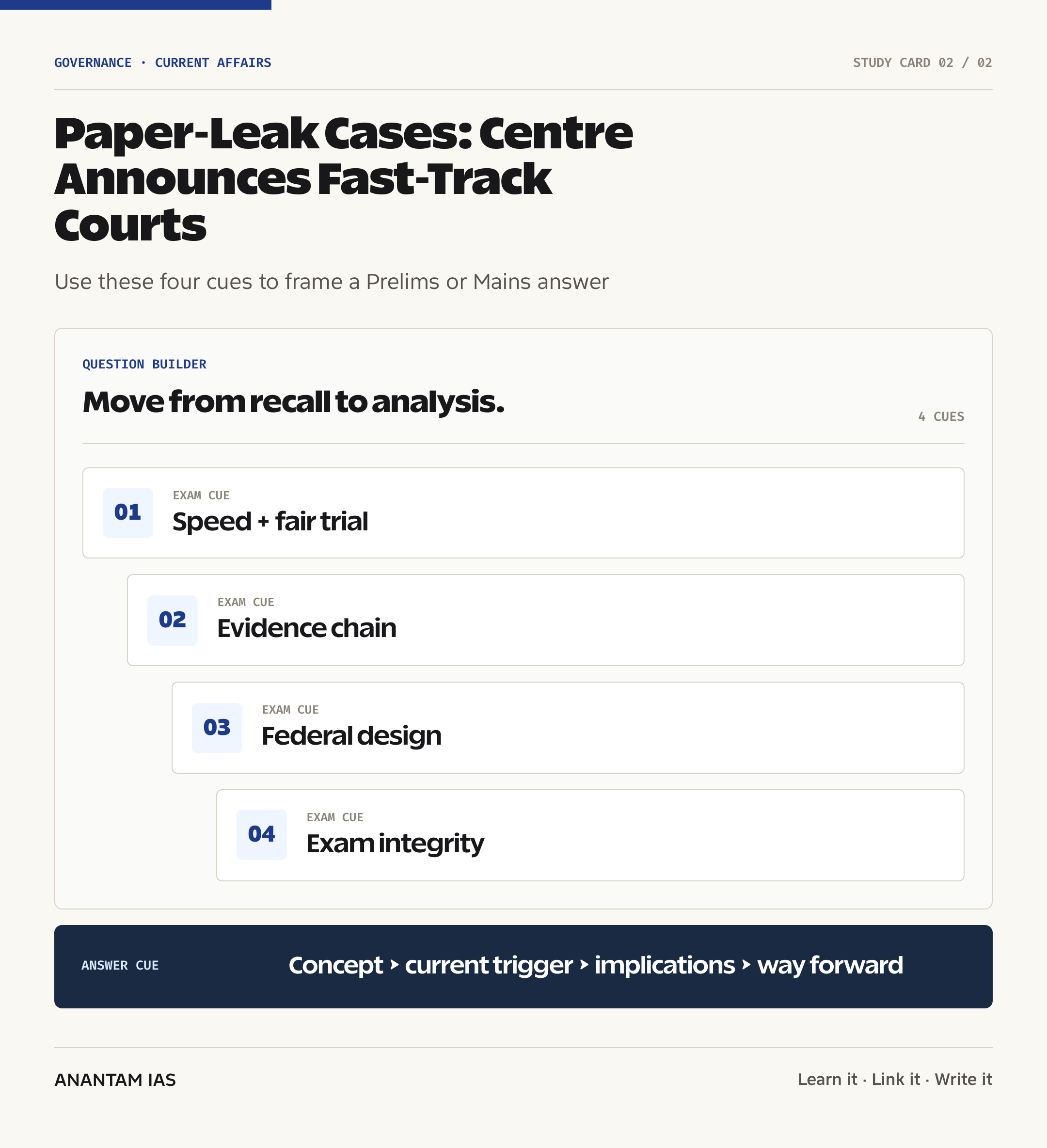
- A workable model must reconcile speed with Article 21, which protects both speedy justice and a fair procedure.
The development matters in the context of:
- The move matters in the context of repeated high-stakes examination failures and the institutional issues explained in Anantam IAS’s NEET 2026 paper-leak analysis.
- It shifts attention from creating offences to securing reliable convictions through forensic evidence, capable prosecutors and disciplined case management.
- It also tests whether a targeted docket can deliver speed without merely moving judges, staff and courtrooms away from other pending criminal cases.
UPSC Relevance
Prelims Relevance
- The Public Examinations (Prevention of Unfair Means) Act, 2024 is Act No. 1 of 2024 and came into force on 21 June 2024.
- Its Schedule covers examinations conducted by UPSC, SSC, Railway Recruitment Boards, IBPS, Central ministries and departments, and NTA, plus any other notified authority.
- Section 3 includes question-paper or answer-key leakage, unauthorised access, collusion, OMR tampering, computer-system tampering and fake examinations among unfair means.
- Under Section 9, offences are cognizable, non-bailable and non-compoundable; non-bailable does not mean that bail can never be granted.
- Section 10 prescribes three to five years’ imprisonment and a fine up to ₹10 lakh for a person resorting to offences under the Act.
- Section 11 prescribes five to ten years’ imprisonment and a fine of at least ₹1 crore for organised crime; an involved institution’s property may be attached and forfeited.
- Under Section 12, investigation must be by an officer not below Deputy Superintendent of Police or Assistant Commissioner of Police; the Centre may refer a case to a Central Investigating Agency.
- The Act supplements other laws under Section 15; charges under other applicable criminal, cyber, corruption or money-laundering laws may coexist when their ingredients are met.
- Police is in the State List, while administration of justice and criminal procedure engage the constitutional distribution of powers between Union and States.
- Article 235 vests control over district courts and subordinate courts in the High Court.
Mains Relevance
GS Paper 2
- Assess fast-track courts as a governance response to breaches of equality of opportunity, merit and public trust in recruitment and admission systems.
- Explain the federal and institutional roles of the Union, States, High Courts, police, examination authorities and prosecuting agencies.
- Balance a time-bound trial with judicial independence, due process, legal aid and reasoned adjudication.
GS Paper 3
- Analyse organised paper-leak networks through cyber forensics, financial trails, vendor risk and chain-of-custody.
- Distinguish deterrent penalties from preventive controls such as compartmentalised access, audit logs and secure question-bank design.
Essay
- Speed is valuable in justice only when accuracy, fairness and institutional legitimacy travel with it.
- A public examination is a test of the candidate, but its integrity is a test of the State.
Background and Context
What the Announcement Does and Does Not Do
The announcement supplies political direction, while the operational court design is still to be disclosed.
- The Prime Minister said fast-track courts would ensure swift punishment and that authorities had been instructed to act.
- A fast-track court is not a separate constitutional tier above ordinary courts; it is generally a designated or additional court with a prioritised docket, focused case management and supporting capacity.
- The statement did not identify whether cases would go to newly created courts, designated existing courts or a special statutory forum.
- It also did not state whether the model would cover only offences under the 2024 central law, related offences, pending cases, future cases or State-level examination leaks.
- The eventual blueprint should distinguish a dedicated court with ring-fenced staff from a designated court that continues to hear its ordinary docket. The labels may sound similar, but their capacity effects are very different.
- Case prioritisation also needs an entry and exit rule: when a matter qualifies, who orders its transfer, how connected prosecutions are grouped and what happens if the charge under the special law is later altered.
- Students should treat phrases such as announced, approved, notified and operational as different administrative stages.
The 2024 Anti-Paper-Leak Framework
The central law targets organised actors and service-provider failures across the examination chain.
- Sections 3 to 8 cover leakage, collusion, unauthorised possession, solving questions during an examination, tampering, security violations, fake websites and failures by service providers to report offences.
- The Act reaches the full ecosystem: individuals, organised groups, institutions, examination authorities, vendors, subcontractors and persons associated with service providers.
- Ordinary offences attract three to five years of imprisonment and a fine up to ₹10 lakh; organised crime attracts five to ten years and a fine of at least ₹1 crore.
- A service provider can face a fine up to ₹1 crore, proportionate recovery of examination cost and a four-year bar from examination work; responsible managers may face personal liability when consent or connivance is proved.
- The statutory design includes a due-diligence defence for specified persons who prove lack of knowledge and reasonable preventive action.
- The Statement of Objects and Reasons says candidates are to remain outside this Act’s penal action and be governed by the examination authority’s administrative rules; the law’s central target is the leak ecosystem, not honest examinees.
Federal and Judicial Architecture
A Union announcement needs coordinated implementation because criminal justice and subordinate-court administration are institutionally distributed.
- The Department of Justice states that ordinary Fast Track Courts are set up by States and Union Territories in consultation with their respective High Courts, based on need and available resources.
- Article 235 places control over district and subordinate courts with the High Court, protecting judicial administration from unilateral executive control.
- Police investigation is principally a State responsibility, while a central agency may investigate where the legal conditions for referral are satisfied; Section 12 expressly permits Central referral under the 2024 Act.
- The executive may provide policy, law, finance and infrastructure, but it cannot dictate the result or day-to-day adjudication of an individual case. Judicial independence remains intact even when a category receives administrative priority.
- For a leak spanning several jurisdictions, a written coordination protocol should prevent parallel teams from duplicating seizures, recording inconsistent versions or leaving evidence gaps. It should identify the lead investigation, nodal prosecutors and lawful channels for sharing records.
- The 2024 Act directly covers the central examination authorities named in its Schedule. State examination cases may depend on State anti-cheating laws and other applicable criminal provisions unless their authority is brought within the central framework.
- The Act’s Objects and Reasons describes it as a model draft for States, making legal harmonisation a cooperative-federalism task rather than an automatic consequence.
- This design should be read with the broader division of responsibility in Indian federalism and Centre-State relations.
Why the Evidence Chain Decides the Trial
A quicker hearing calendar cannot compensate for a broken trail between the sealed question paper, the leak and the accused.
- Investigators must establish the origin, timing, access path, transmission route and beneficiary network, not merely show that a matching paper later appeared online.
- For digital material, device seizure, forensic imaging, hash values, server logs, metadata, access-control records and documented transfers protect the chain of custody.
- CCTV footage, printing logs, custody registers, packet seals, centre access logs and witness statements must fit one coherent timeline.
- A sound case theory should separate discovery evidence, which points investigators towards a suspect, from admissible proof used to establish the offence. This distinction reduces dependence on an unsupported confession or a viral screenshot.
- Time is critical because platform records can be overwritten, devices can be remotely wiped and temporary access logs can expire. Preservation requests, lawful seizure and prompt forensic imaging should begin at the incident-response stage, not after the charge sheet is nearly complete.
- Encrypted messages or screenshots need lawful collection and authentication under the Bharatiya Sakshya Adhiniyam, 2023; an unverified forwarded image is a lead, not automatically conclusive proof.
- Financial investigators should map payments, intermediaries and wrongful gain, especially when the prosecution invokes organised crime or seeks attachment and forfeiture.
- Prosecution teams need early coordination with cyber-forensic laboratories so that data preservation requests and expert reports arrive before volatile evidence disappears.
Speed Must Remain Fair
Fast tracking is legitimate case management, not permission to lower the criminal standard of proof.
- Article 21 protects a speedy trial, but it also requires a fair, just and reasonable procedure for the accused and affected candidates.
- The prosecution must still prove each offence beyond reasonable doubt; public anger, political statements or the scale of an exam cannot replace admissible evidence.
- The accused must receive documents, legal representation, a real chance to cross-examine witnesses and sufficient time to answer complex digital-forensic evidence.
- Non-bailable offences remain subject to judicial bail decisions. Courts must apply the governing law to flight risk, evidence tampering, witness influence and other case-specific factors.
- Open-court principles should guide proceedings, while narrowly tailored protection may be needed for minors, whistle-blowers, confidential question material or personal candidate data. Confidentiality should protect legitimate interests, not conceal the basis of adjudication.
- A fast trial must also permit effective appellate scrutiny. Complete electronic records, properly marked exhibits and reasoned findings help an appellate court review the case without recreating a confused evidence trail.
- Witness protection and candidate privacy matter because whistle-blowers, centre staff and students can face intimidation or reputational harm.
- The design should avoid numerical disposal targets that reward speed at the expense of reasoned judgments or encourage routine adjournment denial.
Capacity Is the Difference Between Priority and Displacement
A labelled fast-track docket works only if it receives additional people, technology and court time.
- Designating an existing court without extra judges, prosecutors, stenographers and infrastructure can simply reorder pendency rather than reduce it.
- Paper-leak cases may span several States, vendors, servers and financial channels, creating a need for joint investigation protocols and a clear lead agency.
- Specially trained prosecutors and judges need competence in cyber evidence, procurement contracts, conspiracy, financial tracing and the 2024 Act.
- Court managers should schedule expert witnesses, ensure timely service of summons and flag missing forensic reports before the hearing date. Active case management can remove avoidable delay without curtailing either side’s legal rights.
- Capacity planning should count not only judges but also prosecutors, defence legal-aid lawyers, forensic analysts, process servers, translators and secure digital-storage support. A bottleneck at any one stage can neutralise a faster courtroom calendar.
- A neutral allocation rule should identify eligible cases by statute and procedural stage, preventing selective listing or political influence over individual matters.
- Public dashboards can report filing-to-disposal time, age of cases, adjournments and appeal outcomes without disclosing protected evidence or prejudicing trial.
- The resource question fits India’s wider judicial pendency and court-capacity challenge: priority needs additional capacity, not a new signboard.
Punishment Cannot Substitute for Exam-System Reform
Conviction addresses a completed breach; exam integrity depends on reducing the opportunity for a breach in the first place.
- Examination authorities should minimise single points of failure through role-based access, compartmentalised question banks, multiple paper sets and tamper-evident custody.
- Vendors need security audits, personnel vetting, subcontractor disclosure, incident-reporting duties and enforceable contractual liability.
- Real-time anomaly detection and immutable access logs can shorten detection time, while independent post-exam audits can identify recurring vulnerabilities.
- Every completed investigation should feed a confidential lessons-learned review: which control failed, when the breach became detectable, why escalation was delayed and which vendor or official retained excessive access. Prevention improves when prosecution evidence informs system redesign.
- Candidate remedies need predetermined rules for cancellation, retest, result correction, fee support and grievance redress so honest students do not carry the full cost of institutional failure.
- The deeper prevention agenda is examined in Paper Leaks and the Crisis of Exam Integrity.
- The best metric is not the number of harsh sentences. It is a sustained fall in compromised examinations, faster lawful case completion and restored confidence in equal opportunity.
Way Forward
Publish an Operational Blueprint
- Specify the legal route, court count, geography, jurisdiction, funding, staffing and start date after consultation with States and High Courts.
- Define objective criteria for transferring pending and future cases, with safeguards against executive selection of a particular judge.
Build an End-to-End Case Protocol
- Create a standard investigation checklist for physical custody, digital preservation, financial trails, inter-State requests and forensic reporting.
- Use one accountable case coordinator per prosecution to track evidence, witnesses, summons, expert reports and statutory disclosures.
Fund Real Additional Capacity
- Provide dedicated judges, trained prosecutors, clerical staff, e-Courts support and accredited forensic access instead of only relabelling existing courtrooms.
- Review workloads with the High Courts so fast tracking one class of offence does not invisibly delay other serious cases.
Protect Fairness and Measure Outcomes
- Set model timelines for investigation and trial while preserving bail adjudication, disclosure, defence preparation and witness examination.
- Publish anonymised performance data on pendency, median age, adjournments, disposal, conviction, acquittal and appellate reversal to test both speed and quality.
Repair the Examination System
- Pair prosecution with secure question-bank architecture, vendor accountability, independent security audits and a clear candidate-compensation framework.
- Encourage States to align their laws and procedures while retaining space for local examination structures and policing needs.
Conclusion
Fast-track courts can close the accountability gap only when they are part of a complete chain: secure examinations, professional investigation, admissible evidence, capable prosecution, independent adjudication and effective remedies for candidates.
The announcement is a starting signal. Its legitimacy will depend on whether the eventual design produces speed with fairness, respects federal and judicial roles, and prevents the next leak instead of only punishing the last one.
UPSC Practice Questions
Prelims MCQ 1
With reference to the Public Examinations (Prevention of Unfair Means) Act, 2024, consider the following statements:
- All offences under the Act are cognizable, non-bailable and non-compoundable.
- An officer below the rank of Deputy Superintendent of Police may investigate an offence under the Act with permission of the examination authority.
- The Central Government may refer an investigation under the Act to a Central Investigating Agency.
How many of the above statements are correct?
(a) Only one (b) Only two (c) All three (d) None
Answer: (b) Only two
Explanation:
Statements 1 and 3 are correct. Sections 9 and 12 make the offences cognizable, non-bailable and non-compoundable, require investigation by an officer not below DSP/ACP rank, and permit Central referral to a Central Investigating Agency. Statement 2 is incorrect.
Prelims MCQ 2
Which one of the following correctly describes the constitutional-administrative position of ordinary Fast Track Courts in India?
(a) They form a separate constitutional hierarchy controlled exclusively by the Union executive (b) They are created only by the Supreme Court under Article 32 (c) States and Union Territories set them up in consultation with their respective High Courts, subject to the applicable legal and funding framework (d) They can try only offences investigated by a Central agency
Answer: (c) States and Union Territories set them up in consultation with their respective High Courts, subject to the applicable legal and funding framework
Explanation:
The Department of Justice describes ordinary FTC establishment and functioning as a State/UT responsibility carried out in consultation with the respective High Court. A fast-track designation does not create a new constitutional court hierarchy.
UPSC Mains Questions
- The announcement of fast-track courts for paper-leak cases can address delay, but not weak investigation or insecure examination design. Critically examine the institutional architecture needed to turn punitive intent into credible deterrence while preserving due process. (250 words)
- Paper-leak prosecution sits at the intersection of Union legislation, State policing and High Court control over the subordinate judiciary. Explain this federal design and suggest a coordination framework for inter-State examination fraud. (250 words)
- A digital evidence chain is the backbone of a modern paper-leak trial. Discuss the investigative and procedural safeguards required to prove leakage, conspiracy and wrongful gain without compromising the accused’s right to a fair trial. (150 words)
Sources: India Code, Public Examinations (Prevention of Unfair Means) Act, 2024 and The Indian Express.
Frequently Asked Questions
Are the new fast-track courts operational?
Not on the evidence publicly reported with the announcement. The Prime Minister announced the decision and directed concerned authorities to act, but no court count, location list, funding plan, notification or operational date was specified. Implementation requires formal steps involving the competent governments and High Courts.
What does the 2024 Act punish?
It punishes conduct such as question-paper leakage, collusion, unauthorised access, answer-sheet tampering, security breaches, fake examinations and service-provider failures. It also creates enhanced punishment for organised crime and allows institutional property attachment and examination-cost recovery in specified cases.
Does non-bailable mean bail is impossible?
No. A non-bailable classification means bail is not an automatic entitlement granted by the police. The accused may seek bail from a court, which applies the governing law and case facts, including flight risk, possible evidence tampering, witness influence and the seriousness of the alleged offence.
Who investigates offences under the Act?
Section 12 requires an officer not below the rank of Deputy Superintendent of Police or Assistant Commissioner of Police. The Central Government may also refer the investigation to a Central Investigating Agency. Inter-State cases still need clear coordination, evidence-sharing and an accountable lead agency.
Why is chain of custody important?
It records how a paper, phone, server image, CCTV file or other exhibit was collected, sealed, copied, transferred, tested and produced in court. A documented chain, supported by hashes and forensic records for digital material, helps establish authenticity and guards against contamination or later alteration.
Can faster trials alone stop paper leaks?
No. Faster trials may improve certainty and timeliness of punishment, but prevention needs secure question banks, restricted access, audited vendors, tamper-evident logistics, digital logs, trained investigators and predictable remedies for candidates. Court speed is one link in a much larger exam-integrity system.