Federalism in India: Features & Centre-State Relations
Indian federalism is a unique system that combines federal structure with unitary features — often described as “quasi-federal” by constitutional scholar K.C. Wheare. The Constitution divides powers between the Union and States through three lists in the Seventh Schedule, while retaining a strong Centre to preserve national unity. Centre-state relations — legislative, administrative, and financial — form the backbone of India’s federal architecture and are a high-priority UPSC Polity topic.
What Makes India Federal?
A federal system typically has two levels of government, a written constitution, division of powers, an independent judiciary, and a rigid constitution. India possesses all these features, but with significant modifications that tilt the balance toward the Centre.
Federal Features
Dual Government: The Constitution establishes governments at both the Union and State levels, each with defined powers and responsibilities.
Written Constitution: India has the world’s longest written constitution, providing the framework for governance and the division of powers.
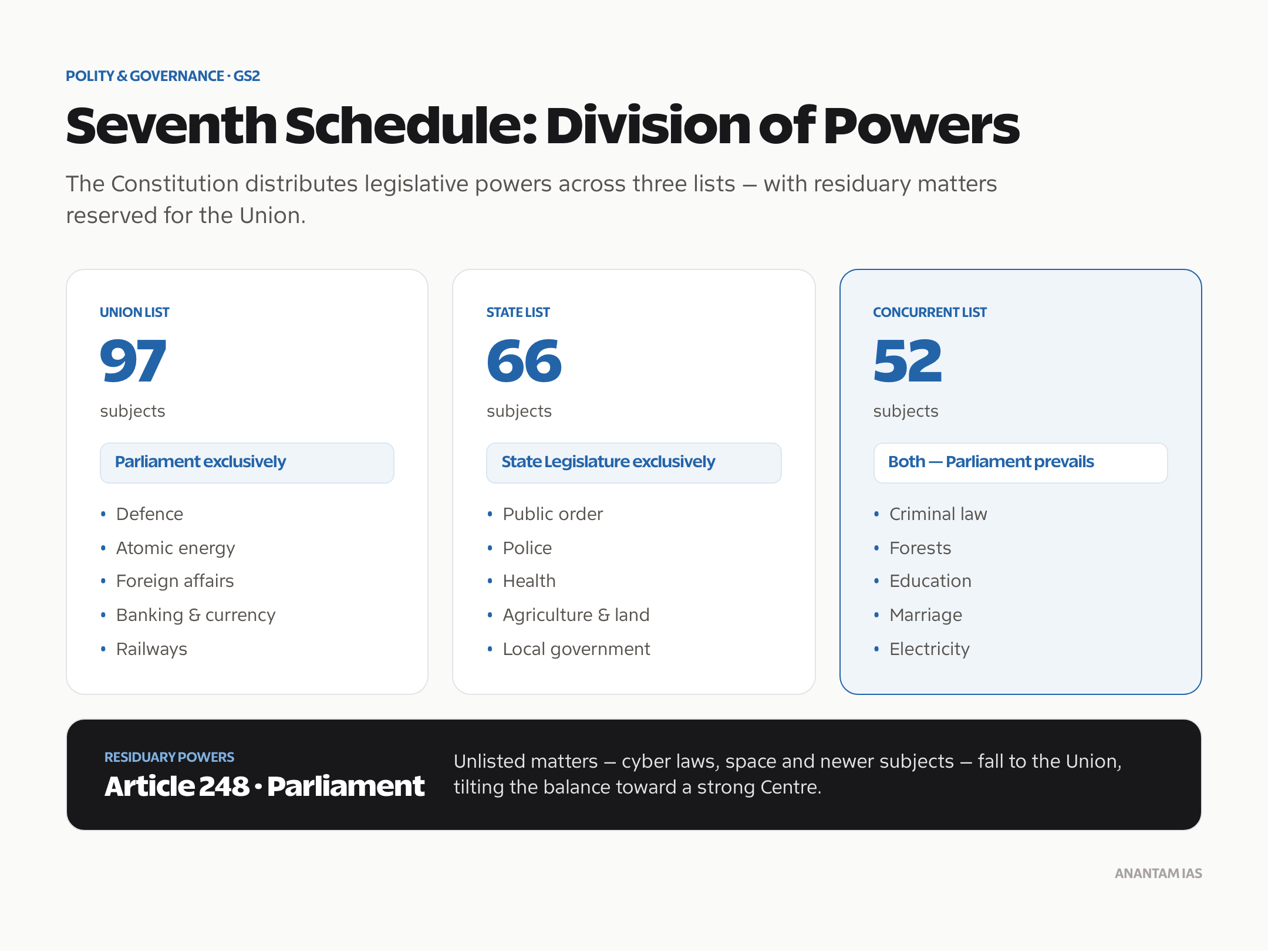
Division of Powers: The Seventh Schedule distributes legislative powers through three lists — Union List (97 subjects), State List (66 subjects), and Concurrent List (52 subjects).
Supremacy of the Constitution: Both the Union and State governments derive their authority from the Constitution. Neither can alter the Constitution unilaterally.
Independent Judiciary: The Supreme Court and High Courts act as guardians of the Constitution and adjudicate disputes between the Union and States.
Bicameral Legislature: The Rajya Sabha represents states at the Union level, reflecting the federal principle.
Unitary Features (Why “Quasi-Federal”)
Single Constitution: Unlike the USA where states have their own constitutions, India has a single Constitution for both the Union and States (except Jammu & Kashmir, which had a separate constitution until 2019).
Strong Centre: Residuary powers lie with the Union. During emergencies, the Centre can override state authority completely. The Governor is appointed by the President and acts as the Centre’s representative.
Single Citizenship: India provides only one citizenship — Indian citizenship. There’s no state citizenship unlike the American system.
Integrated Judiciary: A single judicial system headed by the Supreme Court operates throughout the country.
All-India Services: IAS, IPS, and IFoS officers serve both Union and State governments, creating an integrated bureaucratic structure controlled from the Centre.
Power to Create/Alter States: Parliament can create new states, alter boundaries, and even abolish states by ordinary legislation (Articles 2–4).
Emergency Provisions: During national emergency (Article 352), the federal structure essentially becomes unitary.
Seventh Schedule: Division of Powers
| List | Subjects | Examples | Legislated By |
|---|---|---|---|
| Union List | 97 subjects | Defence, atomic energy, foreign affairs, banking, railways, currency | Parliament exclusively |
| State List | 66 subjects | Public order, police, health, agriculture, land, local government | State Legislature exclusively |
| Concurrent List | 52 subjects | Criminal law, forests, education, marriage, trade unions, electricity | Both Parliament and State (Parliament prevails in case of conflict) |
| Residuary Powers | Unlisted matters | Cyber laws, space, newer subjects | Parliament (Article 248) |
When Can Parliament Legislate on State Subjects?
Parliament can enter the State List domain under five circumstances:
- Rajya Sabha Resolution (Article 249): Two-thirds majority resolution that a subject is of national interest — valid for one year, extendable
- National Emergency (Article 250): Parliament can legislate on any subject during proclaimed emergency
- State Request (Article 252): Two or more state legislatures pass resolutions requesting Parliament
- International Treaties (Article 253): Parliament can legislate to implement treaties and international agreements
- President’s Rule (Article 356): Parliament exercises state legislative powers during the failure of constitutional machinery
Centre-State Relations
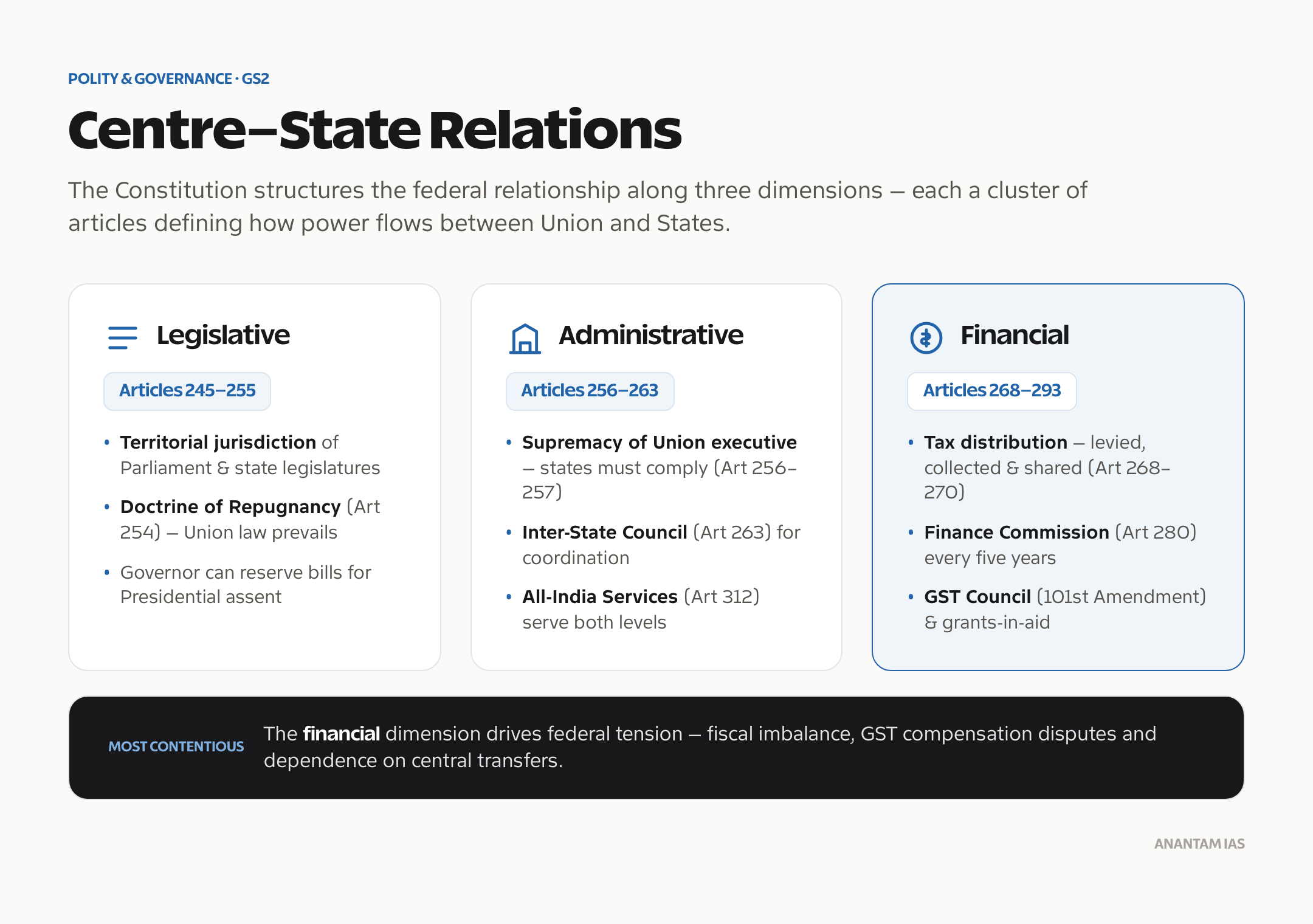
The Constitution addresses Centre-State relations in three dimensions: legislative, administrative, and financial.
Legislative Relations (Articles 245–255)
Territorial Jurisdiction: Parliament can make laws for the whole or any part of India. State legislatures can make laws for the whole or any part of the state. Parliament’s laws can have extra-territorial operation.
Doctrine of Repugnancy (Article 254): If a state law conflicts with a Union law on a Concurrent List subject, the Union law prevails. Exception: If the state law was reserved for and received Presidential assent, it prevails in that state — until Parliament enacts a new law on the subject.
Governor’s Role: The Governor can reserve certain state bills for Presidential consideration, giving the Centre indirect control over state legislation.
Administrative Relations (Articles 256–263)
Supremacy of Union Executive: Article 256 requires states to comply with Union laws and exercise executive power so as not to impede the Union. Article 257 allows the Union to give directions to states.
Inter-State Council (Article 263): The President can establish an Inter-State Council for dispute resolution and coordination.
All-India Services (Article 312): Rajya Sabha can create new All-India Services by two-thirds majority resolution. These services serve both levels of government.
Deployment of Forces: The Centre can deploy central armed forces in states. While the Constitution doesn’t require state consent, the Sarkaria Commission recommended prior consultation.
Financial Relations (Articles 268–293)
The financial relationship is the most contentious aspect of Indian federalism. The Constitution provides for:
Tax Distribution:
- Taxes levied and collected by the Centre but assigned to states (e.g., stamp duties — Article 268)
- Taxes levied by the Centre but collected and retained by states (repealed after GST)
- Taxes levied and collected by the Centre but shared with states (Article 270 — income tax)
- Surcharges on certain taxes (entirely retained by Centre)
GST Framework (101st Amendment): The Goods and Services Tax created a unified indirect tax system. The GST Council — comprising the Union Finance Minister and state finance ministers — decides tax rates, exemptions, and compensation.
Finance Commission (Article 280): Constituted every five years to recommend the distribution of tax revenues between the Centre and States. The 16th Finance Commission was constituted in 2023 under Dr. Arvind Panagariya.
Grants-in-Aid (Articles 275–276): The Centre provides statutory grants (recommended by Finance Commission) and discretionary grants to states.
Comparison: Indian Federalism vs Other Federal Systems
| Feature | India | USA | Canada | Australia |
|---|---|---|---|---|
| Type | Quasi-federal / Union of States | Classical federation | Quasi-federal | Federation |
| Residuary Power | Union (Parliament) | States | Centre (federal) | States |
| State Constitutions | No (single constitution) | Yes (each state) | No | Yes (each state) |
| Citizenship | Single | Dual (state + federal) | Single | Single |
| Emergency provisions | Yes (Centre takes over) | No | Limited | No |
| Upper House | Unequal representation | Equal (2 per state) | Appointed | Equal (12 per state) |
| Secession | Not permitted | Not permitted | Not permitted | Not permitted |
Cooperative and Competitive Federalism
Cooperative Federalism
The post-2014 governance framework emphasises cooperative federalism — the Centre and States working together as partners rather than in a hierarchical relationship.
Key mechanisms include:
- NITI Aayog: Replaced the Planning Commission in 2015. The Governing Council includes all Chief Ministers and Lieutenant Governors
- GST Council: A constitutional body where Centre and States jointly decide tax policy
- Inter-State Council: Forum for resolving disputes and discussing common interests
Competitive Federalism
States compete to attract investment, improve governance indicators, and implement reforms. Rankings like the Ease of Doing Business Index (DPIIT), Sustainable Development Goals Index (NITI Aayog), and Health Index encourage healthy competition.
Key Commissions on Centre-State Relations
Sarkaria Commission (1983–1988): Headed by Justice R.S. Sarkaria. Made 247 recommendations including regular ISC meetings, sparing use of Article 356, consultation before deploying central forces, and strengthening the Concurrent List mechanism.
Punchhi Commission (2007–2010): Headed by Justice M.M. Punchhi. Recommended localising emergency provisions, restricting the Governor’s discretionary powers, ensuring treaty-making considers state interests, and establishing a permanent Inter-State Trade Commission.
Challenges to Indian Federalism
Fiscal Imbalance: States depend heavily on central transfers. Own tax revenues cover only a fraction of state expenditure. The abolition of the Planning Commission reduced an important channel of central grants.
Governor Controversy: Governors acting as Centre’s agents rather than constitutional heads creates friction. Instances of delayed assent to state bills and partisan behaviour during government formation damage federal trust.
Article 356 Misuse: President’s Rule has been imposed over 130 times. The S.R. Bommai judgment (1994) made it subject to judicial review but hasn’t eliminated political misuse entirely.
Centralisation Trends: One Nation One Election proposals, centralised schemes with conditions, and Union legislation on subjects traditionally in the state domain raise concerns about over-centralisation.
Inter-State Council Indian Constitution Finance Commission NITI Aayog
Frequently Asked Questions
Is India a federal or unitary state?
India is best described as u0022quasi-federalu0022 — a federal state with strong unitary features. The Constitution creates two levels of government with divided powers, an independent judiciary, and a written constitution (federal features). But single citizenship, integrated judiciary, emergency provisions, and the Centre’s power to alter state boundaries give it a unitary tilt. The Supreme Court in S.R. Bommai called it u0022federal in structure.u0022
What are the three lists in the Seventh Schedule?
The Seventh Schedule contains three lists dividing legislative powers: the Union List (97 subjects like defence, foreign affairs, banking — Parliament legislates exclusively), the State List (66 subjects like police, health, agriculture — State legislatures legislate), and the Concurrent List (52 subjects like criminal law, education, forests — both can legislate, but Parliament prevails in case of conflict).
What is cooperative federalism in India?
Cooperative federalism means the Centre and States work together as equal partners rather than in a top-down hierarchy. Key institutions include NITI Aayog (policy formulation with state participation), the GST Council (joint tax decisions), and the Inter-State Council (dispute resolution). The concept gained prominence after 2014 with the abolition of the Planning Commission.
How does the Finance Commission affect centre-state relations?
The Finance Commission, constituted every five years under Article 280, recommends how tax revenues should be shared between the Centre and States. It determines vertical devolution (Centre’s share vs States’ share) and horizontal devolution (distribution among states). Its recommendations significantly impact state finances and fiscal federalism. The 15th Finance Commission recommended 41% devolution to states.
Tell Google you want more of this.
Add Anantam IAS as a preferred sourceOne tap, and this site shows up more often in your own Top Stories, AI Overviews and AI Mode. Remove it any time.