PLFS July 2026: Labour Force Participation Rises as Unemployment Eases
Why in News?
The Ministry of Statistics and Programme Implementation released the Periodic Labour Force Survey monthly bulletin for July 2026 on 17 August 2026.
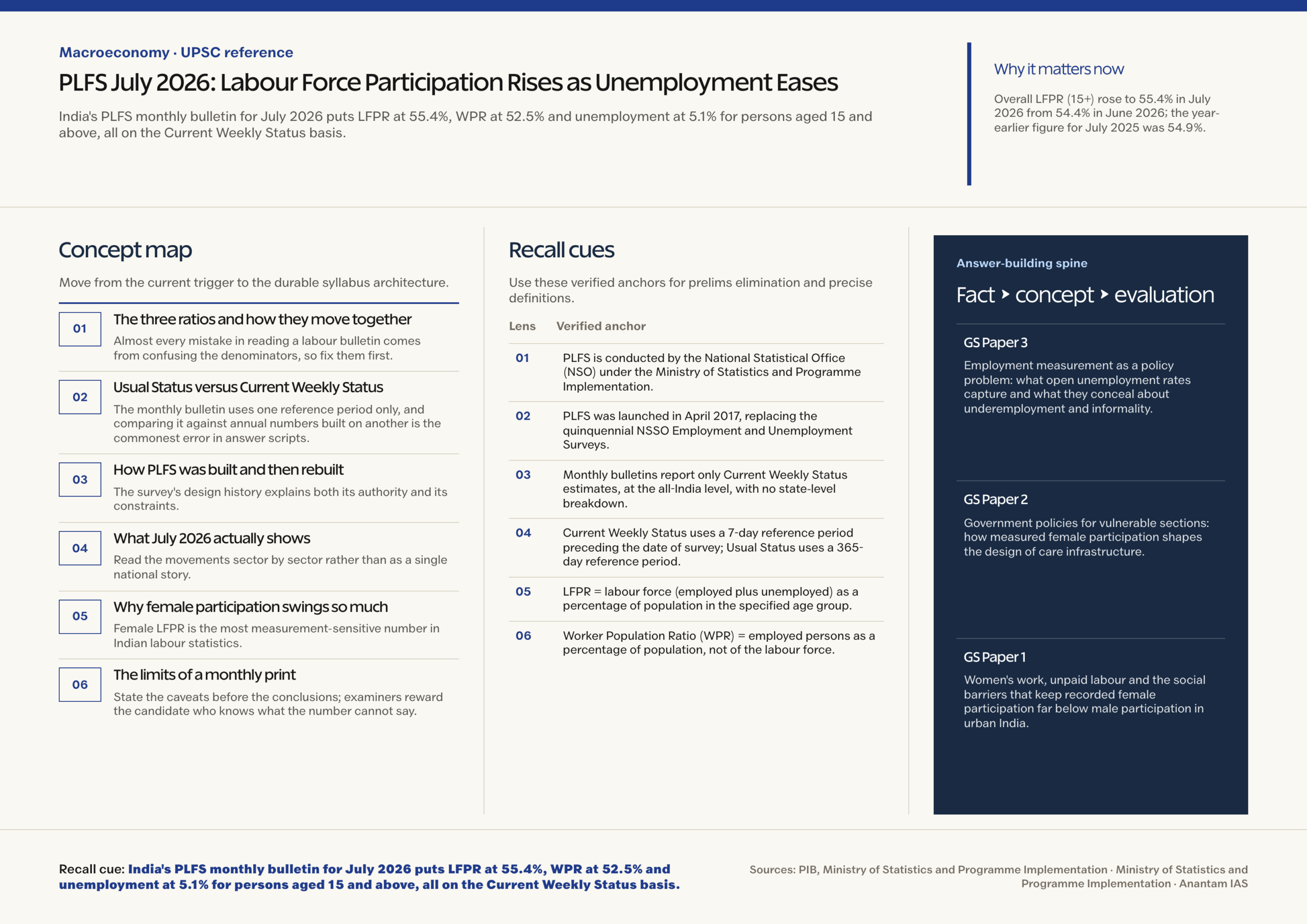
- Overall LFPR for persons aged 15+ rose to 55.4% in July 2026 from 54.4% in June, on Current Weekly Status.
- Worker Population Ratio rose to 52.5% and the Unemployment Rate eased to 5.1% over the same month.
- Monthly PLFS prints are all-India only. They cannot be used to rank states.
- The gain is a one-month reading, not a trend, and the bulletin is not seasonally adjusted.
- PLFS is India’s official employment series, so its definitions decide what counts as a job.
- A falling unemployment rate with rising participation is not a paradox once the three ratios are clear.
- Female participation is the volatile part of the headline, especially in a monsoon month.
UPSC Relevance
Prelims Relevance
- PLFS is conducted by the National Statistical Office under MoSPI.
- It was launched in April 2017, replacing quinquennial NSSO employment surveys.
- Monthly bulletins report only Current Weekly Status, at the all-India level.
- CWS uses a 7-day reference period; Usual Status uses 365 days.
- LFPR is labour force as a share of population; UR is unemployed as a share of the labour force.
- WPR = LFPR × (1 − UR) by construction.
Mains Relevance
GS Paper 3
- What an open unemployment rate captures, and what it conceals about underemployment and informality.
- Why a high-frequency labour print is infrastructure, not a victory headline.
GS Paper 1
- Women’s work, unpaid family labour, and why recorded urban female participation stays far below the male rate.
Essay
- What we count decides what we value: statistics as public purpose.
Background and Context
The three ratios and how they move together
Almost every mistake comes from mixing the denominators of LFPR, WPR and unemployment.
- The labour force is the employed plus the unemployed who were seeking or available for work.
- LFPR divides that labour force by the age-group population.
- WPR divides only the employed by the same population.
- UR divides the unemployed by the labour force, so its denominator moves with participation.
- The identity WPR = LFPR × (1 − UR) is why the July pair is internally consistent.
Usual Status versus Current Weekly Status
The monthly bulletin uses one reference period only. Do not mix it with annual usual-status rates.
- Current Weekly Status classifies a person by the seven days before the survey, treating even an hour of work as employment.
- Usual Status uses 365 days, with a majority-time rule for principal status.
- A week catches short spells of joblessness that a year averages away, so CWS unemployment is usually higher.
- Monthly PLFS bulletins publish CWS only. Annual reports publish both. They are not one series.
- State the status basis and age group in the same sentence as the number.
What a July print cannot say
State the caveats before the conclusions. Examiners reward knowing what the number cannot do.
- There is no seasonal adjustment, so a monsoon rise in rural work is not a structural turn.
- The unemployment rate measures open unemployment. It is silent on underemployment and job quality.
- Rising rural self-employment can be distress absorption. The headline ratios cannot tell the two apart.
- The monthly bulletin reports no earnings, so it says nothing about real wages.
- For the previous month’s reading, see our note on the June 2026 PLFS bulletin.
Why the rural monsoon move is easy to over-read
Most of a July improvement can be farm work that a seven-day window is built to catch.
- Rural women often enter the count as unpaid family helpers on household farms.
- Transplanting weeks pull that work into the reference week, then the next month can drop it.
- Urban female participation is less seasonal and much lower, so the national swing is usually rural.
- None of that is a reason to ignore the print. It is a reason not to call it structural.
- The safe sentence is: participation rose on CWS in a monsoon month, mainly where farm work is seasonal.
Way Forward
Read the architecture, not the print
- Publish confidence intervals with monthly ratios so users can tell signal from noise.
- Keep CWS and Usual Status on separate lines in every answer and briefing.
- Pair participation data with earnings and time-use before claiming a labour-market recovery.
- Treat one monsoon month as a reading, then wait for the next two prints.
Conclusion
- July 2026 is a better month on the official CWS print: participation up, unemployment down.
- The exam-durable takeaway is the architecture: the three ratios, the two status bases, and what a monthly bulletin cannot measure.
UPSC Practice Questions
Prelims MCQ 1
With reference to the Periodic Labour Force Survey (PLFS) monthly bulletin, consider the following statements:
- Monthly bulletins publish Current Weekly Status estimates at the all-India level.
- Current Weekly Status uses a 365-day reference period.
- The Unemployment Rate is unemployed persons as a percentage of the labour force, not of the population.
How many of the above statements are correct?
(a) Only one (b) Only two (c) All three (d) None
Answer: (b) Only two
Explanation:
Statements 1 and 3 are correct. CWS uses a 7-day reference period, not 365 days, so statement 2 is wrong.
Prelims MCQ 2
In official Indian labour statistics, Worker Population Ratio is best described as:
(a) Employed persons as a percentage of the labour force (b) Employed persons as a percentage of the population in the specified age group (c) Unemployed persons as a percentage of the labour force (d) Labour force as a percentage of the working-age population only in urban areas
Answer: (b) Employed persons as a percentage of the population in the specified age group
Explanation:
WPR uses population as the denominator. Unemployed as a share of the labour force is the unemployment rate.
UPSC Mains Questions
- A falling unemployment rate alongside a rising labour force participation rate is often misread as a contradiction. Explain why it is not, using the official Indian definitions. (150 words)
- Monthly PLFS bulletins have improved the frequency of Indian labour data. Examine what they still cannot tell a policymaker. (250 words)
Sources: PIB, Ministry of Statistics and Programme Implementation and Ministry of Statistics and Programme Implementation (MoSPI).
Frequently Asked Questions
What is the headline PLFS July 2026 set?
For persons aged 15 and above on Current Weekly Status, LFPR is 55.4%, WPR is 52.5% and the unemployment rate is 5.1%. Always state the age group and the status basis with the number.
Who conducts PLFS?
The National Statistical Office under the Ministry of Statistics and Programme Implementation. The survey began in April 2017 and replaced the older quinquennial NSSO employment surveys.
Why can monthly PLFS figures not be compared with annual usual-status rates?
Monthly bulletins use Current Weekly Status and a seven-day window. Annual reports also publish Usual Status on a 365-day rule. Mixing the two is a category error.
Does a one-month rise in LFPR mean the labour market has turned?
No. The series is not seasonally adjusted, is all-India only, and says nothing about wages or job quality. One monsoon month is a reading, not a trend.