PM Jan Dhan Account

Why in news:
Under PM Jan Dhan yojana 23% accounts are inoperative.
UPSC Relevance:
UPSC has been continuously asking questions based on various Govt. scheme in news. for example-
PYQ 2014:
Consider the following pairs:
| Programme/Project: | Ministry |
| 1. Drought-Prone Area Programme | Ministry of Agriculture |
| 2. Desert Development Programme | Ministry of Environment and Forests |
| 3. National Watershed Project Development for Rainfed Areas | Ministry of Rural Development |
Which of the above pairs is/are correctly matched?
(a) 1 and 2 only
(b) 3 only
(c) 1, 2 and 3
(d) None
PYQ 2015:
Q.‘Pradhan Mantri Jan-Dhan Yojana’ has been launched for
(a) providing housing loan to poor people at cheaper interest rates
(b) promoting women’s Self-Help Groups in backward areas
(c) promoting financial inclusion in the country
(d) providing financial help to the marginalised communities
UPSC Mains PYQ 2016:
Q. Pradhan Mantri Jan-Dhan Yojana (PMJDY) is necessary for bringing unbanked to the institutional finance fold. Do you agree with this for financial inclusion of the poorer section of the Indian society? Give arguments to justify your option. (150 words, 10 marks)
About PM Jan Dhan Yojana:
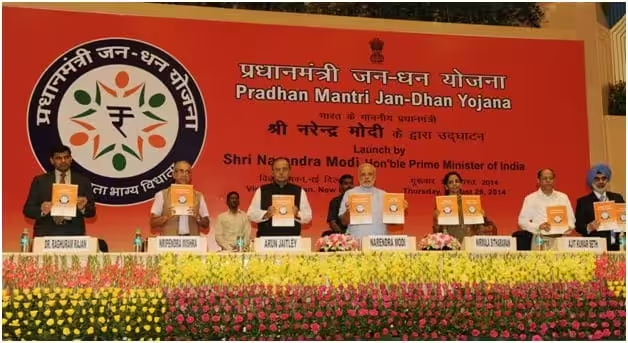
- Pradhan Mantri Jan Dhan Yojana (PMJDY) was announced by Prime Minister, Shri Narendra Modi on 15th August 2014 from the ramparts of the Red Fort and launched by him on 28th August 2014 across the country.
- Pradhan Mantri Jan-Dhan Yojana (PMJDY) is National Mission for Financial Inclusion to ensure access to financial services, namely, a basic savings & deposit accounts, remittance, credit, insurance, pension in an affordable manner.
- Under the scheme, a basic savings bank deposit (BSBD) account can be opened in any bank branch or Business Correspondent (Bank Mitra) outlet, by persons not having any other account.
- . The Mission also envisages extension of Direct Benefit Transfer (DBT) under various Government Schemes through bank accounts of the recipients
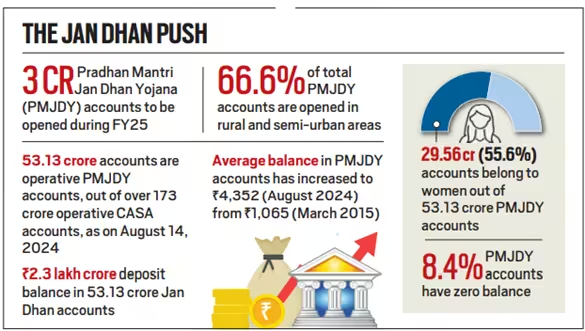
Achievements:
Eligibility:
- The applicant should be an Indian National.
- The applicant should be aged between 18 and 59 years.
- If minors above ten years apply, they will require support from their legal guardians to administer their PMJDY account.
Benefits under PMJDY:
- One basic savings bank account is opened for unbanked person.
- There is no requirement to maintain any minimum balance in PMJDY accounts.
- Interest is earned on the deposit in PMJDY accounts.
- Rupay Debit card is provided to PMJDY account holder.
- Accident Insurance Cover of Rs.1 lakh (enhanced to Rs. 2 lakh to new PMJDY accounts opened after 28.8.2018) is available with RuPay card issued to the PMJDY account holders.
- An overdraft (OD) facility up to Rs. 10,000 to eligible account holders is available.
- PMJDY accounts are eligible for Direct Benefit Transfer (DBT), Pradhan Mantri Jeevan Jyoti Bima Yojana (PMJJBY), Pradhan Mantri Suraksha Bima Yojana (PMSBY), Atal Pension Yojana (APY), Micro Units Development & Refinance Agency Bank (MUDRA) scheme.
Challenges:
- Many cases have been detected that, where an individual has opened more than one account in various banks.
- Budgetary provisions has not been made by the government to provide incentives, otherwise the financial status of the banks may be ruined.
- Insurance companies have to fix a nominal premium to cover the risk of the account holders in case it is not done the state owned LIC may batter with financial losses.
- Overdraft facility needs to be properly regulated, as the same is the discretionary of the concerned banks.
- Many banks may decline to extend the overdraft facility therefore defeating the purpose.
- Bank correspondence i.e. bank mitra is the idea before the finance ministry whereas creating infrastructure mitra for business mitra, including computers, micro ATM biometric scanners, and internet connectivity may be a major concern.
- Private Banks levy hidden charges on the beneficiary which may become a deterrent for the financial inclusion.
Financial Inclusion:
According to world bank:- Financial inclusion means that individuals and businesses have access to and use affordable financial products and services that meet their needs.