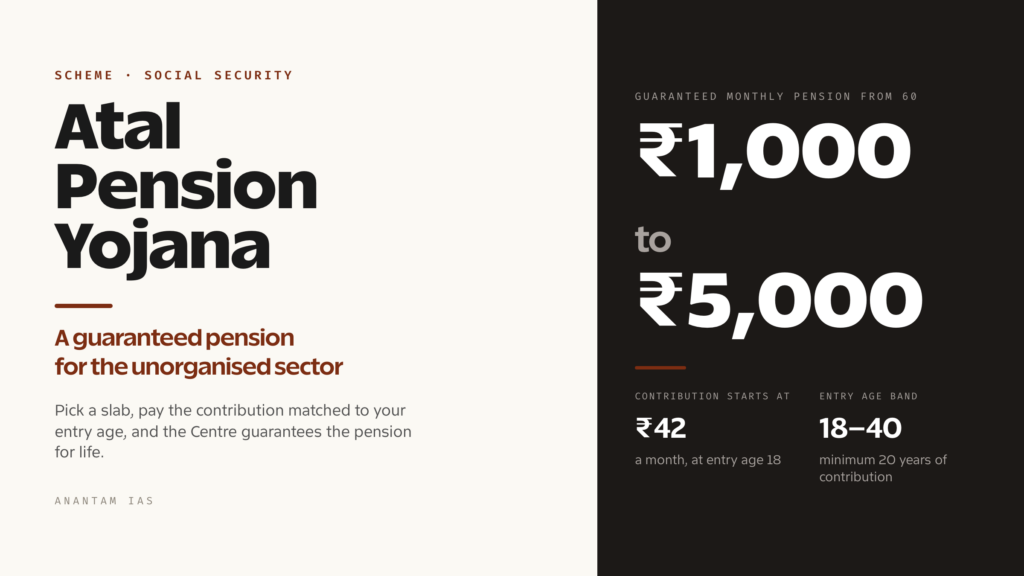
Most working Indians have no pension. A shop assistant, a delivery rider, a tailor, a farm labourer, a domestic worker — none of them accrues a retirement benefit from an employer, and none is covered by the Employees’ Provident Fund. Atal Pension Yojana exists for exactly that gap. You put in a small fixed amount every month from your bank account, and from the month you turn 60 the government guarantees you a defined pension for life.
The guarantee is the point. This is not a mutual fund whose value depends on how markets behaved during your working life. You pick a pension slab between ₹1,000 and ₹5,000 a month, you pay the contribution matched to your entry age, and that pension is what you get. If investment returns fall short, the shortfall is met by the Centre. The scheme is regulated by the Pension Fund Regulatory and Development Authority and administered under the National Pension System architecture, with your bank or post office as the point of contact.
What Atal Pension Yojana Is and Who It Is Built For
APY was launched on 9 May 2015 and replaced the earlier Swavalamban Yojana, whose subscribers in the 18-40 age band were migrated across. The target group has always been the unorganised sector — the roughly nine in ten Indian workers who have no formal retirement cover.
The mechanics are unglamorous by design. You open an APY account through your savings bank or post office savings account. A standing instruction auto-debits the contribution monthly, quarterly or half-yearly. The money is invested under PFRDA-prescribed patterns, and at 60 the accumulated corpus is used to pay you the guaranteed pension. You do not choose fund managers, asset allocation or an annuity provider. That simplicity is what lets the scheme run at scale in bank branches with no financial-advice conversation attached.
In January 2026 the Union Cabinet approved the continuation of APY up to FY 2030-31, along with funding support for promotional activity and gap funding to keep the guarantee credible. That decision settles the question of whether the scheme survives; it does not change the pension slabs.
What the Scheme Offers
APY pays a guaranteed minimum monthly pension from age 60. There are five slabs, and you choose one at the time of joining.
| You choose | Guaranteed monthly pension from 60 | Corpus returned to the nominee |
|---|---|---|
| Slab 1 | ₹1,000 | ₹1.7 lakh |
| Slab 2 | ₹2,000 | ₹3.4 lakh |
| Slab 3 | ₹3,000 | ₹5.1 lakh |
| Slab 4 | ₹4,000 | ₹6.8 lakh |
| Slab 5 | ₹5,000 | ₹8.5 lakh |
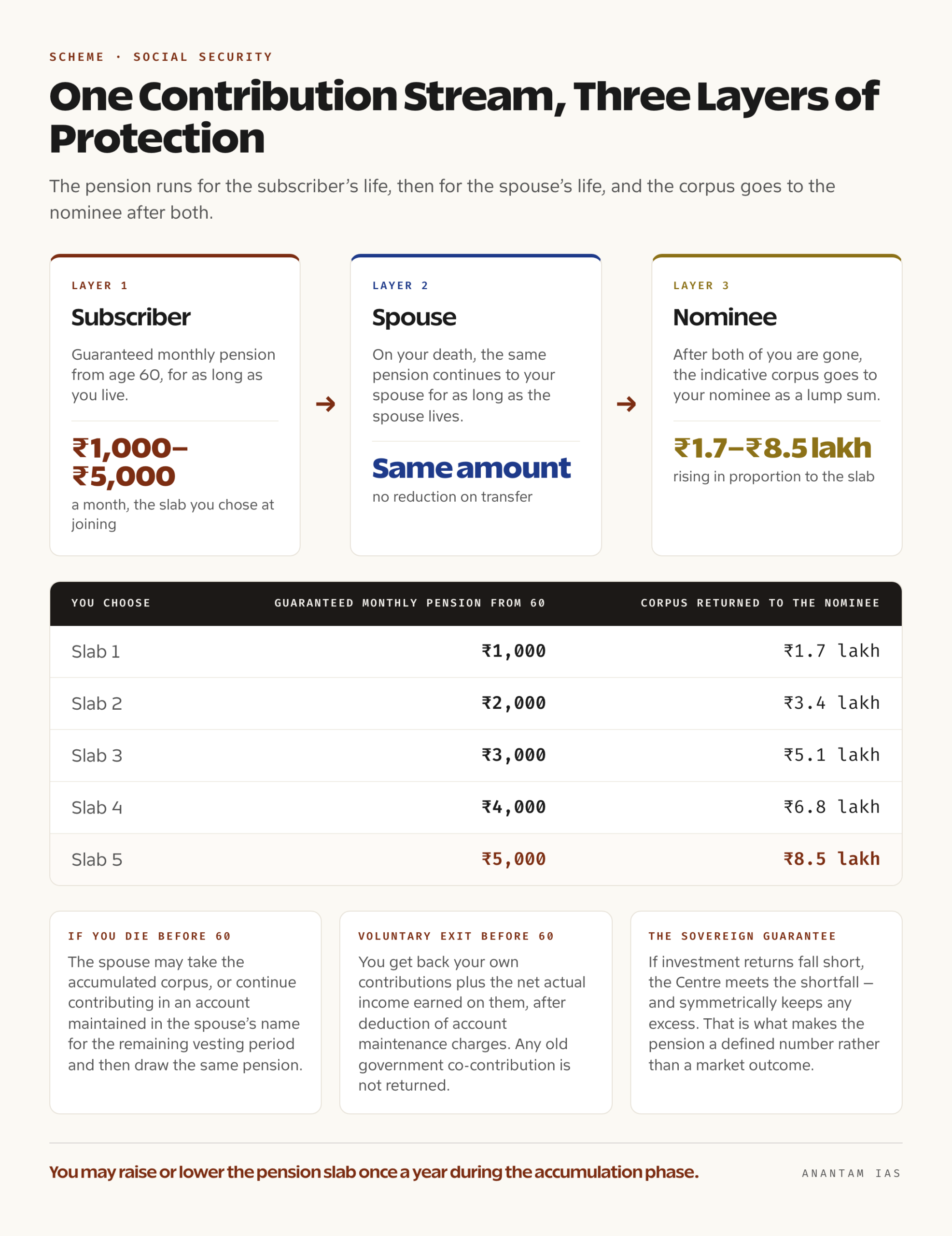
Three benefits sit inside that single number. You get the pension for as long as you live. On your death, the same pension continues to your spouse for as long as the spouse lives. After both of you are gone, the indicative corpus in the third column goes to your nominee as a lump sum. One contribution stream, three layers of protection.
The other benefit is the sovereign guarantee. The Centre commits to making good any shortfall between what the fund earns and what the scheme promises — and, symmetrically, keeps any excess. For a low-income saver who cannot absorb market risk, that trade is usually worth making.
Tax treatment follows the National Pension System. Contributions qualify for deduction under Section 80CCD(1) within the overall Section 80C ceiling, with the additional deduction of up to ₹50,000 under Section 80CCD(1B) available to those who claim it. These deductions are available under the old tax regime, which matters less than it once did, because income-tax payers can no longer join the scheme at all.
Who Is Eligible
| Criterion | Requirement |
|---|---|
| Age at joining | 18 to 40 years completed |
| Citizenship | Indian citizen |
| Bank account | Active savings account or post office savings account |
| KYC | Aadhaar and mobile number, completed KYC with the bank |
| Income-tax status | Must not be, and must not have been, an income-tax payer |
| Minimum contribution period | 20 years, which is why 40 is the upper age limit |
The income-tax exclusion is the rule people most often get wrong. From 1 October 2022, anyone who is or has been an income-tax payer cannot open a new APY account. If an account is found to have been opened on or after that date by a taxpayer, it is closed and the accumulated pension wealth is returned to the subscriber. Existing accounts opened before that date are not disturbed.
The 20-year floor explains the age band. Contributions run until 60, so joining at 40 leaves exactly twenty years of accumulation. That is also why the same pension costs so much more the later you start.
Nothing bars a person who already has EPF, NPS or an insurance-linked pension from holding APY as well, as long as the income-tax condition is met. A spouse who is not an income-tax payer can hold a separate account, which is a common way for a household to build ₹10,000 a month from two ₹5,000 slabs.
The Contribution Chart and How to Apply
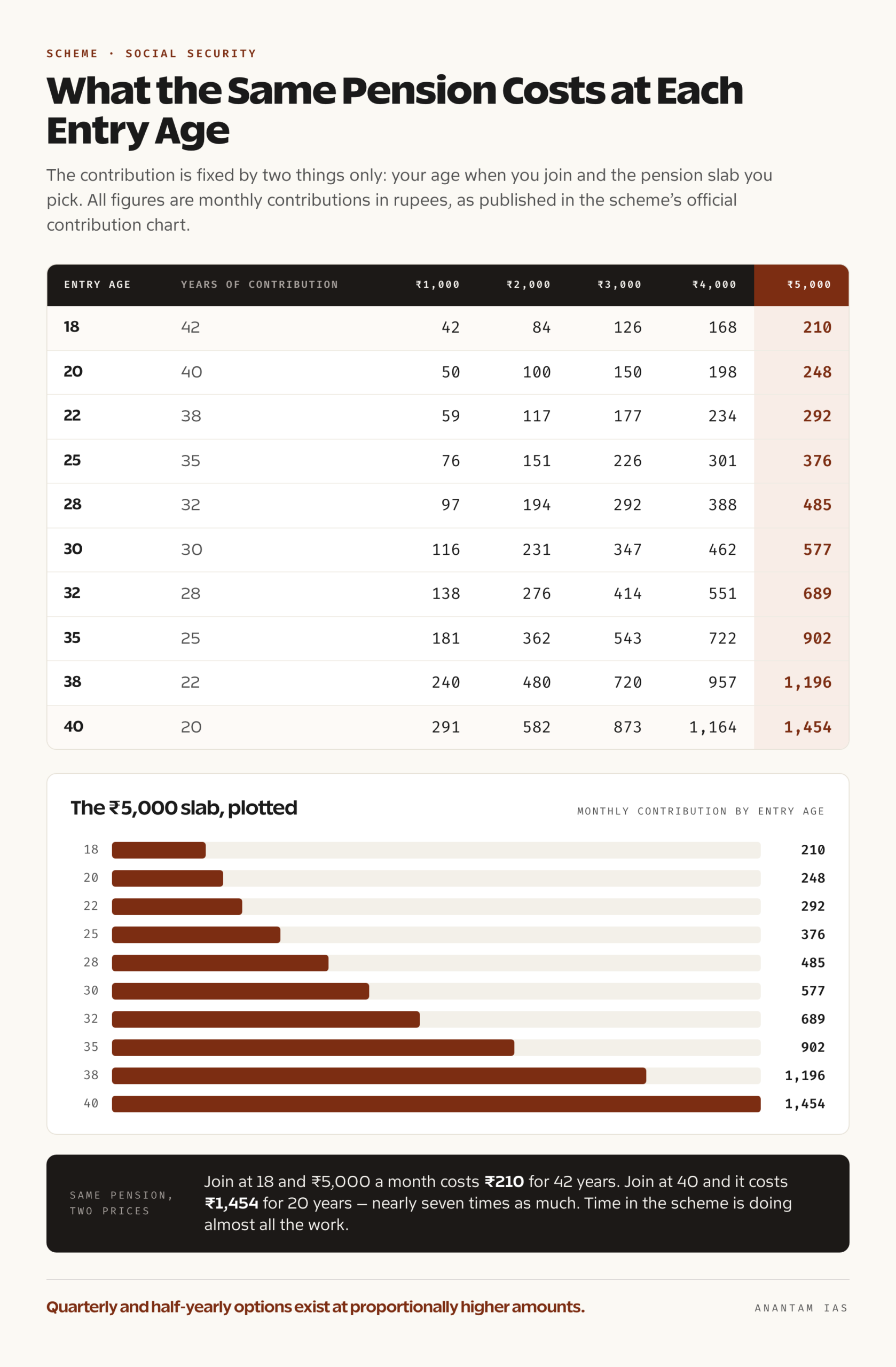
The contribution is fixed by two things only: your age when you join and the pension slab you pick. Below is the monthly contribution for each combination, as published in the scheme’s official contribution chart.
| Entry age | Years of contribution | ₹1,000 | ₹2,000 | ₹3,000 | ₹4,000 | ₹5,000 |
|---|---|---|---|---|---|---|
| 18 | 42 | 42 | 84 | 126 | 168 | 210 |
| 20 | 40 | 50 | 100 | 150 | 198 | 248 |
| 22 | 38 | 59 | 117 | 177 | 234 | 292 |
| 25 | 35 | 76 | 151 | 226 | 301 | 376 |
| 28 | 32 | 97 | 194 | 292 | 388 | 485 |
| 30 | 30 | 116 | 231 | 347 | 462 | 577 |
| 32 | 28 | 138 | 276 | 414 | 551 | 689 |
| 35 | 25 | 181 | 362 | 543 | 722 | 902 |
| 38 | 22 | 240 | 480 | 720 | 957 | 1,196 |
| 40 | 20 | 291 | 582 | 873 | 1,164 | 1,454 |
All figures are monthly contributions in rupees. Quarterly and half-yearly options exist at proportionally higher amounts.
Look at the two ends of the ₹5,000 column. A subscriber who joins at 18 pays ₹210 a month for 42 years. A subscriber who joins at 40 pays ₹1,454 a month for 20 years — nearly seven times as much for the same pension. Time in the scheme is doing almost all the work.
How to open an account
- Approach the bank or post office where you hold your savings account. Every scheduled commercial bank, most regional rural banks and cooperative banks, and India Post offer APY.
- Fill the APY registration form with your Aadhaar number, mobile number, savings account number, chosen pension slab and nominee details. If you are married, spouse details are required by default.
- Give the standing instruction for auto-debit and keep the account funded on the due date.
- Alternatively, use your bank’s net banking or mobile app. Most major banks now carry APY enrolment as a self-service option with Aadhaar-based verification.
- You will be issued a Permanent Retirement Account Number and will get SMS confirmations of contribution credits, plus a physical statement of account once a year.
If you miss a contribution
The account is not closed for a missed payment. Banks recover the arrears whenever the balance allows, along with overdue interest of ₹1 per month for every ₹100 or part of ₹100 of the delayed contribution. That overdue interest is not a fine paid to anyone — it stays in your own pension corpus. Continuous default is the real risk: account maintenance charges keep being deducted, and once the corpus is exhausted the account is closed.
You can also change your pension slab once a year during the accumulation phase, up or down, so a subscriber whose income improves can move from ₹1,000 to ₹3,000 without opening a fresh account.
Exit Rules and Where the Scheme Stands
Exit at 60 is the normal path: you submit a request to the bank and the guaranteed pension begins.
Voluntary exit before 60 is permitted. You get back your own contributions plus the net actual income earned on them, after deduction of account maintenance charges. A subscriber who received the old government co-contribution does not get that portion or the income earned on it back.
On death before 60, the spouse may either take the accumulated corpus or continue contributing in the subscriber’s account, maintained in the spouse’s name, for the remaining vesting period and then draw the same pension. On death after 60, the spouse receives the pension for life, and the nominee receives the corpus after both.
The scale is genuinely large. APY crossed 9 crore gross enrolments in April 2026, with more than 1.35 crore additions in FY 2025-26 — the highest in any year since launch — and assets under management above ₹54,000 crore. Around 45.7 per cent of enrolments in the year came from the 18-25 age group, and women’s participation touched a record 55.14 per cent.
One number complicates the picture: about 86.9 per cent of subscribers sit in the lowest ₹1,000 slab. Reach has been achieved. Adequacy has not.
Challenges and What to Watch
₹1,000 a month is not a pension anyone can live on. It was a modest amount when the scheme launched in 2015 and inflation has eroded it since. The slabs are nominal and carry no indexation, so a 22-year-old joining today for ₹1,000 will collect that same ₹1,000 in the 2060s. PFRDA has publicly pushed for higher guaranteed slabs; nothing has been notified.
Persistence is the quiet weakness. Overall persistence stood at 50.10 per cent as of 31 March 2026 — roughly half of subscribers keeping contributions current. In a scheme where the pension depends on an unbroken 20-year-plus stream, lapses translate directly into smaller or failed entitlements.
Enrolment quality is uneven. APY is pushed hard through bank branches, with performance targets for banks and state-level bankers’ committees. Targets get results, but they also produce accounts opened with thin explanation, which is one reason so many subscribers default to the lowest slab.
The taxpayer exclusion is blunt. It screens out the affluent, but it also shuts out a self-employed person who files a return in a good year and would benefit from a guaranteed pension in the bad ones.
Watch the gap funding. The sovereign guarantee is what makes APY worth joining, and the Cabinet’s January 2026 approval explicitly extends gap funding to 2030-31. The long-run fiscal cost of that guarantee, as the first cohorts approach 60, is the number to follow.
FAQ
Can I join Atal Pension Yojana if I pay income tax? No. Since 1 October 2022, anyone who is or has been an income-tax payer is barred from opening a new APY account. Accounts opened in breach of this are closed and the accumulated amount returned. Accounts opened before that date continue normally.
What is the minimum contribution I can start with? ₹42 a month, which is what an 18-year-old pays for the ₹1,000 pension slab. The amount rises steeply with entry age — the same slab costs ₹291 a month if you join at 40.
What happens if my bank account does not have enough balance on the due date? The contribution is treated as delayed and recovered later along with overdue interest of ₹1 per month for every ₹100 of the contribution. Your account is not shut for a single miss, but sustained default eventually erodes the corpus and closes the account.
Can I increase my pension amount after joining? Yes. You may raise or lower the pension slab once a year during the accumulation phase, with the contribution adjusted accordingly.
What does my family get if I die? Your spouse receives the same monthly pension for life. After the spouse’s death, the nominee receives the accumulated corpus — ₹1.7 lakh for the ₹1,000 slab, rising to ₹8.5 lakh for the ₹5,000 slab.
Practice Questions
Prelims MCQs
- Atal Pension Yojana is regulated by which of the following bodies? (a) Reserve Bank of India (b) Insurance Regulatory and Development Authority of India (c) Pension Fund Regulatory and Development Authority (d) Securities and Exchange Board of India — Answer: (c) APY is administered by PFRDA under the National Pension System architecture.
- What is the age band for joining APY? (a) 18 to 35 years (b) 18 to 40 years (c) 21 to 45 years (d) 21 to 50 years — Answer: (b) The upper limit of 40 follows from the minimum contribution period of 20 years up to age 60.
- Which scheme was replaced by Atal Pension Yojana? (a) Swavalamban Yojana (b) Jeevan Jyoti Bima Yojana (c) Varishtha Pension Bima Yojana (d) Employees’ Pension Scheme — Answer: (a) Swavalamban subscribers aged 18 to 40 were migrated to APY on its launch in 2015.
- Under APY, the corpus returned to the nominee for the ₹5,000 pension slab is approximately: (a) ₹1.7 lakh (b) ₹3.4 lakh (c) ₹5.1 lakh (d) ₹8.5 lakh — Answer: (d) The indicative corpus rises in proportion to the slab, from ₹1.7 lakh for ₹1,000 to ₹8.5 lakh for ₹5,000.
- Since 1 October 2022, which category of person cannot open a new APY account? (a) Non-resident Indians (b) Income-tax payers (c) Government employees (d) Members of the Employees’ Provident Fund — Answer: (b) Anyone who is or has been an income-tax payer is excluded from fresh enrolment.
Mains Practice Questions
- Examine the role of contributory, guaranteed-return pension schemes in extending social security to India’s unorganised sector. What are their fiscal implications? (15 marks, 250 words)
- “Coverage without adequacy is an incomplete achievement.” Critically evaluate this statement in the context of India’s pension architecture for low-income workers. (15 marks, 250 words)
- Compare defined-benefit and defined-contribution approaches to old-age income security, and assess which is better suited to workers with irregular earnings. (15 marks, 250 words)
- Discuss how demographic transition and rising life expectancy will shape India’s old-age social security requirements over the coming decades. (10 marks, 150 words)
- Evaluate the use of the banking network as the primary delivery channel for social security schemes. What are the advantages and the risks of target-driven enrolment? (15 marks, 250 words)
Tell Google you want more of this.
Add Anantam IAS as a preferred sourceOne tap, and this site shows up more often in your own Top Stories, AI Overviews and AI Mode. Remove it any time.