PM-KISAN Extension: Five More Years of Farm Income Support
Why in News?
The Union Cabinet has approved continuation of the Pradhan Mantri Kisan Samman Nidhi (PM-KISAN) for five financial years, from 2026-27 to 2030-31 .
- The continuation covers five years, from FY 2026-27 through FY 2030-31.
- The Cabinet-approved financial envelope is ₹3.15 lakh crore, an arithmetic average of about ₹63,000 crore a year across the approved period.
- The official statement said over ₹4.47 lakh crore had already reached farmer bank accounts through 23 instalments.
- The 23rd instalment transferred ₹18,984 crore to more than 9.49 crore farmers, according to the Cabinet statement reported by The Indian Express.
- The official PM-KISAN portal continues to describe the benefit as ₹6,000 per year in three equal instalments for eligible landholding farmer families.
- The decision matters in the context of farm-income volatility: a predictable cash transfer can help meet seasonal input expenses even when crop prices, rainfall or yields are uncertain.
- It also matters for fiscal policy: a five-year outlay improves budget visibility, but the transfer must be assessed for adequacy, targeting quality and opportunity cost.
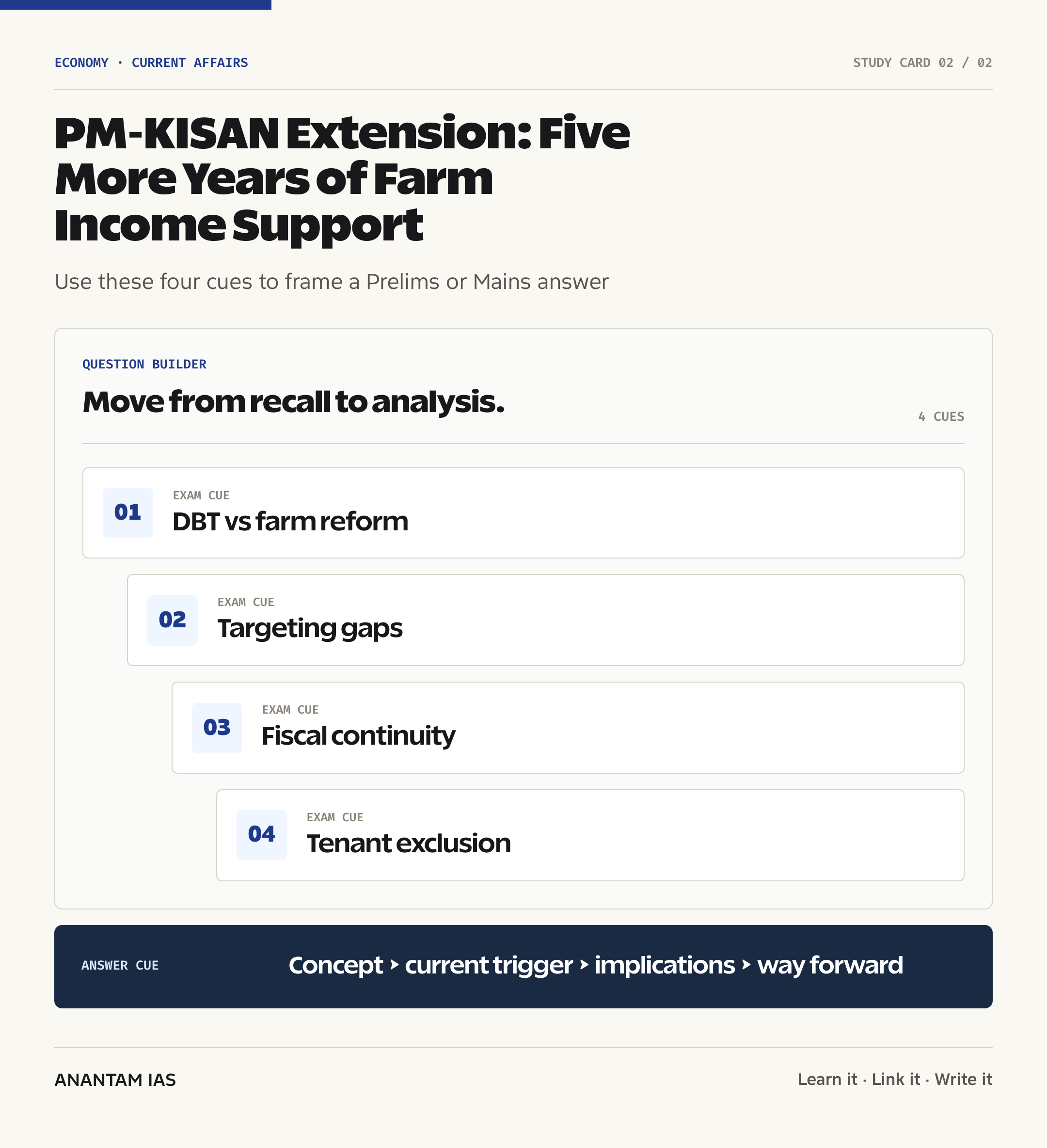
- The extension places renewed attention on land-record-based eligibility, which can exclude tenants, sharecroppers and women cultivators who farm without recorded title.
UPSC Relevance
Prelims Relevance
- PM-KISAN is a Central Sector Scheme with 100% funding by the Union government.
- The scheme became operational from 1 December 2018 and was formally launched on 24 February 2019.
- Eligible landholding farmer families receive ₹6,000 a year in three equal instalments of ₹2,000.
- For the scheme, a farmer family is defined as husband, wife and minor children who collectively own cultivable land as per state or Union Territory records.
- The benefit is transferred directly to bank accounts through DBT; eKYC is mandatory for registered beneficiaries.
- State and Union Territory administrations identify eligible families, verify records and upload beneficiary details, while the Centre finances the benefit.
Mains Relevance
GS Paper 3
- Assess direct income support as an instrument for farm welfare, agricultural investment and reduction of dependence on informal credit.
- Examine whether a flat ₹6,000 annual transfer remains adequate amid rising input costs and regional differences in cultivation expenses.
GS Paper 2
- Analyse Centre-State administrative coordination in a fully centrally funded scheme whose beneficiary identification depends on state land and family records.
- Discuss how digital welfare delivery can reduce leakage while also creating exclusion through faulty land records, Aadhaar mismatches, failed eKYC or bank-account errors.
Essay
- A welfare state must combine predictable support with capabilities that help citizens become less vulnerable.
Background and Context
What PM-KISAN is designed to do
PM-KISAN provides a modest, predictable income supplement rather than compensation linked to a particular crop, loss or market price.
- The scheme is crop-neutral: payment does not depend on what a farmer grows, the area sown in a season or whether produce is sold through a notified market.
- The current benefit is ₹6,000 per year, paid as three ₹2,000 instalments at roughly four-month intervals into the beneficiary’s bank account.
- Because it is a Central Sector Scheme, the Union bears the benefit cost; states and Union Territories perform the critical identification and verification work.
- The transfer is intended to support agricultural inputs and household liquidity, especially before sowing, without the delay and discretion associated with physical distribution.
- A concise scheme overview is available in the site’s PM-KISAN study notes.
How the DBT chain works
The delivery architecture separates beneficiary verification from payment execution while linking both through a digital trail.
- States and Union Territories identify eligible farmer families from land and family records, verify the particulars and upload them to the scheme portal.
- Fund Transfer Orders move through the Public Financial Management System (PFMS) and the banking network so the amount reaches the beneficiary account directly.
- Aadhaar seeding and eKYC help detect duplicates and establish identity, while validated bank details are needed to prevent payment rejection.
- The official operational guidelines assign states responsibility for correcting incomplete bank data and reconciling failed transactions, making local administrative capacity decisive.
- The wider AgriStack architecture can improve record interoperability, but any integration needs consent, correction and grievance safeguards.
Scale and evidence cited with the extension
The Cabinet statement paired the future outlay with cumulative transfer and evaluation data to support continuation.
- More than ₹4.47 lakh crore had been transferred to farmer bank accounts through 23 instalments since the scheme began.
- During the COVID-19 pandemic, the statement said more than ₹1.71 lakh crore was disbursed, showing the value of an existing payment rail during an economy-wide shock.
- Women farmers had received more than ₹1.06 lakh crore, and the statement described nearly one in four beneficiaries as a woman.
- A Development Monitoring and Evaluation Office assessment cited in the statement found that over 92% of beneficiaries reported using assistance for agricultural activities or investment.
- The same assessment said about 85% reported improved agricultural income and lower dependence on informal credit; these are beneficiary-reported outcomes, not a claim that the transfer alone caused every improvement.
Why five-year continuity matters
Policy continuity changes both household expectations and the government’s medium-term budget commitments.
- For farmers, a known payment calendar provides predictable liquidity that can be planned around seed, fertiliser, labour or other seasonal expenses.
- For the Union, a ₹3.15 lakh crore envelope makes the scheme a continuing component of expenditure through 2030-31 rather than a one-year budget choice.
- The arithmetic average of about ₹63,000 crore per year is a planning indicator; actual annual spending will depend on verified beneficiary numbers and payment success.
- A longer horizon also creates a window to improve beneficiary databases, grievance handling and payment reliability instead of treating each instalment as an isolated event.
- But continuation should not freeze the design: periodic evaluation must test adequacy, inclusion, agricultural use and regional variation.
Way Forward
Protect eligible farmers from administrative exclusion
- Create assisted eKYC and bank-correction camps at panchayat level before every instalment cut-off, with special outreach to older farmers and remote villages.
- Give every withheld or failed payment a specific reason code, a simple correction workflow and a time-bound appeal that can be tracked by the farmer.
- Synchronise land mutation, death, inheritance and family records regularly while preserving human review for disputed or exceptional cases.
Conclusion
- The five-year extension makes PM-KISAN a durable part of India’s farm-support architecture through 2030-31 .
- Its next phase should be judged by more than the ₹3.15 lakh crore outlay.
UPSC Practice Questions
Prelims MCQ 1
With reference to PM-KISAN, consider the following statements:
- It is a Central Sector Scheme funded fully by the Union government.
- It provides ₹6,000 per year in three equal instalments to eligible landholding farmer families.
- State and Union Territory administrations identify and verify eligible beneficiary families.
How many of the above statements are correct?
(a) Only one (b) Only two (c) All three (d) None
Answer: (c) All three
Explanation:
All three statements are correct. PM-KISAN is fully funded by the Union, pays ₹6,000 annually in three instalments, and relies on states and Union Territories for beneficiary identification and verification.
Prelims MCQ 2
Which one of the following best describes the main eligibility anchor under PM-KISAN?
(a) Cultivation of a crop notified for Minimum Support Price (b) Ownership of cultivable land recorded by the State or Union Territory (c) Possession of a Kisan Credit Card with an outstanding crop loan (d) Enrolment under the Pradhan Mantri Fasal Bima Yojana
Answer: (b) Ownership of cultivable land recorded by the State or Union Territory
Explanation:
Eligibility is anchored to the landholding farmer family recorded in state or Union Territory land records, subject to exclusions. Crop choice, KCC borrowing and PMFBY enrolment are not the core eligibility tests.
UPSC Mains Questions
- The five-year extension of PM-KISAN provides fiscal continuity but also renews questions about adequacy and inclusion. Examine the scheme’s role in farm-income support, and discuss the reforms needed to cover vulnerable cultivators without weakening accountability.
- Direct Benefit Transfer can reduce leakage while still excluding eligible citizens through weak underlying records. Analyse this tension with reference to PM-KISAN’s land, identity and banking architecture, and suggest a rights-respecting grievance framework.
Sources: PM-KISAN portal, Ministry of Agriculture and Farmers Welfare and The Indian Express.
Frequently Asked Questions
What did the Cabinet approve for PM-KISAN?
The Union Cabinet approved continuation of PM-KISAN for five financial years, from 2026-27 to 2030-31, with a total outlay of ₹3.15 lakh crore. The decision provides a medium-term fiscal framework for continuing direct income support to eligible landholding farmer families.
How much does a PM-KISAN family receive?
The official PM-KISAN portal lists an annual benefit of ₹6,000 for each eligible landholding farmer family. It is paid in three equal instalments of ₹2,000 through Direct Benefit Transfer into the beneficiary’s bank account, subject to verification, eKYC and the.
Is PM-KISAN funded by states?
No. PM-KISAN is a Central Sector Scheme with 100% funding from the Union government. States and Union Territories still perform essential administrative functions: identifying farmer families, validating land and family records, uploading beneficiary data, authorising payment batches and correcting incomplete.
Why can tenant farmers miss PM-KISAN?
PM-KISAN eligibility is linked to ownership of cultivable land in state or Union Territory records. A tenant, oral lessee or sharecropper may actually cultivate and bear production risk while the title remains with somebody else. Without a recognised cultivation record.
What did the cited evaluation find?
The Cabinet statement cited a DMEO, NITI Aayog evaluation in which more than 92% of beneficiaries reported using assistance for agricultural activities or investment. About 85% reported improved agricultural income and lower dependence on informal credit. These are beneficiary-reported findings.