Why in News?
As the Centre prepared to release the 23rd PM-KISAN instalment on 20 June 2026, attention returned to the digital plumbing underneath it: AgriStack, India’s farmer-level Digital Public Infrastructure (DPI) for agriculture, built under the Digital Agriculture Mission approved by the Union Cabinet in September 2024.
AgriStack ties a verified Farmer ID, a geo-referenced land map and a Crop Sown Registry into a single, Aadhaar-linked stack so that scheme benefits flow by data, not by repeated paperwork.
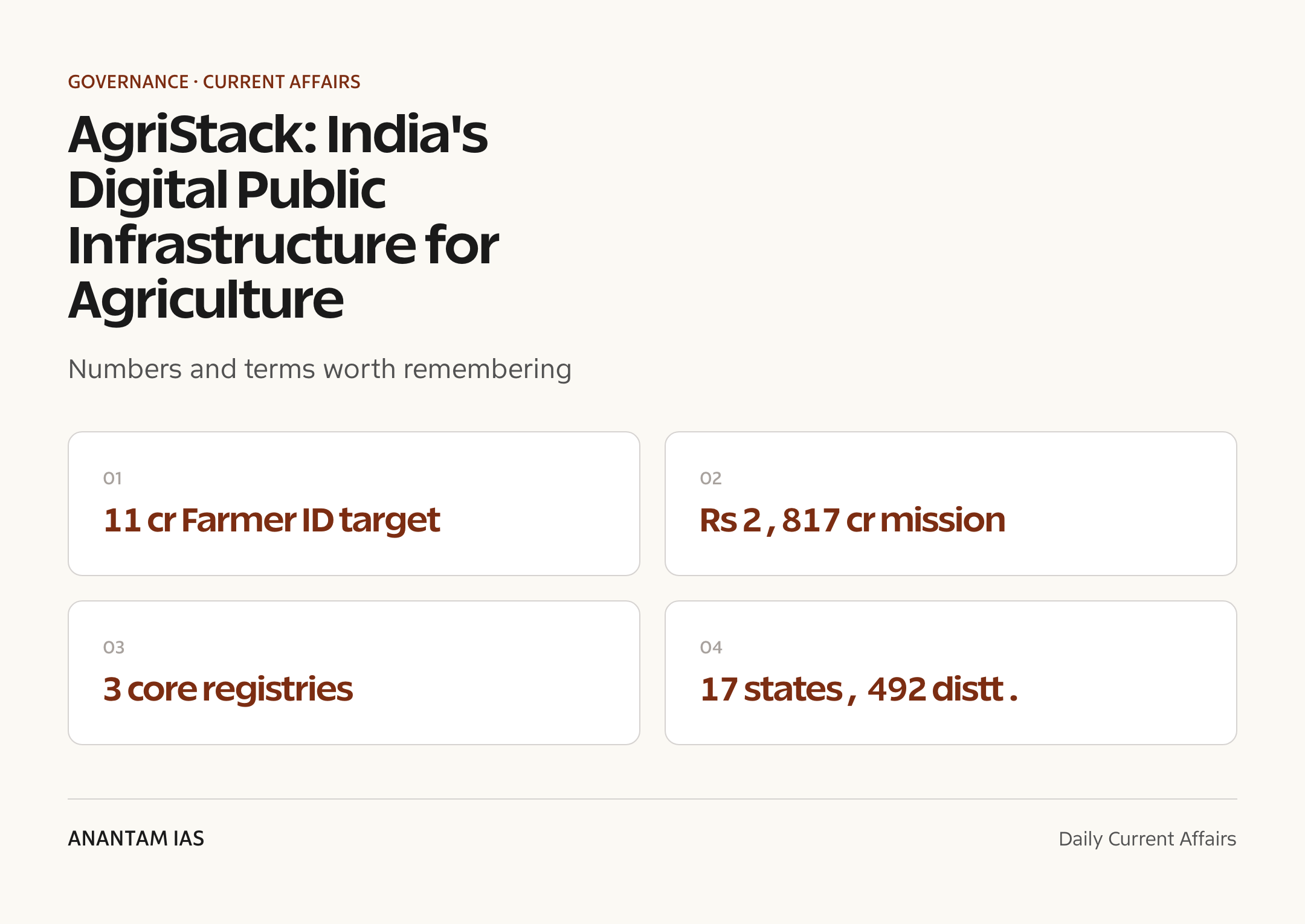
- The Digital Agriculture Mission carries a total outlay of Rs 2,817 crore, including a central share of Rs 1,940 crore.
- AgriStack targets 11 crore Farmer IDs phased as 6 crore in FY 2024-25, 3 crore in FY 2025-26 and 2 crore in FY 2026-27.
- The Digital Crop Survey was piloted across 11 states in 2023-24 and scaled toward 400 districts in FY 2024-25 before nationwide rollout.
- PIB notes that AgriStack’s core registries already span 17 states, around 492 districts and roughly 4.2 lakh villages at plot level.
- DD News reports the 23rd PM-KISAN instalment released about Rs 18,880 crore to nearly 9.44 crore farmers on 20 June 2026.
The development matters in the context of:
- AgriStack converts agriculture from a paperwork-heavy, exclusion-prone system into a data-driven, presence-less, paperless service layer, mirroring the JAM-Aadhaar logic now applied to farms and crops.
- A single verified Farmer ID becomes the entry point for PM-KISAN, Kisan Credit Card (KCC), PM Fasal Bima Yojana, MSP procurement and fertiliser subsidy, reducing duplication and leakage.
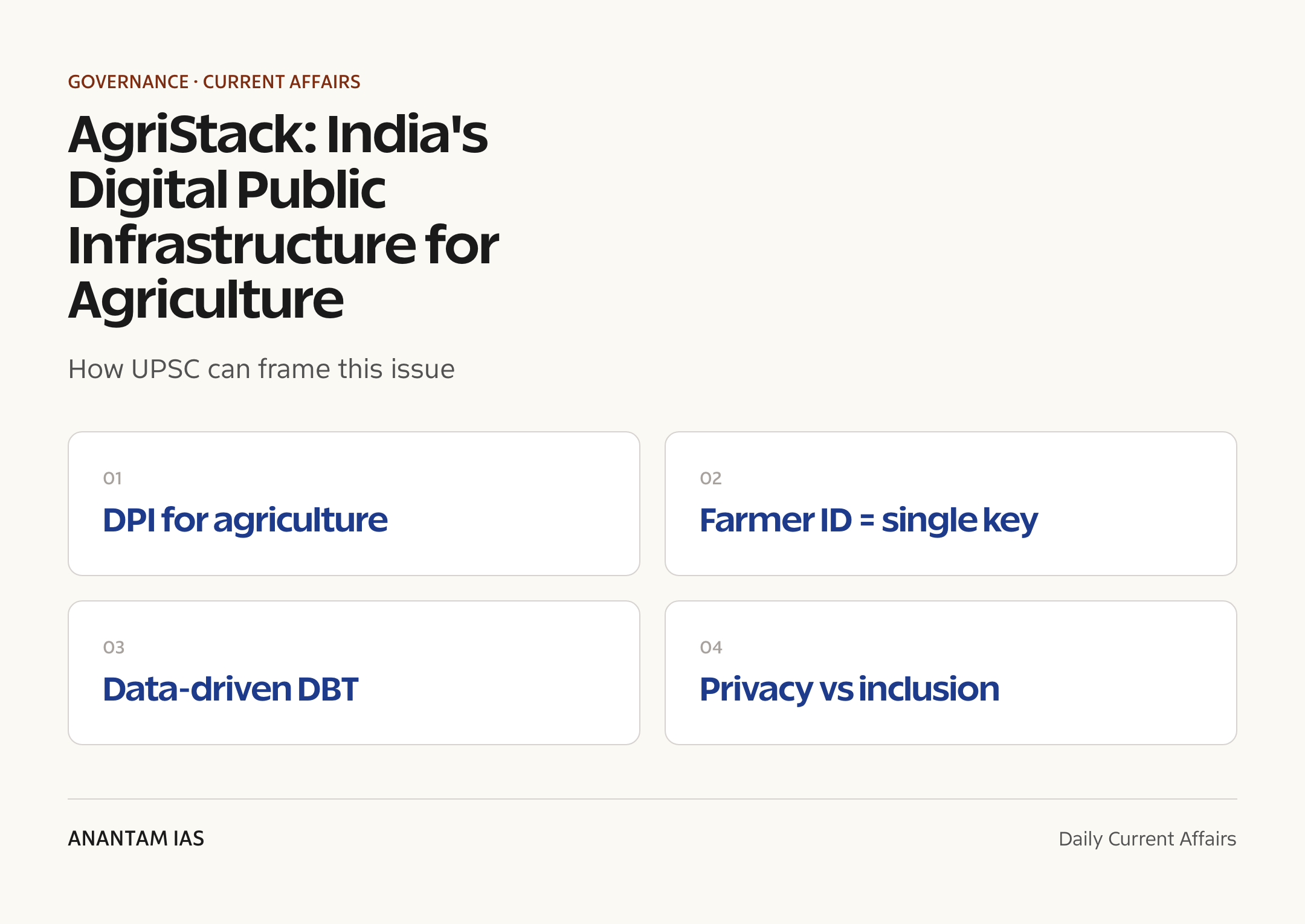
- It anchors the syllabus debate on DPI, e-governance, targeted DBT and the privacy-versus-inclusion tension under the DPDP Act, 2023.
UPSC Relevance
Prelims Relevance
- AgriStack — a federated DPI of registries, datasets, APIs and IT systems for agriculture
- Digital Agriculture Mission — outlay Rs 2,817 crore; central share Rs 1,940 crore; approved Sept 2024
- Three core registries: Farmer Registry, Geo-referenced Village Maps, Crop Sown Registry
- Farmer ID (Kisan Pehchaan Patra) — Aadhaar-linked unique digital identity
- Unified Farmer Service Interface (UFSI) — open API gateway for public/private apps
- Krishi Decision Support System and Soil Profile Mapping — other Mission components
- Farmer ID target: 11 crore by FY 2026-27 (6cr + 3cr + 2cr phasing)
- Digital General Crop Estimation Survey (DGCES) / Digital Crop Survey for crop-sown data
- Nodal ministry: Ministry of Agriculture and Farmers Welfare
- PM-KISAN — Rs 6,000/year DBT; 23rd instalment Rs 18,880 crore to ~9.44 crore farmers
Mains Relevance
GS Paper 3
- AgriStack as Digital Public Infrastructure for agriculture: how a Farmer ID and Crop Sown Registry can improve credit, insurance, MSP procurement and subsidy targeting.
- Use of digital crop surveys and decision-support systems to strengthen yield estimation, agricultural planning and farmer incomes.
GS Paper 2
- E-governance and welfare delivery: DBT, identity-linked registries, and the inclusion-versus-exclusion risks of mandatory digital IDs for accessing entitlements.
Essay
- Technology as an enabler of inclusive growth — but only if the last farmer is not left out of the database.
- Data is the new soil: governing public information infrastructure with trust and consent.
Background and Context
What AgriStack actually is
AgriStack is the agriculture analogue of India Stack — public rails on which services are built.
- PIB describes it as a federated Digital Public Infrastructure made of registries, datasets, APIs and IT systems, owned by government but open to authorised apps.
- It is federated: the Centre sets standards and the core schema, while states build and run their own farmer registries on shared rails.
- The design goal is a single, verified answer to three questions — who farms, on which land parcel, and which crop is sown — refreshed each season.
- It sits inside the Digital Agriculture Mission (outlay Rs 2,817 crore, central share Rs 1,940 crore) alongside the Krishi Decision Support System and Soil Profile Mapping.
The three foundational registries
AgriStack rests on three interoperable registries that together give a plot-level picture of Indian farming.
- Farmer Registry — links a farmer’s demographics, Aadhaar, land records and bank account into one profile, generating the Farmer ID.
- Geo-referenced Village Maps — digitally maps village land so each parcel can be located and tied to a holder.
- Crop Sown Registry — records, every season, which crop is grown on which parcel nationwide, fed by the Digital Crop Survey.
- Because the three registries are interoperable, a benefit can be authorised by matching identity + land + crop rather than by collecting fresh documents each time.
Farmer ID — the trust anchor
The Farmer ID, or Kisan Pehchaan Patra, is the single verifiable key that unlocks the stack.
- It is an Aadhaar-linked unique digital identity issued under the Ministry of Agriculture and Farmers Welfare.
- One ID is meant to be the single entry point for PM-KISAN, fertiliser subsidy, PMFBY crop insurance, KCC loans and future schemes.
- Target is 11 crore Farmer IDs — 6 crore in FY 2024-25, 3 crore in FY 2025-26 and 2 crore in FY 2026-27.
- Several states have begun making the ID a precondition for fresh PM-KISAN instalments and other entitlements, which is where the inclusion debate sharpens.
The Crop Sown Registry and Digital Crop Survey
Real-time crop data is the part that turns a static ID into a living agricultural information system.
- The Digital Crop Survey (the digital General Crop Estimation Survey) captures geo-tagged, parcel-level crop data through field enumerators on a mobile app.
- It was piloted in 11 states in 2023-24 and scaled toward 400 districts in FY 2024-25, moving to nationwide coverage.
- For the first time, Digital Crop Survey data fed into the 2024-25 Kharif estimates, replacing slower eye-estimation methods.
- Accurate sown-area data underpins better yield forecasting, MSP procurement planning and crop-loss assessment for insurance claims.
Unified Farmer Service Interface and APIs
The stack becomes useful only when third parties can build on it — that is the role of the open gateway.
- The Unified Farmer Service Interface (UFSI) is an open API gateway letting authorised public and private apps plug in and exchange data with consent.
- It cuts integration time and cost, so a bank can verify a farmer for KCC, or an insurer can settle a PMFBY claim, by querying the registries rather than rebuilding them.
- This mirrors the India Stack / DPI philosophy — open, interoperable, minimalist rails on which an ecosystem of services competes.
- PIB data places core-registry coverage at roughly 17 states, 492 districts and 4.2 lakh villages at plot level.
Why it matters for delivery
AgriStack is meant to shift agriculture support from exclusion-prone paperwork to data-triggered DBT.
- A verified Farmer ID can make benefits presence-less and paperless — important for the PM-KISAN Rs 6,000-a-year transfer that just released its 23rd instalment.
- DD News reports the 23rd instalment moved about Rs 18,880 crore to nearly 9.44 crore farmers on 20 June 2026, a flow that registries are designed to clean and de-duplicate.
- It can enable pre-approved KCC, automatic crop insurance enrolment and faster claim settlement using crop and land data.
- Better data also strengthens policy — sowing trends, input demand and disaster response can be read at the parcel level.
Risks and the privacy question
A single farm database is powerful and, for the same reason, sensitive.
- Exclusion risk: if a Farmer ID becomes mandatory, tenants, sharecroppers and those with messy land records may be locked out of entitlements.
- Data protection: linking land, Aadhaar, bank and crop data raises consent, purpose-limitation and security concerns under the DPDP Act, 2023.
- Land-record quality: registries are only as good as the underlying records, which remain incomplete or disputed in many states.
- Commercial use: critics warn that opening farm data to private agri-tech and lenders needs strong guardrails against surveillance and predatory targeting.
Way Forward
Make inclusion the default
- Provide assisted, offline-friendly enrolment so tenants and small holders are not excluded, and avoid making the Farmer ID a hard gate before coverage is near-universal.
Hard-wire data protection
- Operationalise consent, purpose limitation and grievance redress under the DPDP Act, 2023, with clear rules on who can query the registries and why.
Fix the land-record base
- Pair AgriStack with faster land-record digitisation and dispute resolution so the Farmer Registry reflects real cultivators, not just titleholders.
Build the service ecosystem
- Use the UFSI to enable pre-approved KCC, automatic PMFBY enrolment and advisory services, while auditing private access for misuse.
Conclusion
AgriStack is India trying to do for farms what India Stack did for payments and identity — turn fragmented, paper-bound records into open, verified, consent-based rails that make schemes like PM-KISAN, KCC and crop insurance flow on data rather than on queues.
The architecture is sound and the early coverage real, but its success will be judged at the margin — whether the tenant farmer with a contested plot gets her instalment as easily as the registered titleholder, and whether the farm database is governed with the privacy safeguards a single, sensitive store of land and crop data demands.
UPSC Practice Questions
Prelims MCQ 1
With reference to AgriStack, consider the following statements:
- It is a Digital Public Infrastructure built around three core registries — Farmer, geo-referenced land/village maps and crop sown.
- The Farmer ID under AgriStack is an Aadhaar-linked digital identity.
- AgriStack is implemented under the Digital Agriculture Mission of the Ministry of Agriculture and Farmers Welfare.
How many of the above statements are correct?
(a) Only one (b) Only two (c) All three (d) None
Answer: (c) All three
Explanation:
AgriStack is a federated DPI built on the Farmer Registry, geo-referenced village maps and the Crop Sown Registry; its Farmer ID is Aadhaar-linked; and it sits under the Digital Agriculture Mission run by the Ministry of Agriculture and Farmers Welfare. All three are correct.
Prelims MCQ 2
Which one of the following components of AgriStack is best described as an open API gateway that lets authorised public and private applications exchange farmer data?
(a) Crop Sown Registry (b) Unified Farmer Service Interface (c) Krishi Decision Support System (d) Soil Profile Mapping
Answer: (b) Unified Farmer Service Interface
Explanation:
The Unified Farmer Service Interface (UFSI) is the open API gateway through which authorised apps plug into AgriStack and exchange data, cutting integration time and cost. The others are data registries or analytical layers, not the interface.
UPSC Mains Questions
- AgriStack has been described as Digital Public Infrastructure for Indian agriculture. Examine its architecture and discuss how it can improve the targeting of credit, insurance and subsidy, while addressing the risks of exclusion and data misuse.
- Accurate, real-time crop data is central to agricultural planning. Discuss how the Digital Crop Survey and the Crop Sown Registry under AgriStack can strengthen yield estimation, MSP procurement and crop-loss assessment in India.
Sources: PIB, PMO and DD News.
Frequently Asked Questions
What is AgriStack in simple terms?
AgriStack is India’s Digital Public Infrastructure for agriculture — government-owned digital rails made of registries, datasets and open APIs. It links a verified Farmer ID, land maps and a crop-sown registry so that schemes like PM-KISAN, crop insurance and KCC loans can be delivered using data rather than repeated paperwork.
What are the three core registries of AgriStack?
The three foundational registries are the Farmer Registry (who farms, generating the Farmer ID), the geo-referenced village or land maps (on which parcel), and the Crop Sown Registry (which crop is grown each season). Together they give a single, verified, plot-level picture of Indian farming.
What is the Farmer ID and is it linked to Aadhaar?
The Farmer ID, or Kisan Pehchaan Patra, is a unique Aadhaar-linked digital identity for farmers under AgriStack. It bundles demographics, land records and bank details into one profile and is intended to be the single entry point for PM-KISAN, fertiliser subsidy, PMFBY crop insurance and Kisan Credit Card loans.
Which mission and outlay back AgriStack?
AgriStack is built under the Digital Agriculture Mission, approved by the Union Cabinet in September 2024 with a total outlay of Rs 2,817 crore, including a central share of Rs 1,940 crore. The mission also includes the Krishi Decision Support System and Soil Profile Mapping.
How does AgriStack relate to the PM-KISAN instalment?
PM-KISAN transfers Rs 6,000 a year directly to farmers; its 23rd instalment released about Rs 18,880 crore to roughly 9.44 crore farmers on 20 June 2026. AgriStack’s verified Farmer Registry is designed to clean and de-duplicate such beneficiary lists so transfers reach genuine cultivators.
What are the main concerns around AgriStack?
The key worries are exclusion of tenants and farmers with poor land records if the ID becomes mandatory, data-protection and consent issues under the DPDP Act 2023, weak underlying land records, and the risk of private commercial misuse of sensitive farm data without strong guardrails.
Tell Google you want more of this.
Add Anantam IAS as a preferred sourceOne tap, and this site shows up more often in your own Top Stories, AI Overviews and AI Mode. Remove it any time.