PMGSY-III Extension Till 2028: ₹83,977 Crore Push for All-Weather Rural Roads
The Union Cabinet on April 20, 2026 cleared a PMGSY-III extension till 2028 with a fresh outlay of ₹83,977 crore. That single line carries more weight than it looks. It tells you the government has decided rural roads remain unfinished business even after 25 years of the scheme, and it commits real money to closing the gap before the next general election cycle.
PMGSY-III is the third phase of the Pradhan Mantri Gram Sadak Yojana, the rural roads programme launched in December 2000. The PMGSY-III extension matters because the original phase-three deadline was March 2025, then March 2027, and several states were still nowhere near completion. Bihar, Jharkhand, Odisha, West Bengal, Madhya Pradesh and Assam together account for the bulk of the leftover network. Pushing the date to 2028 with topped-up funding is the Centre’s way of saying it would rather finish the job properly than declare premature victory.
For UPSC, this decision sits at the intersection of rural development, infrastructure, federal financing, and climate-resilient construction. It’s a classic GS-III question waiting to happen.
Quick Facts at a Glance
- Cabinet approval date: April 20, 2026
- Scheme: Pradhan Mantri Gram Sadak Yojana, Phase III (PMGSY-III)
- Fresh outlay: ₹83,977 crore
- New deadline: March 2028 (earlier March 2027)
- Nodal ministry: Ministry of Rural Development
- Implementing agency: National Rural Infrastructure Development Agency (NRIDA)
- Original PMGSY launch: December 25, 2000, under PM Atal Bihari Vajpayee
- Funding pattern (general states): 60:40 Centre to state
- Funding pattern (NE and Himalayan states): 90:10
- Tech focus: green technologies, cold mix, waste plastic, fly ash, geo-cells
What Just Happened
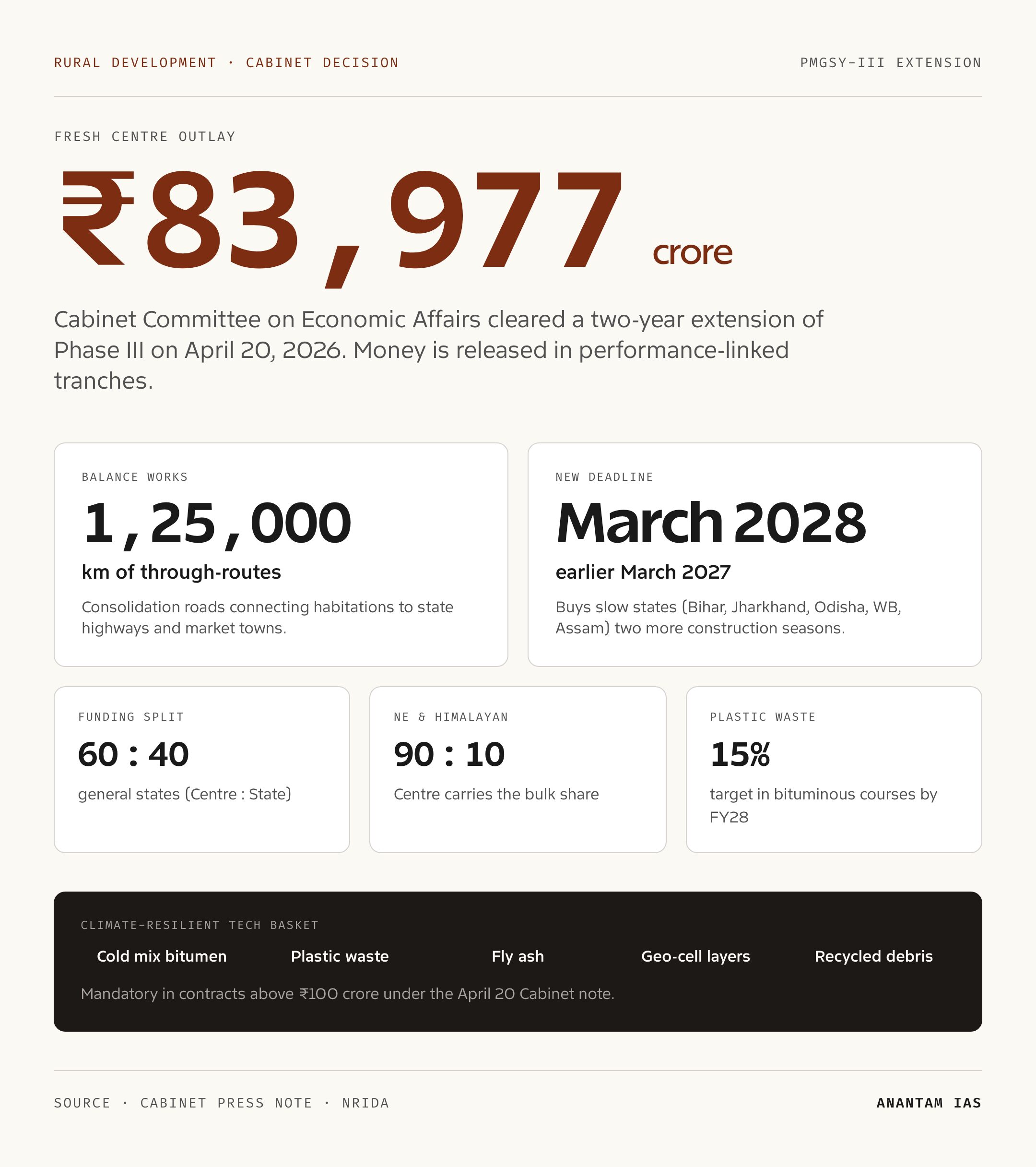
The Cabinet Committee on Economic Affairs (CCEA) approved a two-year extension and additional funding for PMGSY-III. The official press release cited “balance works” of roughly 1,25,000 km of consolidation roads and through-routes that connect habitations to higher-order networks like state highways and market towns.
The ₹83,977 crore figure is the Centre’s share of incremental cost. State contributions push the total project cost higher. Money will be released in installments tied to physical progress, not annual budget heads, which is the standard PMGSY pattern.
A second decision tucked inside the same Cabinet note expanded the scope of climate-resilient road technology. From now on, contracts above ₹100 crore must specify the green tech being used, including cold mix bitumen, plastic waste in surface courses, fly ash in embankments, or cell-confined granular layers. This is small but consequential. It pulls PMGSY into India’s broader climate adaptation push from policy to grassroots without needing a separate scheme.
Background and Historical Context
PMGSY was born out of a simple problem. In 2000, roughly 40% of India’s 6 lakh-odd habitations had no all-weather road connection. During monsoon, ambulances couldn’t reach, schools shut, fertilizer didn’t move, and minor produce rotted at the farm gate. Vajpayee’s government launched PMGSY on December 25, 2000, anchored to a 100% central funding model and a 500-person habitation eligibility threshold (250 in hill, tribal, and desert areas).
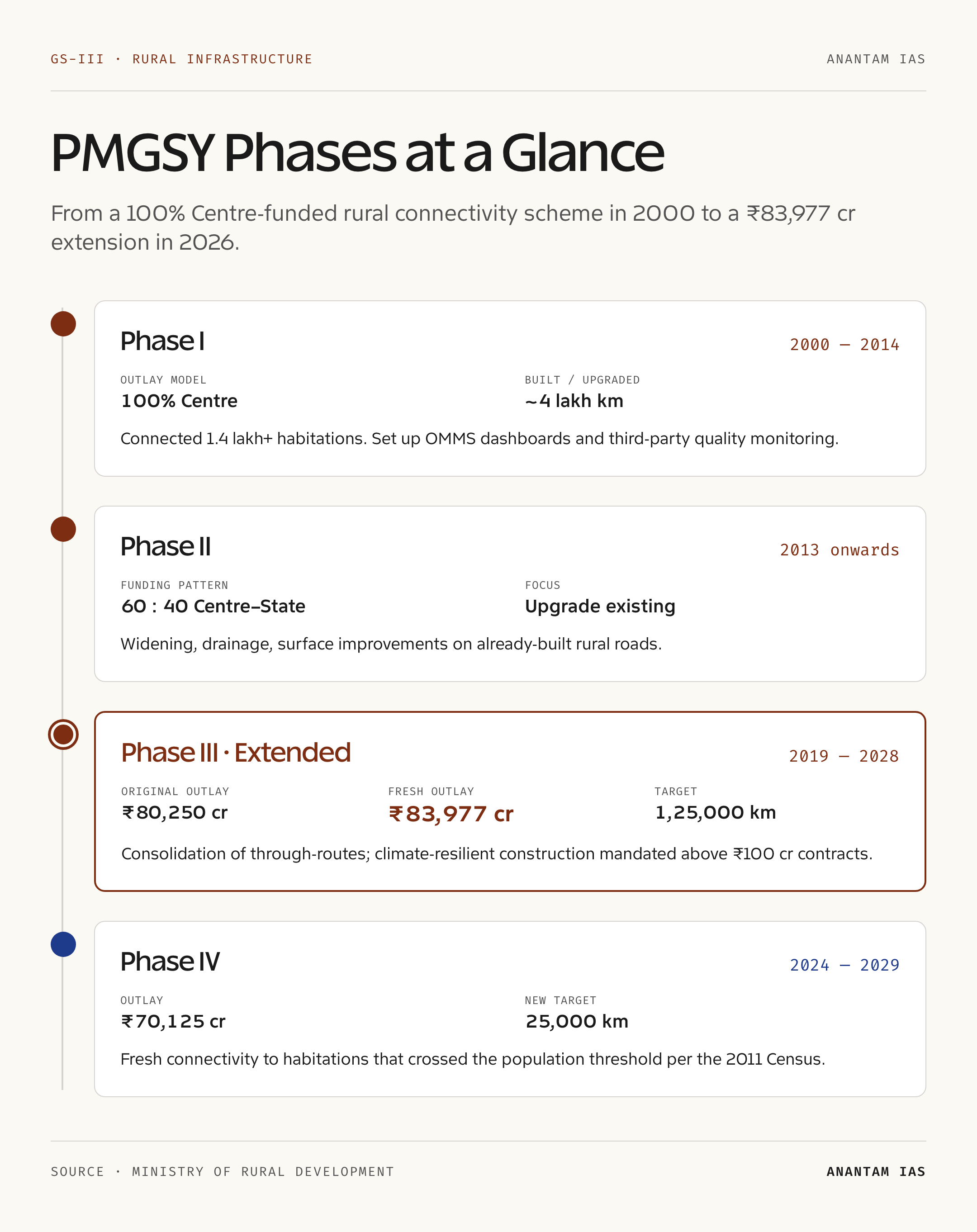
The scheme moved through phases as the original target shrank.
Phase I (2000-2014). Built or upgraded around 4 lakh km of rural roads. Connected over 1.4 lakh habitations. The big shift here was professionalising contract management, introducing third-party quality monitoring, and creating online OMMS dashboards.
Phase II (2013 onwards). Focused on upgrading existing rural roads to higher specifications, including widening, drainage, and surface improvements. Phase II also tightened the 60:40 funding pattern for general states.
Phase III (2019-2028). Approved in July 2019 with a target of 1,25,000 km. Phase III’s distinctive idea is consolidation, meaning instead of just connecting villages it also strengthens “through routes” and “major rural links” so that an existing road actually carries goods to markets without breaking down every monsoon. Outlay at launch: ₹80,250 crore. Original deadline: March 2025. Extended to 2027, now 2028.
Phase IV (2024 onwards). Approved in September 2024 with a target of 25,000 km of new connectivity to habitations that had crossed the population threshold per the 2011 Census. Outlay around ₹70,125 crore. Deadline March 2029. Phase IV runs in parallel with the tail end of Phase III.
That parallel run is why the PMGSY-III extension matters. It buys the slower states two more construction seasons without disturbing Phase IV’s clock.
Key Provisions of the Extension
The extension is not just a calendar push. The April 20, 2026 note carries five operative provisions.
- Centre’s share of ₹83,977 crore released through 2026-27 and 2027-28 in performance-linked tranches.
- State governments must close their existing financial liabilities before drawing new funds, removing the carry-forward overhang that delayed payments to contractors.
- Mandatory use of green road technology in stretches above ₹100 crore, with a 15% target for plastic waste utilisation in bituminous courses by FY 2027-28.
- Geo-tagged progress reporting through OMMS, with quarterly third-party audits.
- Convergence with PM-KUSUM, Jal Jeevan Mission and Saubhagya so that road alignment, water pipelines, and electricity lines are co-located, reducing repeat digging.
Why It Matters: Roads, Markets, Mobility
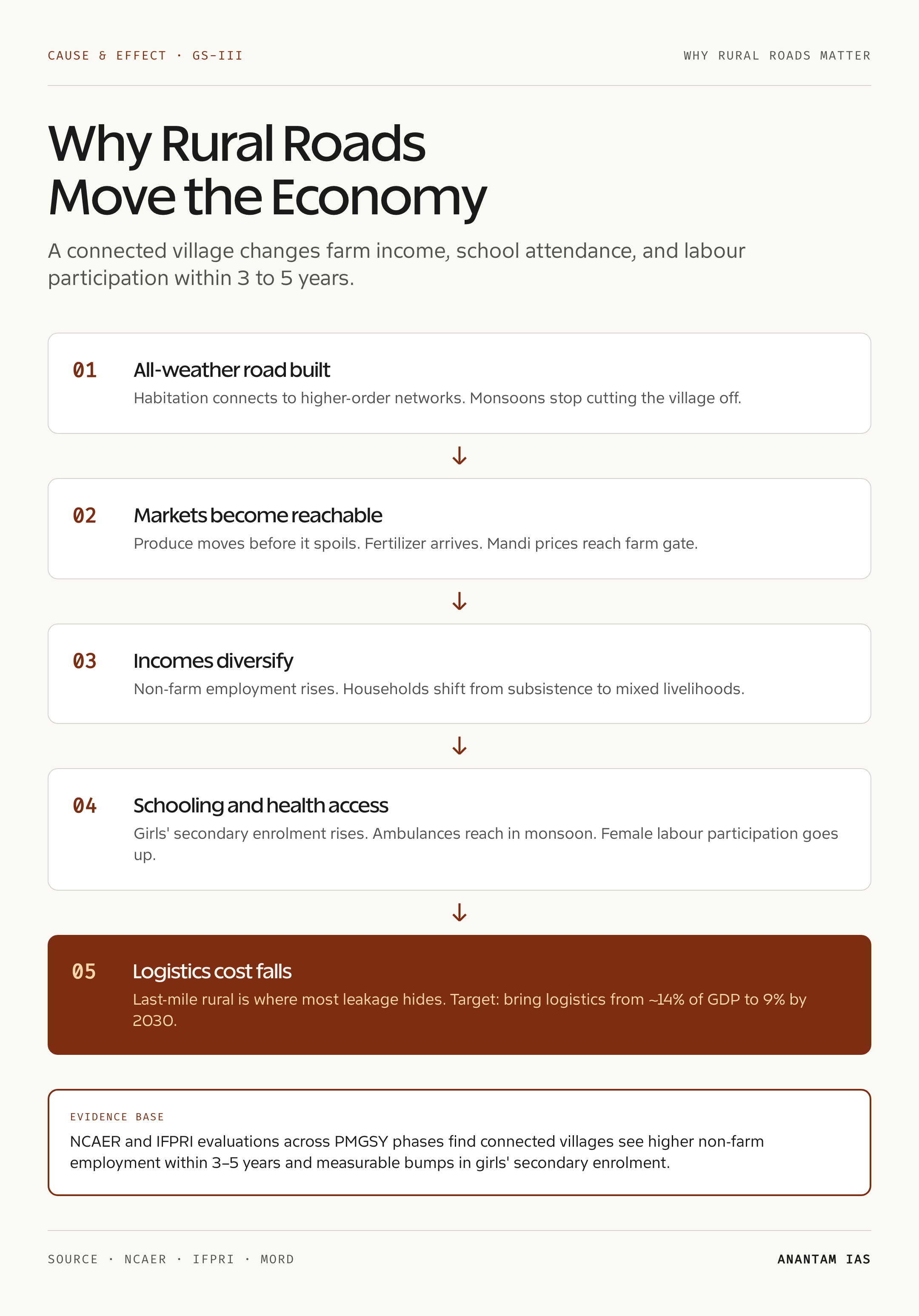
There is solid evidence that rural connectivity correlates with downstream gains in farm incomes, school attendance, female labour participation, and access to non-farm work. NCAER and IFPRI evaluations across PMGSY phases have repeatedly found that connected villages see higher non-farm employment within 3 to 5 years, faster diversification out of subsistence agriculture, and measurable bumps in girls’ secondary enrolment.
The PMGSY-III extension matters because the marginal returns are highest now. The easy roads are built. What’s left is the harder terrain, the tribal blocks, the flood-prone Gangetic stretches, the cyclone-exposed coastal districts. These are the places where through-routes break twice a year and where last-mile connectivity costs more per kilometre. Skipping them would mean leaving the bottom 15% of habitations stuck on weather-dependent connectivity forever.
Rural road density also feeds into India’s broader logistics costs story. The National Logistics Policy 2022 targets a fall in logistics cost from around 14% of GDP to 9% by 2030. Last-mile rural is where most leakage hides.
Detailed Analysis
The Federal Money Question
The 60:40 ratio for general states has been a source of friction. Several large states want a 75:25 split for PMGSY because they argue rural roads are a national objective and state finances are strained by revised GST devolution and finance commission flows. The Centre has so far refused, holding the 60:40 line outside the NE and hill block.
The April 20, 2026 note tries to soften that friction by tying release to performance, not to annual receipt. A state that completes 80% of its current allocation gets the next tranche faster. That’s a reasonable middle path, although it still rewards better-administered states and could widen the rural infrastructure gap between Tamil Nadu and Bihar.
The Climate-Resilient Layer
Climate-resilient road tech is the most interesting clause in the extension. Conventional rural roads in India are designed for a 5- to 10-year life with light reinforcement. With monsoon volatility, urban heat island effects rolling into peri-urban roads, and rising flood frequency, that design assumption is breaking down.
The new tech basket includes:
- Cold mix bitumen. Lower carbon emissions during construction, useful in remote areas without hot mix plants.
- Plastic waste in bitumen. Replaces 8% to 10% of bitumen in surface courses, also a sink for non-recyclable plastic.
- Fly ash embankments. Reduces fresh soil consumption and uses a thermal-power waste stream.
- Geo-cell confined granular layers. Improves load-bearing on soft soils, especially in flood-prone alluvial zones.
- Recycled construction debris. Allowed in lower base layers in select pilot states.
The 15% plastic waste target by FY 2027-28 is realistic but not aggressive. States with large urban waste streams (Maharashtra, Karnataka, Delhi-NCR adjoining districts) will exceed it. Smaller states will struggle.
The Quality and Maintenance Gap
PMGSY assets transfer to state PWDs after a 5-year defect liability period. After that, maintenance funding is a state responsibility, and this is where the system frays. CAG reports across multiple states have flagged poor post-handover maintenance, leading to PMGSY assets degrading within 8 to 12 years instead of the designed 15. The 2026 extension does not fix this. It is the single biggest unaddressed risk of the scheme.
Last-Mile and the Fourth-Phase Overlap
PMGSY-IV technically handles new connectivity for habitations that crossed the 250 or 500 threshold after 2011. In practice, several states are consolidating Phase III through-routes and Phase IV last-mile spurs into single project bundles to save on mobilisation costs. The April note allows this with explicit approval, which removes a procurement headache.
Comparative Perspective
China’s rural road push between 2003 and 2020 added roughly 4 million km of village-level roads under successive Five-Year Plans. The Chinese model used sub-provincial financing vehicles and bond issuances against future tolls or land value uplift. India’s PMGSY is more conservative and grant-based, which avoids the local debt trap China is now unwinding but also means the pace is slower.
Africa’s rural access programmes, particularly under World Bank’s Rural Access Index, classify a household as “connected” if it lives within 2 km of an all-weather road. India’s threshold is similar. The PMGSY data architecture, with OMMS and habitation-level GIS, is among the more granular in the developing world.
Challenges and Critiques
PMGSY-III faces five live problems beyond the maintenance gap.
First, land acquisition. Even small road widening can need narrow strips of private land, and rural land records remain a mess in eastern India. Several Phase III contracts have been stuck for 18 to 24 months at the alignment stage.
Second, contractor concentration. A handful of mid-sized firms dominate PMGSY contracting in slow states, and small contractors complain about being squeezed out of bundled tenders.
Third, climate retrofit cost. Climate-resilient tech adds 6% to 12% to per-km cost in the short run. Without an explicit cost escalator, PWDs cut corners.
Fourth, audit and quality. Third-party quality monitors are stretched thin. Random sample testing covers under 10% of completed length in some states.
Fifth, convergence with rural electrification and water schemes is uneven. Where convergence works (Tamil Nadu, Telangana), trenching costs drop and asset life extends. Where it doesn’t, fresh roads get dug up within months.
UPSC Prelims Pointers
- PMGSY launched on December 25, 2000 by PM Atal Bihari Vajpayee.
- Nodal ministry: Ministry of Rural Development.
- Implementing arm: National Rural Infrastructure Development Agency (NRIDA).
- Funding ratio: 60:40 (general states), 90:10 (NE and Himalayan states), 100% UTs without legislature.
- PMGSY-III approved July 2019; target 1,25,000 km; consolidation focus.
- PMGSY-IV approved September 2024; target 25,000 km new connectivity.
- April 20, 2026 Cabinet decision: PMGSY-III extension to March 2028, fresh ₹83,977 crore.
- Population threshold: 500 in plains, 250 in hill/tribal/desert/LWE blocks.
- Online platform: OMMS (Online Management, Monitoring and Accounting System).
- Green tech basket includes plastic waste, cold mix, fly ash, geo-cell, cell-filled concrete.
Mains Practice Questions
- “Rural roads are necessary but not sufficient for inclusive growth.” Critically examine in light of the PMGSY-III extension and its convergence with other rural development schemes. (GS-III, 250 words)
- Discuss the role of climate-resilient construction technologies in extending the design life of rural infrastructure assets in India. (GS-III, 250 words)
- Evaluate the federal financing architecture of PMGSY. Does the 60:40 funding pattern adequately account for differential state capacity? (GS-II, 150 words)
- The maintenance of completed rural road assets remains the weakest link in PMGSY. Suggest institutional and financial reforms. (GS-III, 250 words)
Way Forward
Three things would help PMGSY land its 25-year promise. One, a permanent maintenance fund tied to a small state cess on commercial vehicles using rural roads, with central matching for backward districts. Two, a cost escalator for green road tech so PWDs don’t quietly drop it. Three, GIS-based public dashboards at the habitation level so citizens can see which stretch is built, which is pending, and which has been handed over to the state.
The PMGSY-III extension till 2028 is the right call. The bigger task is making sure the road that gets built in 2027 is still serviceable in 2042. That’s a different conversation, and it has barely started.
Frequently Asked Questions
What is the PMGSY-III extension?
The Union Cabinet on April 20, 2026 extended PMGSY Phase III by one year to March 2028 and approved a fresh outlay of ₹83,977 crore to complete the balance 1,25,000 km of consolidation and through-route construction.
When was PMGSY launched?
PMGSY was launched on December 25, 2000 by PM Atal Bihari Vajpayee as a 100% centrally funded scheme to provide all-weather road connectivity to unconnected habitations.
What is the funding pattern under PMGSY-III?
60:40 between Centre and state for general states, 90:10 for North-Eastern and Himalayan states, and 100% Centre funding for UTs without legislature.
How is PMGSY-III different from PMGSY-IV?
PMGSY-III focuses on consolidating existing rural roads into through-routes and major rural links. PMGSY-IV, approved in September 2024, focuses on fresh connectivity to habitations that crossed the population threshold per the 2011 Census.
Who implements PMGSY?
The National Rural Infrastructure Development Agency (NRIDA), an autonomous body under the Ministry of Rural Development, handles design standards, monitoring, and capacity support. State Rural Roads Development Agencies execute the works.
What is the role of green technology in the new PMGSY-III extension?
Contracts above ₹100 crore must specify climate-resilient road tech, including cold mix bitumen, plastic waste utilisation, fly ash, and geo-cell confined granular layers. Plastic waste utilisation target is 15% of bituminous surface courses by FY 2027-28.
What is the population threshold for PMGSY eligibility?
500 persons in plain areas and 250 persons in hill, tribal, desert, and Left-Wing Extremism affected blocks, based on the 2011 Census.
Why does PMGSY-III need a fresh extension?
Several large states, including Bihar, Jharkhand, Odisha, West Bengal, and Assam, were behind schedule due to land acquisition delays, contractor capacity gaps, and pandemic-era construction slowdowns. The extension closes the implementation gap without forcing rushed, low-quality completion.