Pakistan-Occupied Kashmir Protests: Economic Grievances and Political Rights
Why in News?
The Pakistan-occupied Kashmir protests intensified in June-July 2026 as a movement rooted in electricity tariffs, subsidised wheat and inflation broadened into demands concerning political representation, governance and civil liberties.
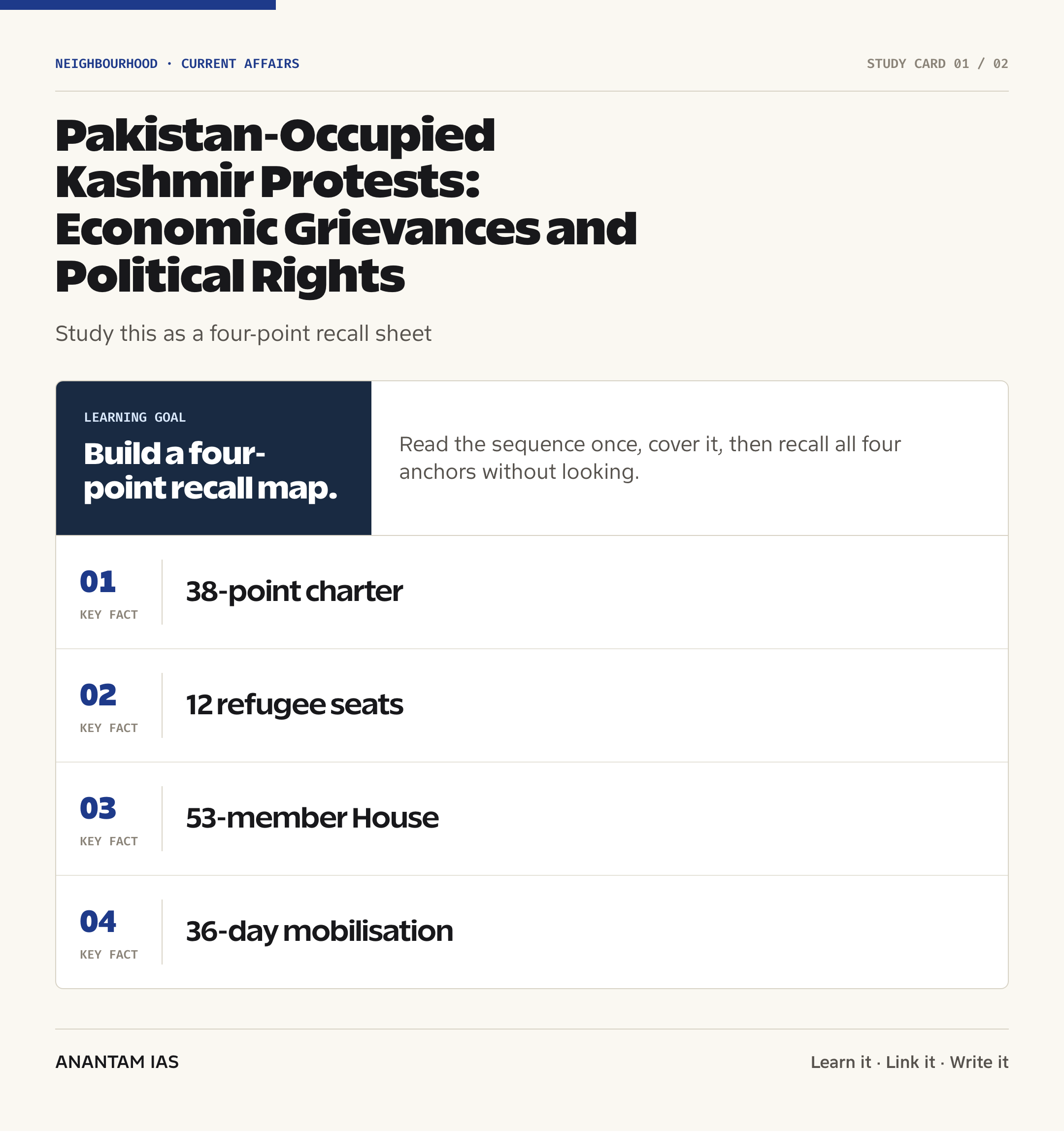
The immediate escalation followed the ban on the Joint Awami Action Committee, arrests around its planned mobilisation, and a dispute over 12 legislative seats reserved for refugees settled in Pakistan. The Hindu described the unrest as among the largest in the region in recent years; Associated Press reporting documented strikes, road blockades, clashes and competing allegations by protesters and authorities.
- Akashvani News reported that the mobilisation entered its 36th consecutive day on 15 July 2026, with a large gathering at Rawalakot.
- The protesters’ 38-point charter combines price relief with changes in representation, public services, taxation, policing and official accountability.
- A regional court ruling held that the 12 refugee seats could not be abolished without a constitutional amendment, sharpening an already active representation dispute.
- Associated Press reported a July operation to clear roads blocked for nearly a month; authorities and protest organisers gave conflicting accounts of responsibility for violence.
- The Ministry of External Affairs linked the unrest to the denial of rights and governance failures in areas under Pakistan’s illegal and forcible occupation.
The development matters in the context of:
- The issue sits at the intersection of neighbourhood stability, popular legitimacy, resource distribution and India-Pakistan relations.
- Economic demands can become constitutional claims when people connect prices and services to who controls budgets, elections and public institutions.
- For India, humanitarian concerns must be analysed alongside its consistent position on the entire territories of Jammu and Kashmir and Ladakh.
UPSC Relevance
Prelims Relevance
- Joint Awami Action Committee: a civil-society coalition associated with traders, lawyers, transporters, students and local groups; it is not an organ of the Government of India.
- The disputed local legislature has 53 members: 33 territorial seats, 12 seats for refugees settled in Pakistan, and eight other reserved or special-category seats, according to its official assembly website.
- Do not confuse those 12 refugee seats with the seats kept vacant in India’s Jammu and Kashmir Legislative Assembly for areas under Pakistani occupation.
- Section 14(4) of the Jammu and Kashmir Reorganisation Act, 2019 provides that 24 seats remain vacant until the area under Pakistan’s occupation ceases to be so occupied and its people elect representatives.
- Article 1 of the Constitution describes India as a Union of States; the First Schedule specifies the territories of States and Union Territories.
- The 1994 Parliament Resolution unanimously stated India’s position that the territory under Pakistan’s occupation is part of India and called for its vacation.
- The Line of Control is a military control line and does not amount to an internationally recognised boundary.
- ICCPR Article 21 protects peaceful assembly, while Article 25 concerns participation in public affairs and genuine periodic elections.
Mains Relevance
GS Paper 2
- India-Pakistan relations, territorial claims, the Simla Agreement and India’s constitutional position on Jammu and Kashmir.
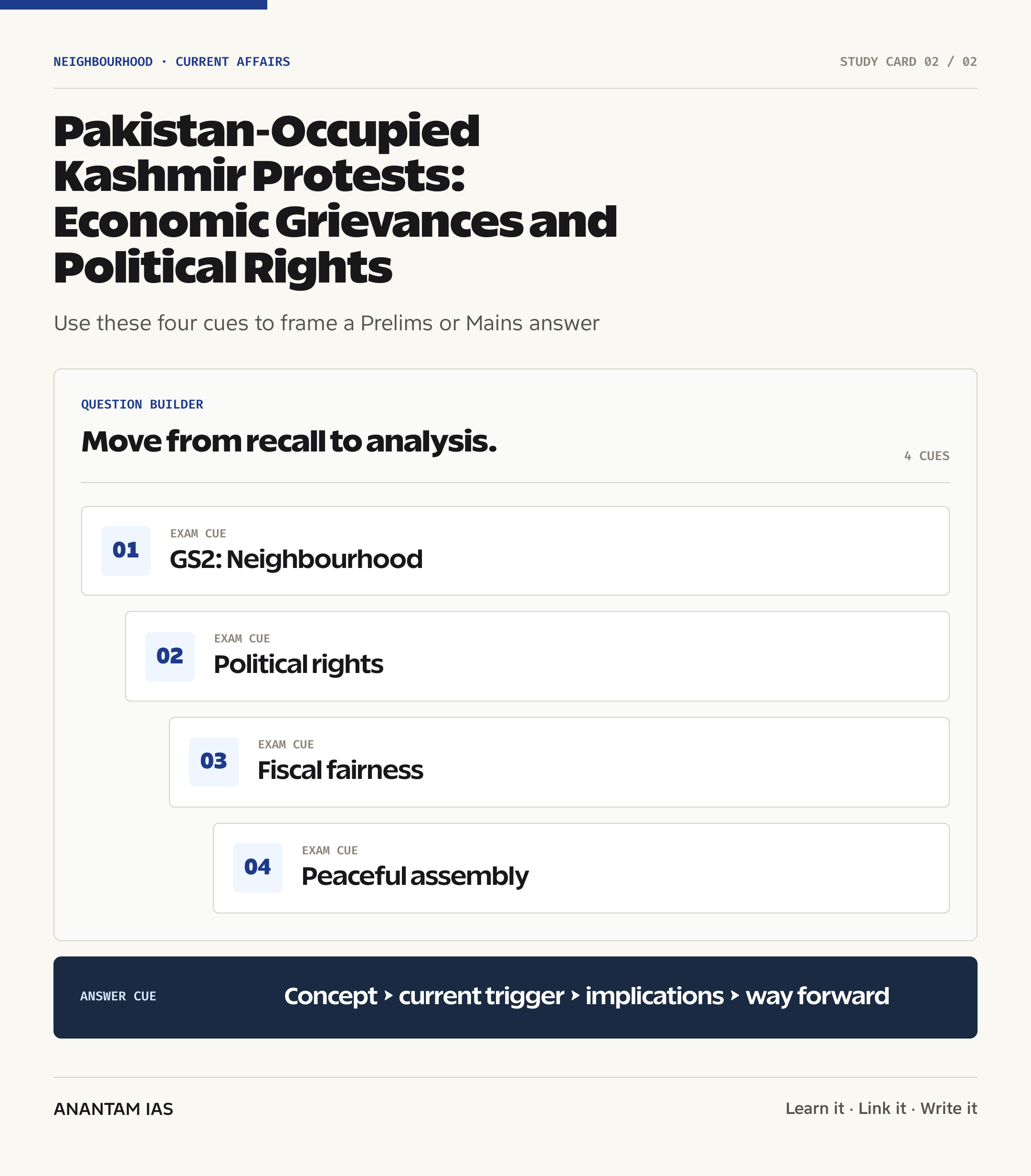
- Representation, accountable institutions, civil liberties and the relationship between economic rights and political legitimacy.
- International human-rights standards governing peaceful assembly, proportional restrictions and public participation.
GS Paper 3
- How electricity pricing, food security, inflation, fiscal transfers and weak service delivery can become drivers of regional instability.
- The neighbourhood-security effects of prolonged blockades, communication restrictions, contested policing and institutional distrust.
Essay
- The price of bread and electricity can become a test of the legitimacy of the state.
- Representation without accountability may preserve institutions while weakening consent.
- Durable peace needs both territorial security and justice in everyday governance.
Background and Context
What triggered the present escalation?
The present crisis is a fresh escalation of an older movement, not a single-issue reaction.
- The movement’s durable base lies in demands for cheaper electricity, subsidised wheat, lower taxes and relief from inflation and unscheduled power cuts.
- The immediate political trigger was the regional government’s ban on the JAAC under anti-terror provisions, followed by arrests ahead of a planned June mobilisation.
- The dispute sharpened after the regional Supreme Court treated the 12 refugee seats as constitutionally protected and said their removal required a constitutional amendment.
- On 14 July, Associated Press reported that police began clearing blocked entry and exit roads. It also recorded official allegations against armed protesters and complaints by residents about shortages, showing why individual claims need careful attribution.
- The analytical distinction is vital: verified developments include the ban, court ruling, strike, blockades and confrontations; precise cumulative crowd, arrest, casualty and injury totals remain contested across reports.
From household prices to governance claims
Economic grievances acquire political force when people see unequal rules behind high prices and poor services.
- Residents question why a hydropower-producing region should face high electricity bills, fuel-adjustment charges and unreliable supply.
- Food-price demands focus on affordable wheat and flour, market oversight and protection from shortages or profiteering.
- The charter links household stress to the cost of political and bureaucratic privileges, making fiscal fairness a governance question.
- Demands concerning health, education, roads and employment show that price relief alone can’t substitute for capable public services.
- This is a classic political-economy chain: concentrated control over resources and budgets can produce weak accountability, unequal distribution and recurring protest.
- The dispute is now about both immediate relief and transparent governance.
The representation dispute
The seat controversy asks whether a legislature can fairly represent both territorial residents and communities displaced outside the territory.
- The official local assembly describes a 53-member House with 33 seats from the territory and 12 seats for refugees settled in Pakistan, alongside seats reserved for women and specified groups.
- Protesters argue that the 12 externally elected seats dilute the political voice of people who live under the administration and receive its services.
- Supporters of the arrangement present the seats as representation for people displaced from Jammu and Kashmir by the conflict.
- The court ruling did not settle the political debate; it located the legal route for change in a constitutional amendment rather than an ordinary executive decision.
- The issue illustrates the difference between descriptive representation, territorial accountability and equal weight in electoral decision-making.
Rights framework for protests and policing
Peaceful protest is a democratic safety valve, while violence by any actor remains subject to law and independent scrutiny.
- ICCPR Article 21 recognises peaceful assembly; restrictions must be lawful, necessary and proportionate for a listed legitimate purpose.
- The UN Human Rights Committee’s General Comment No. 37 says authorities should facilitate peaceful assemblies and shouldn’t treat isolated violence as proof that an entire gathering is non-peaceful.
- Article 25 links participation to the ability to take part in public affairs through freely chosen representatives and genuine periodic elections.
- Blanket bans, prolonged communication shutdowns and mass arrests can deepen distrust when they lack individualised reasons, time limits and effective review.
- Independent investigation is essential where accounts conflict about firing, deaths, injuries or armed participation; news footage and partisan claims aren’t substitutes for verified evidence.
India's constitutional and diplomatic position
India treats the territory as part of India under illegal Pakistani occupation, not as a settled part of Pakistan.
- The Constitution of India, read with the First Schedule and the Jammu and Kashmir Reorganisation Act, provides the domestic constitutional frame for Jammu and Kashmir and Ladakh.
- The Ministry of External Affairs has reiterated the 1994 Parliament Resolution: the entire Union Territories of Jammu and Kashmir and Ladakh have been, are and shall be an integral part of India.
- The Jammu and Kashmir Reorganisation Act, 2019 expressly recognises areas under Pakistan’s occupation for representation purposes and keeps 24 Assembly seats vacant.
- India’s official description is Pakistan-occupied Jammu and Kashmir or areas under Pakistan’s illegal and forcible occupation; terminology should not imply acceptance of Pakistani sovereignty.
- India has also framed the reported crackdown as an issue of rights denial and administrative oppression, while urging international attention to alleged abuses.
- For deeper context, read the earlier PoK protests explainer without treating its historical figures as automatically current.
Bilateral and strategic significance
Local unrest matters beyond the immediate protest because Kashmir remains central to India-Pakistan relations.
- The Simla Agreement provides the durable bilateral frame: differences are to be settled by peaceful means through bilateral negotiations or mutually agreed methods.
- The Agreement requires respect for the Line of Control without prejudice to either side’s recognised position; the LoC doesn’t convert into a legal international boundary by itself.
- Prolonged unrest can affect cross-LoC security calculations, military alertness, displacement risks and the wider information environment.
- China adds a strategic layer because Pakistan illegally ceded territory to China under the 1963 boundary agreement and the China-Pakistan Economic Corridor traverses territory claimed by India.
- India should distinguish support for rights and accountability from speculation about protesters’ final political preferences; the reported charter contains diverse economic, institutional and autonomy-related demands.
- A calibrated reading fits the broader India-Pakistan relations framework of territorial integrity, deterrence, diplomacy and people-centred stability.
Way Forward
Immediate de-escalation
- Protect peaceful assembly, keep hospitals and essential routes open, and create a monitored pause in coercive action by both authorities and organisers.
- Release verifiable information on arrests, casualties and internet restrictions, with prompt access to lawyers, families and medical care.
- Commission an independent investigation into each reported death or serious injury instead of relying on collective blame.
Credible political negotiation
- Publish the status of all 38 demands, the legal basis for accepted items and a time-bound implementation ledger.
- Address the 12-seat question through open constitutional consultation involving territorial residents, refugee communities, legal experts and civil society.
- Use neutral facilitation, recorded minutes and enforceable review dates so dialogue produces measurable outcomes.
Economic and institutional reform
- Disclose electricity generation, procurement, subsidy and tariff calculations so residents can test the claim of unfair resource pricing.
- Target wheat and energy relief transparently while protecting budgets for health, education, local roads and employment.
- Strengthen audit, grievance redress, election administration and legislative scrutiny rather than treating subsidies as a substitute for reform.
India's calibrated response
- Maintain India’s constitutional position, document rights concerns from corroborated sources and avoid amplifying unverified casualty or crowd figures.
- Keep diplomatic messaging focused on illegal occupation, accountable governance and the protection of civilians.
- Combine strategic vigilance with factual restraint; neighbourhood instability is best assessed through law, institutions and verified evidence.
Conclusion
The protests show how electricity bills, wheat prices and inflation can become a wider challenge to representation and political legitimacy when people distrust the institutions controlling resources and elections.
For India, the sound framework combines its settled constitutional position on Jammu and Kashmir with attention to human rights, evidence and regional stability. Sound analysis avoids sensationalism and single-slogan reduction.
UPSC Practice Questions
Prelims MCQ 1
With reference to the Jammu and Kashmir Reorganisation Act, 2019, consider the following statements:
- It provides for a Legislative Assembly for the Union Territory of Jammu and Kashmir.
- It keeps 24 Assembly seats vacant for the area under Pakistan’s occupation until that occupation ceases and representatives are elected.
- These 24 seats are identical to the 12 refugee seats disputed in the legislature administered from Muzaffarabad.
How many of the above statements are correct?
(a) Only one (b) Only two (c) All three (d) None
Answer: (b) Only two
Explanation:
Statements 1 and 2 are correct under Section 14. Statement 3 is incorrect: the 24 vacant seats in Indian law and the 12 refugee seats in the Pakistan-administered legislature arise from different legal and political arrangements.
Prelims MCQ 2
Which provision of the International Covenant on Civil and Political Rights specifically recognises the right of peaceful assembly?
(a) Article 19 (b) Article 21 (c) Article 25 (d) Article 27
Answer: (b) Article 21
Explanation:
Article 21 recognises peaceful assembly. Article 19 protects expression, while Article 25 addresses participation in public affairs, voting and access to public service.
UPSC Mains Questions
- Economic grievances often become political-rights movements when public institutions lack legitimacy. Examine this proposition with reference to the 2026 protests in Pakistan-occupied Jammu and Kashmir, focusing on electricity pricing, public services, representation and accountability. (250 words)
- Explain India’s constitutional and diplomatic position on Pakistan-occupied Jammu and Kashmir. How should India balance territorial integrity, human-rights concerns, factual restraint and neighbourhood stability in responding to the current unrest? (250 words)
- The design of representative institutions can either reduce or deepen conflict in contested regions. Discuss with reference to territorial representation, displaced communities, electoral equality and the dispute over refugee seats in Pakistan-occupied Jammu and Kashmir. (250 words)
Sources: Akashvani News, Ministry of External Affairs and The Hindu.
Frequently Asked Questions
What triggered the 2026 PoK protests?
The deeper grievances concern electricity prices, wheat, inflation, taxes and services. The present escalation followed the ban on the Joint Awami Action Committee, arrests ahead of its mobilisation, and a regional court ruling that 12 refugee seats were constitutionally protected and could be removed only through amendment.
What is the Joint Awami Action Committee?
The Joint Awami Action Committee is a civil-society coalition associated with traders, transporters, lawyers, students and local groups. It has coordinated demands on electricity, wheat, privileges, services and representation. Regional authorities banned it in June 2026, while its supporters continued strikes, sit-ins and blockades.
Why are 12 refugee seats disputed?
The seats represent Jammu and Kashmir refugees settled in Pakistan. Protesters argue that externally elected members dilute the voice of territorial residents; supporters cite representation of displaced communities. The regional court said abolition would require a constitutional amendment, turning an electoral disagreement into a constitutional reform question.
What is India’s position on PoJK?
India maintains that the entire Union Territories of Jammu and Kashmir and Ladakh are integral parts of India and that Pakistan is in illegal and forcible occupation of Indian territory. This position is reflected in the 1994 Parliament Resolution and the Jammu and Kashmir Reorganisation Act, 2019.
Which rights apply to peaceful protests?
ICCPR Article 21 protects peaceful assembly, subject only to lawful, necessary and proportionate restrictions. Article 19 protects expression, and Article 25 concerns participation in public affairs. Authorities must distinguish peaceful participants from individual offenders, while organisers should prevent violence and protect essential access.
Why do these protests matter for India?
They affect a territory claimed by India, expose governance and rights issues under Pakistan’s occupation, and may influence India-Pakistan security calculations. They also test India’s ability to combine a firm constitutional position with corroborated human-rights advocacy, diplomatic restraint and careful monitoring of neighbourhood instability.