Post-Facto Environmental Clearance: Supreme Court Allows a Limited Route
Why in News?
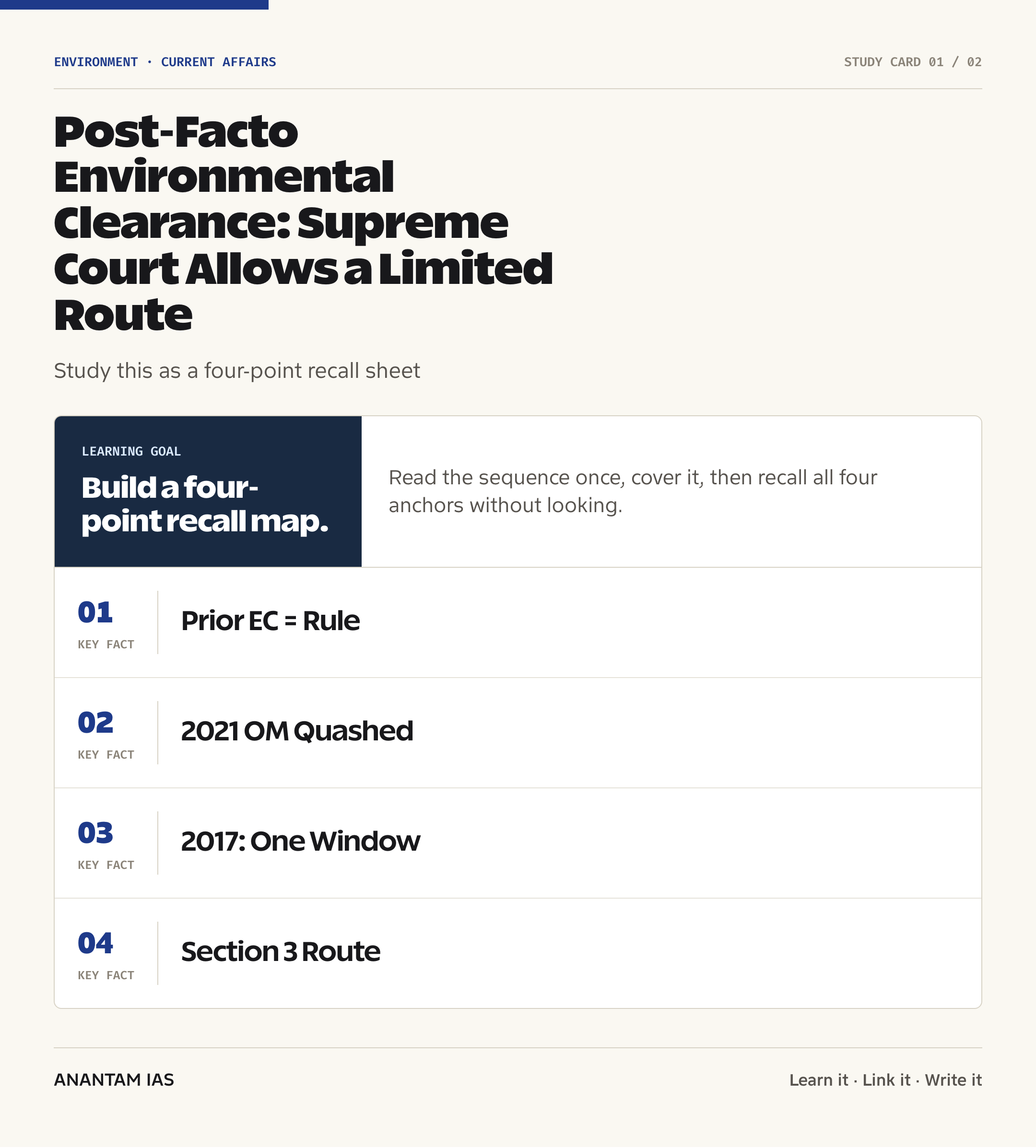
On July 29, 2026, a three-judge Supreme Court Bench led by Chief Justice Surya Kant invalidated the Environment Ministry’s 2021 Office Memorandum that had created a continuing route for projects begun without mandatory prior environmental clearance.
The Court kept prior environmental clearance as the governing rule but recognised a limited exception: the Union may frame a narrow, time-bound statutory amnesty for deserving cases involving supervening public interest, backed by deterrent liability and ecological remediation.
- The Bench also comprised Justices Joymalya Bagchi and Vipul M. Pancholi; the judgment addressed the legality of retrospective regularisation under the Environment (Protection) Act, 1986.
- The 2021 Office Memorandum was struck down because an administrative instruction could not supplant the prior-clearance regime created by the EIA Notification, 2006.
- The Court upheld the 2017 notification as a one-time, time-bound measure, while rejecting the 2021 attempt to turn that exception into an open-ended parallel route.
- Existing clearances remain open to individual legal challenge, pending applications under the earlier instruments may reach a decision, and no fresh applications can enter through the invalidated 2021 route.
- Any future relaxation must come through a valid Section 3 notification, not an Office Memorandum, and must satisfy constitutional tests of equality, proportionality and environmental protection.
The development matters in the context of:
- The ruling matters in the context of the tension between preventive environmental appraisal and the practical consequences of closing or demolishing completed public facilities.
- It also tests whether the polluter-pays principle can support remediation without reducing prior approval to a fee paid after ecological damage.
- The decision places greater responsibility on appraisal bodies, pollution control boards and public authorities to detect violations before sunk costs distort regulatory choices.
UPSC Relevance
Prelims Relevance
- Environmental clearance is a prior regulatory approval for projects listed in the Schedule to the EIA Notification, based on their likely environmental impacts.
- The EIA Notification, 2006 was issued under the Environment (Protection) Act, 1986 and requires prior clearance before specified construction, expansion or modernisation begins.
- The standard EIA process may involve screening, scoping, public consultation and appraisal, depending on the project category.
- The precautionary principle requires anticipatory action where environmental harm may be serious or irreversible, even when scientific certainty is incomplete.
- The polluter-pays principle makes the polluter bear the cost of preventing, controlling and remedying environmental damage; payment does not automatically legalise the activity.
- Section 3 of the 1986 Act empowers the Union government to take measures to protect and improve environmental quality and prevent, control or abate pollution.
- Article 21 has been judicially interpreted to include the right to a clean and healthy environment, while Article 14 controls arbitrary State classification and action.
- Article 142 empowers the Supreme Court to pass orders necessary for complete justice in a case, but it is not a general substitute for statutory compliance.
- The National Green Tribunal is a specialised statutory forum for effective and expeditious disposal of environmental cases; its role is explained in Anantam IAS notes on the NGT.
Mains Relevance
GS Paper 3
- Evaluate how prior EIA operationalises the precautionary principle by identifying alternatives, cumulative impacts and mitigation measures before irreversible commitments are made.
- Examine whether compensation, restoration and community augmentation can remedy ecological loss, and distinguish restorable damage from irreversible loss of wetlands, forests or habitats.
- Analyse the institutional weaknesses that let projects reach completion without clearance, including fragmented responsibility among appraisal committees, State authorities and pollution control boards.
GS Paper 2
- Discuss judicial review of delegated legislation and administrative instructions, especially when an Office Memorandum appears to alter a binding notification.
- Apply the tests of reasonable classification and proportionality to environmental amnesty: legitimate aim, rational connection, necessity and balanced impact on rights.
- Assess the Court’s attempt to reconcile the rule of law with public consequences through prospective relief, supervised remediation and exceptional use of Article 142.
Essay
- Public interest is not a contest between development and environment because environmental security is itself a public good.
- A narrow exception may save an essential facility, but a routine exception changes the behaviour of every future decision-maker.
Background and Context
Why Prior Clearance Is the Core Rule
Environmental appraisal is designed to influence a project before location, technology and scale become a fait accompli.
- A prior EIA allows regulators to compare site and design alternatives, estimate impacts, prescribe safeguards and reject an environmentally unacceptable proposal before capital is locked in.
- Public consultation gives affected communities an opportunity to raise livelihood, health, displacement and local-ecology concerns before the decision is made.
- Once a forest is cleared, a wetland filled or a coastline altered, later appraisal cannot recreate the lost baseline or restore the bargaining position of affected people.
- The sequencing rule is explained in Environment Impact Assessment in India: assess first, decide next and construct only after approval.
- A routine post-facto route can create a perverse incentive: begin construction, raise the social and financial cost of closure, and then seek approval as the least disruptive option.
From the 2017 Window to the 2021 Regime
The legal dispute turned on the difference between a temporary statutory relaxation and a perpetual administrative mechanism.
- The Union’s March 2017 notification offered a one-time window to projects already in violation, requiring them to disclose the default and undergo appraisal, damage assessment, remediation and penalty-related steps.
- That window was limited to existing violations and ultimately closed on April 13, 2018; it was not designed as a permanent alternative to prior clearance.
- The July 7, 2021 Office Memorandum laid down a Standard Operating Procedure for violation cases without a comparable closing date.
- Because the OM admitted later violators into regularisation, it operated as a parallel clearance track for projects that ignored the mandatory sequence.
- The Court found that an administrative OM could not amend or override the delegated legislative framework of the 2006 EIA Notification.
What the Supreme Court Held
The judgment rejected both an unlimited amnesty and an absolute claim that every completed violation must end in demolition.
- The 2021 OM failed because it was open-ended, administratively created and insufficiently differentiated between exceptional cases and ordinary commercial non-compliance.
- The prior-clearance requirement remains mandatory; post-facto approval is not an entitlement and cannot be granted merely because a project is complete or economically valuable.
- A future amnesty must be created through a valid statutory notification, identify a closed class of cases, operate for a fixed period and record why exceptional public interest justifies relaxation.
- The Court distinguished public interest from private gain; sunk private investment alone cannot become the controlling reason for forgiveness.
- Suitable relief may include refusal of the offending project portion, deterrent damages, a scientifically assessed remediation plan and monitored compliance.
- The Court also indicated that public officials responsible for allowing work without prior clearance should face effective accountability, so the State does not benefit from its own regulatory failure.
The Constitutional and Legal Tests
Any exception must survive the Constitution as well as the parent environmental statute.
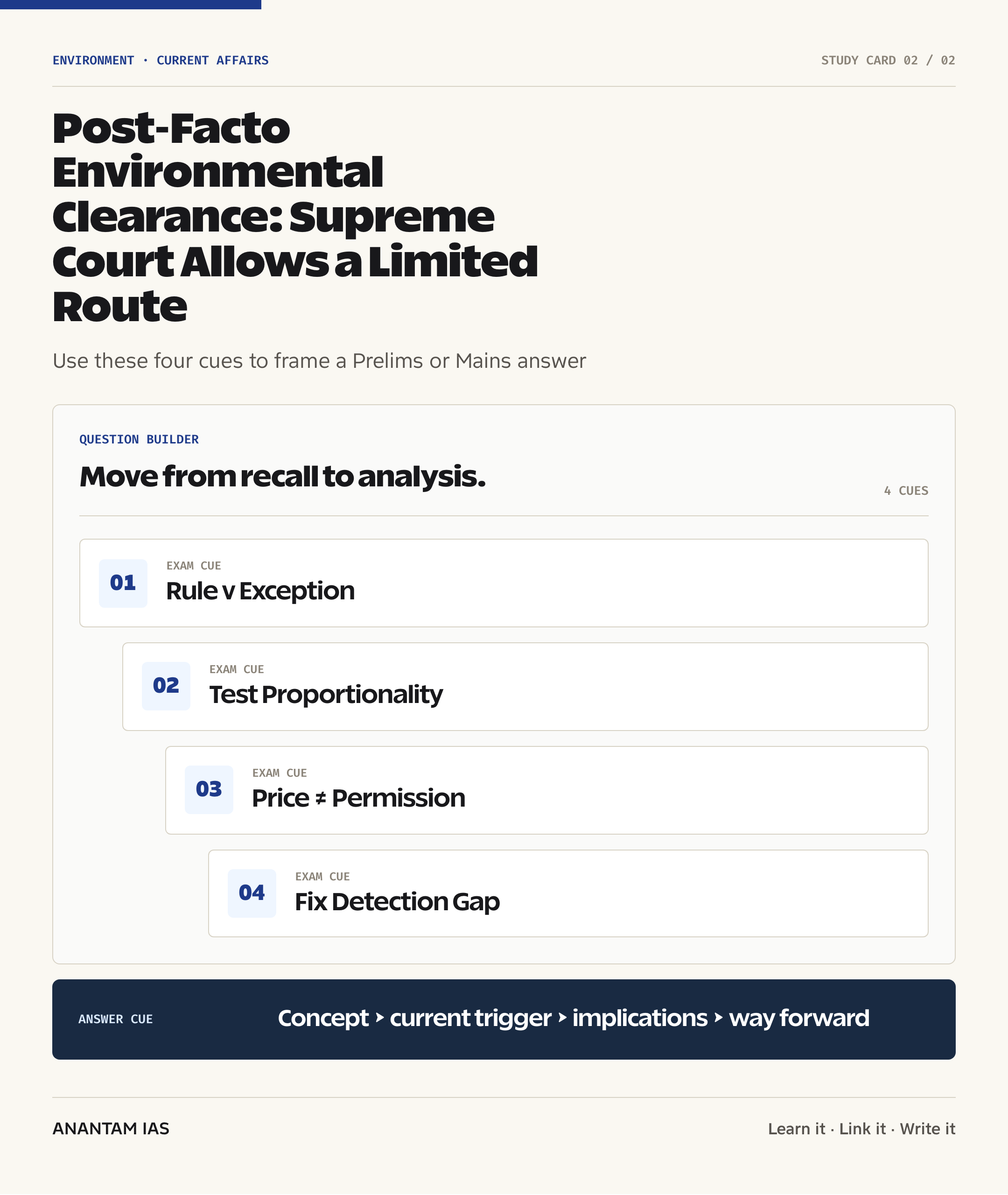
- Under Article 14, the eligible class must rest on an intelligible differentia linked to the object of the scheme; a blanket category covering every violator is vulnerable to arbitrariness.
- Under Article 21, decision-makers must treat environmental quality as part of life, health and dignity rather than as an optional administrative preference.
- The proportionality test asks whether regularisation pursues a legitimate public purpose, is necessary, uses the least harmful route and does not impose excessive ecological or rights costs.
- Under the precautionary principle, uncertainty is a reason for protective assessment, not a reason to postpone scrutiny until after the project is built.
- Under the polluter-pays principle, compensation must reflect damage, unlawful benefit and restoration needs; it is not a licence fee.
- Revise the ethical foundations through Environmental Ethics notes.
Why the Limited Route Remains Controversial
A tightly worded exception can still influence incentives throughout the regulatory system.
- Project proponents may expect future rescue if large investment, employment or an essential service makes closure politically and socially costly.
- A completed project’s impact assessment is structurally weaker because alternatives are no longer equal; demolition is compared with continuation instead of comparing locations before construction.
- Environmental compensation is difficult to calculate when harm is cumulative, long-term, dispersed across communities or linked to ecosystem services without a simple market price.
- Prospective invalidation protects reliance interests and avoids abrupt disruption, but it may leave affected communities to challenge earlier clearances one project at a time.
- The reduced reliance on criminal sanctions after the Jan Vishwas amendments makes meaningful monetary penalties, restoration bonds and official accountability even more important for deterrence.
A Better Answer-Building Framework
UPSC answers should avoid a binary environment-versus-development frame and test the quality of the exception.
- Start with the rule: prior EC is mandatory because prevention, alternatives and public participation cannot be fully reconstructed after construction.
- Acknowledge the hard case: immediate demolition of a hospital, pollution-treatment facility or essential public project may create fresh social and environmental costs.
- Apply four filters: exceptional public purpose, no deliberate evasion, scientifically feasible remediation and no less harmful alternative.
- Demand process safeguards: public disclosure, independent damage assessment, a reasoned order, time limits, judicial or NGT review and personal accountability for enabling officials.
- End with the principle that regularisation must repair a rare governance failure, not create a predictable business strategy of build first, seek permission later.
Way Forward
Prevent violations before construction
- Integrate project-registration, land-use, building-permission, mining, factory and pollution-board databases so an authority cannot issue a downstream approval when prior EC is missing.
- Require geotagged progress reporting and risk-based inspections for listed sectors, with automatic alerts to the SEIAA or MoEFCC when physical work begins before approval.
- Publish responsibility matrices naming the public officers who must detect and stop an unauthorised project at each stage.
Make any amnesty genuinely exceptional
- Define a closed eligibility date, narrow project class and objective public-interest threshold; exclude deliberate concealment, repeated offenders and projects causing irreversible ecological loss.
- Use an independent committee to test alternatives, assess damage and publish reasons before any post-facto decision.
- Protect public participation by giving affected communities access to the violation report, remediation plan and a meaningful hearing.
Link liability to restoration and deterrence
- Calculate compensation from ecological damage, unlawful economic benefit and restoration cost, rather than applying a low standard tariff.
- Use restoration bonds, milestone-based monitoring and third-party audits, with closure triggered by non-compliance.
- Fix disciplinary and financial responsibility on officials whose action or inaction allowed a project to become a fait accompli.
Strengthen review and transparency
- Create a public register of every violation case, appraisal record, penalty, remediation milestone and compliance report.
- Preserve effective access to the NGT and constitutional courts so affected people can test classification, science and proportionality.
- Audit whether the exception is shrinking or becoming the new normal.
Conclusion
The Supreme Court’s middle path keeps prior environmental clearance as the legal rule while recognising that a completed project may sometimes present a harder remedial choice than simple closure.
Its legitimacy will depend on implementation. A narrow, reasoned and supervised exception can address an unusual public-interest failure; a recurring amnesty would weaken the precautionary principle and reward strategic non-compliance.
The lasting reform is not a better post-facto form. It is a regulatory system that identifies violations early, hears affected communities before decisions harden, and makes both project proponents and public officials answer for preventable ecological harm.
UPSC Practice Questions
Prelims MCQ 1
With reference to environmental clearance in India, consider the following statements:
- The EIA Notification, 2006 requires prior environmental clearance for listed projects and activities.
- The 2017 relaxation was designed as a one-time, time-bound window for existing violation cases.
- An Office Memorandum cannot override the prior-clearance requirement contained in delegated legislation.
How many of the above statements are correct?
(a) Only one (b) Only two (c) All three (d) None
Answer: (c) All three
Explanation:
All three are correct. The 2006 notification makes prior EC the rule; the 2017 measure had a limited window; and the Supreme Court rejected the open-ended 2021 administrative mechanism for displacing that legal framework.
Prelims MCQ 2
Which environmental-law principle most directly supports assessment before potentially irreversible harm occurs?
(a) Polluter-pays principle (b) Precautionary principle (c) Public-trust doctrine (d) Absolute-liability principle
Answer: (b) Precautionary principle
Explanation:
The precautionary principle calls for anticipatory protective action when serious or irreversible environmental harm is possible. Polluter pays addresses the costs of prevention and remediation, but payment after damage cannot recreate a prior appraisal.
UPSC Mains Questions
- The Supreme Court’s 2026 ruling on post-facto environmental clearance preserves prior appraisal as the rule but permits a narrow statutory amnesty in exceptional public-interest cases. Examine whether proportionality can reconcile environmental rule of law with the consequences of closing completed public projects.
- Post-facto environmental clearance is not merely delayed paperwork; it alters alternatives, public participation and regulatory incentives. Discuss the institutional reforms needed to prevent projects from becoming a fait accompli before environmental scrutiny begins.
Sources: Supreme Court of India; Environment (Protection) Act, 1986 and The Hindu; The Indian Express.
Frequently Asked Questions
What is post-facto environmental clearance?
It is an environmental approval sought after a project has begun construction, expanded or started operations without the required prior clearance. It reverses the normal EIA sequence because regulators assess an existing project rather than a proposal. The Supreme Court said this cannot become a routine alternative to prior appraisal.
Did the Supreme Court permit all retrospective clearances?
No. The Court struck down the open-ended 2021 Office Memorandum and kept prior clearance as the rule. It allowed only the possibility of a narrow, time-bound statutory amnesty for exceptional projects serving a compelling public interest, supported by reasoned classification, deterrent liability and supervised ecological remediation.
Why was the 2021 Office Memorandum invalid?
The 2021 OM created a continuing administrative mechanism for violation cases. The Court held that an Office Memorandum could not override or supplant the prior-clearance regime established through the EIA Notification, 2006. Its open-ended coverage also failed to distinguish exceptional public-interest cases from ordinary non-compliance.
How is the 2017 notification different?
The 2017 notification offered a one-time route for projects already in violation, with a limited application window that ended in April 2018. The Court treated its closed period and statutory form as materially different from the 2021 OM, which attempted to maintain a perpetual route through an administrative instruction.
Can paying compensation legalise environmental harm?
Not by itself. The polluter-pays principle requires the polluter to bear prevention, damage and restoration costs, but it is not a licence to pollute. A valid exceptional remedy must still consider irreversible harm, alternatives, public participation, deterrent damages, remediation feasibility and the legality of the project.
What should a UPSC answer emphasise?
Begin with prior EC and the precautionary principle. Then acknowledge the difficult case of completed essential public infrastructure. Test any exception through public purpose, proportionality, scientific remediation, independent appraisal, transparency and accountability. Conclude that an amnesty must correct a rare failure, not encourage build-first behaviour.