
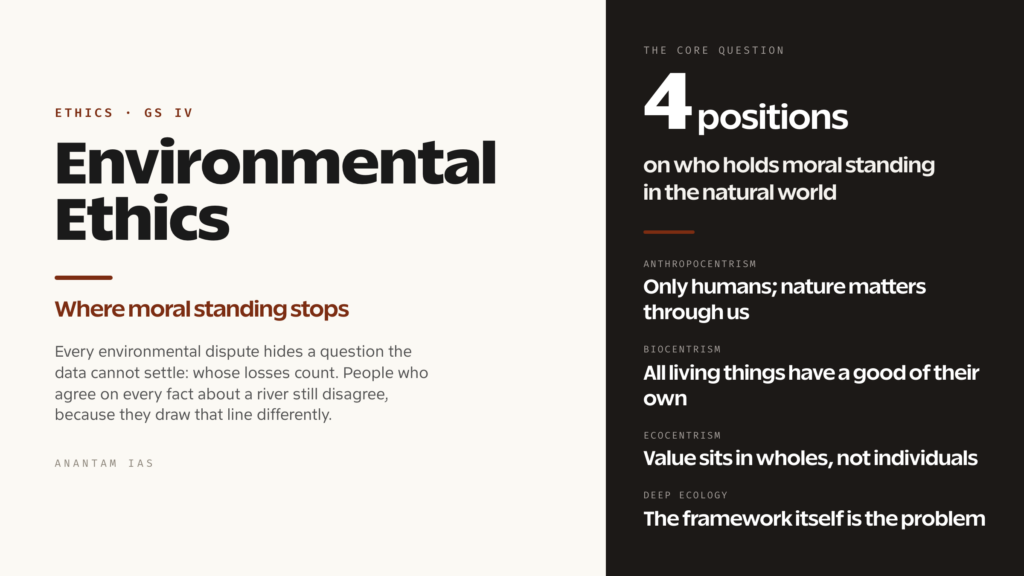
Every environmental dispute contains a hidden question that the technical arguments talk past. A dam will submerge a valley: we can measure the power generated, the people displaced, the species lost. What we cannot measure is whose losses count, and how much. That is not an empirical question, and no amount of data settles it.
Environmental ethics is the discipline that takes that question seriously. It asks who or what has moral standing — whose interests must figure in our reasoning at all — and it turns out that people who agree on every fact about a river can still disagree completely, because they draw that boundary in different places. Learning the positions matters because they are the load-bearing assumptions underneath policy, litigation and protest.
What Environmental Ethics Actually Asks
Three distinctions do most of the work, and confusing them is the commonest error.
Instrumental versus intrinsic value. Something has instrumental value if it is good for something else — a forest that stores carbon, a wetland that prevents floods. It has intrinsic value if it is good in itself, whether or not anyone benefits. Most policy language is instrumental, which is why “ecosystem services” is such a comfortable phrase: it converts nature into a stream of benefits to us. Whether anything in nature has intrinsic value is precisely what the positions below disagree about.
Moral standing versus moral agency. A being has moral standing if it can be wronged. It has moral agency if it can do wrong. An infant has standing without agency; so, arguably, does a tiger. Extending standing does not require pretending that animals have duties.
Individuals versus wholes. Do we owe things to individual organisms, or to species, ecosystems and processes? This sounds academic until you face a cull — killing individual animals to protect a habitat. Individualist ethics struggles to permit it; holistic ethics may require it.
Anthropocentrism: Nature as Resource
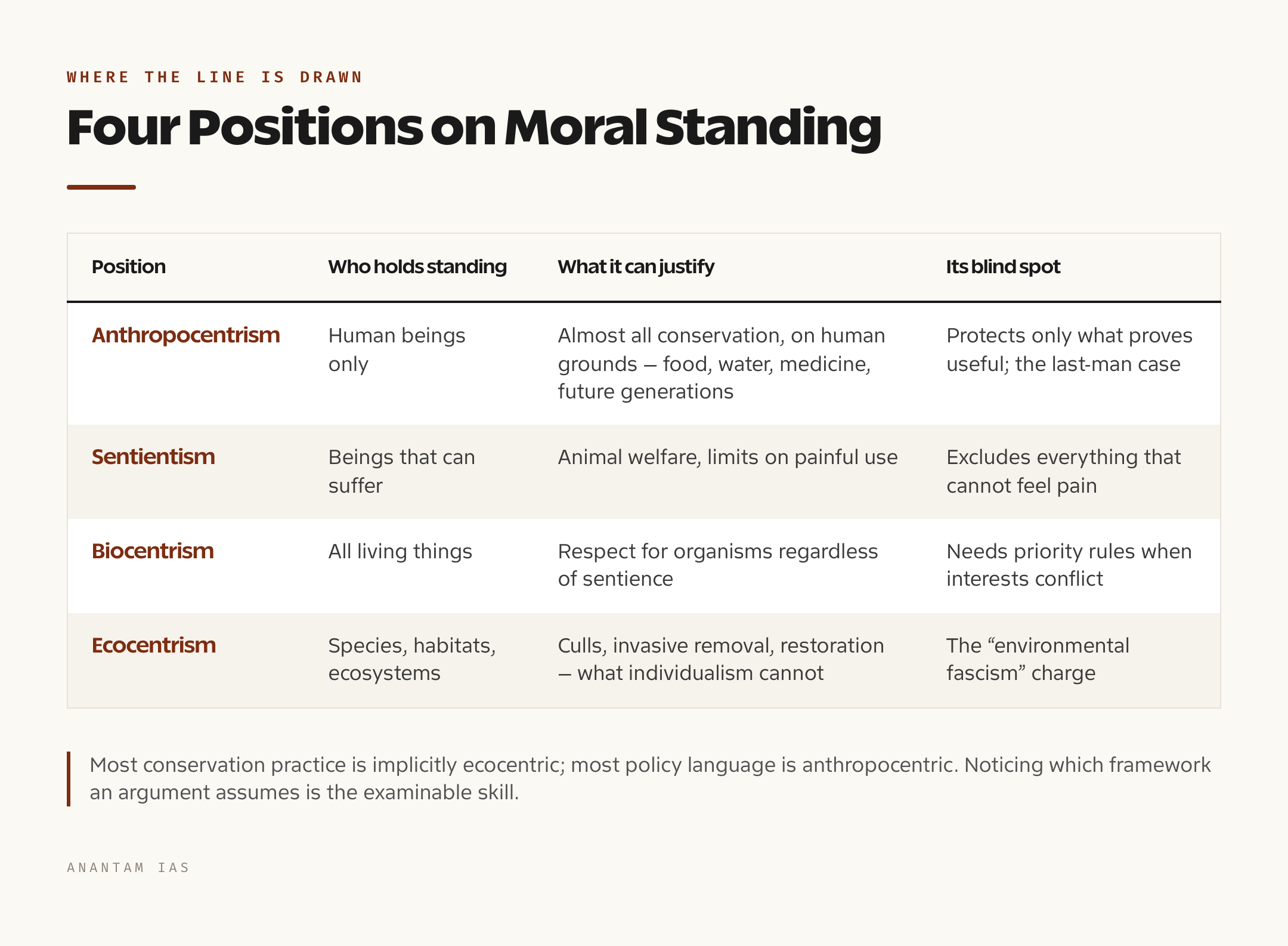
Anthropocentrism holds that only human beings have moral standing. Nature matters, sometimes enormously, but derivatively — because of what it does for us.
The position is stronger than caricature allows. A sophisticated anthropocentrist can justify almost every conservation measure on human grounds: biodiversity underpins food security and medicine, forests regulate water and climate, and future generations are human too. The argument for protecting a wetland need not mention the wetland’s own interests at all.
Two objections bite. The first is scope: anthropocentric reasoning protects only what happens to be useful, and cannot easily explain why an obscure species with no known utility should be saved. The second is the last-man argument — if the last human alive destroyed every remaining forest on the way out, anthropocentrism must say nothing was wronged. Most people find that conclusion hard to accept, which suggests our intuitions are not purely anthropocentric.
Indian constitutional and statutory language is largely, though not entirely, anthropocentric in form. Article 48A directs the state to protect and improve the environment and safeguard forests and wildlife, and Article 51A(g) makes it a fundamental duty of citizens to do the same, with compassion for living creatures — that last clause pointing beyond human interest.
Sentientism and Biocentrism
The first extension outward is to sentient beings — those capable of suffering. If pain is bad when a human feels it, the capacity to feel pain, not species membership, is what matters. This is the utilitarian route into animal ethics, and it is the argument behind objections to factory farming and painful experimentation. Its boundary is sharp: creatures that cannot suffer fall outside.
Biocentrism goes further and locates value in life itself. Albert Schweitzer’s reverence for life and Paul Taylor’s respect for nature both hold that every living thing has a good of its own — a direction of flourishing — and that this commands respect independent of sentience. A tree can be harmed even though it cannot suffer.
The difficulty is practical. If all life has standing, ordinary existence becomes a series of trade-offs between competing claims, and biocentrists must supply priority rules for when interests conflict. Taylor offers principles of self-defence, proportionality and restitutive justice, but the framework asks a great deal of anyone applying it under time pressure.
Ecocentrism and the Land Ethic
Ecocentrism relocates value from individuals to wholes — species, habitats, ecosystems, the biotic community. Aldo Leopold’s land ethic gives the classic formulation: a thing is right when it tends to preserve the integrity, stability and beauty of the biotic community, and wrong when it tends otherwise. Leopold’s shift was to think of the human being as a plain member and citizen of that community rather than its conqueror.
The advantage is that ecocentrism can say what individualist ethics cannot: that an invasive species should be removed, that a population should be culled to protect a habitat, that a species matters more than an equivalent number of individual organisms. Most conservation practice is implicitly ecocentric.
The objection is environmental fascism — the charge that a holistic ethic which subordinates individuals to the good of the whole could, applied consistently, justify sacrificing humans too. Defenders answer that the land ethic supplements rather than replaces our duties to persons. Whether that reply works is a live argument, and it is the sort of tension a good answer names rather than hides.
Deep Ecology
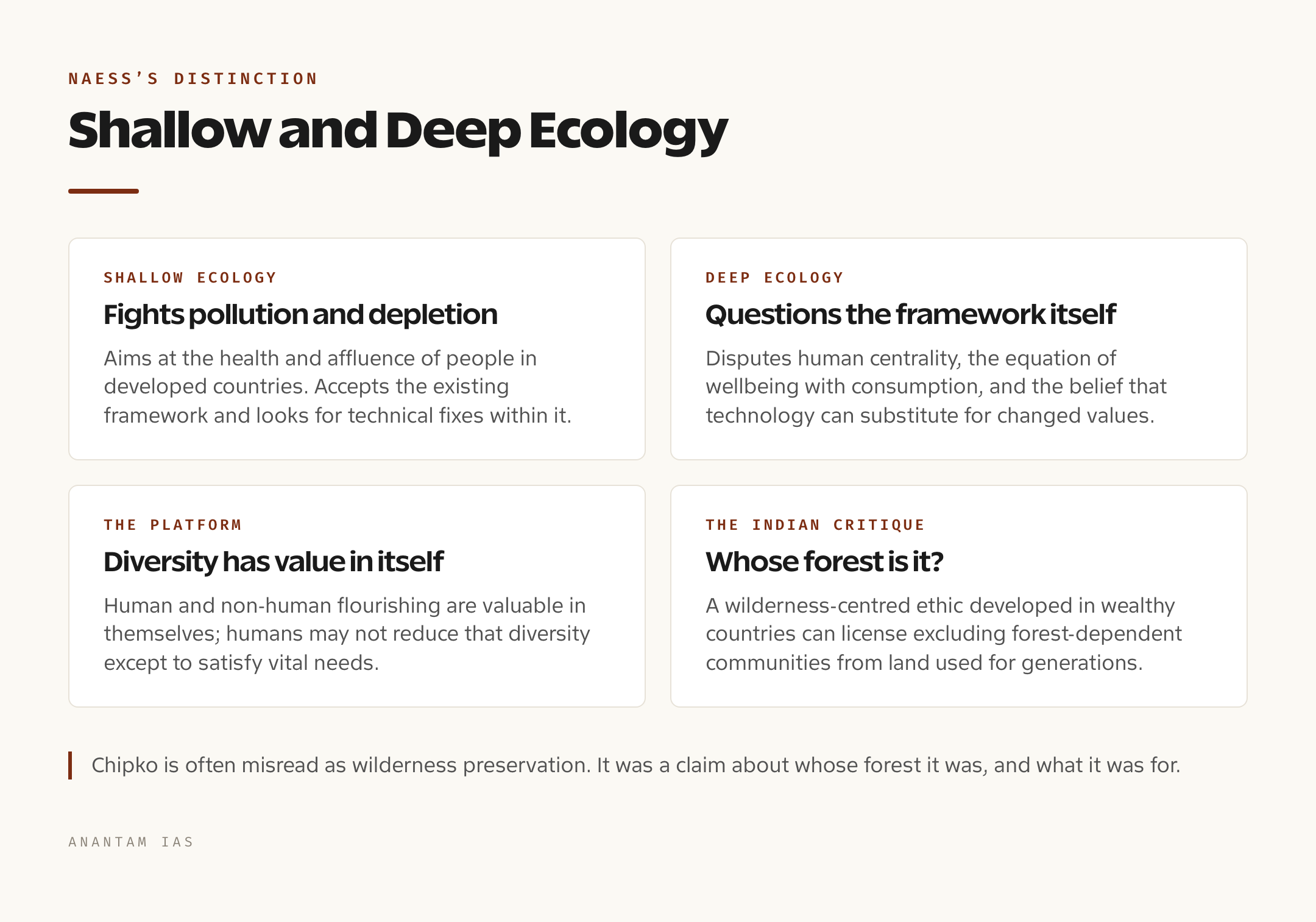
Arne Naess distinguished shallow from deep ecology. Shallow ecology fights pollution and resource depletion for the health and affluence of people in developed countries. Deep ecology questions the framework itself: the assumption of human centrality, the equation of wellbeing with consumption, and the belief that technical fixes can substitute for changed values.
The deep-ecology platform holds that the flourishing of human and non-human life has value in itself, that richness and diversity of life-forms are values in themselves, that humans have no right to reduce this diversity except to satisfy vital needs, and that present human interference is excessive. Naess paired it with self-realisation — the idea that a mature self identifies with a widening circle of life rather than standing apart from it.
Deep ecology is criticised for vagueness about what counts as a vital need, and for a strand of thinking about population that critics regard as indifferent to justice for the poor. The Indian critique, associated with scholars of environmental history, is sharper: a wilderness-centred ethic developed in wealthy countries can license excluding forest-dependent communities from land they have used for generations. That objection matters a great deal here.
The Indian Tradition
India’s traditions supply resources that predate the Western debate, and they do not map neatly onto it.
Dharma frames duties towards non-human life as obligations rather than sentiment. Ahimsa, most rigorously in Jain thought, extends non-injury far beyond sentient beings. The Bishnoi community’s protection of trees and blackbuck — including the willingness to die for them in the eighteenth century — is a lived ecocentrism rather than a theory of one. Sacred groves across the country conserved biodiversity through religious prohibition long before protected-area law existed. Ashoka’s edicts on animal welfare and tree planting are among the earliest state expressions of the idea.
The Chipko movement is the modern hinge, and it is often misread. It was not simply a wilderness-preservation campaign; it was a claim by hill communities about whose forest it was and what it was for. That is why Indian environmentalism is so frequently a livelihood question at the same time as a conservation one — a combination the imported categories handle badly.
Where the Frameworks Actually Bite
Abstract positions earn their keep when a decision has to be made.
Reintroducing a predator. West Bengal plans to reintroduce tigers into the Buxa Tiger Reserve. Anthropocentrism asks about tourism revenue, ecosystem services and the risk to nearby villagers. Ecocentrism asks whether the reserve’s ecological integrity requires an apex predator, and treats restoration as valuable in itself. Biocentrism raises the welfare of the individual translocated animals. And a livelihood-centred view asks what the reintroduction means for people whose access to the forest will tighten — a question none of the three Western frameworks foregrounds.
Development against habitat. A clearance decision is where the trade-off is unavoidable. The honest answer states the competing claims and the principle used to break the tie, rather than pretending conservation and development always align. Indian environmental jurisprudence supplies the tie-breakers: the precautionary principle and polluter pays, read into domestic law in the Vellore Citizens’ Welfare Forum case, and the public trust doctrine, applied in M.C. Mehta v. Kamal Nath, which treats certain natural resources as held by the state in trust rather than owned outright.
Disaster and triage. When extreme rainfall overwhelms a river basin, as in Assam’s floods, the ethical questions arrive as allocation problems: whose settlements are defended, whose are written off as floodplain, and whether embankments that protect one bank raise risk on the other. Intergenerational equity enters directly, because the cheapest response now often transfers risk forward.
The examinable skill is not picking a camp. It is being able to say which framework a given argument assumes, what that framework can and cannot justify, and where its blind spot lies.
FAQ
What is environmental ethics in simple terms? The study of our moral obligations towards the non-human world — which things have moral standing, whether nature has value in itself or only through its usefulness to us, and how to decide when human and non-human interests conflict.
What is the difference between anthropocentrism, biocentrism and ecocentrism? Anthropocentrism grants moral standing only to humans; nature matters instrumentally. Biocentrism grants it to all living things, each having a good of its own. Ecocentrism locates value in wholes — species, habitats and ecosystems — rather than in individuals.
What is deep ecology? Arne Naess’s position that environmental problems require questioning human centrality and consumption itself, not just controlling pollution. He contrasted it with “shallow” ecology, which pursues environmental fixes for human health and affluence.
What is Leopold’s land ethic? The principle that an action is right when it tends to preserve the integrity, stability and beauty of the biotic community, and wrong when it tends otherwise — with humans understood as members of that community rather than its masters.
What is the “last man” argument? A thought experiment: if the last surviving human destroyed all remaining forests before dying, has any wrong been done? Anthropocentrism must answer no. Most people’s intuition says yes, which is used to argue that nature has value beyond its usefulness to us.
Which constitutional provisions relate to environmental ethics in India? Article 48A directs the state to protect and improve the environment and safeguard forests and wildlife. Article 51A(g) makes protecting the environment and having compassion for living creatures a fundamental duty of citizens.
Why is Indian environmentalism often a livelihood question? Because forests and commons in India are inhabited and used. A purely wilderness-centred ethic can end up excluding communities who have depended on that land for generations, which is the central Indian criticism of imported deep-ecology framings.
Practice Questions
Prelims MCQs
- The view that only human beings possess moral standing, and nature matters through its usefulness to us, is: (a) biocentrism (b) anthropocentrism (c) ecocentrism (d) sentientism — Answer: (b) Anthropocentrism treats non-human nature as instrumentally rather than intrinsically valuable.
- “A thing is right when it tends to preserve the integrity, stability and beauty of the biotic community” is associated with: (a) Arne Naess (b) Paul Taylor (c) Aldo Leopold (d) Albert Schweitzer — Answer: (c) This is Aldo Leopold’s land ethic.
- The distinction between “shallow” and “deep” ecology was drawn by: (a) Rachel Carson (b) Arne Naess (c) Peter Singer (d) Garrett Hardin — Answer: (b) Naess distinguished pollution-and-resource environmentalism from a position questioning human centrality itself.
- Which fundamental duty relates directly to the environment? (a) Article 51A(a) (b) Article 51A(d) (c) Article 51A(g) (d) Article 51A(j) — Answer: (c) Article 51A(g) covers protecting the environment and having compassion for living creatures.
- The charge of “environmental fascism” is most commonly raised against: (a) anthropocentrism (b) sentientism (c) ecocentrism (d) shallow ecology — Answer: (c) Critics argue a holistic ethic subordinating individuals to the good of the whole could, applied consistently, sacrifice individual humans too.
Mains Practice Questions
- “Environmental disputes are settled by assumptions about moral standing long before they are settled by data.” Examine this claim with reference to a conservation decision in India. (15 marks, 250 words)
- Distinguish between instrumental and intrinsic value in nature. Can an anthropocentric ethic adequately justify biodiversity conservation? (15 marks, 250 words)
- Critically evaluate deep ecology from the standpoint of forest-dependent communities in India. (15 marks, 250 words)
- Ecocentrism can justify a cull that individualist ethics cannot. Discuss the ethical tension this reveals, and how it might be resolved. (10 marks, 150 words)
- Discuss how the precautionary principle and the public trust doctrine function as tie-breakers when conservation and development conflict. (10 marks, 150 words)
Tell Google you want more of this.
Add Anantam IAS as a preferred sourceOne tap, and this site shows up more often in your own Top Stories, AI Overviews and AI Mode. Remove it any time.