Prambanan temple: Indonesia’s Hindu heritage site and the India connection
Why in News?
Prime Minister Narendra Modi visited the Prambanan Temple complex in Yogyakarta, Indonesia on 8 July 2026 alongside Indonesian President Prabowo Subianto. The Indian Express reported that the visit marked the beginning of India’s effort to help restore the iconic UNESCO World Heritage Site — extending India’s heritage-restoration diplomacy in Southeast Asia to Indonesia’s grandest Hindu monument.
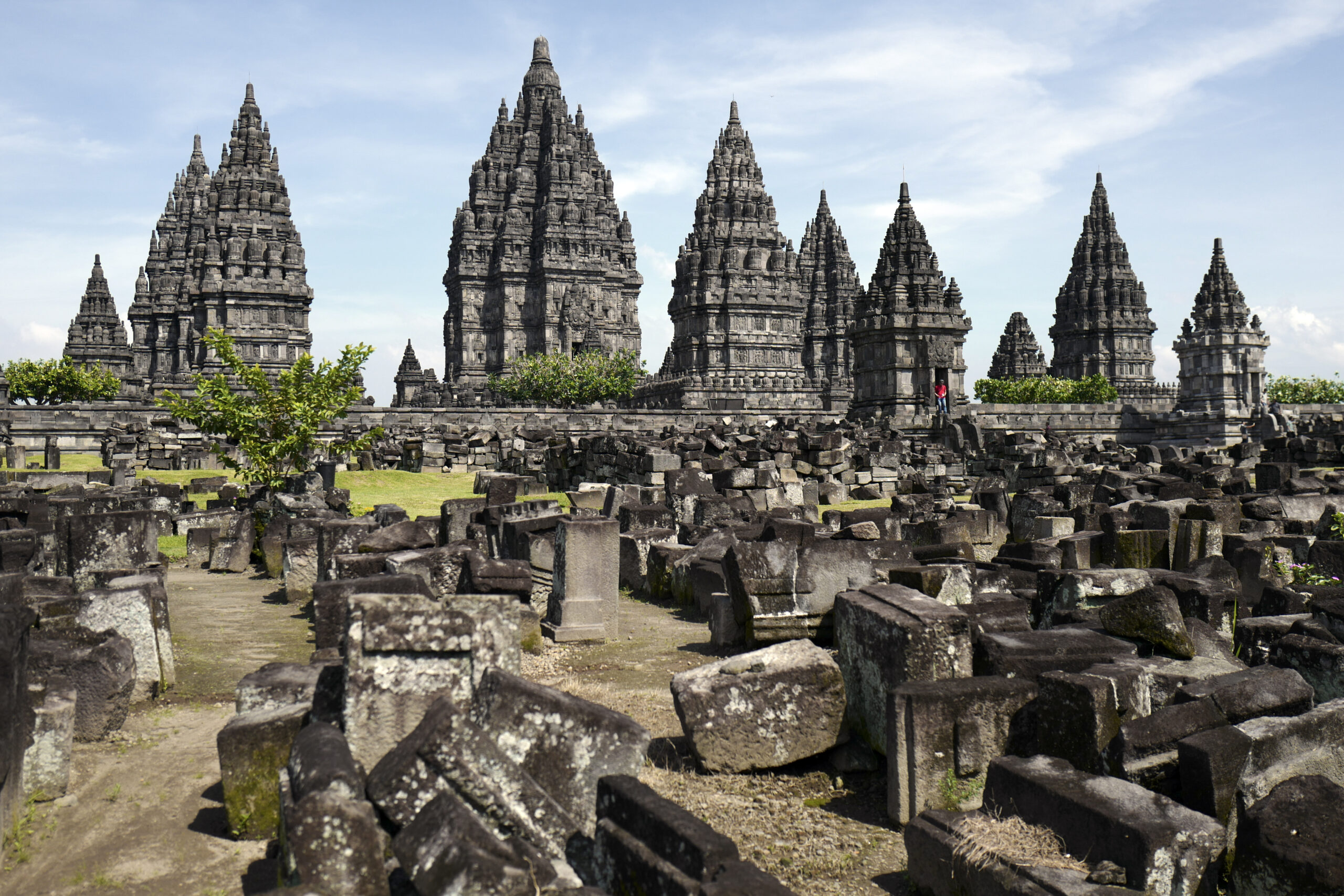
The 9th-century Prambanan Temple Compounds, sitting on the border of Indonesia’s Yogyakarta Special Region and Central Java province on the island of Java, form the largest temple compound dedicated to Shiva in Indonesia. For UPSC, the site bundles three high-yield threads into one topic: the Indianised kingdoms of Southeast Asia, classic Hindu temple architecture abroad, and contemporary cultural diplomacy.
- The PM’s stop at Prambanan came during his visit to Yogyakarta on 8 July 2026; India will assist in the restoration and conservation of the complex.
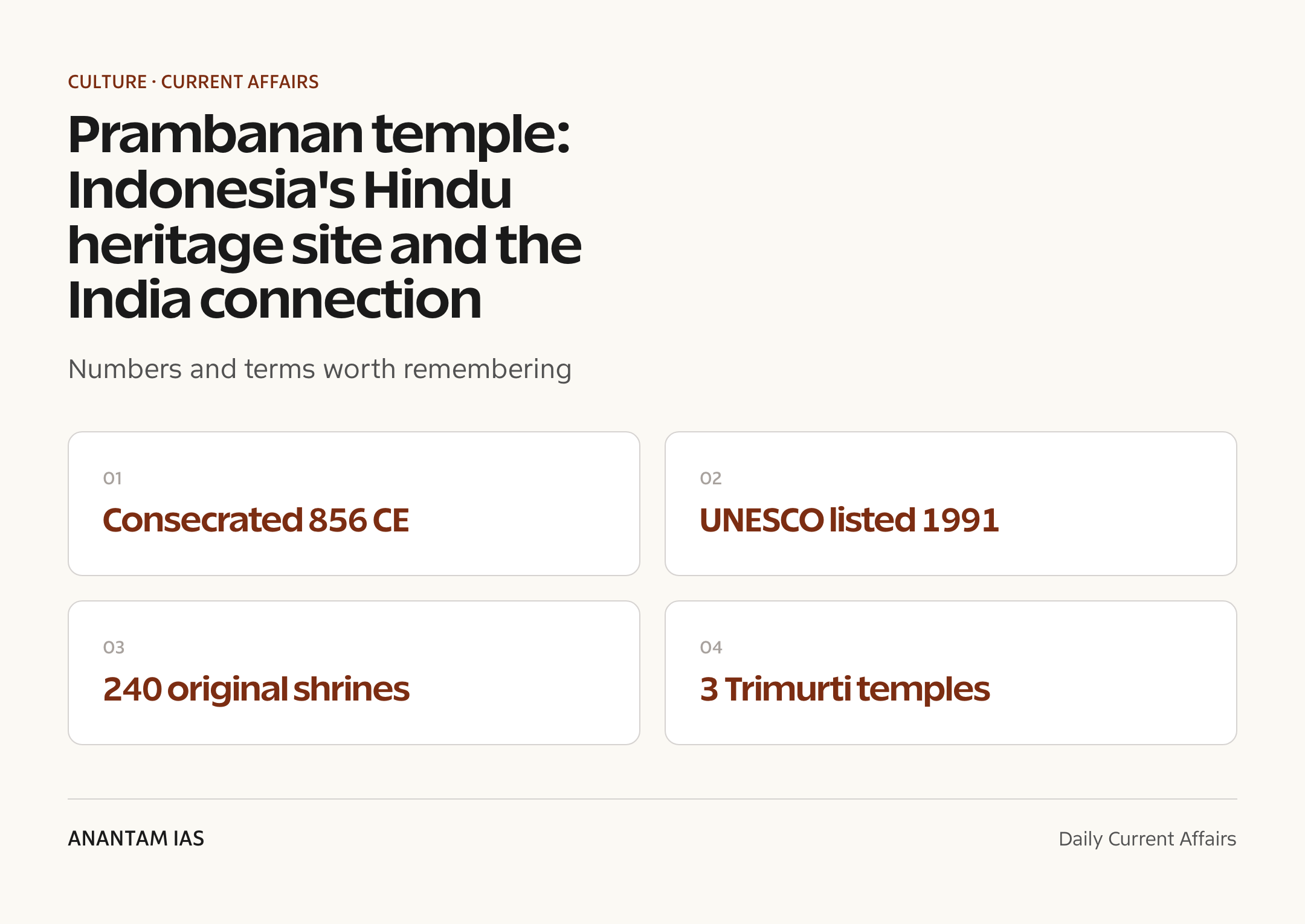
- The compounds include Prambanan Temple (also called Loro Jonggrang or Candi Prambanan) along with the Sewu, Bubrah and Lumbung temples — the central complex originally had about 240 large and small temples.
- Prambanan was inscribed on the UNESCO World Heritage List in 1991, declared a National Cultural Property of Indonesia in 1998, and is protected under a 2010 national conservation law.
- The move fits India’s record of restoring temples abroad through the Archaeological Survey of India (ASI) — from Angkor Wat in Cambodia to My Son in Vietnam.
- The visit was part of the PM’s three-nation Southeast Asia tour under the Act East Policy — covered in our companion note on the PM’s three-nation visit and Act East Policy.
The development matters in the context of:
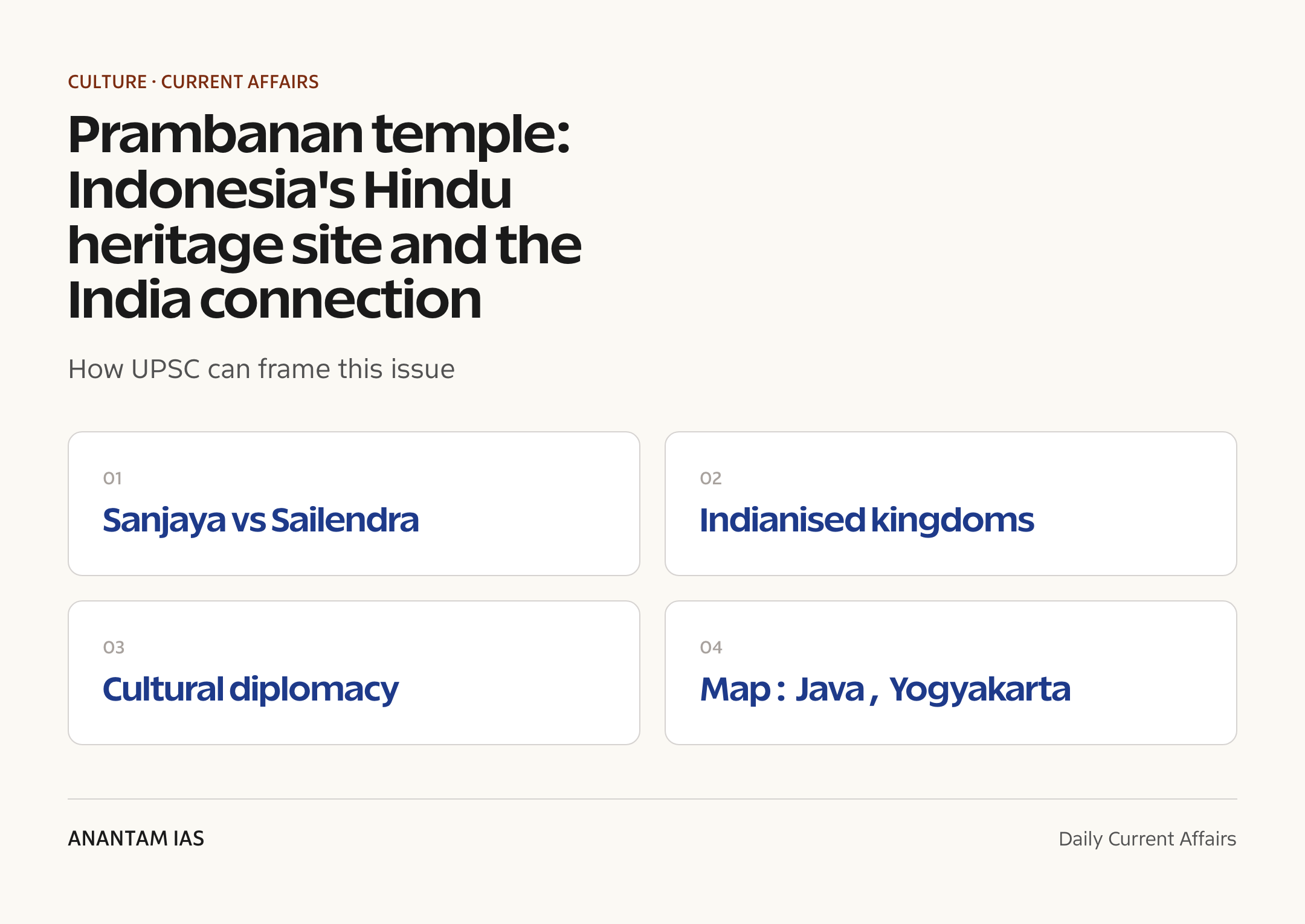
- For Prelims, Prambanan is a ready map-and-culture item: a named monument, a precise location (Java), datable dynasties and a UNESCO year — exactly the fact-cluster UPSC likes to test.
- For Mains, it illustrates how civilisational links with Southeast Asia — the so-called Greater India sphere — are being converted into instruments of soft power and bilateral goodwill.
- It also revives the classic GS1 theme of Indian cultural influence abroad: Sanskrit inscriptions, Ramayana traditions and temple-building in the Indonesian archipelago.
UPSC Relevance
Prelims Relevance
- Location: Prambanan lies on the border of the Yogyakarta Special Region and Central Java, on the island of Java, Indonesia.
- It is the largest Shiva temple compound in Indonesia; the main temple is locally called Loro Jonggrang.
- Commissioned by Rakai Pikatan of the Hindu Sanjaya dynasty (Mataram Kingdom); inscriptions record its consecration in 856 CE.
- Its construction marked the return of the Shaivite Sanjaya line after nearly a century of dominance by the Buddhist Sailendra dynasty — the builders of Borobudur.
- Three main shrines honour the Trimurti — Shiva, Vishnu and Brahma — faced by three shrines for their vahanas; relief panels depict scenes from the Ramayana.
- The northern chamber of the Shiva temple houses Durga as Mahishasuramardini, whom locals call Loro Jonggrang; the western chamber houses Ganesha.
- In Indonesian, candi means an ancient Hindu or Buddhist temple or shrine.
- The Mataram political centre shifted to East Java around 929–930 CE — often linked to an eruption of Mount Merapi — after which Prambanan was abandoned and buried under volcanic debris.
- Early documentation: Dutch East India Company official C A Lons (1733) and Thomas Stamford Raffles, Lieutenant-Governor of Java (1811–16); main-temple reconstruction begun in 1918 was completed in 1953 and inaugurated by President Soekarno.
- UNESCO World Heritage List: 1991 (Prambanan Temple Compounds).
Mains Relevance
GS Paper 1
- Indian cultural influence on Southeast Asia — religion, epics, temple architecture and kingship in the Indianised kingdoms of Java.
- Temple architecture as a source of history: what Prambanan’s Trimurti plan and Ramayana reliefs reveal about 9th-century religion and society.
- Religious syncretism: a Hindu king marrying a Buddhist princess, and Hindu and Buddhist candis built side by side in central Java.
GS Paper 2
- Cultural diplomacy and soft power in India’s Act East Policy — heritage restoration as a low-cost, high-goodwill instrument.
- Institutional dimension: the ASI’s overseas conservation portfolio (Angkor Wat, Ta Prohm, My Son, Bagan) and how it deepens bilateral ties.
Essay
- Civilisational connections as the quiet foundation of modern diplomacy — culture travels farther than armies.
- Heritage is not the past; it is a shared future — monuments as bridges between nations.
Background and Context
Where Prambanan sits and what it contains
Prambanan is not one temple but a cluster of compounds on Java’s volcanic plain.
- The Prambanan Temple Compounds straddle the border of the Yogyakarta Special Region and Central Java province, on the island of Java.
- The listed property comprises Prambanan Temple (Loro Jonggrang / Candi Prambanan) plus the nearby Sewu, Bubrah and Lumbung temples.
- The core Prambanan complex originally consisted of about 240 large and small temples, arranged around the towering central shrines.
- It is the largest temple compound dedicated to Shiva in Indonesia — the Shaivite counterpart to the Buddhist Borobudur, which lies in the same region of central Java.
- The name Prambanan is believed to derive from the village to which the complex once belonged; candi is the Indonesian word for an ancient Hindu or Buddhist shrine.
Sanjaya, Sailendra and the making of a Hindu sanctuary
Prambanan was born of a dynastic contest between a Shaivite and a Buddhist royal house.
- The Sanjaya dynasty ruled the Mataram Kingdom in central Java through the 8th and 9th centuries and is associated with the revival of Shaivite Hinduism on the island.
- Its dominance was challenged by the Sailendra dynasty, a powerful Buddhist house under whom Javanese art, architecture and Buddhist scholarship flourished; hundreds of temples and shrines rose between 700 and 900 CE.
- After the reign of Samaratungga of the Sailendras, Rakai Pikatan of the Sanjaya line is believed to have married Samaratungga’s daughter Pramodhawardhani, ruling between 842 and 856 CE.
- Rakai Pikatan is widely credited with commissioning Prambanan as a grand Hindu sanctuary; researcher Hary Gunarto notes it was intended to mark the return of the Hindu Sanjaya dynasty after nearly a century of Buddhist Sailendra dominance.
- The exact start of construction is uncertain, but inscriptions record the temple’s consecration in 856 CE; for about a century it served as an important pilgrimage centre.
Architecture: a Trimurti complex with a Ramayana gallery
The plan of Prambanan is a textbook statement of Shaivite theology rendered in stone.
- At the heart of the complex stand three temples to the Trimurti — Shiva, Vishnu and Brahma — decorated with relief panels narrating scenes from the Ramayana.
- Opposite them stand three temples dedicated to the gods’ vahanas (mounts) — the animal vehicles who serve them.
- Each of the four projecting sides of the main temple has a stairway leading to a separate chamber, or cella; the eastern stairway opens into the main chamber housing the statue of Shiva.
- The western chamber holds Ganesha; the northern chamber holds the famous Durga as Mahishasuramardini, shown with the demon drawn from the slain buffalo — local people call her Loro Jonggrang, giving the temple its popular name.
- Buddhist artistic influence is visible too: a stupa-like element tops the superstructure, and Buddhist candis of the same era — Sewu, Bubrah, Lumbung, Kalasan, Plaosan and Sari — ring the Hindu complex.
- The marriage of the Hindu ruler and the Buddhist princess, mirrored in this mixed sacred landscape, is often read as a symbol of religious harmony in 9th-century Java.
Abandonment, rediscovery and restoration
Prambanan’s biography runs from volcanic burial to a national icon of independent Indonesia.
- Around 929–930 CE the political centre of the Mataram Kingdom shifted to East Java — a move often linked to an eruption of Mount Merapi, though historians also cite political and economic reasons.
- As central Java emptied, Prambanan fell into disuse and was buried under vegetation and volcanic debris, largely forgotten for centuries.
- A possible early witness was the 15th-century East Javanese court poet Mpu Tanakung, whose description of a ruined temple complex closely matches Prambanan.
- The earliest known European account came from C A Lons, a Dutch East India Company official who toured the ruins in 1733, as scholar Roy E Jordaan records in his 1996 study In Praise of Prambanan.
- Thomas Stamford Raffles, Lieutenant-Governor of Java during the British interregnum (1811–16), took a keen interest in documenting central Java’s ancient monuments, including Prambanan.
- Modern reconstruction of the main temple began in 1918 but — interrupted by the Second World War and Indonesia’s independence struggle — was completed only in 1953, inaugurated by President Soekarno.
- Prambanan entered the UNESCO World Heritage List in 1991, became a National Cultural Property in 1998, and gained further protection under a 2010 national law on conservation.
The India connection: Indianised kingdoms of Southeast Asia
Prambanan is the most visible Javanese chapter of a much older story of Indian cultural transmission.
- From roughly the early centuries CE, Indian traders, priests and scholars carried Sanskrit, Hindu-Buddhist religion, epics and ideas of kingship across the Bay of Bengal, producing the Indianised kingdoms of Southeast Asia.
- Java’s Mataram rulers used Sanskrit-derived inscriptions, Puranic iconography and the Ramayana — the same epic carved on Prambanan’s balustrades and still performed in the celebrated Ramayana ballet staged beside the temple.
- The pattern repeats across the region: Angkor in Cambodia (Khmer), My Son in Vietnam (Champa), Bagan in Myanmar, and Borobudur-Prambanan in Java — all drawing on Indian religious and architectural vocabularies while remaining distinctly local creations.
- Indonesia today is a Muslim-majority nation that treats Prambanan and Borobudur as core national heritage, while Hindu traditions continue on Bali — a living bridge for India-Indonesia cultural ties.
- For GS1, the takeaway is adaptation, not transplantation: Javanese builders absorbed Indian templates and produced original forms — the candi is a Javanese invention with an Indian grammar.
India's restoration diplomacy: the ASI abroad
Helping restore Prambanan extends a proven Indian playbook of heritage diplomacy.
- The Archaeological Survey of India (ASI) has a long record of conserving monuments abroad — most famously at Angkor Wat in Cambodia, where it worked on the main temple from the late 1980s, and later at Ta Prohm.
- The ASI has also restored the Cham temple complex at My Son in Vietnam and the Ananda Temple at Bagan in Myanmar — projects that pair technical conservation with visible goodwill.
- Prambanan brings Indonesia — Southeast Asia’s largest country and a key Indo-Pacific partner — into this circuit, reinforcing the civilisational pillar of the Act East Policy.
- Heritage cooperation is classic soft power: modest budgets, durable symbolism, and direct people-to-people resonance in a country where the Ramayana remains popular culture.
- Read it with the strategic backdrop of the PM’s tour in our note on the three-nation visit and Act East Policy, and explore more topics in Art and Culture.
Way Forward
Institutionalise heritage cooperation
- Convert the Prambanan commitment into a time-bound conservation MoU with clear ASI deliverables, joint documentation and training of Indonesian conservators.
- Build a standing India-ASEAN heritage-conservation programme so projects outlive individual summits, drawing on the Angkor and My Son templates.
Deepen the cultural bridge
- Pair stone conservation with living culture — Ramayana festivals, museum exchanges, digital archives and university partnerships on Southeast Asian studies.
- Develop joint heritage-tourism circuits (Borobudur–Prambanan with Indian Buddhist and temple circuits) to give the diplomacy an economic base.
Conclusion
Prambanan compresses a millennium of shared history into a single skyline: a Shaivite sanctuary raised by the Sanjaya kings in 856 CE, buried by a volcano, recovered by scholars, and now embraced by two modern republics as common inheritance. India’s offer to help restore it is cultural diplomacy at its most natural — the restorer and the restored share the same epic.
For the exam, file Prambanan alongside Borobudur, Angkor and My Son as the monument-map of Indianised Southeast Asia, and alongside the ASI’s overseas projects as the policy face of Indian soft power. One site, two GS papers, and a very likely map question.
UPSC Practice Questions
Prelims MCQ 1
With reference to the Prambanan Temple Compounds, consider the following statements:
- It is the largest temple compound dedicated to Shiva in Indonesia.
- Its construction is credited to the Buddhist Sailendra dynasty.
- It is inscribed on the UNESCO World Heritage List.
How many of the above statements are correct?
(a) Only one (b) Only two (c) All three (d) None
Answer: (b) Only two
Explanation:
Statements 1 and 3 are correct: Prambanan is Indonesia’s largest Shiva temple compound and was UNESCO-listed in 1991. Statement 2 is incorrect — it was commissioned by Rakai Pikatan of the Hindu Sanjaya dynasty (consecrated 856 CE), marking the Sanjaya return after Buddhist Sailendra dominance; the Sailendras are associated with Borobudur.
Prelims MCQ 2
The Sanjaya and Sailendra dynasties, associated with the Prambanan and Borobudur temples respectively, ruled over which of the following regions?
(a) Central Java, Indonesia (b) Sumatra, Indonesia (c) Bali, Indonesia (d) The Malay Peninsula
Answer: (a) Central Java, Indonesia
Explanation:
Both dynasties ruled the Mataram Kingdom region of central Java in the 8th-9th centuries CE. The Shaivite Sanjayas built Prambanan; the Buddhist Sailendras are linked to Borobudur. The political centre shifted to East Java around 929-930 CE, after which Prambanan was abandoned.
UPSC Mains Questions
- The temples of Southeast Asia are Indian in grammar but local in genius. Discuss with reference to Prambanan, Borobudur and Angkor, and examine what such monuments reveal about the process of cultural transmission from India. (250 words)
- Heritage restoration abroad has become a distinctive instrument of India’s cultural diplomacy. Examine its role in the Act East Policy, citing the work of the Archaeological Survey of India in Southeast Asia. (250 words)
Sources: Indian Express Explained and UNESCO World Heritage Centre.
Frequently Asked Questions
Where is the Prambanan temple located?
Prambanan stands on the border of Indonesia’s Yogyakarta Special Region and Central Java province, on the island of Java. The UNESCO-listed compounds include Prambanan (Loro Jonggrang), Sewu, Bubrah and Lumbung temples, originally comprising about 240 large and small shrines.
Who built the Prambanan temple and when?
Rakai Pikatan of the Hindu Sanjaya dynasty, ruler of the Mataram Kingdom, is credited with commissioning Prambanan. Inscriptions record its consecration in 856 CE. Its construction marked the Sanjaya dynasty’s return to power after nearly a century of Buddhist Sailendra dominance in central Java.
Which deities is Prambanan dedicated to?
Prambanan is Indonesia’s largest Shiva temple compound. Its three central shrines honour the Trimurti — Shiva, Vishnu and Brahma — faced by shrines to their vahanas. The Shiva temple also houses Ganesha and Durga as Mahishasuramardini, locally called Loro Jonggrang, and carries Ramayana relief panels.
When did Prambanan become a UNESCO World Heritage Site?
The Prambanan Temple Compounds were inscribed on the UNESCO World Heritage List in 1991. Indonesia designated the site a National Cultural Property in 1998, and a 2010 national law further supports its protection and conservation. Borobudur, nearby in central Java, was also listed in 1991.
Why is Prambanan in the news for India?
Prime Minister Modi visited Prambanan in Yogyakarta on 8 July 2026 with President Prabowo Subianto, beginning India’s effort to help restore the complex. It extends the ASI’s heritage-restoration diplomacy — seen earlier at Angkor Wat, Ta Prohm, My Son and Bagan — to Indonesia.
How was Prambanan rediscovered after its abandonment?
After Mataram’s centre shifted to East Java around 929-930 CE, Prambanan lay buried under volcanic debris. Dutch East India Company official C A Lons reported the ruins in 1733, Stamford Raffles documented them during 1811-16, and reconstruction begun in 1918 was completed in 1953 under President Soekarno.