Why in News?
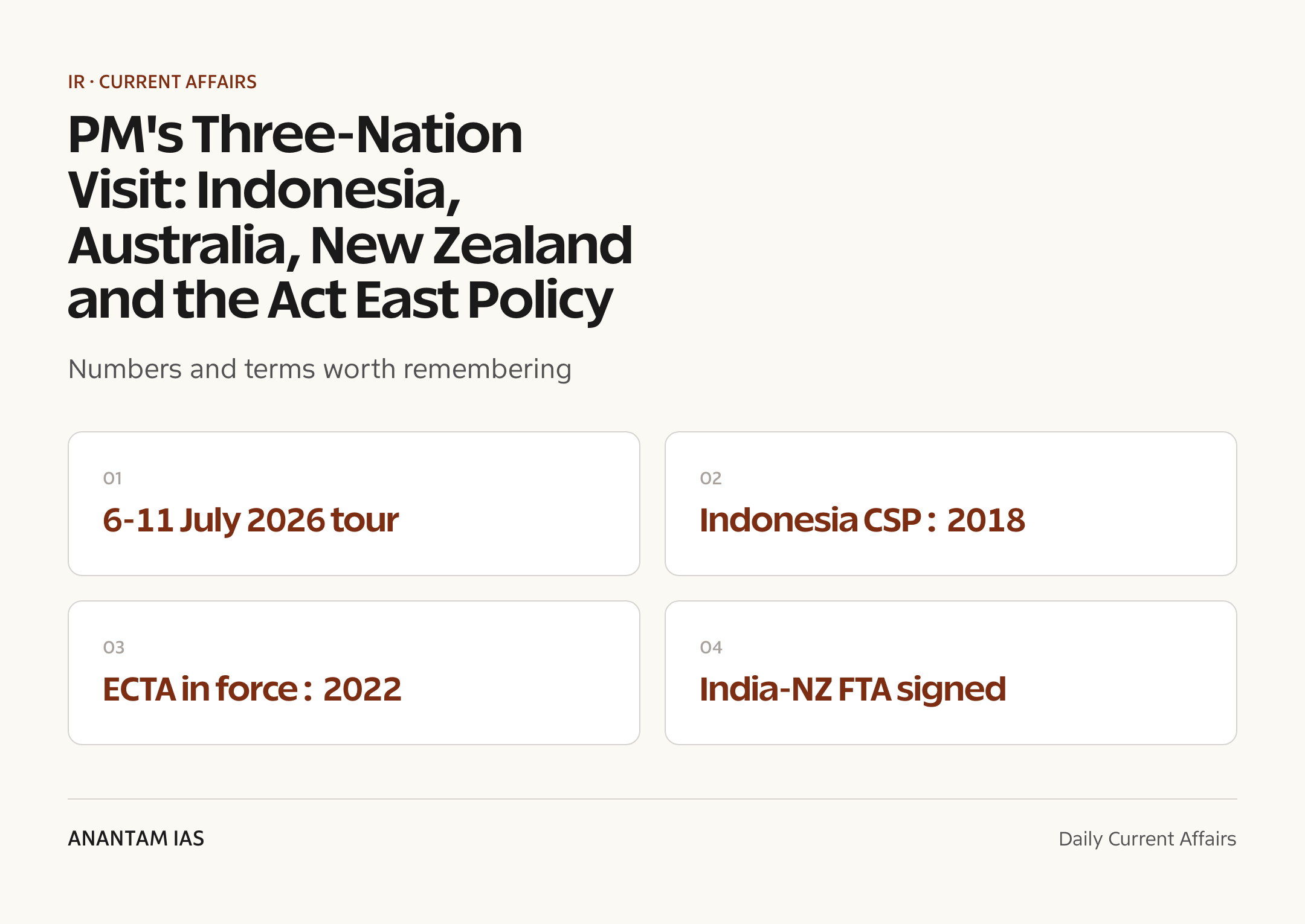
The Prime Minister began a three-nation visit to Indonesia, Australia and New Zealand from 6-11 July 2026. PIB released his departure statement, which frames the tour as a single strategic arc — from the Eastern Indian Ocean (Indonesia) through the Southern Indian Ocean (Australia) to the South Pacific (New Zealand).
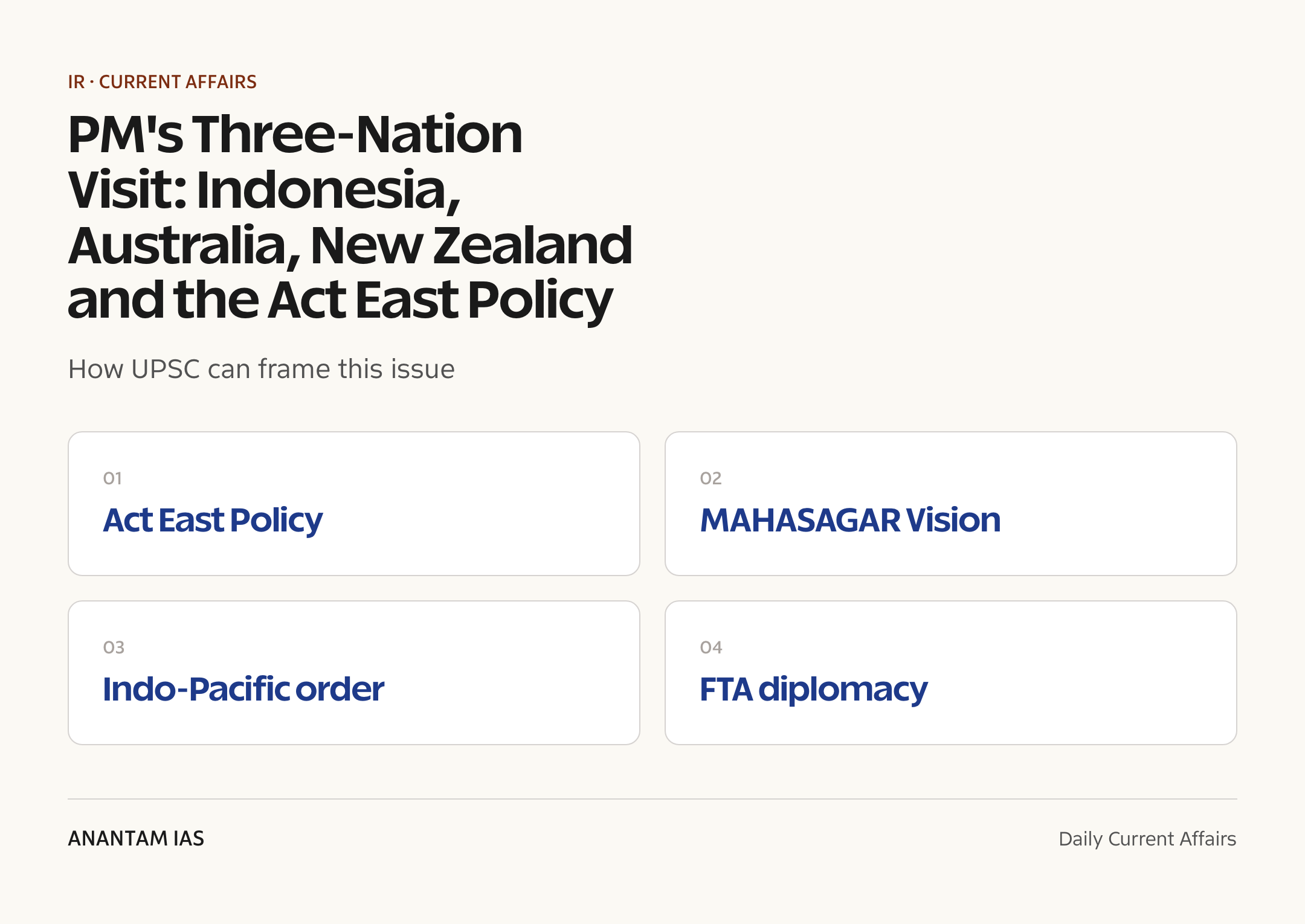
The PM said the visit will strengthen India’s Act East Policy, the MAHASAGAR Vision and the country’s outlook towards a free and open Indo-Pacific. The Hindu reported that this is his first bilateral visit to Indonesia since ties were elevated to a Comprehensive Strategic Partnership (CSP) in 2018.
- Indonesia leg (6-8 July): at the invitation of President Prabowo Subianto; first bilateral PM visit after the 2018 CSP elevation, and a return call after Prabowo was Republic Day 2025 chief guest.
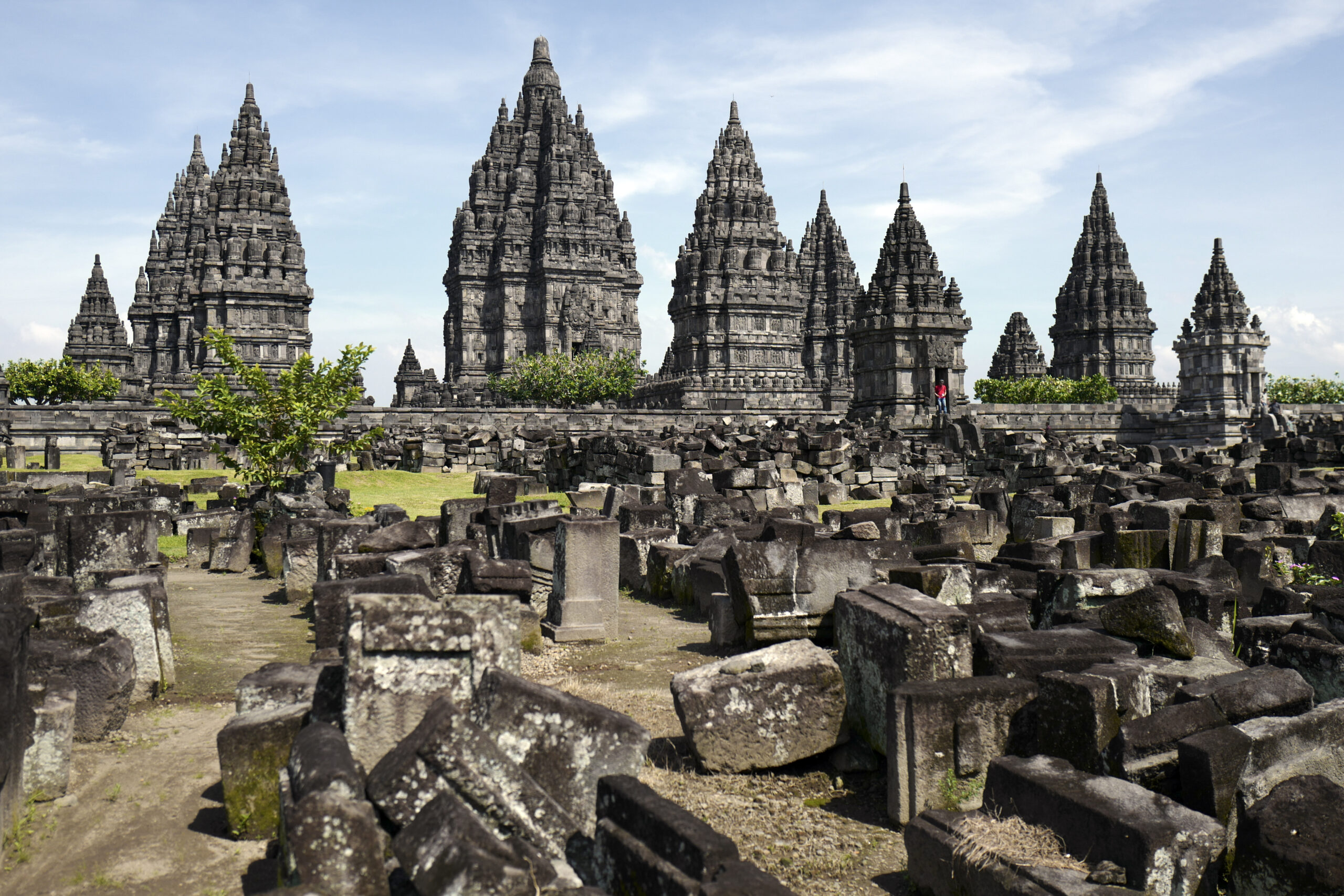
- The PM will visit the Prambanan Temple complex at Yogyakarta with President Prabowo — a 9th-century Hindu temple ensemble that showcases civilisational links.
- Australia leg (Melbourne): talks with PM Anthony Albanese on defence and security, trade and investment, education and mobility, plus emerging and critical technologies and sports science.
- New Zealand leg (Auckland): talks with PM Christopher Luxon, building on Luxon’s March 2025 India visit and the newly signed India-New Zealand Free Trade Agreement.
- Diaspora outreach is a common thread — the PM will address Indian communities in all three countries.
The development matters in the context of:
- The tour is a live case study of how Act East has widened from an ASEAN-centred economic outreach into a full Indo-Pacific strategy spanning Southeast Asia and Oceania.
- It stitches together three different instruments of foreign policy — CSP-level summitry (Indonesia, Australia), trade agreements (ECTA, India-NZ FTA) and diaspora diplomacy.
- The explicit reference to MAHASAGAR signals that India’s maritime doctrine, first articulated as SAGAR in 2015, now anchors even bilateral visits.
UPSC Relevance
Prelims Relevance
- Act East Policy — announced in November 2014 at the 12th India-ASEAN Summit in Nay Pyi Taw, Myanmar; upgrade of the 1992 Look East Policy.
- The 4 Cs of Act East: Culture, Commerce, Connectivity, Capacity building.
- MAHASAGAR — Mutual and Holistic Advancement for Security and Growth Across Regions; unveiled during the PM’s Mauritius visit in March 2025 as the evolution of SAGAR (2015).
- India-Indonesia Comprehensive Strategic Partnership — elevated in 2018; President Prabowo Subianto was chief guest at Republic Day 2025.
- Prambanan — 9th-century Hindu temple complex near Yogyakarta, Indonesia; a UNESCO World Heritage Site dedicated to the Trimurti.
- India-Australia CSP dates from the June 2020 virtual summit; the ECTA trade pact entered into force in December 2022.
- Quad members: India, USA, Japan, Australia — New Zealand is NOT a member.
- India-New Zealand FTA — negotiations launched during PM Luxon’s March 2025 visit; the agreement has since been signed, per the PIB statement.
- Indo-Pacific Oceans Initiative (IPOI) — proposed by India at the East Asia Summit, Bangkok, 2019.
Mains Relevance
GS Paper 2
- Evolution of the Act East Policy from Look East: drivers, instruments and outcomes across ASEAN and Oceania.
- India-Indonesia ties as the fulcrum of maritime-neighbour diplomacy — CSP, defence cooperation and ASEAN centrality.
- Trade-led statecraft: how ECTA and the India-NZ FTA convert strategic convergence into economic interdependence.
- Diaspora diplomacy as a pillar of bilateral partnerships in Australia and New Zealand.
GS Paper 3
- Maritime security in the Indo-Pacific: SAGAR to MAHASAGAR, sea-lane security and the Andaman Sea neighbourhood.
- Critical minerals and emerging technologies cooperation with Australia as a supply-chain resilience play.
Essay
- Geography is destiny: India’s two-ocean future and the Indo-Pacific century.
- Soft power and civilisational connect as instruments of foreign policy — from Prambanan to the diaspora.
- Trade agreements as the new alliances: economics at the heart of 21st-century strategy.
Background and Context
From Look East to Act East: the policy arc
The visit sits squarely within a three-decade evolution of India’s eastern engagement.
- The Look East Policy (1992), launched under PM P. V. Narasimha Rao after the balance-of-payments crisis, sought economic integration with the fast-growing economies of Southeast Asia.
- It was upgraded to the Act East Policy in November 2014 at the 12th India-ASEAN Summit in Nay Pyi Taw, Myanmar — shifting from passive economic engagement to proactive strategic, security and connectivity partnerships.
- Act East rests on the 4 Cs — Culture, Commerce, Connectivity, Capacity building — and now extends beyond ASEAN to Japan, South Korea, Australia, New Zealand and the Pacific Island states.
- This tour operationalises that wider canvas: Indonesia anchors the ASEAN pillar, while Australia and New Zealand represent the Oceania extension of Act East.
- The PM’s own framing — Indonesia in the Eastern Indian Ocean, Australia in the Southern Indian Ocean, then New Zealand — presents the three legs as one continuous maritime geography, not three separate bilaterals.
India-Indonesia: the first leg (6-8 July)
Jakarta is the strategic heart of the tour — a giant maritime neighbour and ASEAN’s largest economy.
- India and Indonesia elevated ties to a Comprehensive Strategic Partnership during the PM’s first visit in 2018; PIB confirmed this is his first bilateral visit since that elevation.
- The visit reciprocates President Prabowo Subianto’s state visit as chief guest at Republic Day, 26 January 2025 — a slot India reserves for its closest partners.
- The two countries are close maritime neighbours: India’s Andaman and Nicobar Islands lie near Indonesia’s Aceh province across the Andaman Sea, making Jakarta central to India’s sea-lane security.
- Defence ties include coordinated naval patrols (IND-INDO CORPAT) and the bilateral naval exercise Samudra Shakti.
- Indonesia is the world’s largest archipelagic state and its largest Muslim-majority nation — yet the shared Ramayana-Mahabharata heritage gives the relationship a rare civilisational depth.
- The joint visit to the Prambanan Temple complex at Yogyakarta — a 9th-century Hindu temple ensemble and UNESCO World Heritage Site — is deliberate cultural signalling of that shared inheritance.
India-Australia: the Melbourne leg
The Australia stop consolidates one of India’s fastest-deepening strategic partnerships.
- India and Australia elevated ties to a Comprehensive Strategic Partnership at the June 2020 virtual summit; both are Quad members alongside the USA and Japan.
- The Economic Cooperation and Trade Agreement (ECTA) entered into force in December 2022 — India’s first trade pact with a developed economy in over a decade — and talks continue on a fuller CECA.
- Per the departure statement, the agenda spans defence and security, trade and investments, education and mobility, and people-to-people ties.
- New frontiers flagged by the PM: emerging and critical technologies and sports and sports science — the latter notable ahead of Brisbane 2032 and India’s own Olympic ambitions.
- Australia is a key partner for critical minerals (lithium, cobalt, rare earths) that feed India’s clean-energy and semiconductor plans.
- The Indian diaspora in Australia, which the PM called an important pillar of the partnership, is among the country’s fastest-growing migrant communities.
India-New Zealand: the Auckland leg and the FTA
The final stop converts a long-quiet relationship into a trade-first partnership.
- The visit builds on PM Christopher Luxon’s visit to India in March 2025, when the two sides launched free trade negotiations after a decade-long freeze.
- PIB confirmed the two countries have now signed a Free Trade Agreement — the anchor of the Auckland conversations on economic, trade and commercial engagement.
- For New Zealand, India offers market diversification away from over-dependence on China; for India, the FTA extends its Oceania footprint beyond Australia.
- The Indian community in New Zealand has, in the PM’s words, contributed significantly to bilateral ties; he will address a large diaspora gathering in Auckland.
- Both countries share stakes in a rules-based South Pacific, where infrastructure and aid competition among major powers has intensified.
SAGAR to MAHASAGAR: the doctrinal frame
The visit’s vocabulary matters as much as its itinerary.
- SAGAR (Security and Growth for All in the Region), announced in Mauritius in 2015, was India’s first named maritime doctrine for the Indian Ocean.
- It was upgraded to MAHASAGAR — Mutual and Holistic Advancement for Security and Growth Across Regions — during the PM’s Mauritius visit in March 2025, widening the canvas from the Indian Ocean region to the broader Indo-Pacific and the Global South.
- The Hindu noted the PM’s statement explicitly tied this tour to MAHASAGAR and to a free, open and inclusive Indo-Pacific — language that signals convergence with partners wary of coercion in the region.
- Complementary frameworks: the Indo-Pacific Oceans Initiative (IPOI, 2019), the Quad, and India’s ASEAN-centrality posture all plug into the same architecture.
- Taken together, the doctrine stack shows India positioning itself as a net security provider and development partner, not merely a balancer.
Significance and the harder questions
The tour advances real interests, but examiners reward candidates who also see the friction points.
- Strategic: three democracies on one arc deepen India’s options in a contested Indo-Pacific without formal alliance commitments.
- Economic: ECTA and the India-NZ FTA give Act East a trade backbone that the older Look East era lacked; Indonesia remains India’s largest ASEAN trading partner.
- Challenges: India stayed out of RCEP (2019), so bilateral FTAs must do the heavy lifting of regional economic integration.
- Defence and connectivity promises with Indonesia (including port and patrol cooperation near the Malacca Strait approaches) have historically moved slower than announced.
- Balancing deep economic ties with China — the top trading partner of Indonesia, Australia and New Zealand alike — limits how far each partner will go on security alignment.
- Diaspora diplomacy cuts both ways: it builds constituencies for India, but visa, mobility and community-safety issues need steady consular follow-through.
Way Forward
Institutionalise the gains
- Convert summit momentum into scheduled mechanisms — annual leader-level meetings, 2+2 style dialogues and delivery-bound joint working groups with Indonesia.
- Fast-track utilisation of the India-NZ FTA and push the India-Australia CECA to completion so tariff gains reach exporters quickly.
Build the maritime spine
- Deepen maritime domain awareness sharing, coordinated patrols and humanitarian-assistance capacity across the Andaman Sea and South Pacific under MAHASAGAR.
- Pair security cooperation with visible development delivery — connectivity, digital public infrastructure and capacity building — to keep ASEAN centrality credible.
Sustained diaspora engagement — mobility partnerships, mutual recognition of qualifications and student pathways — can quietly compound every other pillar of these three relationships.
Conclusion
The three-nation tour is Act East in motion: one journey linking a civilisational partner in ASEAN, a Quad ally in the Southern Indian Ocean and a new FTA partner in the South Pacific. The PIB statement’s closing line — that the visit strengthens the Act East Policy, MAHASAGAR and a free and open Indo-Pacific — is effectively a one-sentence summary of India’s eastern strategy.
For the exam, treat this visit as a peg to revise the whole framework: Look East to Act East, SAGAR to MAHASAGAR, CSP diplomacy, and the growing role of trade agreements and the diaspora in India’s external engagement. The durable syllabus behind the headline is what UPSC will test.
UPSC Practice Questions
Prelims MCQ 1
With reference to India’s recent three-nation visit and its eastern-engagement frameworks, consider the following statements:
- The Act East Policy was announced in 2014 as an upgrade of the earlier Look East Policy.
- India and Indonesia elevated their relationship to a Comprehensive Strategic Partnership in 2018.
- Both Australia and New Zealand are members of the Quad grouping.
How many of the above statements are correct?
(a) Only one (b) Only two (c) All three (d) None
Answer: (b) Only two
Explanation:
Statements 1 and 2 are correct — Act East was announced at the 12th India-ASEAN Summit (Nay Pyi Taw, 2014), and India-Indonesia ties became a CSP during the PM’s 2018 visit. Statement 3 is wrong: the Quad comprises India, the USA, Japan and Australia; New Zealand is not a member.
Prelims MCQ 2
The ‘MAHASAGAR’ vision, often mentioned alongside India’s Indo-Pacific outreach, is best described as:
(a) A deep-ocean mineral exploration mission of the Ministry of Earth Sciences (b) India’s vision of Mutual and Holistic Advancement for Security and Growth Across Regions, evolving from the earlier SAGAR doctrine (c) A coastal shipping and inland waterways integration scheme (d) A multilateral naval exercise hosted by India with ASEAN navies
Answer: (b) India's vision of Mutual and Holistic Advancement for Security and Growth Across Regions, evolving from the earlier SAGAR doctrine
Explanation:
MAHASAGAR, unveiled during the PM’s March 2025 Mauritius visit, upgrades the 2015 SAGAR (Security and Growth for All in the Region) doctrine to a wider Indo-Pacific and Global South canvas.
UPSC Mains Questions
- The Act East Policy has evolved from an economic outreach to ASEAN into a comprehensive Indo-Pacific strategy. Discuss this evolution in the light of India’s recent engagements with Indonesia, Australia and New Zealand.
- Trade agreements are emerging as the backbone of India’s strategic partnerships in the Indo-Pacific. Examine with reference to the India-Australia ECTA and the India-New Zealand Free Trade Agreement.
- India-Indonesia relations illustrate how civilisational ties, maritime geography and strategic convergence can reinforce one another. Analyse in the context of the Comprehensive Strategic Partnership.
Sources: PIB, Prime Minister's Office and The Hindu.
Frequently Asked Questions
What is the PM’s three-nation visit about?
The Prime Minister is visiting Indonesia, Australia and New Zealand from 6 to 11 July 2026. PIB says the tour will deepen bilateral ties with each country and strengthen India’s Act East Policy, the MAHASAGAR Vision and its outlook towards a free and open Indo-Pacific.
Why is the Indonesia leg significant?
It is the PM’s first bilateral visit to Indonesia since ties were elevated to a Comprehensive Strategic Partnership in 2018, and it reciprocates President Prabowo Subianto’s visit as Republic Day 2025 chief guest. A joint visit to the Prambanan Hindu temple complex highlights civilisational links.
What is the Act East Policy?
Announced in November 2014 at the India-ASEAN Summit in Myanmar, Act East upgraded the 1992 Look East Policy. It pursues culture, commerce, connectivity and capacity building with Southeast Asia and the wider Indo-Pacific, including Australia, New Zealand and the Pacific Islands.
What is the MAHASAGAR Vision?
MAHASAGAR — Mutual and Holistic Advancement for Security and Growth Across Regions — was unveiled in Mauritius in March 2025. It expands the 2015 SAGAR doctrine from the Indian Ocean region to the broader Indo-Pacific and the Global South, combining security cooperation with development partnership.
What is the India-New Zealand FTA context?
Free trade negotiations were launched during PM Christopher Luxon’s March 2025 visit to India, and the agreement has since been signed. The Auckland leg focuses on expanding economic, trade and commercial engagement on the back of this new FTA.
How do Quad and ECTA fit into this visit?
Australia is India’s Quad partner and CSP ally; the ECTA trade pact, in force since December 2022, anchors economic ties. The Melbourne talks cover defence, trade, education, mobility, emerging and critical technologies, and sports science.
Tell Google you want more of this.
Add Anantam IAS as a preferred sourceOne tap, and this site shows up more often in your own Top Stories, AI Overviews and AI Mode. Remove it any time.