RBI Polymer Banknote Trial: Durability, Security and Costs
Why in News?
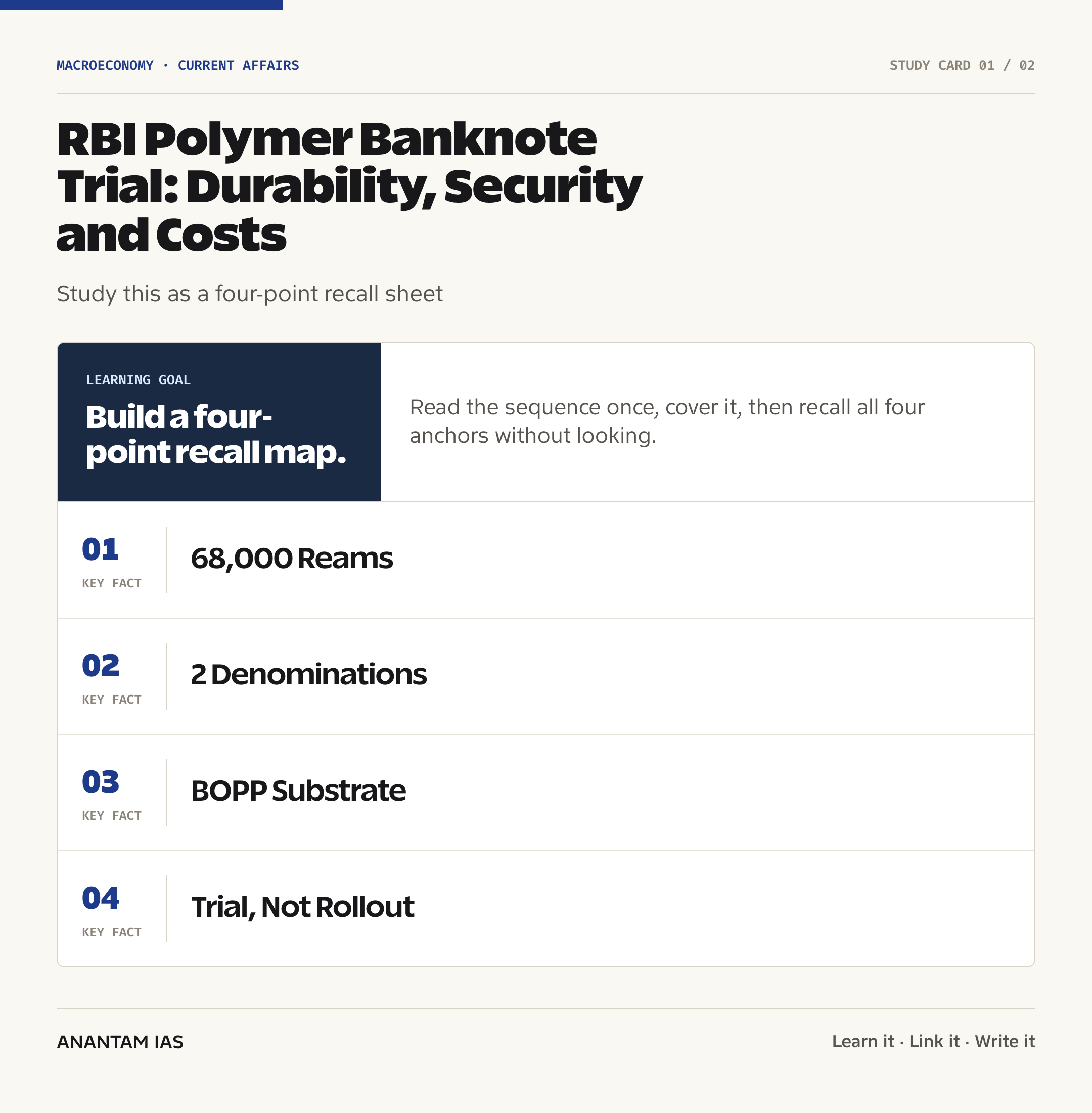
The Indian Express reported in July 2026 that Bharatiya Reserve Bank Note Mudran Private Limited, an RBI-owned banknote printer, had invited global bids for polymer substrate sheets for a fresh field trial. The development moves the idea from policy consideration toward procurement, but no polymer denomination has yet been issued to the public.
The expression of interest seeks 68,000 reams, with 500 sheets per ream, of security-featured biaxially oriented polypropylene-based opacified substrate. Half the quantity is intended for each of two denominations, which the tender does not name. A trial is not a nationwide replacement decision.
- BRBNMPL and the government-owned SPMCIL are expected to print the trial notes at India’s banknote presses.
- The requirement equals 3.4 crore sheets; the tender describes it as an immediate requirement before any larger procurement after a successful trial.
- At the June 2026 post-policy interaction, RBI Governor Sanjay Malhotra said the proposal was at a preliminary stage and its costs and benefits were still being examined.
- The RBI Annual Report 2025-26, as cited by the Indian Express, recorded ₹4,875 crore of expenditure on printing notes, making lifecycle cost a central trial question.
The development matters in the context of:
- This matters in the context of the Clean Note Policy, because longer-lasting notes could reduce the frequency of sorting, withdrawal, destruction and replacement.
- It also tests whether currency security, public convenience and machine compatibility can improve without creating a weak end-of-life plastic stream.
- The trial connects physical cash management with fiscal prudence: a costlier note can still be economical if it remains fit much longer and lowers recurring logistics costs.
UPSC Relevance
Prelims Relevance
- Section 22 of the RBI Act, 1934 gives the Reserve Bank the sole right to issue banknotes in India.
- Under Section 25, the Central Government approves the design, form and material of banknotes after considering recommendations of the RBI Central Board.
- Section 26 makes every RBI banknote legal tender for its expressed amount and provides a Central Government guarantee.
- Current Indian banknote paper is made from 100% cotton; calling it ordinary wood-pulp paper is inaccurate.
- Polymer supports integrated features such as a transparent window, but the substrate alone does not make a note counterfeit-proof.
- BRBNMPL is a wholly owned RBI subsidiary with presses at Mysuru and Salboni; SPMCIL is a Government of India company with currency presses at Nashik and Dewas.
- The Clean Note Policy aims to keep good-quality notes in circulation by sorting returned notes and destroying those found unfit.
Mains Relevance
GS Paper 3
- Economics of currency lifecycle management, including printing, distribution, machine processing, replacement and destruction costs.
- Role of substrate choice in counterfeit resilience, note quality and trust in sovereign money.
- Environmental appraisal through a cradle-to-grave assessment, not a paper-versus-plastic label.
GS Paper 2
- Division of authority between the RBI Central Board and Central Government under the RBI Act.
- Need for transparent trials, accessibility testing and public communication before a nationwide currency change.
Essay
- The material of money can change, but public trust remains its real foundation.
- A durable technology is sustainable only when its full lifecycle is designed, measured and governed.
Background and Context
What a Polymer Banknote Actually Is
A polymer banknote is a security document printed on engineered film, not ordinary plastic currency.
- Biaxially oriented polypropylene is stretched along two axes, opacified for printing and engineered to receive inks, coatings and machine-readable security elements.
- Selected areas may remain clear to form a transparent window, a feature that is difficult to imitate convincingly with a printed paper counterfeit.
- India’s present notes use cotton-based banknote paper. The policy comparison is polymer versus cotton substrate, not plastic versus tree-based office paper.
- The substrate is only one layer of security. Intaglio print, color-shifting elements, tactile marks, serial numbering and machine authentication still determine the strength of the finished note.
India's Long Trial History and Present Status
India has studied polymer notes for years, but past announcements did not produce a public issue.
- In 2012, the Ministry of Finance said one billion ₹10 polymer notes were planned for a field trial in five cities, primarily to extend the life of low-denomination notes.
- The proposed cities, Kochi, Mysuru, Shimla, Jaipur and Bhubaneswar, represented different climatic conditions, but the announced circulation trial did not materialize.
- A 2016 Lok Sabha reply said procurement had begun, and a 2017 PIB release confirmed government approval for procurement and printing of ₹10 trial notes.
- The Indian Express reports that the RBI’s 2014-15 Annual Report referred to technical infirmities after evaluation. The present procurement should be read as a renewed test, not proof that those issues have already been solved.
Legal and Institutional Architecture
Changing the substrate is an administrative and statutory process within India’s existing currency framework.
- Section 22 of the RBI Act vests the sole right to issue banknotes in the Reserve Bank; printing contractors do not become issuers.
- Under Section 25, the Central Government approves the note’s design, form and material after considering the RBI Central Board’s recommendation.
- The Issue Department manages note issuance separately within RBI, while BRBNMPL and SPMCIL provide production capacity. Read the wider institutional role in RBI functions and responsibilities.
- The RBI Governor heads the central bank, but substrate adoption is not a unilateral personal decision; it follows statutory recommendation, government approval, procurement and testing. See the RBI Governor’s role.
Lifecycle Economics and Printing Costs
The right comparison is total cost per year of useful circulation, not the factory price of one note.
- A polymer note can cost more to produce because it needs specialized substrate, coatings, inks and security integration. Upfront unit cost may rise even when lifecycle cost falls.
- Longer service life can reduce repeated printing, transport, sorting and destruction. Savings are strongest for denominations that circulate frequently and become soiled quickly.
- The RBI’s reported ₹4,875 crore printing expenditure in 2025-26 gives scale, but it does not prove how much polymer would save. Tender prices, yield loss and Indian survival data are still needed.
- The pilot should calculate cost per fit-circulation year, including machine upgrades, staff training, dual-stock handling, reverse logistics and recycling contracts.
- Cost appraisal should use several survival assumptions, because a small change in actual note life can alter the result. RBI should compare identical denominations and handling environments rather than average unlike notes into one headline estimate.
- The procurement test should record sheet yield, printing rejects and feature-integration failures. A lower substrate quote can become expensive if more sheets fail quality control or if presses require slower production runs.
- Tender evaluation should cover supplier concentration, secure transport and technology transfer. Currency material is strategic: price competition matters, but resilience against delayed imports, compromised inputs and vendor lock-in also carries an economic value.
Durability and Security Gains
Polymer’s strongest case is the combination of longer circulation and a richer security-feature platform.
- The non-porous surface resists moisture, dirt and oils better than cotton paper, which may help notes remain machine-readable and visibly clean for longer.
- Polymer can integrate clear windows, complex optical effects and tactile features into the substrate, raising the equipment and skill needed for a convincing imitation.
- A counterfeit number must be interpreted carefully. The reported 2.3 lakh fake notes detected in 2025-26 measures detections in the banking system, not the total stock of counterfeit money in the economy.
- Substrate is not a standalone cure. Effective protection still needs secure design, machine authentication, public awareness and enforcement against production and distribution networks.
- The trial should use an explicit counterfeit attack model: crude paper copies, simulated windows, altered genuine notes and high-quality reproductions may fail in different ways. Security must be tested by both trained cash handlers and ordinary users.
- A security feature is useful only if it remains recognizable after circulation. RBI should measure whether windows, tactile print and optical effects survive folding, abrasion and contamination without causing genuine notes to be rejected as suspect.
- Detection data should be normalized against the volume of notes processed and separated by denomination and imitation method. A raw increase in detected pieces may reflect more counterfeiting, better screening or both.
Climate, Machines and Public Adoption
India’s heat, humidity, cash intensity and diverse handling practices make local evidence essential.
- Tests should expose notes to summer heat, monsoon humidity, dust, sweat, oils and repeated folding, rather than transferring foreign durability claims directly to India.
- Polymer performs in warm countries such as Australia and Thailand, but substrate formulation, coatings and local handling differ. High-temperature deformation still requires controlled laboratory and field testing.
- ATMs, counting machines, note sorters, vending systems and cash recyclers must recognize the new thickness, friction and optical profile. Calibration costs belong in the pilot’s economics.
- New polymer notes can feel slippery or initially stick together. Cash handlers, retailers and banks need training in counting, authentication and safe storage.
- Accessibility testing should cover tactile identification, contrast, note size and performance after wear, with direct participation by persons with visual disabilities.
- The field design should span coastal humidity, dry heat, cold conditions and monsoon exposure, while also sampling dense urban cash use and rural circulation. A short laboratory test cannot reproduce repeated transfer between hands, tills, pockets and machines.
- RBI should provide controlled test packs to ATM and cash-equipment manufacturers before public circulation. Acceptance, dispensing, counting, fitness sorting and counterfeit rejection require separate tests because one successful machine function does not prove the others.
- Accessibility must be assessed on worn notes, not only pristine samples. The pilot should check whether raised marks and color contrast remain usable after abrasion and whether machine-readable aids serve people who cannot reliably inspect visual security features.
Environmental Trade-offs and Recycling
Polymer can lower lifecycle impact only when longer life and a real recycling chain outweigh fossil-based inputs.
- A polymer substrate is based on a non-renewable petrochemical feedstock. It should not be called green merely because it is recyclable in principle.
- The 2012 PIB reply said an RBI-commissioned TERI lifecycle study found environmental benefits over cotton notes, with longevity as the central reason.
- Fewer replacements may reduce material use, printing energy and transport. But India’s decision needs an updated lifecycle assessment covering domestic energy, logistics, reject rates and end-of-life treatment.
- Withdrawn notes require secure destruction before recycling. A credible system needs segregation, granulation, audited recyclers and traceability so security waste does not leak.
- Recycling cannot be improvised after issuance. RBI needs verified capacity to handle coated and printed polymer waste, including production offcuts, rejected sheets and unfit notes, without mixing secure material into ordinary municipal waste.
- Contracts should assign responsibility for collection, destruction certificates and material recovery. Public reporting should distinguish material sent to a recycler from material actually converted into usable feedstock, since the two figures can differ.
- The environmental comparison should test poor outcomes too: shorter-than-expected life, low recovery or long-distance transport to a recycler. Sensitivity analysis reveals whether polymer remains preferable when field performance falls below the optimistic case.
International Experience and Lessons for India
Foreign experience supports cautious optimism, but it also shows that transition management matters as much as substrate choice.
- Australia pioneered modern polymer notes and uses transparent windows and other integrated features; its central bank also recycles withdrawn polymer into other products.
- The Bank of Canada reports longer note life and lower lifecycle impact, while its handling guidance recognizes that fresh notes may initially stick and damaged edges can tear.
- The Bank of England moved denomination by denomination, supplied samples to equipment makers and coordinated ATM, retail and cash-industry readiness before launch.
- Thailand expanded polymer issuance after observing improved durability of its first denomination, showing the value of staged evidence in a warm and humid setting.
Way Forward
Publish a measurable trial protocol
- Predefine note-life, machine-rejection, counterfeit, user-comfort and end-of-life indicators, using matched cotton-note cohorts and varied climatic locations.
Price the whole system
- Compare lifecycle cost, not procurement price alone, including equipment calibration, training, dual circulation, secure disposal and supply continuity.
Design security and inclusion together
- Co-test visible, tactile and machine-readable features with banks, retailers, equipment makers and persons with disabilities, backed by public authentication guidance.
Build end-of-life capacity first
- Contract audited domestic recyclers, define secure destruction and publish recovery and disposal outcomes within a fresh India-specific lifecycle study.
Conclusion
The RBI polymer banknote trial is best viewed as a currency-management experiment, not a symbolic move away from paper and not a fresh demonetization. Its promise lies in keeping notes fit longer while supporting stronger security features.
The policy case will stand only if Indian field evidence shows that durability savings exceed higher production and transition costs, machines remain reliable, users can handle the notes easily and withdrawn polymer enters a secure recycling chain.
For UPSC answers, the balanced position is clear: support a transparent, staged pilot under the RBI Act, but reserve judgment on nationwide adoption until lifecycle, inclusion and climate results are public.
UPSC Practice Questions
Prelims MCQ 1
With reference to the issue of banknotes in India, consider the following statements:
- The Reserve Bank of India has the sole right to issue banknotes under Section 22 of the RBI Act, 1934.
- The material of a banknote is approved by the Central Government after considering the recommendation of the RBI Central Board.
- Changing a banknote from cotton substrate to polymer automatically changes its legal-tender status.
How many of the above statements are correct?
(a) Only one (b) Only two (c) All three (d) None
Answer: (b) Only two
Explanation:
Statements 1 and 2 are correct under Sections 22 and 25 of the RBI Act. Statement 3 is incorrect: substrate choice does not by itself alter legal tender, which is governed by the statutory issue and notification framework.
Prelims MCQ 2
Which one of the following best describes the principal economic test for a polymer banknote?
(a) Whether its factory price is lower than a cotton note (b) Whether it contains no petrochemical material (c) Whether its total lifecycle cost per useful circulation period is lower (d) Whether every counterfeit can be eliminated by the substrate
Answer: (c) Whether its total lifecycle cost per useful circulation period is lower
Explanation:
Polymer may have a higher upfront unit cost. The relevant test includes note life, printing, transport, sorting, machine changes, destruction and recycling. Neither zero petrochemical input nor complete elimination of counterfeiting is a valid assumption.
UPSC Mains Questions
- A banknote substrate is not a minor printing choice but an element of currency governance. Examine the statutory process for changing banknote material in India and assess the institutional safeguards needed before polymer notes move from field trial to wider circulation.
- Polymer banknotes promise greater durability and counterfeit resilience, yet their economic case depends on lifecycle evidence. Analyze the costs, operational risks and environmental trade-offs that the RBI should measure in the renewed trial.
- International adoption of polymer notes offers lessons, not a ready-made verdict for India. Discuss how climate, cash-handling infrastructure, accessibility and end-of-life recycling should shape an India-specific decision.
Sources: PIB, Ministry of Finance and Indian Express Explained.
Frequently Asked Questions
Has RBI launched polymer notes?
No. The 2026 procurement process prepares substrate for a field trial. The tender points to two unnamed denominations, but RBI has not issued polymer notes to the public or announced a nationwide replacement of existing cotton-substrate notes.
Are polymer notes ordinary plastic?
No. They use an engineered, opacified BOPP-based substrate designed for secure printing, coatings and integrated authentication features. The phrase plastic currency is shorthand and should not be confused with ordinary packaging film, payment cards or the digital rupee.
Who approves banknote material?
Under Section 25 of the RBI Act, 1934, the Central Government approves the design, form and material of banknotes after considering recommendations from the RBI Central Board. RBI retains the sole right to issue banknotes under Section 22.
Why can polymer notes cost less?
A polymer note may cost more at the printing stage. It can still be cheaper over time if longer life reduces repeated printing, distribution, sorting and destruction. India needs trial data before claiming a net saving.
Are polymer notes impossible to counterfeit?
No banknote is impossible to counterfeit. Polymer enables difficult-to-copy features such as an integrated clear window, but security also depends on design, inks, tactile features, machine authentication, public awareness and law enforcement.
Are polymer notes better for the environment?
They can be if greater durability reduces manufacturing and transport and if withdrawn notes are securely recycled. But polymer uses a fossil-based feedstock. An India-specific lifecycle assessment must include energy, rejects, logistics and the actual recycling rate.