Samagra Shishu Bal Swasthya: Child Health and Anaemia-Free India
Why in News?
PIB said Union Health Minister J.P. Nadda would launch the Samagra Shishu Bal Swasthya Programme at the 16th Conference of the Central Council of Health and Family Welfare. The announcement makes child health a live governance issue, not just a static welfare topic.
PIB also said the minister would release operational guidelines for the Anaemia Mukt Bharat campaign at the same meeting. For UPSC, the news connects early childhood health, nutrition security, cooperative federalism and last-mile service delivery.
- The launch is anchored in the Central Council of Health and Family Welfare, a Centre-State forum for public-health priorities.
- Samagra Shishu Bal Swasthya signals an integrated approach to child health rather than isolated disease-specific work.
- Anaemia Mukt Bharat remains important because anaemia affects learning, productivity, maternal health and child survival.
- The policy angle is not only medical treatment; it includes screening, nutrition, behaviour change and state capacity.
- The issue sits at the junction of GS2 health governance, social justice, women and child development, and human capital.
The development matters in the context of:
- Child health is a lifecycle issue: poor nutrition and untreated illness in early years can affect schooling, cognition and future productivity.
- Anaemia is both a medical and social problem because it reflects diet diversity, sanitation, infection burden, adolescent health and maternal care.
- Federal coordination matters because health is primarily a State subject, while national missions, guidelines and funding support come from the Union.
UPSC Relevance
Prelims Relevance
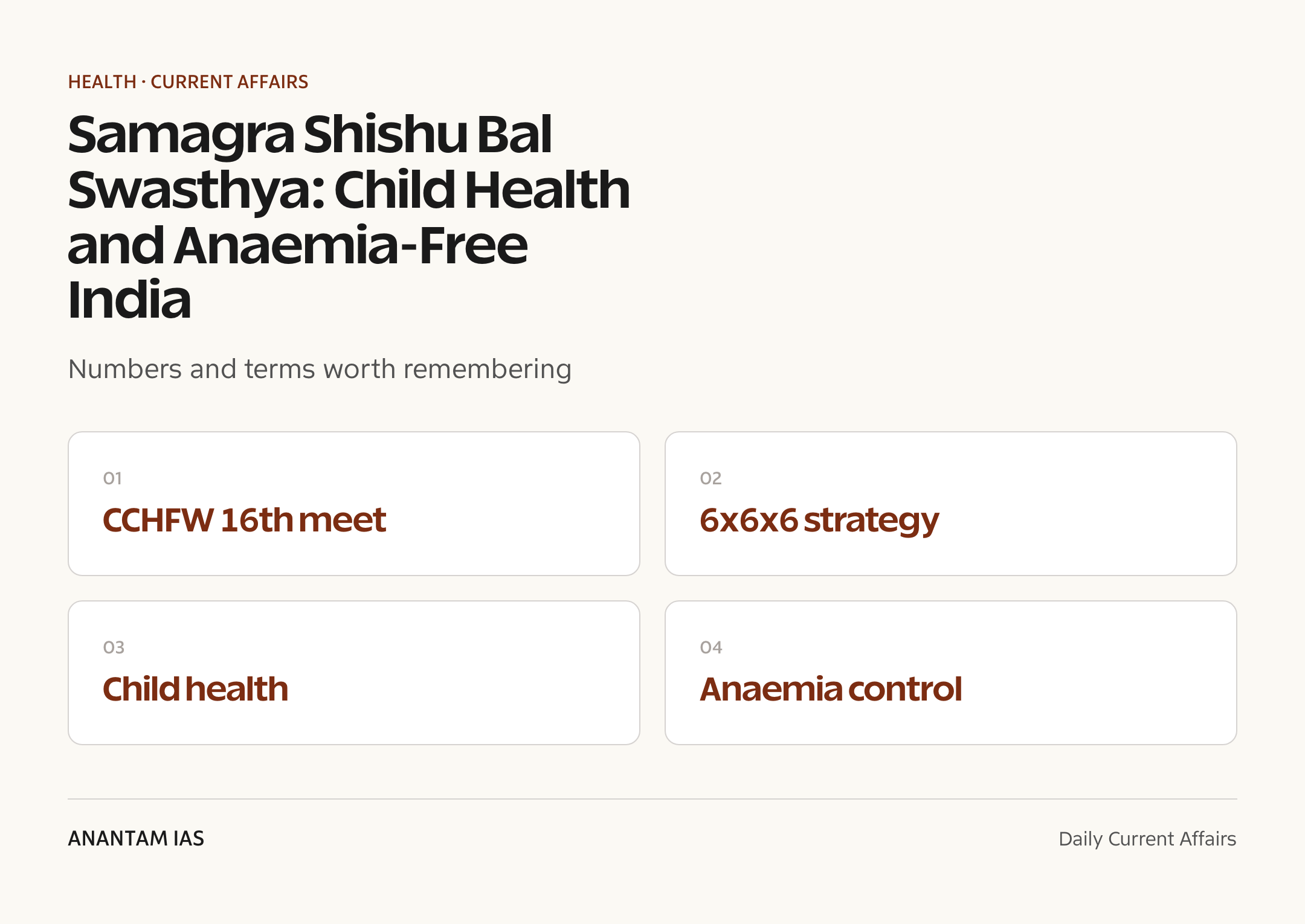
- Central Council of Health and Family Welfare (CCHFW): a high-level platform where the Union Health Ministry and States discuss health policy priorities.
- Anaemia Mukt Bharat: a national strategy under the broader nutrition and health mission architecture to reduce anaemia across age and gender groups.
- 6x6x6 strategy: six target beneficiary groups, six interventions and six institutional mechanisms used to structure anaemia-control work.
- NFHS-5 (2019-21): recorded high anaemia prevalence among children, women and adolescents, making anaemia a persistent public-health concern.
- POSHAN Abhiyaan: India’s flagship nutrition mission; anaemia control links with nutrition, counselling, supplementation and convergence.
- Iron and folic acid (IFA): a core intervention for anaemia prevention and treatment, especially for children, adolescents and pregnant women.
- Deworming: important because worm infestation can worsen anaemia by affecting nutrient absorption and blood loss.
- Rashtriya Bal Swasthya Karyakram (RBSK): screens children for defects at birth, diseases, deficiencies and developmental delays.
- Health and Wellness Centres: primary-care platforms that can support screening, counselling, follow-up and referral.
- Social determinants of health: food security, sanitation, gender norms, school health and poverty shape child-health outcomes.
Mains Relevance
GS Paper 2
- Analyse child health as a governance challenge involving nutrition, primary care, school systems, women and child development, and Centre-State coordination.
- Assess why anaemia persists despite national programmes, and suggest reforms in data, diet diversity, supplementation, counselling and local accountability.
GS Paper 3
- Link child health and anaemia reduction with human capital, demographic dividend and long-term productivity.
Essay
- A nation’s future is built in the first years of a child’s life.
- Public health is the foundation of human capital.
Background and Context
Why Child Health Needs an Integrated Frame
Child health cannot be solved through a single clinic visit or a single nutrition scheme.
- Early childhood is a sensitive window for growth, brain development, immunity and school readiness.
- A child may face overlapping risks: low birth weight, poor feeding, repeated infections, anaemia, stunting and delayed development.
- A fragmented system can miss children who need follow-up, especially when services sit across health, ICDS, schools and local bodies.
- An integrated child-health program can combine screening, referral, immunisation, nutrition counselling and family-level tracking.
- The word Samagra is important for exam framing because it suggests convergence across services, not one isolated intervention.
- Frontline workers become the hinge of the programme: ASHAs, ANMs and Anganwadi workers must identify risk, counsel families and make sure referral advice does not stop at paper records.
- A strong child-health design should connect the home, the Anganwadi centre, the school and the primary health facility so that growth, nutrition and illness are reviewed together.
Anaemia as a Public-Health Problem
Anaemia is common, measurable and deeply linked with social conditions.
- Anaemia means a lower-than-normal level of haemoglobin or red blood cells, reducing the body’s capacity to carry oxygen.
- Common drivers include iron deficiency, folate or vitamin B12 deficiency, malaria, worm infestation, repeated infection and poor diet diversity.
- Among children, anaemia can affect attention, learning, physical growth and immunity.
- Among adolescent girls and women, anaemia raises risks during pregnancy, delivery and postpartum recovery.
- The problem needs both medical care and social action: supplementation alone works poorly if food insecurity, sanitation and counselling gaps remain.
- Diet diversity is a key constraint because many children consume enough calories but not enough iron-rich foods, protein, fruits and vegetables.
- Repeated infections, unsafe water and poor sanitation can reduce nutrient absorption, so anaemia control also links with WASH and preventive health.
Anaemia Mukt Bharat and the 6x6x6 Design
Anaemia Mukt Bharat gives anaemia-control work a structured national template.
- The Anaemia Mukt Bharat approach is known for its 6x6x6 strategy.
- The six target groups include children, adolescents, women of reproductive age, pregnant women and lactating mothers.
- The six interventions include IFA supplementation, deworming, behaviour-change communication, testing and treatment, delayed cord clamping, and fortification-related measures.
- The six institutional mechanisms include coordination, supply-chain management, monitoring, digital tools, capacity building and accountability.
- For Prelims, the key is to remember the target-group-intervention-mechanism structure; for Mains, the key is why implementation remains difficult.
- The strategy also shows why programme design must be age-specific: infants, school children, adolescent girls and pregnant women need different doses, counselling and follow-up cycles.
- A useful Mains answer can compare supply-side work (tablets, testing, staff, logistics) with demand-side work (trust, adherence, food habits, household awareness).
Role of the Central Council of Health and Family Welfare
The CCHFW setting gives the announcement a federal governance angle.
- Health is mainly a State subject, but national programmes depend on Union guidelines, financing support and common monitoring frameworks.
- A conference of the CCHFW helps align States on priorities such as child health, anaemia control, primary care and digital health.
- Operational guidelines matter because district officials need clarity on target groups, reporting formats, referral pathways and review indicators.
- Centre-State platforms can reduce duplication between ministries, especially where health, education, ICDS and sanitation intersect.
- The federal challenge is to keep national standards while allowing local adaptation for tribal areas, urban slums, aspirational districts and high-burden blocks.
- States differ sharply in disease burden, food habits, health staffing and supply chains, so a single guideline needs flexible district-level execution.
- The CCHFW route is useful because it can turn a national launch into reviewable commitments by States, rather than leaving the programme as a central announcement.
Implementation Gaps
India’s child-health challenge is often less about intent and more about execution.
- Screening gaps: children may be identified once but not tracked until treatment or referral closure.
- Supply gaps: IFA tablets, testing kits and deworming medicines must be available at the right level of care.
- Behaviour gaps: families need counselling on diet diversity, breastfeeding, complementary feeding and adherence to supplements.
- Data gaps: dashboards can report activity but still miss quality, follow-up and household-level outcomes.
- Equity gaps: high-burden communities, migrants, tribal families and urban poor children need stronger outreach.
- Referral gaps: screening has limited value if a child with severe anaemia, developmental delay or chronic illness cannot reach a higher facility.
- Trust gaps: families may stop IFA because of side effects, misconceptions or lack of visible short-term benefit, so counselling must be repeated and local.
Why This Matters for Human Capital
Child health is not a soft welfare subject; it is economic infrastructure.
- Healthy children attend school more regularly, learn better and enter adulthood with stronger physical and cognitive capacity.
- Reducing anaemia can improve energy, concentration and productivity across the lifecycle.
- Better child health reduces household out-of-pocket expenditure and lowers pressure on secondary and tertiary care.
- The demographic dividend depends on quality of population, not just population size.
- For answer writing, this topic lets students connect health, nutrition, education, gender and economy in one frame.
- It also helps students avoid a common mistake: treating health as only hospital infrastructure when the biggest gains often come from prevention, nutrition and primary care.
- A child-health programme that works well can reduce learning poverty, improve women’s health over the long term and make welfare spending more productive.
Way Forward
Make Tracking Outcome-Oriented
- Track not only children screened, but also treatment completion, referral closure and improvement in haemoglobin or nutrition indicators.
- Use digital dashboards for district review, while keeping field verification and community feedback in place.
Strengthen Convergence
- Link health workers, Anganwadi centres, schools, Panchayats and local nutrition committees for follow-up.
- Align child-health work with POSHAN Abhiyaan, school health services and adolescent-health interventions.
Fix the Last Mile
- Ensure uninterrupted supply of IFA, deworming tablets, testing kits and counselling material.
- Train frontline workers to explain side effects, dosage and diet changes in simple local language.
Target High-Burden Areas
- Prioritise aspirational districts, tribal blocks, urban slums and migrant-heavy settlements.
- Use local food systems, fortified staples where suitable, and culturally acceptable diet counselling.
Conclusion
The Samagra Shishu Bal Swasthya launch and the Anaemia Mukt Bharat guidelines should be read together: India is trying to move from episodic child-health services to a more integrated lifecycle approach. The real test will be whether screening, nutrition, treatment and follow-up meet the same child at the right time.
For UPSC, the issue is a strong GS2 case because it joins health policy with social justice and cooperative federalism. A good answer should not stop at programme names; it should explain why anaemia persists, why child health shapes human capital, and why district-level execution decides the outcome.
UPSC Practice Questions
Prelims MCQ 1
With reference to Anaemia Mukt Bharat, consider the following statements:
- It is structured around six target beneficiary groups, six interventions and six institutional mechanisms.
- Iron and folic acid supplementation is one of its core interventions.
- It deals only with pregnant women and excludes children and adolescents.
How many of the above statements are correct?
(a) Only one (b) Only two (c) All three (d) None
Answer: (b) Only two
Explanation:
Statements 1 and 2 are correct. Statement 3 is wrong because Anaemia Mukt Bharat covers multiple beneficiary groups, including children and adolescents.
Prelims MCQ 2
The Central Council of Health and Family Welfare is best understood as:
(a) A constitutional court for health disputes (b) A Centre-State forum for discussing health and family welfare policy (c) A private hospital accreditation body (d) A WHO regional office for South Asia
Answer: (b) A Centre-State forum for discussing health and family welfare policy
Explanation:
The CCHFW is a policy-coordination forum involving the Union Health Ministry and States. It is important for cooperative federalism in public health.
UPSC Mains Questions
- Child health is a lifecycle governance challenge rather than a narrow medical issue. Discuss with reference to nutrition, primary care, data systems and Centre-State coordination. (GS2)
- Why does anaemia persist in India despite national programmes? Suggest reforms in supplementation, diet diversity, behavioural counselling, monitoring and local accountability. (GS2)
- Healthy children are the foundation of India’s demographic dividend. Examine the statement in the context of public health and human capital. (GS3)
Sources: PIB, Ministry of Health and Family Welfare and PIB, Ministry of Health and Family Welfare.
Frequently Asked Questions
What is Samagra Shishu Bal Swasthya?
It is a child-health initiative announced by the Union Health Ministry. The available PIB note frames it as a comprehensive child-health programme. The details to watch are screening, referral, nutrition links, follow-up and how States implement it.
Why is anaemia important for UPSC?
Anaemia affects child growth, learning, maternal health and productivity. It is also a governance issue because it depends on diet, supplementation, deworming, sanitation, counselling and reliable public-health delivery.
What is the 6x6x6 strategy?
It is the design frame of Anaemia Mukt Bharat: six target beneficiary groups, six interventions and six institutional mechanisms. It helps students remember both the coverage and the implementation architecture.
What is the CCHFW?
The Central Council of Health and Family Welfare is a Centre-State platform for discussing national health priorities. It matters because health programmes need common guidelines, State ownership and district-level execution.
How is child health linked to human capital?
Poor child health can reduce school attendance, learning, immunity and future productivity. Strong early health and nutrition improve the demographic dividend by improving the quality of the workforce, not just its size.
What should a Mains answer include?
A good answer should cover nutrition, screening, primary health care, frontline workers, data systems, equity gaps and Centre-State coordination. It should also mention that anaemia is shaped by social determinants, not only by tablets.