Sarnath: UNESCO Inscription Recognises a Living Buddhist Heritage
Why in News?
The World Heritage Committee inscribed the ancient Buddhist site at Sarnath, Uttar Pradesh, on the UNESCO World Heritage List during its 48th session in Busan, Republic of Korea. The official decision inscribed it under cultural criteria (iii) and (vi).
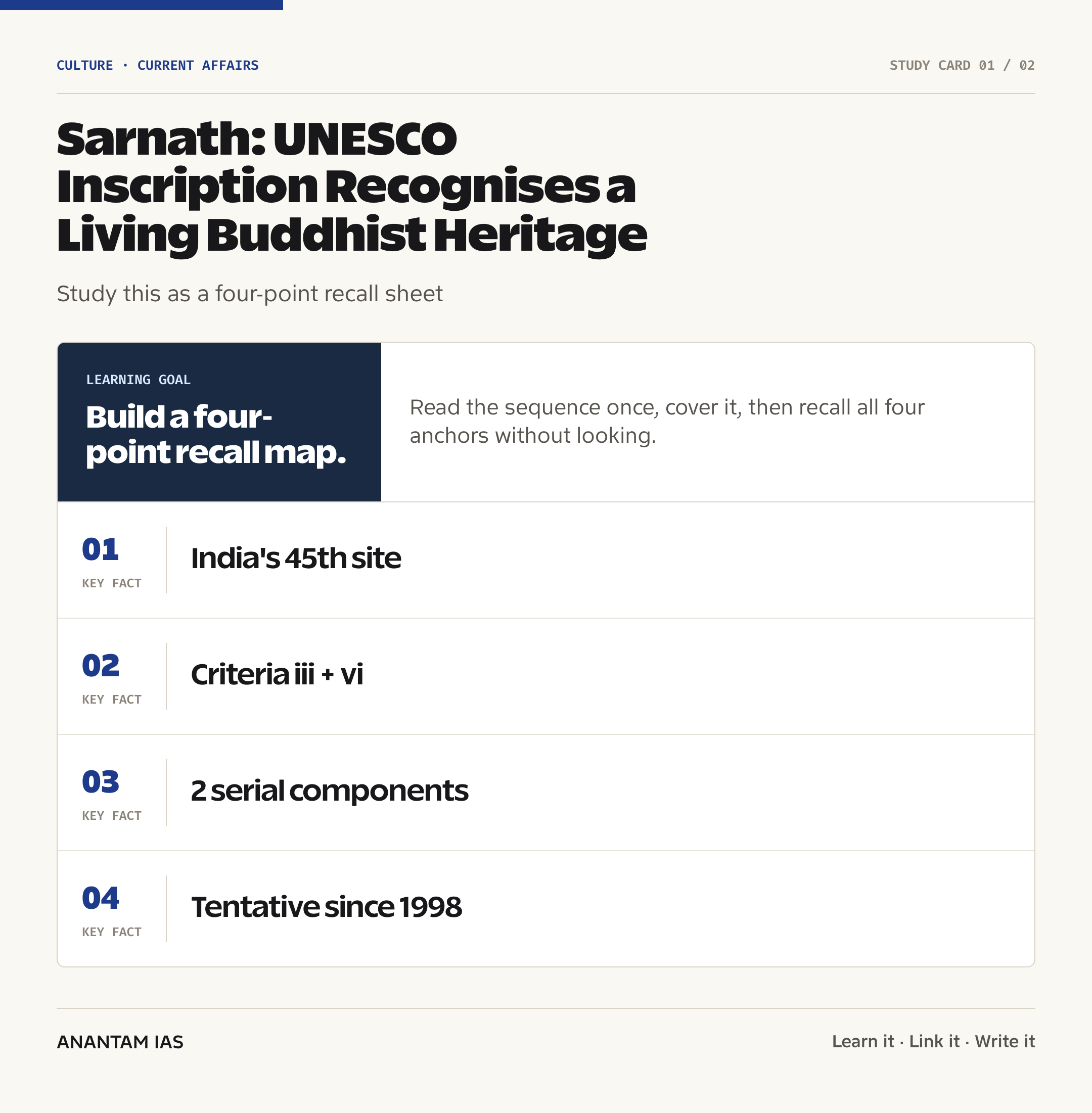
The inscription makes Sarnath India’s 45th World Heritage property and Uttar Pradesh’s fourth. PIB confirmed the inscription and highlighted Sarnath’s association with the Buddha’s message of wisdom, compassion and harmony.
- UNESCO’s final property name is Ancient Buddhist Site of Sarnath, not the broader tentative-list wording used in 1998.
- It is a serial cultural property consisting of two component parts: Chaukhandi Stupa and the Archaeological Remains of Sarnath.
- India proposed criteria (ii), (iii), (iv) and (vi); the Committee accepted criteria (iii) and (vi) in Decision 48 COM 8B.17.
- The site had entered India’s UNESCO Tentative List on 3 July 1998, submitted by the Archaeological Survey of India.
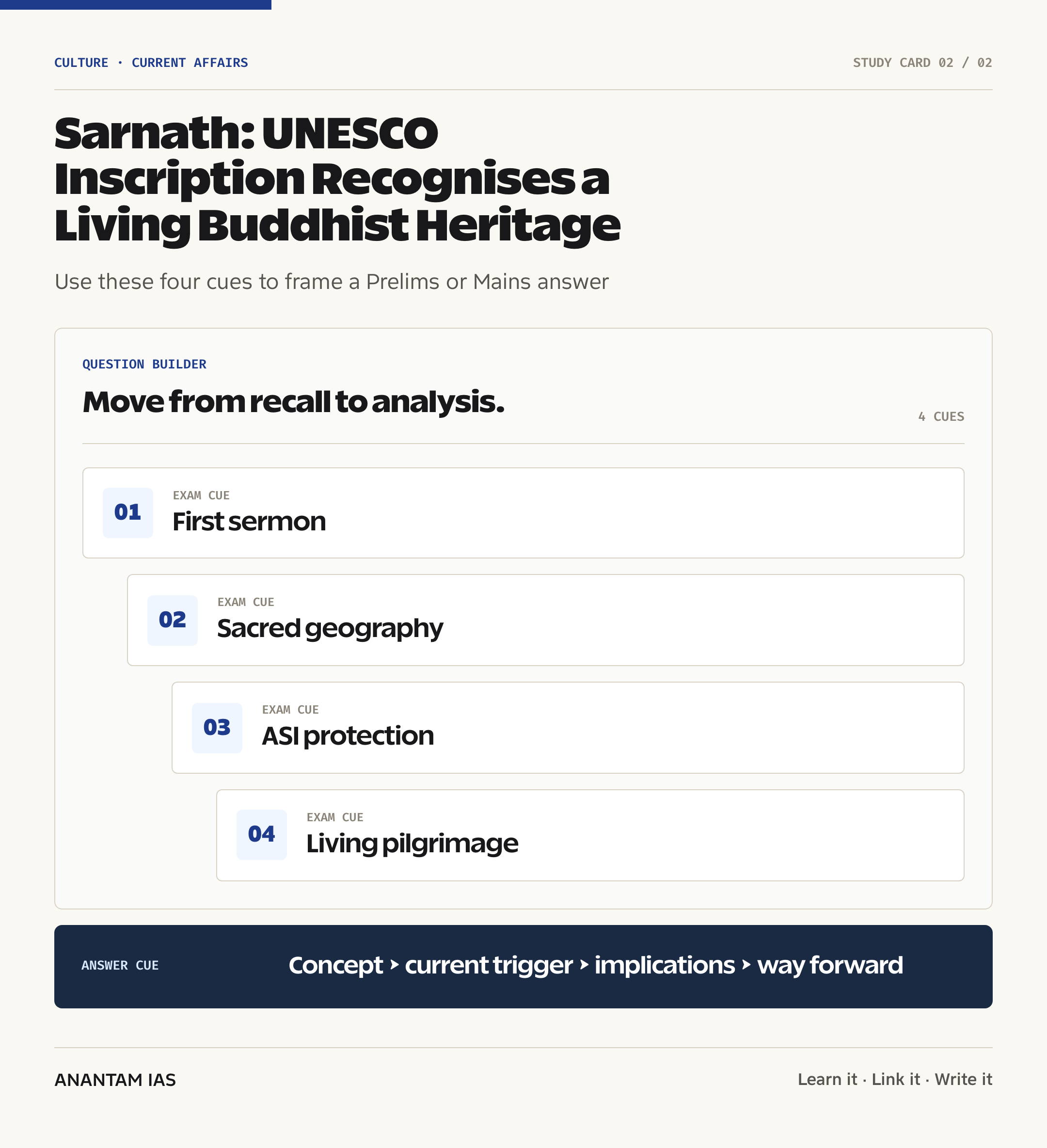
- The Committee’s statement links Sarnath directly with the Buddha’s first sermon, his first disciples and the enduring memory of one of Buddhism’s four principal pilgrimage destinations.
The development matters in the context of:
- The decision brings a foundational place in Buddhist sacred geography into the international World Heritage protection framework.
- Recognition creates a governance obligation: tourism growth must support, rather than erode, the site’s Outstanding Universal Value and spiritual character.
- For India, the inscription connects ancient history, ASI conservation, pilgrimage management, cultural diplomacy and the Buddhist Circuit.
- For earlier nomination context, see Anantam IAS’s note on the Sarnath site.
UPSC Relevance
Prelims Relevance
- Sarnath is in Varanasi, Uttar Pradesh, and is associated with the Buddha’s first sermon, traditionally called Dharmachakrapravartana, and his first disciples.
- Traditional names include Rishipatana, Ishipatana, Mrigadava and Deer Park.
- The World Heritage property has two components: Chaukhandi Stupa and the Archaeological Remains of Sarnath.
- The property was inscribed as a cultural site under UNESCO criteria (iii) and (vi).
- Criterion (iii) concerns an exceptional testimony to a cultural tradition or civilisation; at Sarnath it recognises enduring Buddhist spiritual significance and centuries of religious construction.
- Criterion (vi) concerns direct association with events, living traditions, ideas or beliefs of outstanding universal significance; at Sarnath it relates to the Buddha’s first sermon and first disciples.
- The archaeological sequence includes evidence from the pre-Mauryan, Mauryan, Kushana and Gupta phases and continued religious construction up to the 12th century CE.
- Important remains include the Dhamek Stupa, Dharmarajika Stupa, Ashokan pillar, monasteries, temples and votive stupas.
- The Lion Capital of Ashoka found at Sarnath inspired India’s State Emblem, while the wheel on its abacus informs the Ashoka Chakra. Revise the object through the National Emblem explainer.
- Both components are managed by the Archaeological Survey of India and protected under the AMASR Act, 1958, amended in 2010.
Mains Relevance
GS Paper 1
- Trace how royal, monastic and lay patronage shaped Buddhist architecture at Sarnath from the Mauryan to Gupta periods and beyond.
- Explain Sarnath’s place in Buddhist sacred geography, pilgrimage and the diffusion of the Buddha’s teachings across Asia.
- Assess the inscription as recognition of both tangible archaeological remains and the spiritual memory attached to place.
GS Paper 2
- Use the case to discuss UNESCO heritage governance, India’s obligations under the 1972 World Heritage Convention and coordination across institutions.
- Examine stakeholder participation involving the ASI, state and city authorities, Buddhist communities, residents and tourism bodies.
GS Paper 3
- Analyse visitor pressure, carrying capacity, Heritage Impact Assessment and risk preparedness as tools for sustainable heritage tourism.
- Relate conservation to urban planning through the Varanasi Master Plan 2031, protected zones and management of the wider setting.
Essay
- A monument survives through stone, but a sacred place survives through memory, practice and community.
- Heritage protection requires a balance between access and restraint, economic opportunity and cultural responsibility.
- The Buddha’s first sermon offers a bridge between India’s civilisational inheritance and its contemporary cultural diplomacy.
Background and Context
What UNESCO Actually Inscribed
The inscription covers a precisely defined serial property, not every modern religious or tourism facility in greater Sarnath.
- UNESCO identifies two component parts: the Chaukhandi Stupa and the Archaeological Remains of Sarnath, joined conceptually and protected through a common buffer zone.
- UNESCO’s map records component areas of 2.02 hectares for Chaukhandi Stupa and 6.03 hectares for the archaeological remains.
- The serial approach allows separate but historically connected areas to form one World Heritage property when their combined attributes express Outstanding Universal Value.
- The Committee changed the nominated name from Ancient Buddhist Site, Sarnath, Varanasi to Ancient Buddhist Site of Sarnath.
- Uttar Pradesh’s other three World Heritage properties are the Taj Mahal, Agra Fort and Fatehpur Sikri; Sarnath is the first in the state outside the Agra cluster.
Sarnath in the Buddha's Life
Sarnath’s global importance rests on a foundational event in Buddhist tradition rather than on architectural scale alone.
- After attaining enlightenment at Bodh Gaya, the Buddha is believed to have travelled to Mrigadava, the Deer Park, and delivered his first sermon to five former companions.
- The event is remembered as Dharmachakrapravartana, or setting the Wheel of Dharma in motion, and marks the public teaching of the path.
- The meeting with the first disciples is associated with the emergence of the Sangha; together with the Buddha and Dharma, it completes the Triratna or Three Jewels.
- Sarnath is counted among four principal Buddhist pilgrimage places linked to the Buddha’s life, alongside Lumbini, Bodh Gaya and Kushinagar.
- UNESCO’s criterion (vi) rests on this direct and tangible association with the first sermon and the formation of the earliest community of disciples.
Layers of Architecture and Patronage
The site records repeated construction, rebuilding and commemoration across many historical periods.
- UNESCO’s statement notes evidence from the pre-Mauryan period, followed by Mauryan, Kushana and Gupta phases, with activity continuing until Sarnath’s decline in the 12th century CE.
- Under Emperor Ashoka, Sarnath received monumental expressions of imperial Buddhist patronage, including a pillar and stupa tradition.
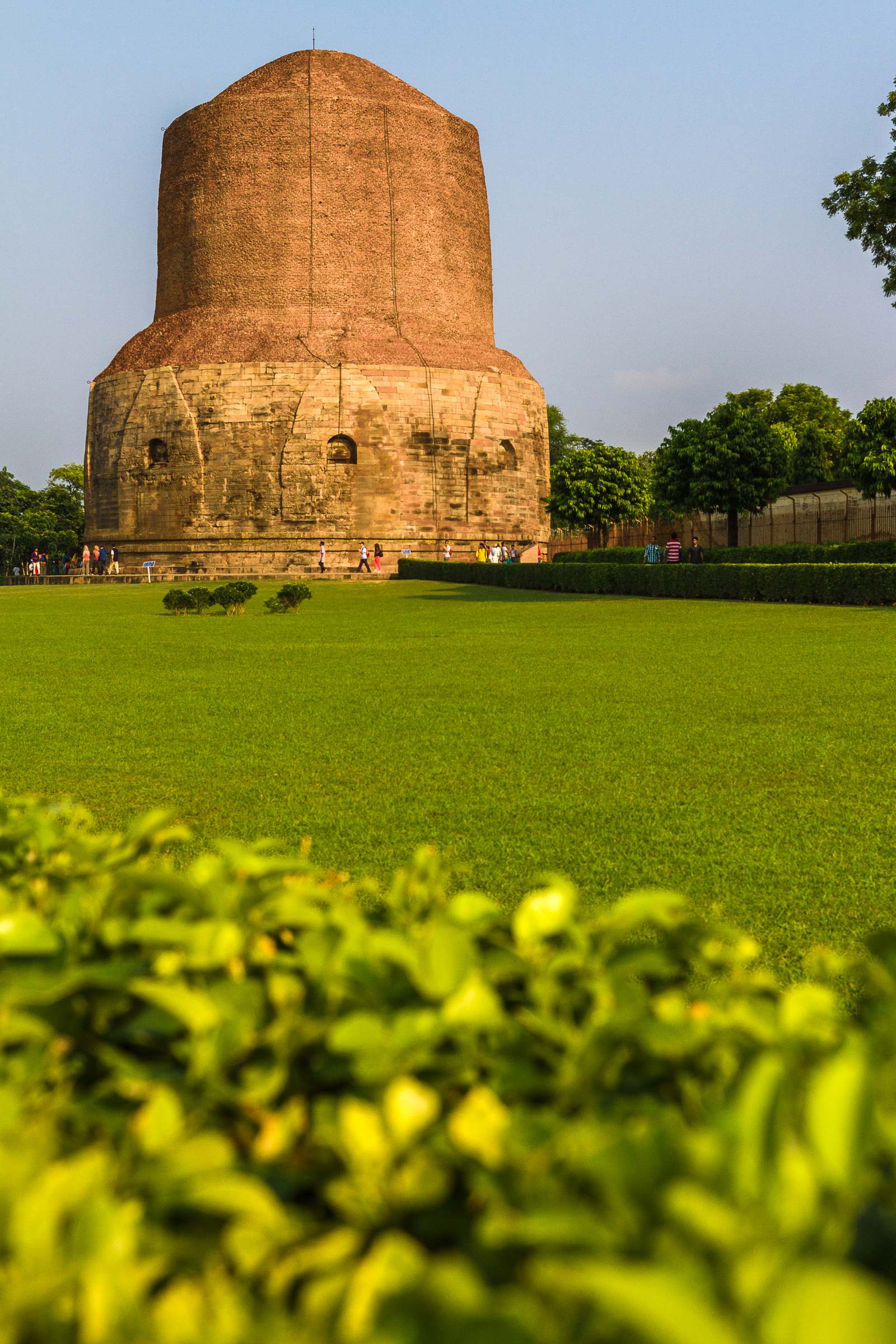
- The archaeological zone includes the Dhamek Stupa, Dharmarajika Stupa remains, an Ashokan column, temple remains, monasteries and votive stupas.
- The Gupta period made Sarnath an influential centre of Buddhist sculpture, known for refined modelling, serene expression and thin, nearly transparent treatment of monastic robes.
- The polished Sarnath Lion Capital, created under Mauryan patronage, later supplied the model for India’s State Emblem. The Dharma Chakra on the national flag is based on the wheel shown on its abacus, making the site’s visual language part of modern constitutional symbolism.
- The Chaukhandi Stupa marks the traditional meeting place of the Buddha and the five disciples. Its brick mass is crowned by an octagonal Mughal tower built in 1588 to commemorate Humayun’s visit.
- For a comparative view of stupa form, relic worship and narrative art, read the Sanchi Stupa notes.
Why Criteria (iii) and (vi) Matter
The accepted criteria explain the property’s value more accurately than a simple label such as ‘ancient monument’.
- Under criterion (iii), Sarnath bears exceptional testimony to an enduring Buddhist cultural and spiritual tradition, visible in centuries of monuments built and rebuilt at the site.
- Under criterion (vi), the archaeological remains are directly associated with the Buddha’s first sermon, his first disciples and ideas of outstanding significance to Buddhist communities.
- India had also proposed criteria (ii) and (iv), concerning interchange of human values and an outstanding architectural type or ensemble, but the final inscription is based only on (iii) and (vi).
- This distinction matters in Prelims: a State Party’s proposed criteria are not automatically the same as the Committee’s accepted criteria.
- It also shapes management because spiritual association, pilgrimage and the site’s atmosphere become attributes to protect, not incidental uses beside an archaeological park.
A Living Heritage, with a Historical Gap
Sarnath is a living pilgrimage destination today, but UNESCO does not describe its pilgrimage practice as continuously documented for 2,500 years.
- The site declined in the 12th century CE, fell into obscurity and was rediscovered in the 18th century before systematic archaeological work and conservation.
- UNESCO states that pilgrimage is not attested between the 12th century and the modern era; the 20th-century revival shows Sarnath’s powerful place in Buddhist memory and spiritual imagination.
- The property no longer performs its original function as an active monastic complex, but it continues to attract Buddhist pilgrims from around the world.
- Archaeological recovery also has layers. The UNESCO narrative records 18th-century rediscovery, while the ASI’s protected-monument register identifies remains excavated in 1904-05 among the nationally protected Sarnath complex. Documentation, excavation and conservation helped reconnect material evidence with remembered sacred geography.
- So ‘living heritage’ should mean a revived and active relationship among place, belief, community and practice, not an unsupported claim of uninterrupted institutional continuity.
- The distinction protects historical accuracy while recognising that sacred significance can be renewed through collective memory and contemporary practice.
Integrity, Authenticity and the Wider Setting
UNESCO recognised the preserved core while recording real weaknesses in the landscape and visitor experience.
- The two components retain all known preserved structures of the former Buddhist monastic complex, and their common buffer zone reflects their past connection.
- But the wider sacred geography, once understood as a forested setting, has been compromised by later change and urban pressure.
- Conservation since the early 20th century has preserved original materials with minimal intervention, supporting the authenticity of the archaeological and architectural remains.
- UNESCO cautions that treating Sarnath mainly as an archaeological park or recreational destination can weaken its spiritual character.
- This is a useful distinction: integrity asks whether the attributes are sufficiently complete, while authenticity asks whether their form, material, setting, use and meaning credibly express heritage value.
Protection and Institutional Architecture
World Heritage status adds international scrutiny but does not replace India’s domestic conservation law or responsible site management.
- Both components are protected through the Ancient Monuments and Archaeological Sites and Remains Act, 1958, amended in 2010.
- The law provides a 100-metre prohibited area around a protected monument or site, followed by a 200-metre regulated area where construction requires approval.
- The Archaeological Survey of India is responsible for protection, conservation and management of both serial components.
- Planning support comes from the Varanasi Master Plan 2031; UNESCO also notes Wildlife Protection Act, 1972 regulations for the buffer-zone setting.
- World Heritage inscription does not transfer ownership or routine management to UNESCO. India remains responsible for law, staffing, conservation and development control, while the World Heritage Committee monitors whether the property’s Outstanding Universal Value is being protected.
- A Site Management Plan supplies conservation recommendations, but effective delivery needs coordination with city authorities, tourism agencies, religious stakeholders, residents and visitors.
- For the wider national context and updated list logic, use the UNESCO World Heritage Sites in India guide.
The Management Test After Inscription
The harder task begins after celebration: retaining the site’s meaning while visitor numbers, infrastructure demands and global attention grow.
- UNESCO recommends a management strategy balancing devotion, conservation, tourism and community needs, with non-state religious stakeholders included in an advisory role.
- A carrying-capacity study should guide tourism planning so footfall, crowd movement, facilities and events remain compatible with the property’s spiritual dimension.
- The monitoring system must cover every attribute of Outstanding Universal Value, not only visible damage to masonry.
- An interpretation strategy should explain Sarnath as a spiritual destination and connected serial property, instead of presenting isolated ruins as recreational objects.
- Heritage Impact Assessment should precede development within the property, buffer zone and immediate setting, allowing harm to be avoided before project approval.
- Future archaeological survey around the buffer zone can clarify the historical extent of Sarnath’s sacred geography and improve evidence-based boundary management.
Way Forward
Put Outstanding Universal Value at the Centre
- Translate criteria (iii) and (vi) into measurable conservation indicators covering fabric, setting, pilgrimage practice, silence, movement and spiritual atmosphere.
- Publish a clear monitoring dashboard for the ASI, local administration and heritage experts without reducing sacred values to footfall or revenue.
Manage Visitors, Not Just Monuments
- Complete the recommended carrying-capacity study and use timed entry, guided circulation, shaded rest areas and separate quiet zones where evidence supports them.
- Coordinate peak pilgrim seasons, school visits and general tourism so conservation needs and ritual access don’t compete.
Make Development Heritage-Sensitive
- Require credible Heritage Impact Assessments before roads, commercial facilities, lighting, utilities or large visitor infrastructure are approved near the property.
- Enforce the AMASR prohibited and regulated zones alongside the Varanasi Master Plan, with transparent decisions and cumulative-impact review.
Interpret the Whole Cultural Landscape
- Connect Chaukhandi Stupa and the archaeological remains through a single narrative of the first disciples, patronage, monastic life and pilgrimage.
- Use multilingual, accessible interpretation that distinguishes verified archaeology, textual tradition and later memory without flattening them into one claim.
Share Stewardship
- Create regular consultation with Buddhist institutions, monks, local communities, historians, conservation architects and persons with disabilities.
- Direct part of tourism value toward conservation skills, local livelihoods, waste management and respectful public behaviour around the sacred site.
Conclusion
Sarnath’s inscription recognises more than a group of ancient ruins. It recognises a place where archaeology, Buddhist memory and contemporary pilgrimage meet, anchored in the Buddha’s first sermon and the earliest community of disciples.
The strongest response is not higher visitor numbers alone. It is careful stewardship that protects the two serial components, recovers the logic of the wider sacred geography and keeps devotion, learning and conservation compatible.
If India implements UNESCO’s recommendations with the ASI, local authorities and Buddhist communities working together, the 45th inscription can become a model for managing a sacred archaeological site as both inherited evidence and active cultural meaning.
UPSC Practice Questions
Prelims MCQ 1
With reference to the Ancient Buddhist Site of Sarnath, consider the following statements:
- It was inscribed on the World Heritage List under criteria (iii) and (vi).
- The serial property consists of Chaukhandi Stupa and the Archaeological Remains of Sarnath.
- UNESCO records an uninterrupted pilgrimage tradition at Sarnath from the 6th century BCE to the present.
How many of the above statements are correct?
(a) Only one (b) Only two (c) All three (d) None
Answer: (b) Only two
Explanation:
Statements 1 and 2 are correct. Statement 3 is incorrect: UNESCO says pilgrimage is not attested between the 12th century CE and the modern era, while the 20th-century revival demonstrates Sarnath’s continuing place in Buddhist memory.
Prelims MCQ 2
Which one of the following best explains UNESCO criterion (vi) in Sarnath’s inscription?
(a) It is the largest surviving brick monument of the Mauryan age (b) It displays an interchange of architectural values across all Buddhist countries (c) It is directly associated with the Buddha’s first sermon and first disciples (d) It preserves a complete continuously occupied ancient monastic city
Answer: (c) It is directly associated with the Buddha's first sermon and first disciples
Explanation:
Criterion (vi) recognises Sarnath’s direct and tangible association with events and ideas of outstanding significance to the Buddhist community, especially the first sermon and meeting of the first disciples.
UPSC Mains Questions
- Sarnath’s World Heritage inscription rests as much on spiritual association and Buddhist memory as on its archaeological fabric. Examine this statement with reference to UNESCO criteria (iii) and (vi), the site’s historical layers, and the meaning of living heritage.
- World Heritage recognition can intensify the very tourism and development pressures that threaten a sacred archaeological site. Suggest a governance framework for Sarnath that balances conservation, pilgrimage, community needs, interpretation and urban development.
Sources: UNESCO World Heritage Centre and PIB, Prime Minister's Office.
Frequently Asked Questions
Why is Sarnath important in Buddhism?
Sarnath is traditionally identified as the place where the Buddha delivered his first sermon after enlightenment and met his first disciples. The event is remembered as Dharmachakrapravartana, setting the Wheel of Dharma in motion. It is also associated with the early Sangha and is one of the four principal Buddhist pilgrimage places.
Which UNESCO criteria apply to Sarnath?
The World Heritage Committee inscribed the Ancient Buddhist Site of Sarnath under cultural criteria (iii) and (vi). Criterion (iii) recognises its testimony to an enduring Buddhist spiritual tradition. Criterion (vi) recognises its direct association with the Buddha’s first sermon, first disciples and teachings of outstanding significance.
What are Sarnath’s two component parts?
The serial property comprises Chaukhandi Stupa and the Archaeological Remains of Sarnath. The latter includes major stupas, the Ashokan pillar remains, temple remains, monasteries and votive stupas. A common buffer zone reflects the historic relationship between the two separately bounded components.
Is Sarnath an unbroken living monastery?
No. UNESCO says Sarnath declined in the 12th century CE, and pilgrimage isn’t attested there between that period and the modern era. The site no longer functions as its original monastic complex. Its living character comes from a strong 20th-century revival and continuing international Buddhist pilgrimage.
Who protects and manages Sarnath?
The Archaeological Survey of India protects, conserves and manages both components. Domestic protection comes mainly from the AMASR Act, 1958, amended in 2010. The Varanasi Master Plan 2031 and buffer-zone regulations add planning support, while World Heritage status brings monitoring and international accountability.
What must happen after UNESCO inscription?
UNESCO recommends balanced management of devotion, conservation, tourism and community needs. Priorities include a carrying-capacity study, better monitoring, spiritually sensitive interpretation, Heritage Impact Assessment before development, stakeholder participation and archaeological survey around the buffer zone to clarify the historic sacred geography.