Satpura-Melghat Tiger Corridor: Rail Approval Comes With Wildlife Safeguards
Why in News?
The Standing Committee of the National Board for Wildlife recommended in-principle wildlife clearance for a third railway line from Jujharpur to Chichonda in Madhya Pradesh at its 9 July meeting, The Indian Express reported.
- The proposed section is about 160.6 km, between Jujharpur in Betul district and Chichonda in Narmadapuram district.
- Official proposal records cover 206.09 hectares in the notified corridor: 74.69 hectares of forest land and 131.4 hectares of non-forest land.
- The section forms part of a larger Itarsi-Nagpur route capacity-expansion plan involving third-line and possible fourth-line works.
- Central Railway proposed 34 wildlife overpasses, but the inspection committee found that their siting was not yet backed by a completed landscape-level scientific assessment.
- The State Forest Research Institute, Jabalpur had submitted a mitigation study; the inspection committee must examine it and revisit the project area before definitive recommendations.
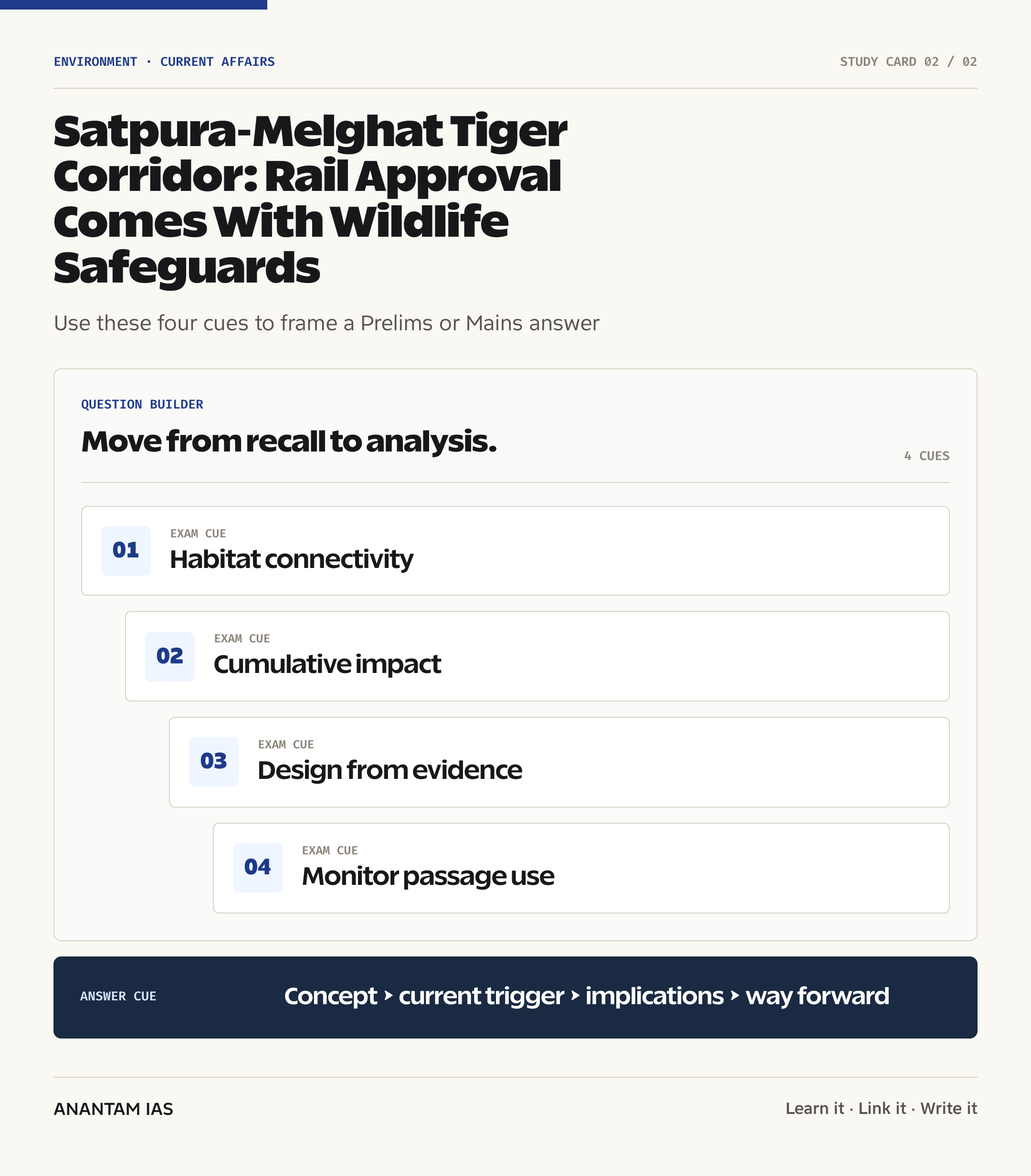
- The case tests whether linear infrastructure can add transport capacity without turning a functional habitat link into a barrier or mortality zone.
- A wildlife passage works only when its location, width, approach habitat and connectivity correspond to how animals actually move across the landscape.
- The approval process illustrates the distinct roles of the NBWL Standing Committee, NTCA, Wildlife Institute of India and state forest authorities.
UPSC Relevance
Prelims Relevance
- The Satpura Tiger Reserve is in Madhya Pradesh; the Melghat Tiger Reserve is in Maharashtra.
- A wildlife corridor connects habitat patches and supports dispersal, seasonal movement and genetic exchange between populations.
- A corridor may extend beyond the boundary of a National Park, Wildlife Sanctuary or Tiger Reserve; landscape connectivity is the core ecological idea.
- The National Board for Wildlife is a statutory body under the Wildlife (Protection) Act, 1972 and is chaired by the Prime Minister.
- Its Standing Committee appraises project proposals affecting protected areas and wildlife values on behalf of the Board.
- The National Tiger Conservation Authority is a statutory authority under the Wildlife (Protection) Act and advises on tiger-reserve and corridor safeguards.
Mains Relevance
GS Paper 3
- Biodiversity conservation, habitat fragmentation and the ecological value of landscape-scale tiger corridors.
- Environmental appraisal of railways, highways and other linear infrastructure in wildlife-sensitive areas.
GS Paper 2
- Institutional coordination among the Union environment ministry, NBWL, NTCA, WII, Railways and state governments.
- Reasoned, science-based conditional approvals as part of accountable environmental governance.
Essay
- Connectivity is as important for ecosystems as it is for economies.
Background and Context
What Is the Satpura-Melghat Corridor?
The corridor is a landscape link between major tiger habitats of central India, not merely a narrow line drawn between two reserve boundaries.
- It links the Satpura landscape of Madhya Pradesh with the Melghat landscape of Maharashtra through forests and mixed-use areas.
- The NTCA’s corridor assessment describes the Satpura-Melghat link as mostly forested, with relatively low-intensity agriculture and human density in parts of the landscape.
- The link supports movement by tigers, leopards, sloth bears and herbivores, allowing animals to disperse beyond individual protected areas.
- Dispersal can maintain gene flow, reduce isolation and help recolonisation when local habitats retain breeding and prey conditions.
- For a broader species overview, revise India’s tiger conservation story.
Why Railways Can Fragment Habitat
A railway becomes an ecological barrier when animals cannot cross it safely or when repeated disturbance changes their movement behaviour.
- Tracks, embankments, fencing and associated works can create a physical barrier across established animal routes.
- Train movement can cause collision mortality, while noise, vibration and night-time activity may disturb sensitive stretches.
- Construction access, vegetation clearing and material movement can widen the project’s disturbance footprint beyond the rails themselves.
- Adding a third and potentially a fourth line can create cumulative impacts; assessing each structure in isolation may miss the wider barrier effect.
- Fragmentation risk depends on local topography, drainage, forest cover, prey use and movement data, so a standard passage design cannot be copied everywhere.
The Proposal and Its Approval Path
The present decision sits inside a staged appraisal process rather than granting an unconditional right to begin work across the corridor.
- The project proponent is Central Railway, which argues that another line will improve capacity, operational efficiency and safety on the busy route.
- At an earlier meeting, the Standing Committee deferred the proposal and asked for a site inspection involving the environment ministry, WII, NTCA, the state forest department and the user agency.
- The July recommendation came with a rider that the proposed mitigation structures be supported by scientific study and engineering design.
- The inspection committee must re-examine the project after considering the SFRI study and other data, then recommend the location, dimensions, design and connectivity of the passages.
- Students should distinguish an in-principle recommendation from final approval and compliance through construction and operation.
Institutions and Legal Logic
Tiger-corridor appraisal combines statutory authority, scientific advice and site-level administration.
- Under the Wildlife (Protection) Act, 1972, the NBWL provides the central statutory framework for wildlife policy and project appraisal; revise the Act’s institutions and protected-area provisions.
- Section 38-O assigns the NTCA a role in ensuring that tiger reserves and areas linking protected areas or tiger reserves are not diverted for ecologically unsustainable uses except under the statutory public-interest and approval safeguards.
- The WII contributes ecological expertise, while the state Chief Wildlife Warden and field staff supply site knowledge and records. See the WII mandate and research role.
- The Railways remains the user agency responsible for engineering, funding and implementing the conditions attached to approval.
- Good appraisal connects central rules with a state wildlife action framework and measurable field outcomes.
Way Forward
Complete the Landscape-Level Assessment
- Place the SFRI study, movement evidence and mortality data before the inspection committee and record how each finding changes the design.
- Assess the third and possible fourth lines together so that cumulative impacts are not split across separate files.
- Finalise each passage’s location, span, approach and connectivity jointly with wildlife scientists and railway engineers.
- Protect the habitat leading to each structure; an isolated crossing cannot sustain landscape connectivity.
Conclusion
- The Satpura-Melghat case is not a simple contest between trains and tigers.
- The in-principle recommendation remains credible only if the rider changes the final design on the ground.
UPSC Practice Questions
Prelims MCQ 1
With reference to the Satpura-Melghat landscape, consider the following statements:
- Satpura Tiger Reserve is in Madhya Pradesh.
- Melghat Tiger Reserve is in Maharashtra.
- A wildlife corridor must lie entirely inside the notified boundaries of tiger reserves.
How many of the above statements are correct?
(a) Only one (b) Only two (c) All three (d) None
Answer: (b) Only two
Explanation:
Statements 1 and 2 are correct. Statement 3 is incorrect: corridors connect habitat patches and may include forests and other lands outside notified tiger-reserve boundaries.
Prelims MCQ 2
Which institution is specifically constituted under the Wildlife (Protection) Act to strengthen tiger conservation and advise on tiger reserves and linking areas?
(a) Central Pollution Control Board (b) National Tiger Conservation Authority (c) Forest Survey of India (d) Central Zoo Authority
Answer: (b) National Tiger Conservation Authority
Explanation:
The National Tiger Conservation Authority is the statutory authority for tiger conservation. Its mandate includes safeguards concerning tiger reserves and areas linking protected areas or tiger reserves.
UPSC Mains Questions
- Wildlife passages are effective only when ecological evidence determines engineering design. Examine this statement in the context of the proposed third railway line through the Satpura-Melghat tiger corridor and suggest an outcome-based monitoring framework.
- How should environmental governance reconcile the capacity needs of linear infrastructure with the long-term connectivity of wildlife landscapes? Discuss the roles of the NBWL Standing Committee, NTCA, WII, state agencies and the project proponent.
Sources: The Indian Express and Standing Committee of the National Board for Wildlife, MoEFCC.
Frequently Asked Questions
What is the Satpura-Melghat tiger corridor?
It is a central Indian landscape connection between the Satpura tiger habitat in Madhya Pradesh and the Melghat tiger habitat in Maharashtra. Its forests and intervening lands support animal movement, dispersal and genetic exchange. A corridor is valued for ecological.
Has the railway project received final wildlife clearance?
No unconditional final clearance is described. The Standing Committee recommended in-principle wildlife clearance with a rider: scientific findings and engineering review must guide the location, dimensions, design and connectivity of mitigation structures, and the inspection committee must revisit the area.
How much corridor land does the proposal cover?
Official proposal records describe 206.09 hectares within the notified corridor, comprising 74.69 hectares of forest land and 131.4 hectares of non-forest land. The proposed Jujharpur-Chichonda railway section is about 160.6 km long and forms part of a wider Itarsi-Nagpur capacity.
Why were 34 proposed overpasses not enough?
The issue was not only the count. The inspection committee noted that the proposed sites relied largely on field inputs and mortality records while a comprehensive landscape-level assessment and final engineering designs were still pending. A passage succeeds only if.
Which institutions are reviewing the safeguards?
The process involves the Standing Committee of the National Board for Wildlife, the National Tiger Conservation Authority, the Wildlife Institute of India, the Union environment ministry, Madhya Pradesh forest authorities and Central Railway. The State Forest Research Institute, Jabalpur, prepared.