The Wildlife Institute of India (WII) is the country’s premier research and training institution in wildlife science. Based in Dehradun, Uttarakhand, it operates as an autonomous body under the Ministry of Environment, Forest and Climate Change (MoEFCC). Since its establishment in 1982, WII has shaped almost every major wildlife policy decision — from the tiger census methodology to protected-area management plans and species recovery programmes. For UPSC candidates, WII sits at the intersection of environment, governance, and science.
Establishment and Institutional Status
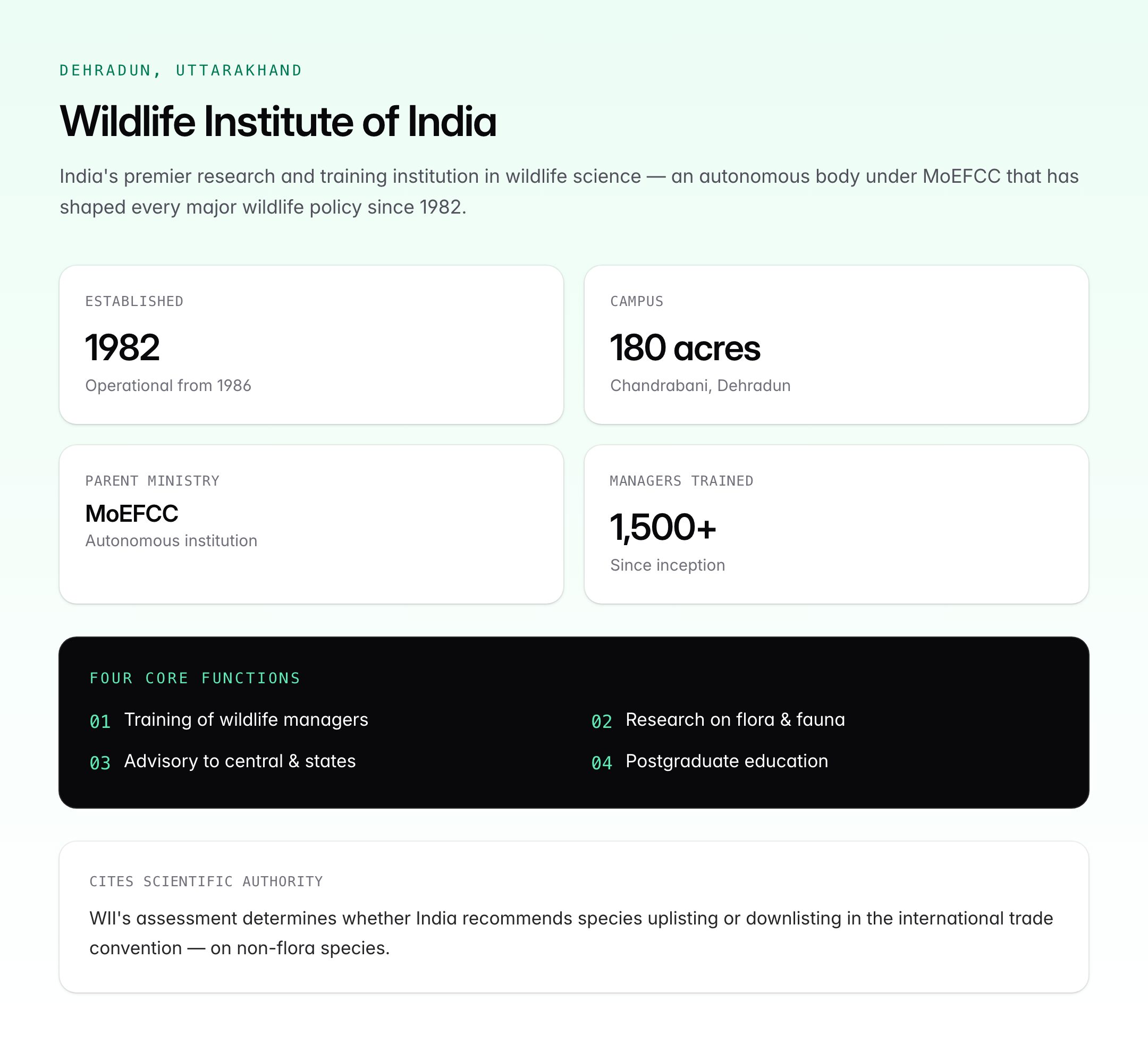
WII was set up on the recommendations of the Task Force on Eco-Development and the Indian Board for Wildlife. It was formally established in 1982 and became fully operational in 1986.
| Parameter | Detail |
|---|---|
| Established | 1982 (operational from 1986) |
| Location | Chandrabani, Dehradun, Uttarakhand |
| Campus area | 180 acres |
| Parent ministry | Ministry of Environment, Forest and Climate Change (MoEFCC) |
| Status | Autonomous institution |
| Governing body | Chaired by Union Minister, MoEFCC |
| Director | Senior Indian Forest Service officer |
As an autonomous body, WII sets its own research priorities while receiving core funding from MoEFCC. It collaborates with state forest departments, international conservation organisations, and academic institutions.
Mandate and Core Functions
The founding charter gave WII four primary roles. They remain the backbone of its work today.
- Training — Build human capacity in wildlife management across forest departments, NGOs, and academia
- Research — Generate scientific knowledge on Indian flora, fauna, ecosystems, and conservation threats
- Advisory — Provide technical support to central and state governments on wildlife policy
- Education — Offer postgraduate degrees and short-term courses in wildlife science
WII has produced over 1,500 trained wildlife managers since inception, a majority of whom serve in the Indian Forest Service.
Academic Programmes
WII is an academic institution as well as a research body. Its programmes are recognised nationally and globally.
| Programme | Duration | For |
|---|---|---|
| M.Sc. Wildlife Science | 2 years | Open to graduates (competitive entrance) |
| Ph.D. Wildlife Science | 3+ years | Affiliated with Saurashtra University |
| Postgraduate Diploma in Advanced Wildlife Management | 9 months | Mid-career forest officers |
| Certificate Course in Wildlife Management | 3 months | State forest officials |
| Short courses | 1–4 weeks | Enforcement staff, NGO workers, students |
The M.Sc. programme is among the most selective in environmental science in India. Graduates are employed by forest departments, international NGOs (WWF, WCS), and research organisations.
Major Research Divisions
WII's research is organised by discipline and by species. Key divisions include:
- Endangered Species Management
- Habitat Ecology
- Wildlife Health
- Landscape Level Planning
- Population Management, Capture and Rehabilitation
- Protected Area Network, Wildlife Management and Conservation Education
- Forensic Cell — the first wildlife forensic lab in South Asia
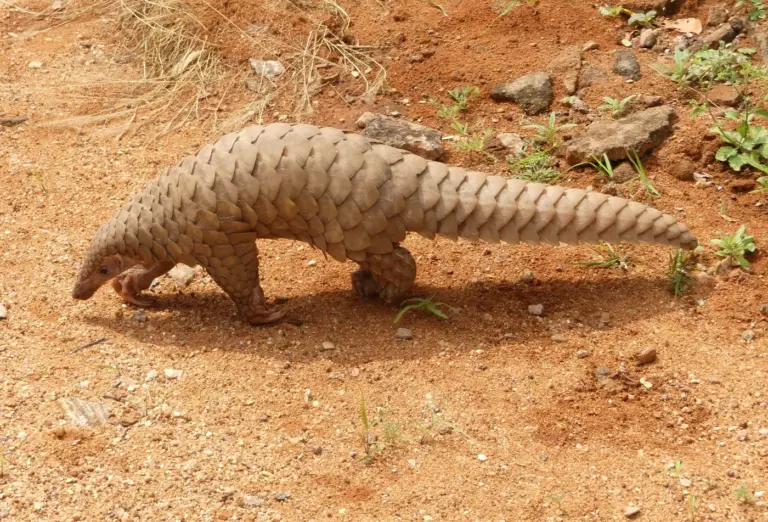
The Forensic Cell assists enforcement agencies in species identification from seized wildlife products — a capability critical in curbing illegal trade in tiger parts, ivory, pangolin scales, and reptile skins.
Flagship Research — Project Tiger Monitoring
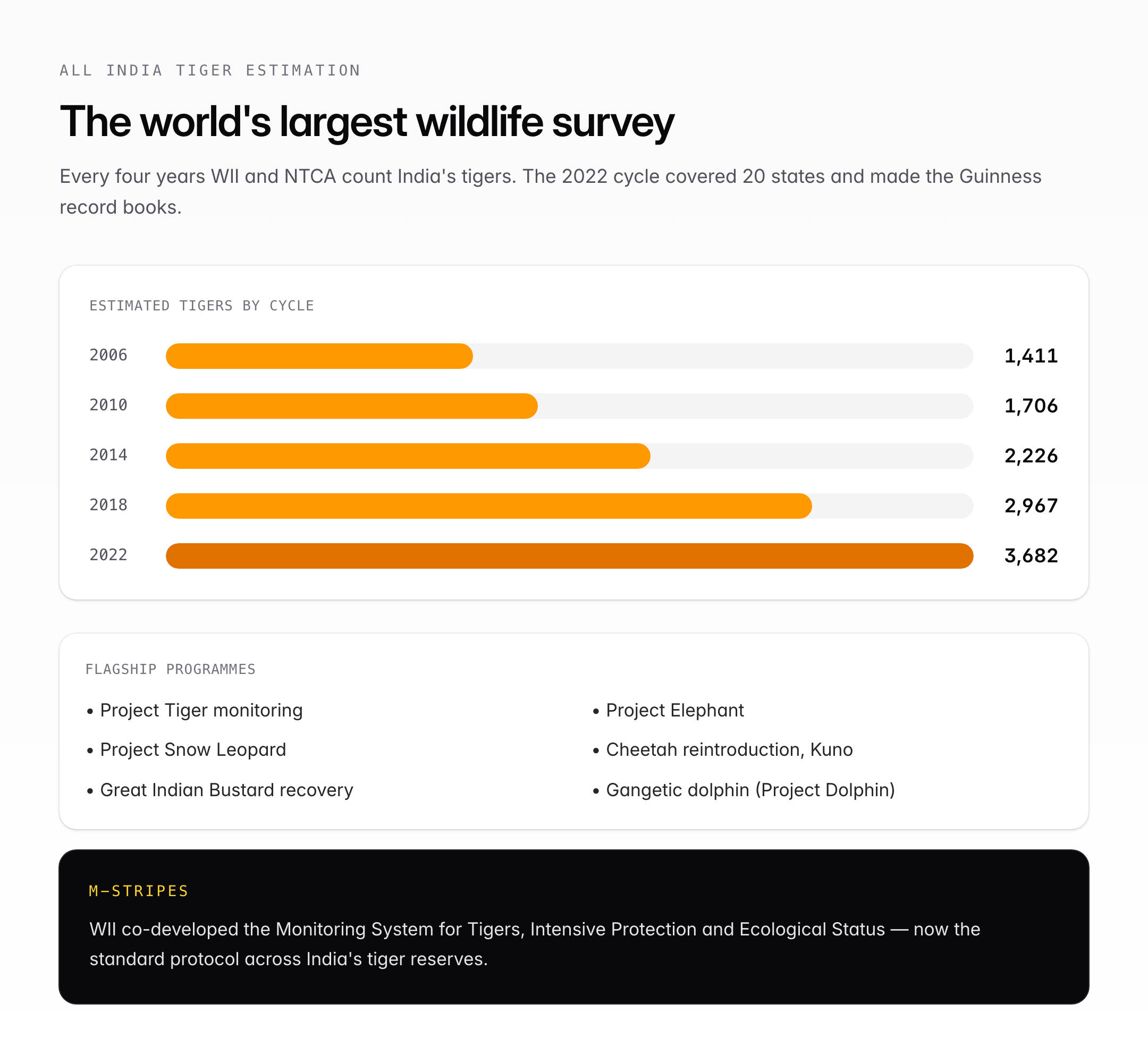
WII's most visible contribution is the All India Tiger Estimation, conducted every four years jointly with the National Tiger Conservation Authority (NTCA) and state forest departments. It is recognised by Guinness World Records as the world's largest wildlife survey.
| Cycle | Estimated tigers | Methodology |
|---|---|---|
| 2006 | 1,411 | Camera traps + occupancy |
| 2010 | 1,706 | Refined double-sampling |
| 2014 | 2,226 | Expanded camera trapping |
| 2018 | 2,967 | Systematic grid-based survey |
| 2022 | 3,682 (minimum) | Largest-ever effort |
The M-STrIPES (Monitoring System for Tigers, Intensive Protection and Ecological Status) app, co-developed by WII, allows field staff to log patrols, sign surveys, and illegal incidents in real time. It has become the standard protocol for tiger reserve management across India.
Other Major Conservation Programmes
WII is involved in long-term programmes spanning terrestrial, freshwater, and marine ecosystems.
- National Mission for Clean Ganga (NMCG) — River dolphin research and Ganga biodiversity baseline
- Project Elephant — Population estimates, corridor mapping, human-elephant conflict mitigation
- Project Snow Leopard — Population assessment across the Himalayan range
- Cheetah reintroduction — Scientific partner for the Kuno National Park cheetah translocation from Namibia and South Africa
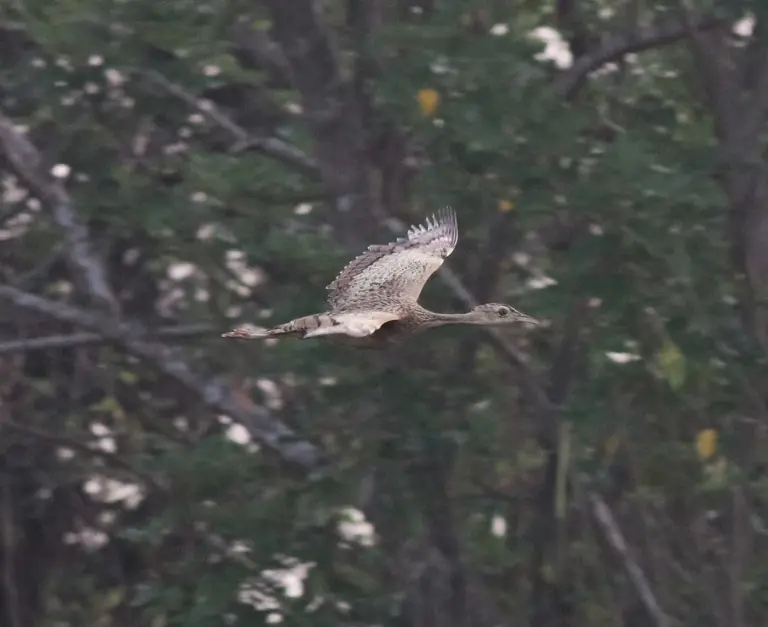
- Great Indian Bustard recovery — Captive breeding centre in Sam, Rajasthan (with Rajasthan Forest Department)
- Gangetic River Dolphin conservation — Assessment under Project Dolphin
- National Board for Wildlife — Technical input on infrastructure projects through protected areas
Publications and Data Products
WII produces authoritative reference works and open datasets that shape both policy and scholarship.
| Publication | Frequency | Focus |
|---|---|---|
| ENVIS Bulletin on Wildlife and Protected Areas | Annual | Specific themes (e.g., Gangetic dolphin, elephants) |
| Status of Tigers, Co-predators and Prey | Every 4 years | National tiger census |
| National Studbook | Species-specific | Captive population genetics |
| Journal of Wildlife Research | Quarterly | Peer-reviewed science |
| Protected Area Update | Bimonthly | PA governance news |
Infrastructure and Field Network
WII's Dehradun campus includes research laboratories, a GIS cell, a radio-telemetry lab, a wildlife health centre, a museum, and one of South Asia's largest wildlife libraries. The institute also maintains field stations in strategic ecosystems:
- Valmiki Tiger Reserve (Bihar)
- Kaziranga–Karbi Anglong (Assam)
- Gir Landscape (Gujarat)
- Sundarbans (West Bengal)
- Trans-Himalaya field base (Ladakh/Himachal)
Collaborations and Partnerships
WII collaborates widely:
- International: IUCN, WWF, Smithsonian Institution, USFWS, CITES Secretariat
- National: NTCA, CZA, ZSI, BSI, ICFRE, state forest departments
- Academic: IITs, IISc, Wildlife Conservation Society-India, Nature Conservation Foundation
It is the CITES Scientific Authority for India on non-flora species — meaning WII's assessment determines whether India recommends species uplisting or downlisting in the international trade convention.
Criticisms and Challenges
Despite its stature, WII faces recurrent concerns.
- Perceived close ties with MoEFCC can limit independent critique of government infrastructure clearances
- Some EIA reviews done by WII for projects in protected areas have been questioned by civil-society scientists
- Funding constraints have slowed expansion despite a widening mandate
- The dual role of researcher and regulatory advisor creates occasional conflicts of interest
These debates are themselves valuable UPSC case material on autonomy, scientific governance, and the politics of environmental decision-making.
UPSC Relevance
WII is a high-frequency Environment topic.
- Prelims: Year of establishment (1982), parent ministry (MoEFCC), location (Dehradun), autonomous status, flagship surveys (All India Tiger Estimation, M-STrIPES)
- Mains GS Paper III: Role in biodiversity conservation, cheetah reintroduction scientific basis, tiger census methodology evolution, human-wildlife conflict research
- Current affairs link-ups: Project Cheetah (Kuno NP), 2022 tiger census results, Great Indian Bustard captive breeding, Gangetic dolphin Project Dolphin
- Institutional map: Relationship with NTCA (statutory body under Wildlife Protection Act, 1972), CZA, NBWL, ZSI, BSI
- Conservation conventions: WII's role as CITES Scientific Authority, IUCN Red List inputs
Candidates should be able to distinguish between WII (research and training), NTCA (tiger-specific statutory regulator), MoEFCC (ministry), and state forest departments (field implementation) — a common area of Prelims confusion.
Tell Google you want more of this.
Add Anantam IAS as a preferred sourceOne tap, and this site shows up more often in your own Top Stories, AI Overviews and AI Mode. Remove it any time.