Supreme Court to Invoke Article 142 to Quash Student NEET-Protest FIRs
Why in News?
On 18 August 2026, a three-judge Supreme Court Bench headed by Chief Justice Surya Kant agreed to invoke Article 142 to quash FIRs naming only students in nationwide NEET-UG protest cases.
- The Court asked for the list of FIRs in which only students were named. Delhi Police have still not shared those numbers.
- Chief Justice Kant said the Bench will quash those student-only FIRs under Article 142. Cases with serious criminal antecedents will be heard separately.
- Solicitor General Tushar Mehta, also Delhi Police counsel, said investigation would be confined to 2,873 persons with a serious criminal background identified at the site.
- That 2,873 figure is the SG’s attributed count of history-sheeters, including alleged murder, rape and child sexual abuse charges, not a convicted set.
- The Bench will constitute a high-powered committee on NEET-UG protest issues, invited suggestions, and said the order would come the next day.
- Nationwide student protests over NEET-UG leaks reached the Court after a Delhi crackdown. The grievance is testing failure, not the later force mix.
- Article 142 is complete justice in a pending cause. It is not a standing amnesty for every protest FIR in the country.
- The exam split is peaceful student speech under Article 19 versus identified persons with serious criminal antecedents.
UPSC Relevance
Prelims Relevance
- Article 142(1) lets the Supreme Court pass orders necessary for complete justice in a pending cause or matter.
- An Article 142 order is enforceable throughout India. It is not a general amnesty and cannot run without a live cause.
- Article 19 protects speech and dissent. The Chief Justice tied peaceful student protest to that guarantee.
- A First Information Report is the police case. A quash still needs the specific FIR numbers.
- The figure 2,873 is the Solicitor General’s attributed headcount of serious-antecedent persons, not a conviction count.
- A court-constituted high-powered committee is not a statutory commission of inquiry.
Mains Relevance
GS Paper 2
- Article 142 as complete justice in a pending cause, set against ordinary criminal process.
- Article 19 peaceful protest versus public order when a crowd is infiltrated.
- Police accountability when FIR numbers, named suspects and internal action are missing.
GS Paper 4
- Why unnamed plainclothes officers and a silent affidavit weaken public trust in force.
- How a court should separate student futures from persons with serious criminal antecedents.
Essay
- Complete justice is not the same as a general pardon.
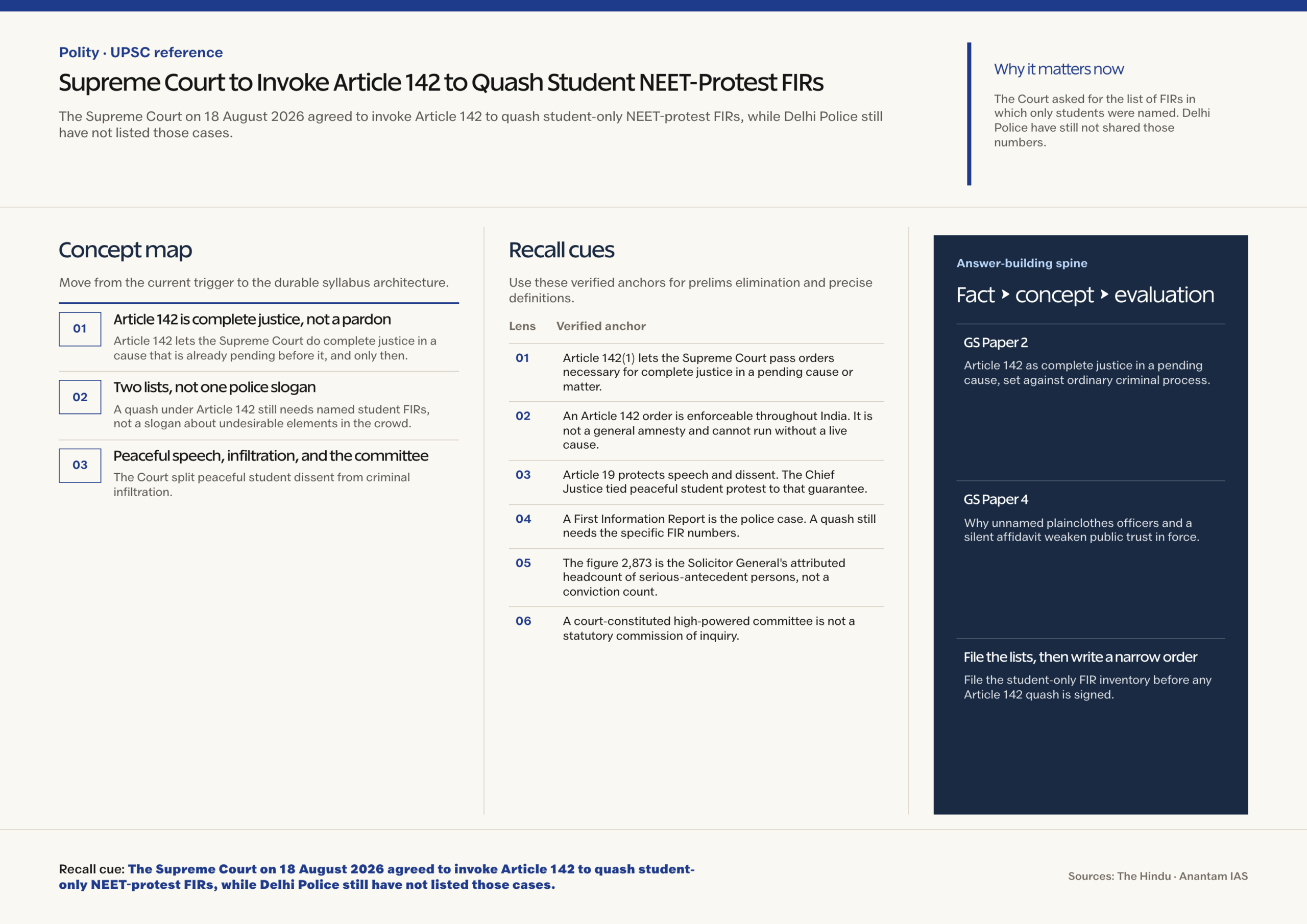
Background and Context
Article 142 is complete justice, not a pardon
Article 142 lets the Supreme Court do complete justice in a cause that is already pending before it, and only then.
- Article 142(1) lets the Court pass any decree or order necessary for doing complete justice in a pending cause or matter. That is the constitutional text, not a slogan from the Bar.
- Any such order is enforceable throughout the territory of India. It is not a free-standing pardon that can run when no cause is on the docket at all.
- On 18 August the three-judge Bench headed by Chief Justice Surya Kant agreed to invoke this power for student-only FIRs. A spoken agreement is still not a signed quash order.
- An objector asked whether the relief would be a one-off or a new precedent. The Court answered in terms of student futures and public confidence in the system, not a protest template.
- Teach Article 142 as case-specific relief inside this cause. It is not a standing amnesty for protest waiting for the next student crowd on the street. That is the exam trap.
Two lists, not one police slogan
A quash under Article 142 still needs named student FIRs, not a slogan about undesirable elements in the crowd. The State must produce both lists.
- The Court asked for every FIR in which only students were named, before any quash can issue. An FIR is a liberty event; see grounds of arrest and personal liberty.
- Delhi Police had promised no action against students who protested peacefully. They have still not disclosed even the FIR numbers on which that promise to the Court depends.
- Counsel Vrinda Grover pointed out that missing inventory. Chief Justice Kant asked how the Bench can quash FIRs that have not been placed before it at all. The list is the first obstacle.
- Justice Joymalya Bagchi said the State cannot refer to undesirable elements in generic terms. Identification is a duty the Court can test, not a courtroom flourish.
- Solicitor General Tushar Mehta said police had identified 2,873 persons with a serious criminal background at the site, including history-sheeters, and that the rest, in his words, are students.
Peaceful speech, infiltration, and the committee
The Court split peaceful student dissent from criminal infiltration, then sent the leftover protest issues to a high-powered committee.
- Chief Justice Kant tied the gathering to the Article 19 right to speech and dissent, so long as students intended to hold a peaceful and lawful protest on their exam demands.
- He drew a clear line between peacefully agitating students and hardened criminals who had infiltrated the protest to spread violence rather than to press exam demands. The two tracks must stay separate.
- Nationwide protests over NEET-UG leaks reached the Court after a Delhi crackdown. The trigger is testing failure, not the later force mix; see also paper-leak courts.
- The Bench will constitute a high-powered committee on protest issues, invited suggestions, heard a request for a woman member, and said the order would be out the next day.
- The panel must look urgently at alleged sexual molestation of women protesters. The Delhi Police affidavit is silent on internal action and admits plainclothes policemen without name tags.
Way Forward
File the lists, then write a narrow order
- File the student-only FIR inventory before any Article 142 quash is signed.
- Identify the 2,873 serious-antecedent cases by name and charge, not only by a rounded headcount.
- Put molestation allegations and unnamed plainclothes officers on the committee’s urgent list.
- Keep the relief inside this cause. Article 142 should not become a standing protest amnesty.
Conclusion
- The news is a promised use of Article 142, not a signed quash. Without the student-only FIR list, complete justice still has no file to act on.
- In an answer, split Article 19 student speech from identified serious-antecedent cases, and treat 2,873 as an attributed police count, not a convicted class.
- Put force, molestation and unnamed officers on the committee’s urgent list. Those facts belong with the panel, not inside the Article 142 paragraph.
UPSC Practice Questions
Prelims MCQ 1
With reference to the Supreme Court’s 18 August 2026 hearing on NEET-UG protest FIRs, consider the following statements:
- Article 142(1) empowers the Supreme Court to pass such decree or make such order as is necessary for doing complete justice in any cause or matter pending before it.
- The Bench agreed to invoke Article 142 for FIRs in which only students were named, while FIRs involving persons with serious criminal antecedents would be decided separately.
- The figure of 2,873 is a Supreme Court finding that 2,873 protesters have been convicted of serious offences.
How many of the above statements are correct?
(a) Only one (b) Only two (c) All three (d) None
Answer: (b) Only two
Explanation:
Statements 1 and 2 follow the constitutional text and the Chief Justice’s 18 August statement. Statement 3 is wrong: 2,873 is the Solicitor General’s attributed count of persons with a serious criminal background identified at the site, not a convicted set.
Prelims MCQ 2
The Supreme Court’s 18 August 2026 response to student FIRs from the NEET-UG protests is best described as:
(a) A final Article 142 order quashing every FIR arising from the protests (b) An agreement to invoke Article 142 for student-only FIRs after the Court obtains that list (c) A direction that Delhi Police drop the 2,873 serious-antecedent investigations (d) A constitutional amendment creating a standing amnesty for student protest
Answer: (b) An agreement to invoke Article 142 for student-only FIRs after the Court obtains that list
Explanation:
The Bench agreed to use Article 142 and asked for the student-only FIR list. It has not signed a quash, has not closed the 2,873 track, and has not rewritten the Constitution.
UPSC Mains Questions
- Article 142 is a power to do complete justice in a pending cause, not a general protest amnesty. Discuss with reference to the 18 August 2026 NEET-UG student FIR hearing. (250 words)
- How should constitutional courts separate peaceful student speech under Article 19 from criminal infiltration of a public protest? (150 words)
Source: The Hindu.
Frequently Asked Questions
Has the Supreme Court quashed the NEET-protest FIRs?
No. On 18 August 2026 the Bench agreed to invoke Article 142 for student-only FIRs. It first wants that list. No quash order is yet on the record.
What is Article 142?
Article 142(1) lets the Supreme Court pass any order needed for complete justice in a cause or matter pending before it. The order is enforceable throughout India.
Who are the 2,873 persons mentioned in court?
The Solicitor General said police would confine investigation to 2,873 persons with a serious criminal background identified at the site. It is an attributed count, not a convicted set.
Why does the Court need the FIR list?
Without FIRs that name only students, the Court cannot identify whom an Article 142 quash would cover. Delhi Police have not shared even the FIR numbers.
What will the high-powered committee examine?
It will examine NEET-UG protest issues, including urgent allegations of sexual molestation of women protesters. The Bench invited suggestions and heard a request for a woman member.