SC calls on students to educate elders in Waste Management
Why in News?
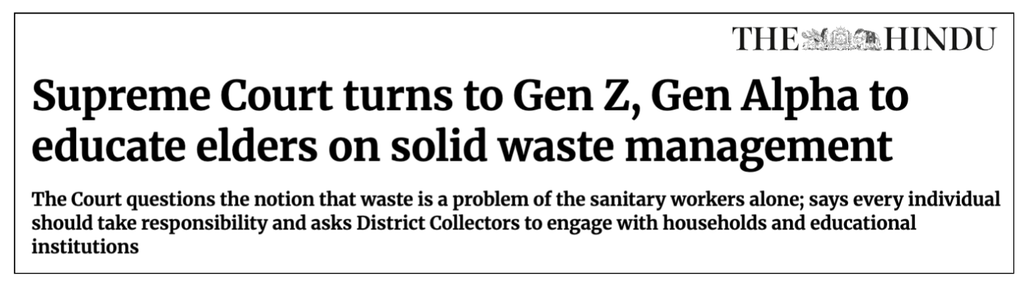
The Supreme Court has directed school and higher-education authorities to integrate theoretical as well as practical solid-waste-management education into the curriculum. It observed that children can become effective agents of behavioural change by encouraging parents and communities to reduce and segregate household waste.
The directions were issued in Bhopal Municipal Corporation v. Dr Subhash C. Pandey, where the Court is monitoring nationwide implementation of the Solid Waste Management Rules, 2026.
| UPSC Relevance: GS-3 Environment & Biodiversity: Pollution, Conservation; GS-2 Governance; GS-4 Ethics Prelims: Solid Waste Management Rules 2026 Mains: Waste Management: Challenges, Constitutional & governance dimensions, Govt policies. |
What did the Court observe?
The Court rejected the assumption that waste management is solely the responsibility of sanitation workers. A small workforce cannot manage the increasingly complex waste generated by nearly 1.4 billion people without cooperation from households and institutions.
The Court directed:
- Immediate inclusion of practical waste-management lessons in schools and colleges
- Training teachers as trainers
- Engagement by District Collectors with households and educational institutions; and
- Participation of students in educating family and community members about responsible waste behaviour.
It had earlier constituted a monitoring committee comprising five Union Secretaries and the Member-Secretary of the Central Pollution Control Board to oversee implementation of the 2026 Rules.
Solid Waste Management Rules, 2026:
Notified under the Environment (Protection) Act, 1986, the Rules superseded the 2016 framework and became effective on April 1, 2026. They mandate segregation at source into four streams:
- Wet waste: Kitchen and biodegradable waste;
- Dry waste: Paper, plastic, metal, glass and other recyclables;
- Sanitary waste: Diapers, sanitary products and similar waste; and
- Special-care waste: Medicines, bulbs, paint containers and mercury thermometers.
The Rules incorporate the circular-economy and polluter-pays principles, online monitoring, environmental compensation and Extended Bulk Waste Generator Responsibility.
Read more: Solid Waste Management Rules, 2026 https://anantamias.com/current-affairs/a-decentralised-solution-for-waste-crisis/
Constitutional and governance dimensions:
- Article 21: The right to life includes the right to a clean and healthy environment.
- Article 48A: Directs the State to protect and improve the environment.
- Article 51A(g): Makes environmental protection a fundamental duty of every citizen.
- Article 21A: Environmental education can form part of meaningful and socially relevant education.
- Twelfth Schedule: Public health, sanitation and solid-waste management are functions of Urban Local Bodies.
The judgment therefore reframes waste management from a narrow municipal service into a form of participatory environmental governance.
Why involve students?
- Behavioural habits such as segregation, reuse and responsible consumption are easier to build at an early age.
- Children can transfer environmental knowledge from classrooms to households.
- School waste audits, composting and recycling projects connect theory with practice.
- Eco-clubs, NCC, NSS and community campaigns can strengthen civic responsibility.
- Education reduces reliance on punishment by encouraging voluntary compliance.
This approach aligns with Mission LiFE, which seeks to transform individual lifestyle choices into collective environmental action.
Concerns and Limitations:
Education cannot substitute for functional public infrastructure. Asking children to promote segregation will have limited impact if municipal bodies subsequently mix waste during collection.
- Children must not be made to handle sanitary, biomedical or hazardous waste.
- Student participation should not become unpaid sanitation labour.
- Sanitation workers and informal waste pickers require protective equipment, fair wages, mechanisation and social security.
- Urban Local Bodies need adequate finance, trained personnel, Material Recovery Facilities and scientific processing capacity.
- Producers must remain responsible for plastic, electronic and packaging waste.
Way Forward:
- Introduce age-appropriate modules on the waste hierarchy: refuse, reduce, reuse, repair, recycle and recover.
- Establish zero-waste campuses with separate bins, composting and verified recycling.
- Conduct household and school waste audits rather than symbolic cleanliness drives.
- Ensure segregated door-to-door collection and traceability up to final processing.
- Formalise and integrate waste pickers into municipal systems.
- Link behavioural education with enforcement of user charges, Extended Producer Responsibility and the polluter-pays principle.
The Supreme Court’s intervention recognises that cleanliness cannot be outsourced to sanitation workers. Students can act as powerful catalysts of change, but lasting success requires responsible citizens, accountable producers and capable local governments to work together across the entire waste chain.