Why in News?
The Solid Waste Management Rules, 2026, have replaced the 2016 Rules with effect from April 1, 2026. While the Rules aim to improve waste management and environmental outcomes, concerns have been raised regarding excessive centralisation, weak federal design, and impractical compliance burdens for States and local bodies.
| UPSC Relevance: GS-2 Governance; GS-3 Environment: Pollution Prelims: Solid Waste Management Rules, 2026 Mains: Solid Waste Management Rules, 2026 (Key features & associated challenges) |
India’s Growing Waste Crisis:
India’s waste crisis has evolved from a local sanitation issue into a major ecological and governance challenge.
Key Concerns due to the growing Waste Crisis:
- Urban Waste Crisis: Rapid urbanisation has led to the mounting generation of solid waste. Large landfills in cities such as Delhi, Mumbai, and Bengaluru have become major sources of Methane emissions, Toxic leachate, Frequent landfill fires, and air and groundwater pollution.
- Plastic Pollution: Plastic waste clogs urban drains, worsening monsoon flooding. Single-use plastics and packaging waste increasingly contaminate rivers and coastal ecosystems.
- Rural Waste Challenge: Rural India now faces a rising accumulation of Plastic packaging, Sanitary waste, Pesticide containers, E-waste, and Non-biodegradable consumer waste.
- Public Health Impacts: Open dumping and burning release toxic pollutants. Poor waste management contributes to respiratory illnesses, vector-borne diseases and water contamination.
Solid Waste Management Rules, 2026;
The Solid Waste Management Rules, 2026, effective April 1, 2026, replace the 2016 regulations.
Key Features of the 2026 Rules:
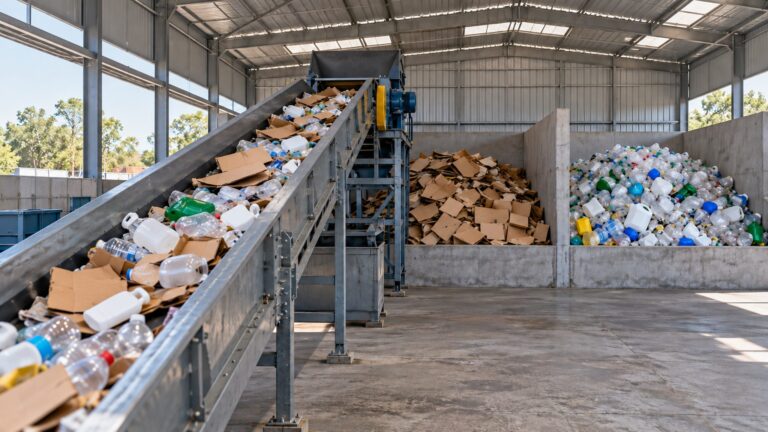
- Mandatory Four-Stream Waste Segregation at Source:
- Wet Waste: Kitchen, food, and fruit peels (for composting/ bio-methanation).
- Dry Waste: Plastic, paper, metal, and glass (for Material Recovery Facilities/recycling).
- Sanitary Waste: Diapers, napkins (wrapped securely).
- Special Care Waste: Batteries, bulbs, and medicines.
- Bulk Waste Generators (BWGs): Entities qualifying as BWGs (floor area ≥20,000 sq m, water use ≥40,000 L/day, or waste ≥100 kg/day) must ensure end-to-end environmentally sound waste management. BWGs account for ~30% of total solid waste.
- Extended BWG Responsibility (EBWGR): Mandates on-site wet waste processing; where not feasible, an EBWGR certificate must be obtained. User fees may be levied by local bodies.
- Digital Monitoring & Compliance: Centralised Online Portal to track waste generation, collection, transport, processing, and disposal. Mandatory audits of all facilities, with reports uploaded on the portal. Biomining and bioremediation of legacy dumpsites to be tracked with quarterly progress updates. Online registration and authorisation of all waste processing facilities.
- Land Allocation & Infrastructure: Graded buffer zone criteria around facilities with capacity >5 tonnes per day to expedite land allocation by states. Material Recovery Facilities (MRFs) are formally recognised as sorting facilities and designated collection points for e-waste, sanitary, and special care waste. Local bodies are encouraged to generate carbon credits.
- Refuse Derived Fuel (RDF): RDF (from non-recyclable plastic, paper, and textiles) is mandated as a fuel substitute for cement plants and waste-to-energy plants. Substitution rate to rise from 5% to 15% over six years.
- Landfill Restrictions & Legacy Waste: Landfills are restricted strictly to non-recyclable, non-energy-recoverable, and inert waste. Higher landfill fees for unsegregated waste (costlier than segregation + processing combined). Annual audits by SPCBs; performance overseen by District Collectors. All legacy dumpsites to be mapped, assessed, and remediated in a time-bound manner.
- Special Provisions: Hilly Areas & Islands: Tourist-specific user fees and regulated tourist inflow based on local waste capacity. Designated non-biodegradable waste collection points. Hotels and restaurants to process wet waste decentrally per SPCB norms.
- Polluter Pays Principle: Environmental compensation (fines) will be imposed for non-compliance, with specific guidelines for penalties developed by the Central Pollution Control Board (CPCB).
- Implementation Coverage: Rules apply to all urban and rural local bodies, special economic zones, industrial areas, railways, airports, and religious places.
- Implementation Oversight: Landfill performance will be audited annually by State Pollution Control Boards (SPCBs) and monitored by District Collectors.
- Governance Structure:
- Central level: CPCB develops guidelines and oversees the online portal.
- State level: Committee chaired by the Chief Secretary recommends implementation measures to CPCB.
- Special attention is mandated for peri-urban rural areas under the state sanitation departments.
Legal Basis of the Rules:
- The Rules are framed under the Environment (Protection) Act, 1986.
- The Act derives constitutional legitimacy from Article 253 of the Constitution.
- Article 253 empowers Parliament to legislate for implementing international obligations, such as the United Nations Conference on the Human Environment. This enables Parliament to legislate even in areas connected to:
- Public health
- Sanitation
- Local government
- Agriculture
- Land and water management
- Article 253 empowers Parliament to legislate for implementing international obligations, such as the United Nations Conference on the Human Environment. This enables Parliament to legislate even in areas connected to:
Associated Concerns:
- Intersection with State Subjects: Waste management is intrinsically linked to public health, sanitation, land use, and water management, which are largely state or local subjects under the Constitution. The 2026 rules, enacted under the Environment (Protection) Act, 1986, create a “technocratic vision” that risks ignoring local political and economic realities.
- Centralisation vs Cooperative Federalism: The Rules create a highly centralised regulatory structure where the Centre designs norms, States largely implement, and Local bodies bear operational burdens. This risks undermining state autonomy and local innovation.
- One-Size-Fits-All Design: A system suited to Mumbai cannot be mechanically applied to:
- A Himalayan pilgrimage town with narrow roads and fragile slopes
- A coastal panchayat facing tidal flooding and marine litter
- An island settlement with scarce land
- A tribal hamlet where low-density habitation makes collection costly
- Digital Portal as Surveillance, Not Service: The centralised CPCB reporting portal risks converting local officials into data entry operators rather than governance actors. The danger: reporting to New Delhi replaces actual service delivery on the ground. Data should build local capacity and citizen transparency and not serve upward compliance.
- Weak Democratic Accountability: Waste management reports are uploaded to central portals for bureaucratic review rather than being presented to ward committees, gram sabhas, or municipal councils. Democratic accountability (the most effective driver of service delivery) is bypassed in favour of technocratic monitoring.
- Unfunded Mandates: New obligations are placed on municipalities and panchayats without corresponding formula-based, predictable financial transfers. The 15th Finance Commission provided Rs. 8,000 crore for urban local bodies for solid waste management (2021-26), but this remains inadequate relative to the scale of investment required.
- Problems with Uniform Rural Application: The Rules extend sophisticated waste-management obligations to gram panchayats. However, most rural local bodies lack technical staff, sanitation engineers, waste vehicles, digital infrastructure, and adequate funding. Thus, treating gram panchayats like mini municipalities may create unrealistic compliance burdens, inflated reporting and weak implementation.
Way Forward:
- Waste Governance Needs Differentiation:
- Allow states to frame their own SWM rules for 5 years within minimum national norms. The Centre reviews, identifies best practices, and revises baseline standards based on evidence.
- Megacities need stronger institutions: Large metropolitan cities require Metropolitan Waste Management Authorities, Technical expertise, Citizen oversight, State participation, and integrated planning.
- Minimum National Standards: Central Government should shift from micro-managing to setting a quality floor (Centre defines the outcome, but does not dictate the process).
- State Flexibility: States have the autonomy to design the specific rules and delivery mechanisms to avoid “one-size-fits-all” failures. For instance, a coastal state’s approach will differ vastly from a Himalayan state’s.
- Empowered Local Bodies: Moving Urban Local Bodies (ULBs) and Panchayats from “agency” roles to “governance” roles. Metro Waste Authorities for big cities; gram sabha models for villages.
- Predictable Finance: Replacing discretionary grants with a formula-based, statutory funding model based on clear mandates (like population or performance). This allows them to engage in long-term urban planning rather than living from budget to budget.
- Citizen Accountability: Local participation and social audits should become central pillars.
The Solid Waste Management Rules, 2026, reflect a strong environmental intent, but their highly centralised design risks undermining effective implementation. Without decentralised governance and local ownership, India risks producing extensive compliance paperwork rather than genuinely cleaner cities and villages.
Tell Google you want more of this.
Add Anantam IAS as a preferred sourceOne tap, and this site shows up more often in your own Top Stories, AI Overviews and AI Mode. Remove it any time.