AI in Indian Courts: Inside the Supreme Court’s Draft Regulations, 2026
Why in News?
The Supreme Court released the draft Regulations for Use of Artificial Intelligence (AI) in Courts, 2026 in June 2026 — India’s first comprehensive governance framework for AI across the judiciary. The Indian Express explained the draft this month; public comments are open till July 15, 2026.
The core principle is unambiguous: no judicial outcome may be reached through algorithmic decision-making alone. AI can assist with transcription, translation, research and case management, but human judicial authority stays determinative in every adjudicative decision — and risk-scoring, bail evaluation and black-box tools are banned outright.
- The draft prescribes general principles for AI use in the judiciary and an institutional framework to enforce them; public comments close on July 15, 2026.
- It takes effect for the Supreme Court on a date notified by the Chief Justice of India; each High Court’s Chief Justice notifies separately for courts and tribunals under it.
- Courts must “actively seek opportunities” to deploy AI that demonstrably improves access to justice, cuts delays or raises administrative efficiency.
- A new Apex Body at the Supreme Court, AI Committees, AI Secretariats and a research centre (CoRE-AI) will govern adoption.
- Bans on risk scoring, recidivism prediction, bail-eligibility evaluation and witness-credibility assessment are “absolute and non-derogable” — no authority can relax them.
The development matters in the context of:
- India’s first formal rulebook on what AI may and may not do inside a public institution — a ready-made example for GS2 governance and GS3 technology-regulation answers.
- It lands amid over 5 crore pending cases (National Judicial Data Grid) and the ₹7,210-crore e-Courts Phase III push — efficiency pressure meeting due-process safeguards.
- The EU AI Act classifies AI in the administration of justice as high-risk; India’s draft answers the same concern through institutional design, not statute.

UPSC Relevance
Prelims Relevance
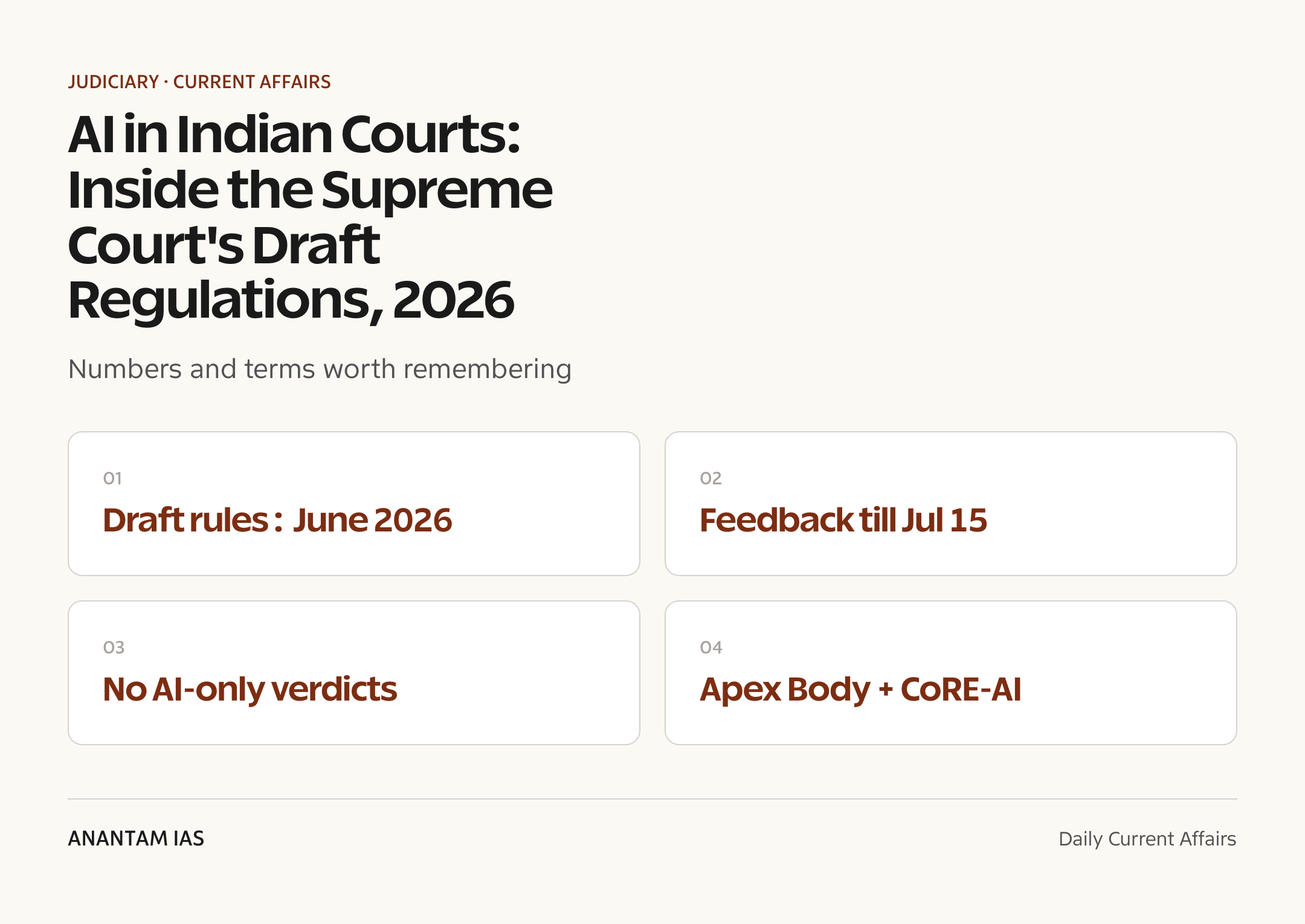
- Draft Regulations for Use of AI in Courts, 2026 — released by the Supreme Court, June 2026; comments till July 15, 2026.
- Apex Body — sitting SC and High Court judges, a MeitY official, finance and cybersecurity experts; works through five specialised committees.
- CoRE-AI — Centre of Research and Excellence on Artificial Intelligence; evaluates tools and tracks developments for the Apex Body.
- AI Register — per court, lists approved systems and audit outcomes; AI Incident Database — per AI Secretariat, with a 24-hour failure-notification rule.
- Absolutely prohibited: risk scoring, recidivism prediction, bail-eligibility evaluation, witness-credibility assessment, and black-box AI in personal-liberty matters.
- SUVAS (2019) — SC’s AI judgment-translation software; SUPACE (2021) — its AI research-assistance portal.
- e-Courts Phase III — approved 2023; ₹7,210-crore outlay for judicial digitisation.
- Kerala High Court (July 2025) — first High Court with an AI-use policy for its district judiciary.
- EU AI Act — lists AI in the administration of justice among high-risk uses.
Mains Relevance
GS Paper 2
- Judicial accountability — disclosure when AI “materially assists” a court; grievance route for prohibited-use harms.
- Institutional design for technology governance: Apex Body, AI Committees and Secretariats instead of a statute.
- Due process and Article 21 — why black-box AI is barred from matters touching personal liberty.
GS Paper 3
- Lifecycle regulation of AI — impact assessment, controlled testing, audits, incident reporting — as a template for high-risk deployments.
- Data governance with vendors: court data can’t train or fine-tune models without written approval; no exclusive IP over tools built on judicial data.
GS Paper 4
- Accountability can’t be delegated to a tool — automation bias, the seduction of fluent output, and human-in-the-loop ethics.
Essay
- AI can advise; only humans may decide — technology on the perch, judgment on the throne.
- Efficiency without accountability is a false bargain in public institutions.
- Regulating a technology while adopting it: the governance tightrope of the AI age.
Background and Context
What the Draft Regulations Are
The draft is the judiciary’s own rulebook for AI — principles, permissions and institutions in one document.
- Formally the draft Regulations for Use of Artificial Intelligence in Courts, 2026, released by the Supreme Court in June 2026, with comments invited till July 15, 2026.
- Three aims: a governance framework for AI in the judiciary, general principles for its use, and institutional machinery to enforce both.
- Commencement is decentralised — the Chief Justice of India notifies dates for the Supreme Court; each High Court’s Chief Justice notifies for courts and tribunals under it, and different provisions can start on different dates, phasing adoption.
- Researchers at the Vidhi Centre for Legal Policy read the draft as optimising court administration — not bringing AI into adjudication.
What AI May Do: The Permitted Zone
The draft is actively pro-adoption for assistive work — with approvals, supervision and disclosure attached.
- Courts must “actively seek opportunities” to deploy AI that demonstrably improves access to justice, cuts delays or raises efficiency.
- Permitted: case management, transcription, translation, legal research, document summarisation, accessibility and court administration.
- Every use needs written approval — from the Apex Body (Supreme Court) or the AI Committee of the High Court or tribunal concerned.
- Nominated court officers must supervise and verify AI-assisted work; no tool runs unattended.
- If AI materially assists in case management, document analysis or judicial administration, parties must be told in a timely, accessible manner — trivial uses don’t trigger disclosure.
What AI May Never Do: The Red Lines
A short list of prohibitions is drafted to be permanent — “absolute and non-derogable”.
- No risk scoring of flight risk, no recidivism prediction, no AI evaluation of bail eligibility.
- No AI assessment of witness credibility; no predicting or profiling the future conduct of parties, accused persons, witnesses or lawyers.
- AI-generated output can’t be submitted as independent evidence without full disclosure of its AI-generated character.
- Black-box (unexplainable) AI is barred from any matter affecting personal liberty.
- Above all: no judicial outcome through algorithmic decision-making alone — human judicial authority is determinative; AI input stays advisory, subject to independent judicial evaluation.
The Institutional Architecture
Governance runs through a three-tier machinery, topped by an Apex Body at the Supreme Court.
- Apex Body: sitting SC and High Court judges, a MeitY official, and finance and cybersecurity experts — sets mandatory standards and approves AI systems through five specialised committees.
- The Supreme Court and every High Court get their own AI Committee, each backed by an AI Secretariat.
- CoRE-AI — Centre of Research and Excellence on Artificial Intelligence — evaluates tools and tracks developments for the Apex Body.
- Each court keeps an AI Register of approved systems and audit outcomes; each Secretariat logs malfunctions, errors and biases in an AI Incident Database, with 24-hour notification when a tool fails or is suspended.
- Every High Court must keep an emergency fall-back protocol so court processes continue manually if a system goes down.
Vendors, Data and the Safety Lifecycle
Private AI vendors can enter — but on the judiciary’s terms, across the tool’s entire life.
- Vendor contracts must settle ownership of court data and AI outputs, bar the use of sensitive judicial data, and need written approval.
- Vendors can’t retain or fine-tune models on court data without the AI Committee’s written nod, nor claim exclusive intellectual property over tools built substantially on judicial data or public resources.
- Pre-deployment: a Technical and Ethical Impact Assessment — architecture, training data, bias, hallucination risks, cybersecurity; some systems must first clear Controlled Environment Testing in isolation.
- Post-deployment: technical, legal, ethical and cybersecurity audits — all in-house, since source code and training data can never go to a third party.
- Where a prohibited use causes harm, the affected party applies to the court that used the system, which must hear them and pass appropriate orders; High Courts may add simplified complaint formats.
How India Got Here: From SUVAS to the Draft
The judiciary has experimented with AI for years; the draft turns scattered practice into one framework.
- SUVAS (Supreme Court Vidhik Anuvaad Software, 2019) translates judgments into Indian languages; SUPACE (2021) assists judges with research — both strictly assistive.
- In 2023, a Punjab and Haryana High Court judge consulted ChatGPT on bail jurisprudence while clarifying it played no role in the merits — an early test of the advise-don’t-decide line.
- In July 2025, the Kerala High Court became the first to issue an AI-use policy for its district judiciary, restricting AI in drafting judgments and findings.
- The push coincides with e-Courts Phase III (2023, ₹7,210 crore) and over 5 crore pending cases on the National Judicial Data Grid — see our note on the judicial pendency crisis.
- India has no standalone AI statute; governance stays sector-led — our explainer on AI governance in India maps the wider landscape.
Significance and the Open Questions
The draft is a milestone, but commentators flag where the design could fray in daily practice.
- It answers the concern the EU AI Act codifies by listing justice administration as high-risk — but through institutional oversight, not legislation.
- The Hindu carried an essay by the Vice-Chancellor of RV University using a Jataka image: the clever parrot may advise from the perch, but only the king decides from the throne.
- Its warning fits courts — institutions are seduced by fluency, not accuracy, and verification is the step they sustain worst; a tool’s operator shouldn’t also certify its output.
- Disclosure covers only material assistance, and the special grievance route only prohibited-use harms — a litigant hurt by a sloppy but permitted use falls back on ordinary remedies.
- In-house audits protect confidentiality but trade away independent scrutiny; much depends on whether AI Registers go public.
Way Forward
Build capacity before deployment
- Train judges, registrars and staff — through the National Judicial Academy and state academies — in how generative AI and large language models work, fail and hallucinate.
- Separate roles: the officer who operates an AI tool shouldn’t certify its output — operator-verifier separation keeps the check honest.
- Staff AI Secretariats and CoRE-AI with technologists, not just registry officials, so audits are substantive.
Deepen transparency
- Publish each court’s AI Register and audit summaries proactively; opacity would undercut the draft’s own accountability logic.
- Clarify the material assistance threshold through illustrative guidelines so disclosure doesn’t vary bench to bench.
- Roll out simplified grievance formats in local languages, as the draft invites High Courts to do.
Phase in, measure honestly
- Start with low-risk, high-volume work — translation, transcription, summarisation — and log errors caught, not just hours saved.
- Align rollout with e-Courts Phase III infrastructure and data duties under the DPDP Act, 2023.
- Review the regulations on a fixed cycle; rules written for today’s models must anticipate tomorrow’s.
Conclusion
The draft Regulations mark a first for India: a constitutional institution writing, for itself, a complete rulebook on what AI may and may not do inside its walls — an adoption mandate for assistive uses, hard red lines around liberty and adjudication, and a full stack of approvals, audits and incident reporting.
The deeper principle survives every clause: machines may inform, only judges decide. Whether that line holds will be settled not by the text but by daily practice — by whether verification survives the seduction of fluent output. For aspirants, this is the cleanest live model yet of a public institution embracing a powerful technology without outsourcing its judgment to it.
UPSC Practice Questions
Prelims MCQ 1
With reference to the draft Regulations for Use of Artificial Intelligence in Courts, 2026, consider the following statements:
- They have been released by the Supreme Court and will come into force for High Courts on dates notified by the Chief Justices of the respective High Courts.
- They permit courts to use AI for evaluating bail eligibility, subject to written approval of the Apex Body.
- They provide that no judicial outcome shall be reached through algorithmic decision-making alone.
How many of the above statements are correct?
(a) Only one (b) Only two (c) All three (d) None
Answer: (b) Only two
Explanation:
Statements 1 and 3 are correct. Statement 2 is wrong: evaluating bail eligibility is an absolute, non-derogable prohibition — no authority, including the Apex Body, can permit it.
Prelims MCQ 2
Under the Supreme Court’s draft AI regulations, the Centre of Research and Excellence on Artificial Intelligence (CoRE-AI) is best described as:
(a) A tribunal that hears grievances from litigants harmed by AI use in courts (b) A research body that evaluates AI tools and tracks developments to support the Apex Body (c) A vendor-accreditation agency functioning under MeitY (d) A committee of High Court judges that approves AI use in district courts
Answer: (b) A research body that evaluates AI tools and tracks developments to support the Apex Body
Explanation:
CoRE-AI is the dedicated research arm under the draft. Grievances go to the court where the AI system was used; approvals come from the Apex Body or the AI Committees.
UPSC Mains Questions
- The Supreme Court’s draft Regulations for Use of Artificial Intelligence in Courts, 2026 direct courts to actively adopt AI while excluding it from adjudication. Examine how the draft reconciles administrative efficiency with judicial accountability and due process. (250 words)
- “AI can advise, but humans must decide.” In the light of the proposed institutional architecture for AI in Indian courts, discuss the safeguards public institutions need when they deploy artificial intelligence tools. (250 words)
Sources: The Indian Express (Explained) and The Hindu.
Frequently Asked Questions
What are the draft AI regulations for courts?
Released by the Supreme Court in June 2026, they are India’s first judiciary-wide AI framework: general principles, assistive uses under written approval, outright bans on high-risk uses, and a new Apex Body, AI Committees and research centre (CoRE-AI) to govern it all. Public comments were invited till July 15, 2026.
Can AI decide cases under the draft rules?
No. The draft is categorical that no judicial outcome shall be reached through algorithmic decision-making alone or solely on AI-generated information. Human judicial authority is determinative in every adjudicative decision. AI input can only be advisory, and it must pass through independent evaluation by the judge before it influences anything.
Which AI uses are completely banned in courts?
The absolute, non-derogable prohibitions cover risk scoring of flight risk, predicting recidivism, evaluating bail eligibility, assessing witness credibility, profiling the future conduct of parties or witnesses, presenting undisclosed AI output as independent evidence, and using black-box (unexplainable) AI in matters affecting personal liberty. No authority can later permit these.
Will litigants know when AI is used?
Only when it matters. If an AI tool materially assists the court in case management, document analysis or judicial administration, the parties must be informed in a timely, accessible manner. Routine or trivial uses don’t trigger disclosure — the threshold is material assistance to the judge, not any use at all.
What are the Apex Body and CoRE-AI?
The Apex Body is the top governance tier at the Supreme Court — sitting SC and High Court judges, a MeitY official, and finance and cybersecurity experts — setting standards and approving AI systems through five committees. CoRE-AI is the research centre that evaluates tools and tracks developments to support it.
What remedy exists if court AI causes harm?
Where harm flows from a prohibited use of AI, the affected party can apply to the court where the system was used; that court must grant a hearing and pass appropriate orders. High Courts may prescribe simplified complaint formats for people with limited legal literacy, and this remedy operates alongside ordinary legal remedies.