Early Release of Vulnerable Prisoners: Supreme Court Orders Time-Bound State Policies
Why in News?
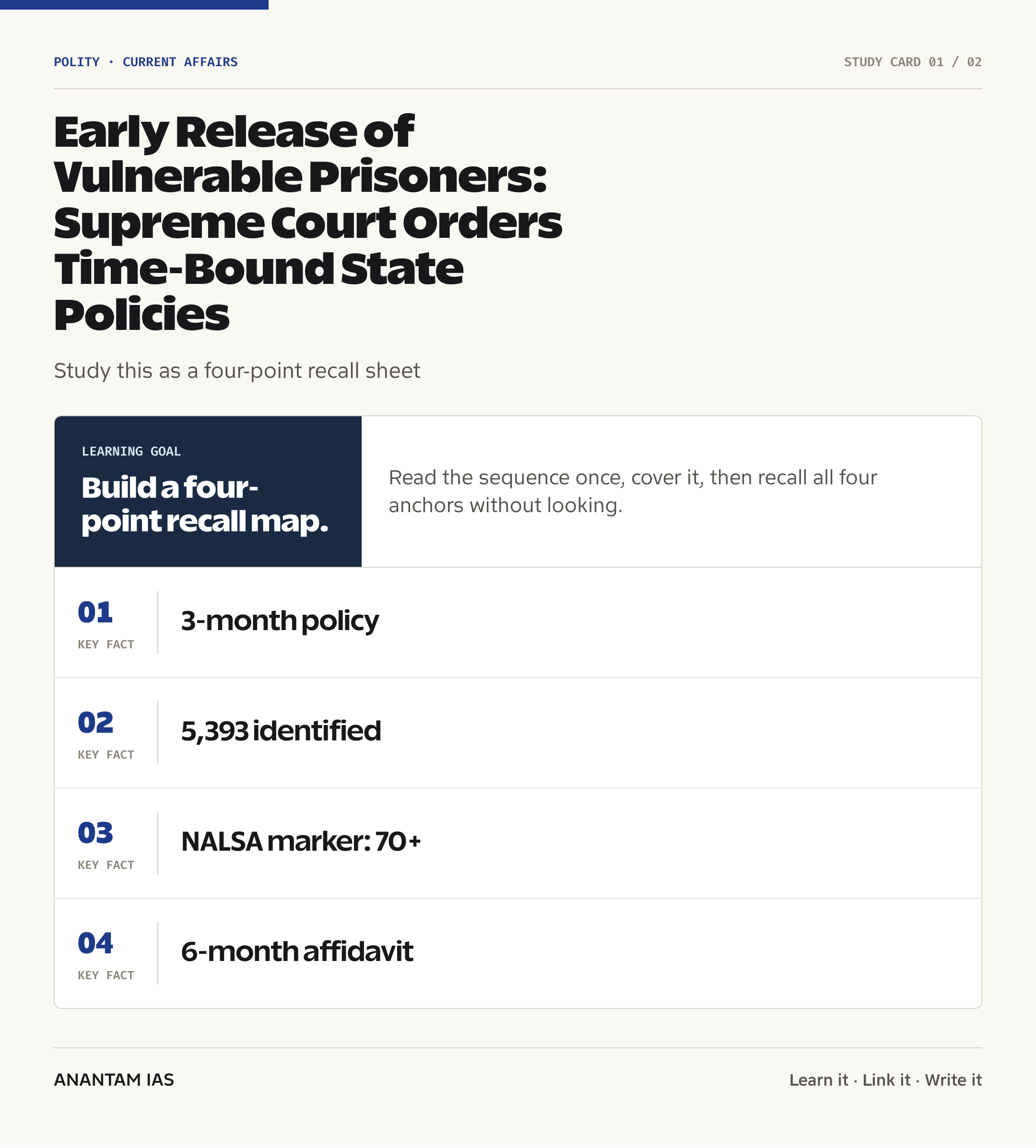
In National Legal Services Authority v. Union of India, the Supreme Court directed every State and Union Territory to formulate and notify, within three months, a comprehensive policy for the early or premature release of prisoners of advanced age and/or those who are terminally ill.
The judgment, delivered on July 16, 2026 by Justices Vikram Nath and Sandeep Mehta, treats humane, time-bound consideration as part of Article 21. It does not order automatic release; it creates a review architecture combining medical certification, legal-services coordination, reasoned decisions and digital accountability.
- Each policy must state clear eligibility criteria, a uniform working definition of terminal illness and an accessible, time-bound procedure.
- States and Union Territories must consult their State Legal Services Authorities so eligible prisoners can be identified and assisted rather than left to navigate the process alone.
- Independent Medical Boards must assess terminal illness or advanced medical vulnerability and periodically review identified cases.
- Under Trial Review Committees must periodically examine vulnerable prisoners and recommend suitable action such as bail, parole, remission or release.
- The entire application chain must be integrated with the National e-Prisons Portal, while protecting confidential medical and personal data.
- The Union, States and Union Territories must file compliance affidavits within six months; the Court will review them on January 19, 2027.
The development matters in the context of:
- The case connects prison reform with the constitutional rule that lawful custody cannot become cruel, degrading or medically neglectful confinement.
- It addresses an implementation gap: a 2010 Union advisory had already urged humane treatment and release mechanisms for terminally ill prisoners, but practice remained uneven.
- A uniform process matters in the context of prison overcrowding, ageing inmates, unequal State remission policies and limited capacity for specialised or end-of-life care.
UPSC Relevance
Prelims Relevance
- Prisons and persons detained in them fall under Entry 4 of the State List in the Seventh Schedule.
- Article 21 protects life, dignity, health and humane treatment even after a person has been lawfully incarcerated.
- Article 14 requires non-arbitrary eligibility rules and consistent decision-making for similarly placed prisoners.
- Articles 32 and 142 formed the constitutional basis for the Supreme Court’s binding remedial directions in this case.
- Article 39A supports equal justice and free legal aid; NALSA is constituted under the Legal Services Authorities Act, 1987.
- Articles 72 and 161 confer clemency powers on the President and Governors, respectively; these powers are distinct from statutory remission.
- Remission reduces the sentence to be served without wiping out the conviction, while commutation substitutes a lighter form of punishment.
- UTRCs are review and recommendation bodies; the competent court or executive authority still takes the legally required decision.
- The e-Prisons Portal is a national digital prison-management system supported by the National Informatics Centre.
- The judgment permits use of the UNODC Handbook on Prisoners with Special Needs to frame a workable definition of terminal illness.
Mains Relevance
GS Paper 2
- Fundamental rights of prisoners: dignity, healthcare, proportionality and protection from cruel or degrading treatment under Article 21.
- Federal governance: State control over prisons combined with judicially supervised minimum standards and Union-supported digital infrastructure.
- Access to justice: the role of NALSA, SLSAs and DLSAs in identifying vulnerable prisoners and converting rights into usable remedies.
GS Paper 4
- Public ethics: compassion and human dignity must coexist with legality, public safety, accountability and the legitimate interests of victims.
- Administrative ethics: reasoned orders, transparent timelines and reviewable discretion reduce neglect without replacing case-specific judgment.
Essay
- Human dignity is tested most clearly where the State exercises maximum control over people with minimum power.
- A humane justice system measures punishment by proportionality and purpose, not by suffering detached from reform or public safety.
Background and Context
The Constitutional Status of a Prisoner
A prison sentence restricts liberty, but it does not place the prisoner outside the Constitution.
- The Court located the issue in Article 21: custody must remain fair, humane and compatible with dignity, including access to necessary medical and palliative care.
- Article 14 guards against arbitrary exclusions, unexplained delay and inconsistent treatment of prisoners facing comparable age or medical vulnerability.
- The judgment draws on Sunil Batra and the wider prisoner-rights jurisprudence that rejects cruel, inhuman or degrading treatment behind prison walls.
- The Court used Articles 32 and 142 to enforce fundamental rights while leaving States room to frame policy suited to their legal and administrative settings.
- Its key restraint is equally important: compassionate consideration is mandatory, but release itself remains a reasoned, case-specific legal decision.
Federalism and the Legal-Services Chain
The order builds a national minimum process without erasing the States’ primary responsibility for prison administration.
- Entry 4 of the State List places prisons, reformatories and persons detained in them within the legislative and administrative domain of States.
- NALSA brought the petition under Article 32 after a nationwide campaign revealed a systemic gap in identifying and assisting vulnerable prisoners.
- Each State policy must be prepared with the relevant SLSA, linking prison records, medical assessment, legal aid and executive decision-making.
- At the district level, the DLSA may move an appropriate application when release is not recommended and no suitable application has already been filed.
- This chain turns Article 39A from a broad promise of equal justice into proactive help for people who may be too ill, old or isolated to seek a remedy.
What the Three-Month Policy Must Contain
The judgment supplies minimum safeguards so that compassionate release does not depend on ad hoc mercy or administrative luck.
- The policy must define advanced age, terminal illness, eligibility, documentary requirements, the competent authorities and the route for examination and disposal.
- For terminal illness, States may adapt the UNODC test centred on a degenerating medical condition for which there is no reasonable prospect of avoiding death.
- Independent Medical Boards at divisional and State levels must provide objective certification; the Court’s Schedule A also illustrates screening by prison doctors and district-board assessment.
- Every application must follow an accessible and time-bound procedure, because delay can consume the final months or years during which relief could have practical meaning.
- A refusal or approval must contain recorded reasons and remain open to judicial review, keeping compassionate discretion within the rule of law.
How Schedule A Organises Case Review
The annexed model separates medical identification from the final legal decision and assigns a role at each stage.
- For a terminally ill prisoner, the Prison Medical Officer conducts initial screening before the case enters the UTRC and medical-board process.
- The District Medical Board determines whether the prisoner meets the terminal-illness test and may issue the necessary certificate.
- Recommended cases go to the State Government for consideration; a DLSA can pursue the suitable court or administrative remedy if release is not recommended.
- For an old-aged prisoner, the UTRC reviews the case and, through the Prison Superintendent, forwards a recommendation for a case-by-case State decision.
- States may adopt or adapt Schedule A, but they must preserve the core principles of dignity, proportionality and humane treatment.
Bail, Parole, Furlough and Remission Are Different
The judgment uses several remedies because the correct route depends on whether the person is an undertrial or a convict.
- Bail releases a person from custody subject to conditions while a criminal proceeding or appeal continues; it does not decide guilt by itself.
- For eligible undertrials, Section 479 of the BNSS provides a detention-duration safeguard, subject to its statutory conditions and exclusions.
- Parole and furlough are forms of temporary release governed mainly by State prison rules; neither automatically cancels the sentence.
- Remission shortens the unexpired sentence without nullifying the conviction, while commutation changes the punishment to a legally permitted lighter form.
- Constitutional clemency under Articles 72 and 161 is distinct from statutory powers and remains subject to limited judicial review for illegality, mala fides or arbitrariness.
Why an e-Prisons Workflow Matters
Digital integration is meant to expose delay and responsibility, not merely convert a paper file into an online file.
- Every application must receive a unique tracking number, creating an auditable path from filing to the final reasoned decision.
- The portal must record medical evaluations, prison reports, Medical Board and UTRC recommendations, the competent authority’s decision and reasons.
- Automated alerts must monitor prescribed timelines, while periodic compliance reports support oversight by States, SLSAs and other competent authorities.
- The Union’s Law and Justice Ministry, Home Ministry and NIC must provide software, infrastructure, maintenance, training and capacity-building support.
- Because the records contain sensitive diagnoses and identifiers, privacy and confidentiality must be designed into access controls, data sharing and reporting.
Evidence of the Implementation Gap
The Court moved from isolated hardship cases to a systemic remedy because official data showed scale and uneven follow-through.
- NALSA’s special campaign ran from December 10, 2024 to March 10, 2025 through national, State and district units that visited prisons and checked records.
- It identified 5,393 vulnerable prisoners: 1,886 undertrials and 3,507 convicts falling within the elderly and/or terminally ill groups.
- The judgment cited NCRB’s Prison Statistics India 2022: 27,690 of 133,415 convicts, or about 20.8%, were aged 50 years or above.
- The petition also placed the issue within India’s roughly 131% prison occupancy as of December 31, 2022, where overcrowding compounds healthcare and caregiving deficits.
- A 2010 Union advisory already sought medical boards, specialised care and release pathways, but continuing gaps showed why deadlines, reasons and monitoring were needed.
- The reform complements, rather than replaces, the wider challenge of prison overcrowding by undertrials.
The Balance: Humanity Without Automaticity
Compassionate release is strongest when it is both humane and institutionally credible.
- Advanced age or serious illness should trigger priority review, not a blanket presumption that every applicant presents no public-safety concern.
- Authorities may examine the nature of the offence, conduct, medical evidence, risk, sentence law and the conditions governing the available remedy.
- Any conditions must be proportionate and workable; an infirm person should not receive reporting or travel conditions that defeat access to treatment.
- Victim interests and public confidence are protected through reasoned decisions, legal criteria and review, not through indefinite administrative inaction.
- Release planning must connect the person to community healthcare, social welfare and family support, so custody is not replaced by medical abandonment.
Way Forward
Use Precise, Inclusive Eligibility Rules
- States should define advanced age and medical vulnerability with room for functional incapacity, disability and rapid deterioration rather than relying on age alone.
- Policies should identify exclusions and risk factors narrowly, require individual assessment and explain how competing considerations will be weighed.
Fix Responsibility and Timelines
- Each stage should name a responsible officer, deadline and escalation route, with deemed alerts reaching the Prison Superintendent, SLSA and reviewing authority.
- Medical Boards need scheduled sittings, specialist access and a fast reconsideration process when the prisoner’s health condition changes.
Make Digital Oversight Rights-Safe
- The e-Prisons design should use role-based access, minimal data collection, secure audit logs and anonymised public reporting.
- A prisoner or authorised legal-aid representative should receive the tracking status and reasoned order in an accessible language and format.
Plan Care Beyond the Prison Gate
- Before release, authorities should confirm treatment continuity, palliative-care access, identity documents, transport, housing and a willing care network.
- District administrations should coordinate health, welfare and legal services so a person is not denied relief merely because the family lacks financial capacity.
Audit Outcomes, Not Just Portals
- Compliance reports should disclose applications, decisions, processing time, reasons for rejection and post-release support, disaggregated without exposing personal medical data.
- High Courts and legal-services institutions can use this evidence to detect State-wise disparities, recurring delay and policies that work only on paper.
Conclusion
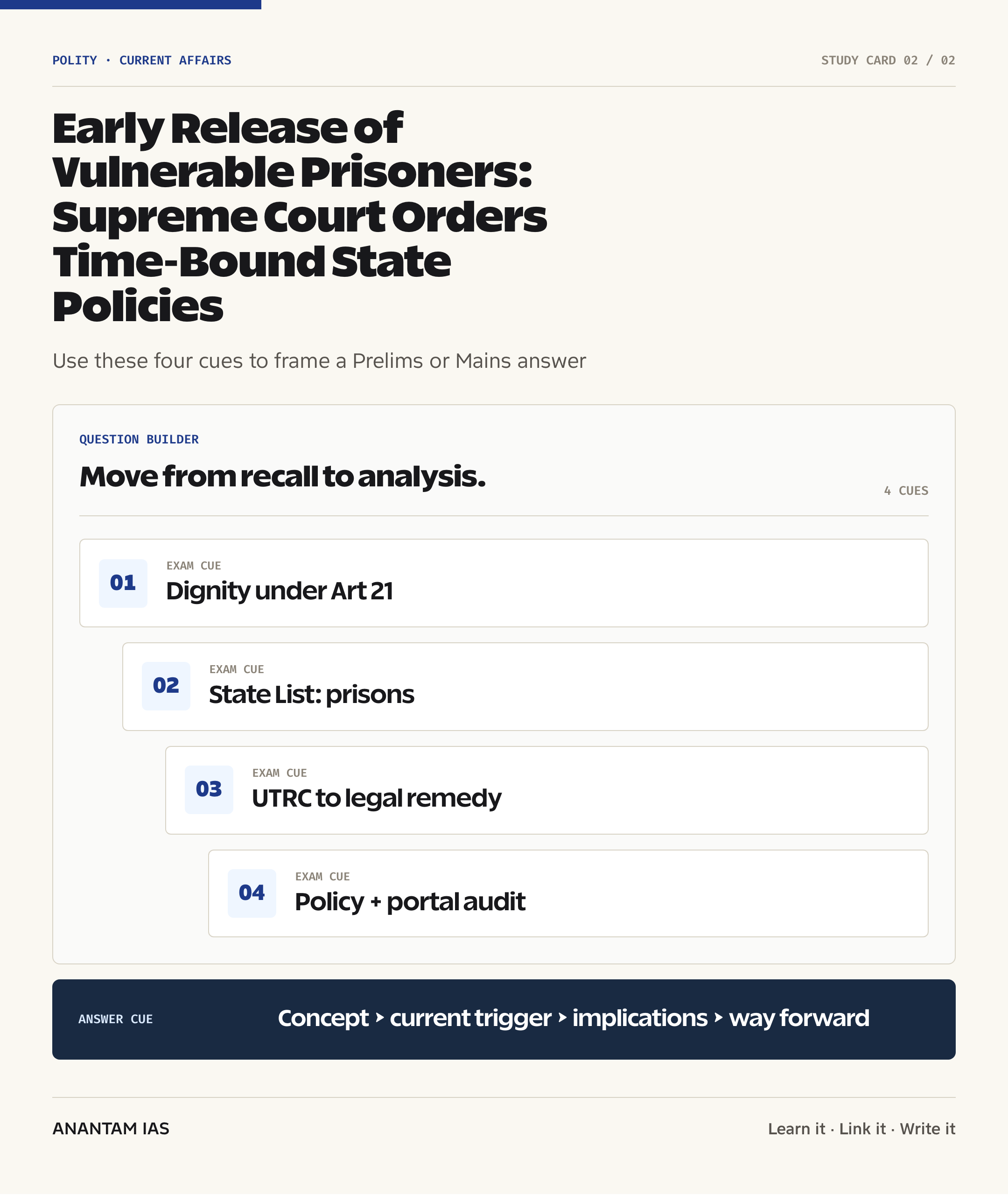
The Supreme Court’s intervention reframes compassionate release as a problem of constitutional governance, not occasional charity. The State may punish according to law, but it cannot let age, terminal illness and administrative delay convert a sentence into avoidable suffering.
The real test will be whether medical evidence, legal aid, digital tracking and community care produce timely, reasoned outcomes. A credible policy must protect dignity without abandoning public safety, and it must make every authority’s decision visible and reviewable.
UPSC Practice Questions
Prelims MCQ 1
With reference to the Supreme Court’s 2026 directions on vulnerable prisoners, consider the following statements:
- States and Union Territories must notify a policy within three months in consultation with their State Legal Services Authorities.
- Every prisoner aged 70 years or above must be released automatically without a case-specific decision.
- Applications must be integrated with e-Prisons and assigned unique tracking numbers.
How many of the above statements are correct?
(a) Only one (b) Only two (c) All three (d) None
Answer: (b) Only two
Explanation:
Statements 1 and 3 are correct. The Court mandated a policy-and-tracking framework, but it did not create automatic release at a fixed age; eligibility and the final remedy require a reasoned, case-specific process.
Prelims MCQ 2
Which one of the following best describes remission of a sentence?
(a) Provisional release before conviction that permanently ends the trial (b) Reduction of the unexpired sentence after conviction without erasing the conviction (c) Judicial substitution of every prison sentence with bail (d) Temporary release that automatically extinguishes the remaining sentence
Answer: (b) Reduction of the unexpired sentence after conviction without erasing the conviction
Explanation:
Remission affects the period of punishment to be undergone, not the underlying conviction. Bail concerns custody during proceedings, while parole or furlough is ordinarily temporary release under applicable rules.
UPSC Mains Questions
- The right to life does not stop at the prison gate. Examine how the Supreme Court’s policy directions for elderly and terminally ill prisoners translate Article 21 into medical review, legal aid, reasoned decisions and continuity of care within a federal prison system.
- Prisons are a State subject, yet constitutional rights require minimum national safeguards. Discuss the federal balance reflected in the Court’s use of State policies, SLSAs, e-Prisons and Union technical support for compassionate-release applications, and assess the strengths and limits of this model.
- A humane release policy must avoid both mechanical detention and automatic release. Suggest a framework that balances dignity, medical vulnerability, public safety, victim interests, privacy and post-release care through transparent and reviewable administration for elderly and terminally ill prisoners in India.
Sources: Supreme Court of India (2026 INSC 713) and The Hindu.
Frequently Asked Questions
Did the Court order automatic release?
No. The Supreme Court ordered States and Union Territories to create a comprehensive, time-bound policy and review eligible cases. Medical vulnerability or advanced age triggers structured consideration, not guaranteed release. The competent court or executive authority must apply the governing law, record reasons and remain open to judicial review.
Who falls within the judgment’s scope?
The directions cover prisoners of advanced age and/or those who are terminally ill. The NALSA campaign used 70 years and above as an elderly-prisoner marker, but each notified policy must clearly state eligibility. The UTRC review also extends to prisoners with conditions causing serious physical incapacitation.
How is terminal illness to be defined?
States may adapt the UNODC Handbook approach: a medical condition with no reasonable prospect that degeneration leading to death can be avoided. The policy must provide a clear, uniform definition, and an independent Medical Board must objectively assess and certify the prisoner’s condition rather than rely on an unsupported claim.
What role does a UTRC perform?
An Under Trial Review Committee periodically identifies and reviews vulnerable prisoners and recommends the legally appropriate route, including bail, parole, remission or release. It does not overturn a conviction or grant every remedy itself. Its value lies in proactive review, inter-agency coordination and preventing eligible people from disappearing inside administrative files.
What will e-Prisons track?
The e-Prisons Portal must register each application, assign a unique number and record medical evaluation, prison reports, committee recommendations, the final decision and its reasons. Automated alerts should flag delay, while compliance reports support oversight. Access controls must protect confidential medical and personal information.
How do bail, parole and remission differ?
Bail concerns release from custody subject to conditions during a proceeding or appeal. Parole and furlough are generally temporary-release mechanisms under State rules. Remission reduces the remaining sentence without cancelling the conviction. The suitable remedy depends on whether the person is an undertrial or convict and on the applicable law.