
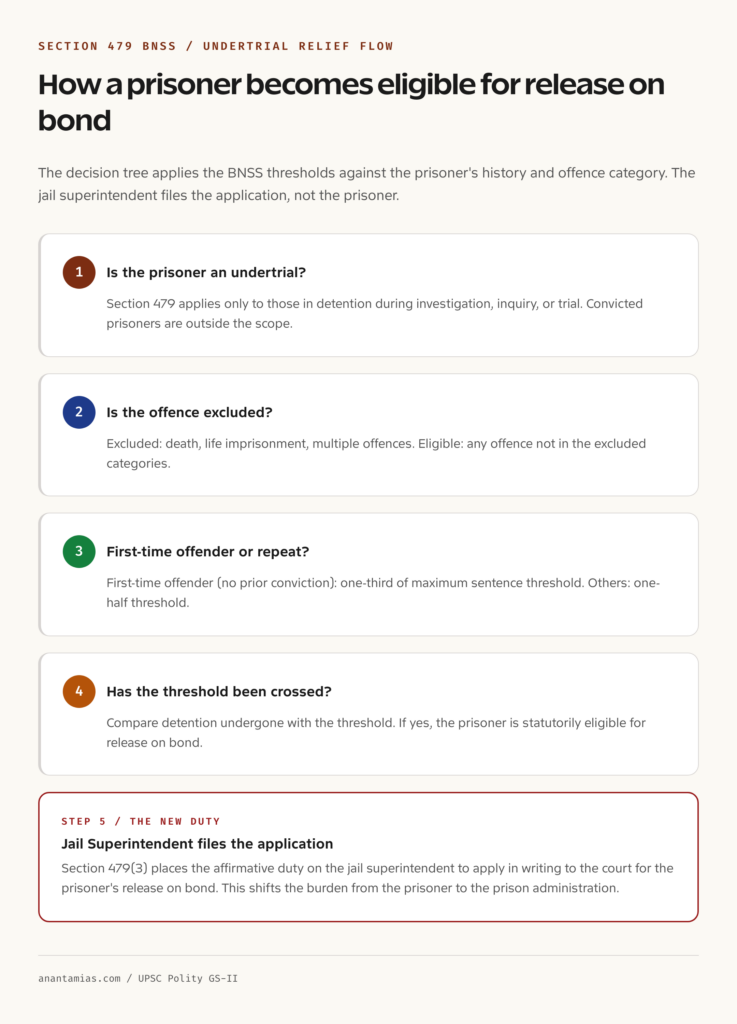
The Bharatiya Nagarik Suraksha Sanhita, 2023, replaced the Code of Criminal Procedure, 1973, with effect from 1 July 2024. Most of the new code’s provisions are renumbered or restructured versions of the old Code. Section 479, which deals with the release of undertrial prisoners who have already served a substantial portion of the maximum possible sentence, is one of the rare sections that does substantively more than its predecessor. It introduces a new one-third rule for first-time offenders, mandates jail superintendents to take affirmative steps for eligible prisoners, and places the section at the centre of India’s response to prison overcrowding.
The Ministry of Home Affairs has issued advisories to all States and Union Territories pressing for immediate implementation of Section 479. The Supreme Court, hearing the suo motu case In Re: Inhuman Conditions in 1382 Prisons, has separately tracked compliance. The provision is therefore both a legislative reform and a live administrative project, and aspirants should expect questions on its precise contours.
This guide walks through Section 479’s text and structure, the difference between the one-third rule for first-time offenders and the one-half rule for others, the exclusions for serious offences, the new institutional duty placed on jail superintendents, and the way the provision connects to the Indian judiciary, the 42nd Amendment framework on the right to liberty, and broader questions of criminal justice reform.
Quick Facts on Section 479 BNSS
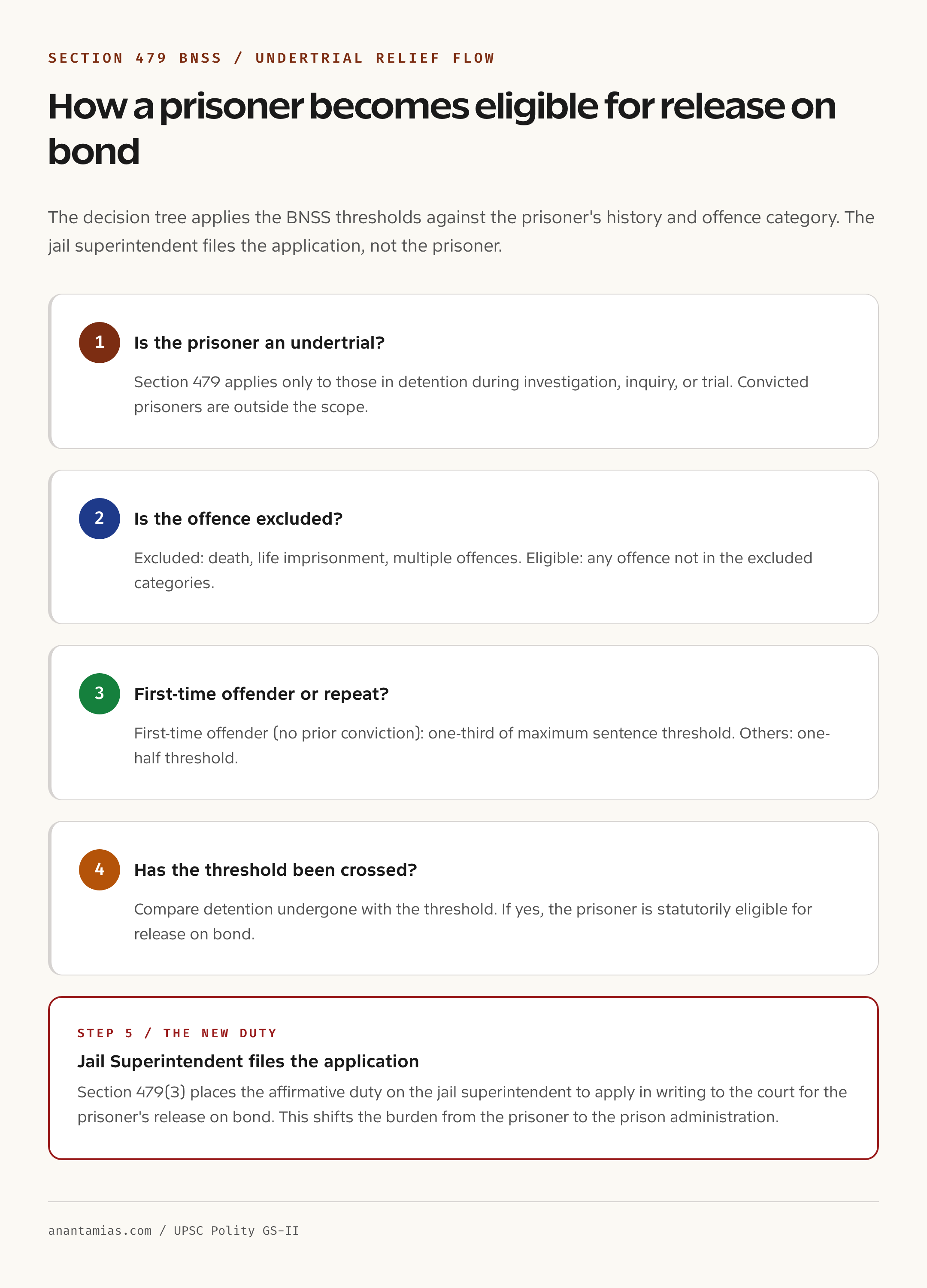
Section 479 of the Bharatiya Nagarik Suraksha Sanhita, 2023, replaces Section 436A of the Code of Criminal Procedure, 1973. It deals with the release of undertrial prisoners who have already spent a significant portion of the maximum sentence in detention. For a first-time offender with no past criminal precedent, release on bond or bail is mandated after one-third of the maximum imprisonment specified for the offence. For repeat offenders or general cases, release is mandated after one-half of the maximum imprisonment. The section does not apply to offences punishable with death or life imprisonment, nor to proceedings against a person involving more than one offence. The Bill’s most operationally significant innovation is Section 479(3), which places a duty on the jail superintendent to identify eligible prisoners and to file the bail application on their behalf.
The Constitutional Backdrop: Article 21 and Pre-Trial Liberty
Article 21 of the Indian Constitution protects life and personal liberty against deprivation except by procedure established by law. The Supreme Court has repeatedly held that prolonged pre-trial detention without proportionate justification violates the right to liberty. Hussainara Khatoon v. State of Bihar, 1979, is the founding case: Justice Krishna Iyer struck down the indefinite detention of undertrials in Bihar prisons and held that speedy trial is an integral component of Article 21. A.R. Antulay v. R.S. Nayak, 1992, generalised the principle into a constitutional right to speedy trial in all criminal cases.
The 1973 CrPC’s Section 436A was the legislative response to this constitutional pressure. It allowed release on bond after the undertrial had served one-half of the maximum sentence, with exceptions. The 2023 BNSS Section 479 deepens that response by adding the one-third rule for first-time offenders and by placing affirmative obligations on prison authorities. The constitutional logic is unchanged: protracted detention without trial is incompatible with Article 21, and the legislature must build escape valves into the procedural code.
Text and Structure of Section 479 BNSS
Section 479 is structured in three clauses. The first clause deals with the general rule and the one-half threshold. The second clause introduces the new proviso for first-time offenders and the one-third threshold. The third clause places the duty on the jail superintendent. A reading of the text shows the layered design.
The general rule is that where a person has, during the period of investigation, inquiry, or trial under any law for the time being in force of an offence not punishable with death or life imprisonment, undergone detention for a period extending up to one-half of the maximum period of imprisonment specified for that offence under that law, he shall be released by the court on his personal bond, with or without sureties.
The first proviso then introduces the new first-time offender rule. Where such person is a first-time offender, who has never been convicted of any offence in the past, he shall be released on bond by the court on completion of one-third of the period of detention. The first-time offender criterion is an absolute one: any prior conviction, in any forum, removes the prisoner from the one-third bucket and pushes him into the general one-half category.
The One-Third Rule for First-Time Offenders
The one-third rule is the structural innovation of Section 479. Before BNSS, all undertrials were treated alike for the purposes of Section 436A: the threshold was one-half of the maximum sentence, regardless of criminal history. The 2023 BNSS recognises that a first-time offender is, by definition, the kind of accused for whom protracted pre-trial detention does the most damage. The person has never been convicted, the presumption of innocence applies in full force, and the disruption of family, employment, and community ties is hardest to repair when there is no prior criminal pattern.
The one-third threshold therefore moves the moment of release earlier in the procedural calendar. For an offence with a maximum sentence of six years, the first-time offender is eligible for release at two years, while the repeat offender or general accused must wait for three years. The differentiation aligns Indian law with the broader principle that pre-trial detention should be calibrated to risk, with first-time offenders presumed less likely to abscond or interfere with the trial.
The One-Half Rule for Other Cases
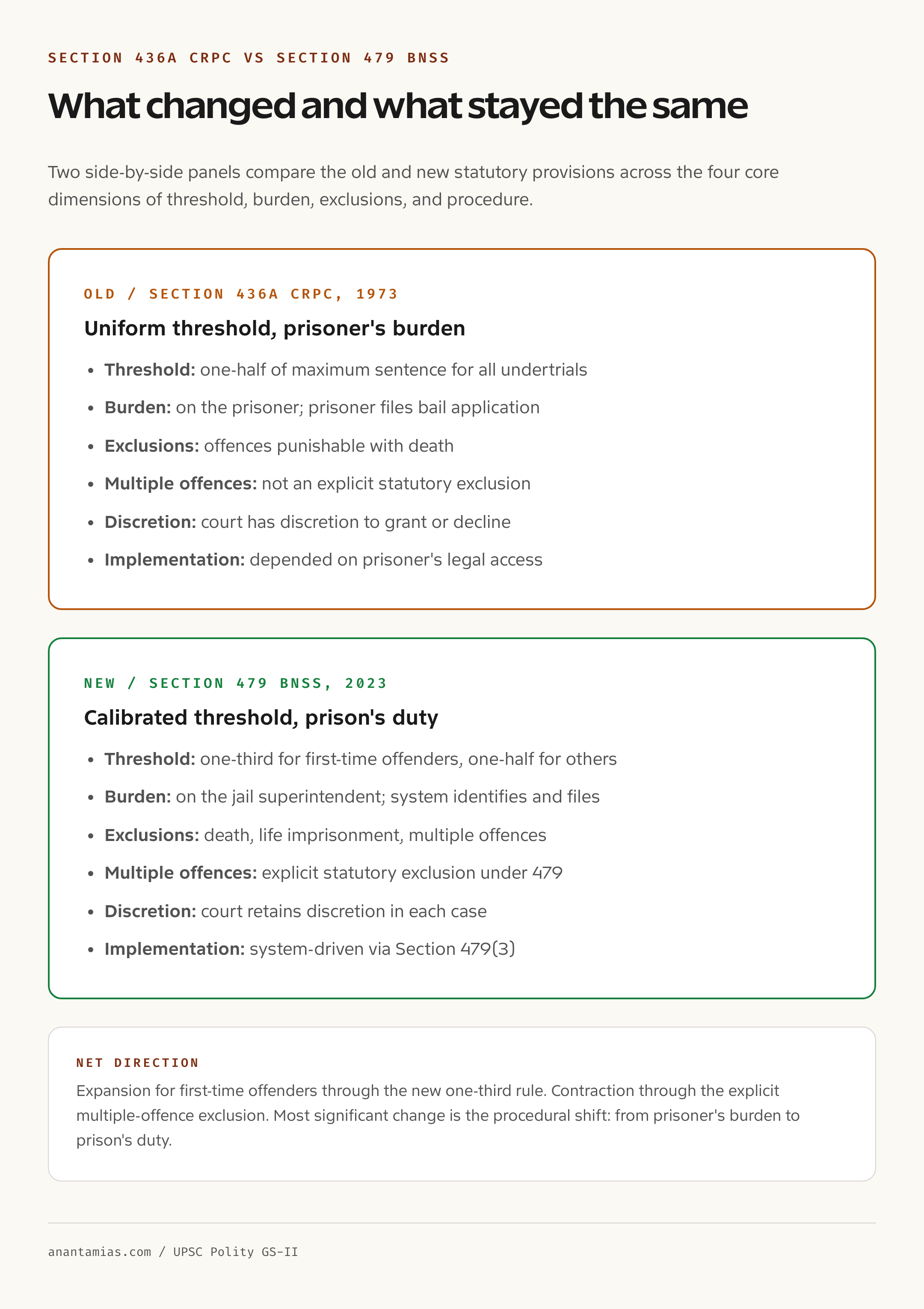
The one-half rule continues from the old Section 436A and applies to every undertrial who is not within the first-time offender bucket. The threshold is the same: detention undergone equal to one-half of the maximum sentence triggers eligibility for release on bond. The provision functions as a backstop. Even where the trial drags on through no fault of the accused, the one-half ceiling ensures that the pre-trial detention does not exceed half of what the prosecution itself would seek by way of sentence on conviction.
The court retains discretion. Section 479 does not create an automatic right to walk out of prison on completion of the threshold. The court may decline release where there are countervailing reasons such as flight risk, witness tampering, or the seriousness of the offence even within the non-excluded category. But the burden shifts: the prosecution must articulate why continued detention is necessary, rather than the accused having to argue for his own release.
Excluded Offences: Death, Life Imprisonment, and Multiple Charges
Section 479 expressly excludes three categories. The first is offences punishable with death. The second is offences punishable with imprisonment for life. The third is proceedings against a person involving more than one offence. The third exclusion is the most consequential in practice. Many investigations under modern statutes layer multiple offences. A robbery investigation may add charges under Section 392 IPC (now BNS), the Arms Act, and possibly the Maharashtra Control of Organised Crime Act. The presence of multiple charges takes the accused outside Section 479 even if no single charge is a death or life imprisonment offence.
The exclusion has attracted criticism from prison reform advocates who argue that the multiple-offence carve-out is broader than necessary and undoes much of the protective intent. Defenders of the carve-out point to the risk of organised crime and to the difficulty of assessing flight risk where layered charges are pending. The Supreme Court is yet to authoritatively interpret the multiple-offence exclusion, and the contours will be settled through litigation in the years ahead.
Section 479(3): The Jail Superintendent’s New Duty
The most operationally radical provision is Section 479(3), which transfers the burden of seeking release from the prisoner to the prison administration. The text places a duty on the jail superintendent in charge of the prison where the undertrial is detained to apply in writing to the court for the release of such person on bond, after the prisoner has completed the prescribed period of detention.
The shift is structural. Under Section 436A CrPC, the prisoner had to know about the provision, hire a lawyer, and file the application. The system therefore favoured well-resourced prisoners while leaving the genuinely poor to languish. Section 479(3) closes the legal-aid gap administratively. The jail superintendent has the necessary records: the date of remand, the nature of the offence, the maximum sentence, and the criminal history. The superintendent identifies the eligible prisoners and sends the application to the court of original jurisdiction, with copies to the prosecution.
The MHA advisories have pressed States to set up dedicated cells within prisons to maintain the eligibility roster, to update it monthly, and to coordinate with the District Legal Services Authority for follow-up bail proceedings. Implementation is uneven across States, and the Supreme Court is monitoring compliance through the suo motu prison conditions matter.
Section 436A CrPC vs Section 479 BNSS: What Changed
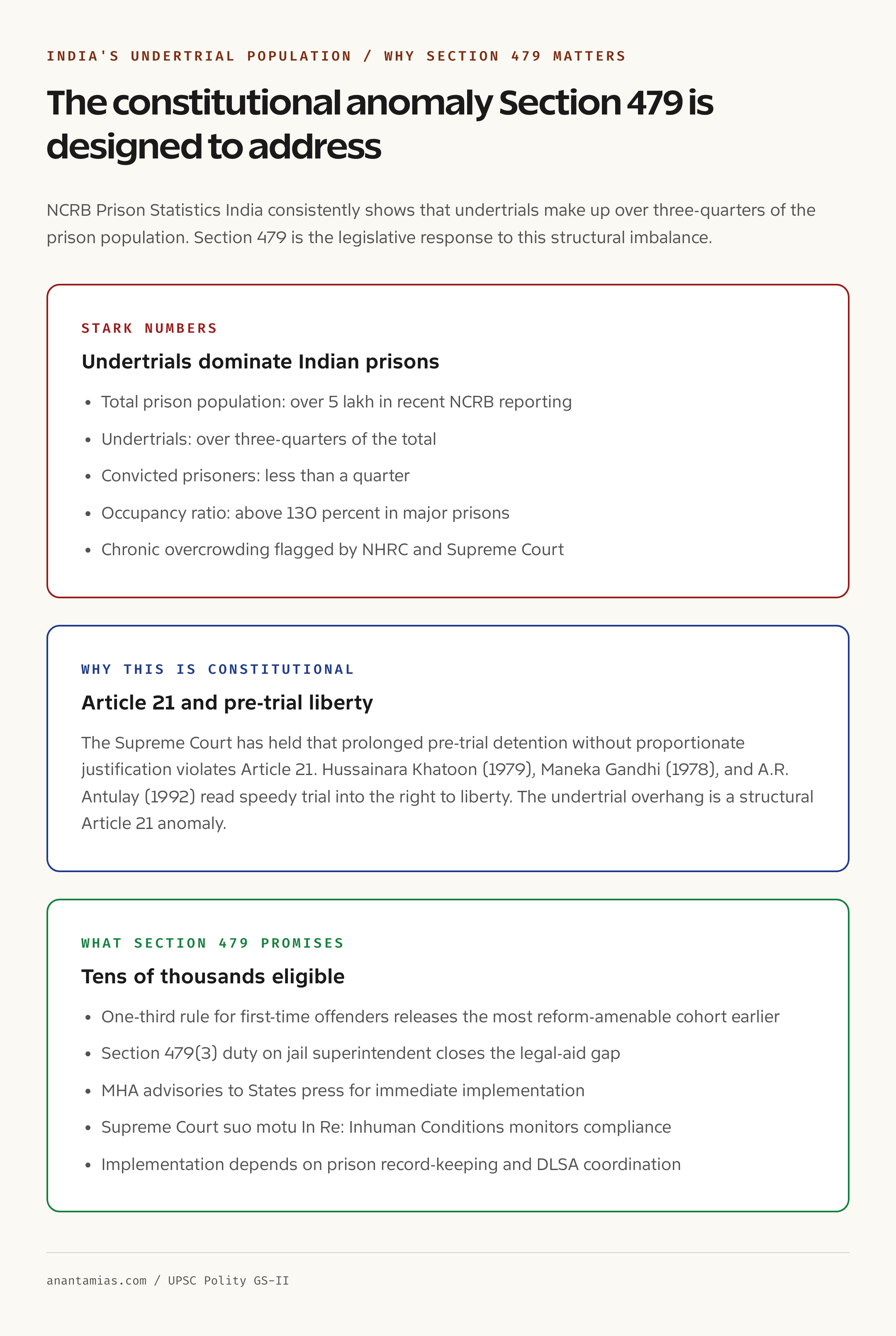
A focused comparison clarifies the reform. Under Section 436A CrPC, all undertrials had a single one-half threshold, the prisoner bore the burden of seeking release, exclusions covered death and life imprisonment offences, and the multiple-offence carve-out did not exist as an explicit statutory exclusion. Under Section 479 BNSS, first-time offenders have a one-third threshold, the jail superintendent bears the affirmative duty, the death and life imprisonment exclusions continue, and the multiple-offence exclusion is now an explicit statutory carve-out.
The net effect is a simultaneous expansion and contraction of relief. Expansion: first-time offenders get the new lower threshold. Contraction: the multiple-offence exclusion explicitly bars cases that might earlier have been argued under the old Section 436A. The administrative duty on the jail superintendent is the most significant practical change because it converts a paper right into an enforceable institutional obligation.
India’s Undertrial Population: Why the Reform Matters
National Crime Records Bureau Prison Statistics India consistently shows that undertrials make up over three-quarters of India’s prison population. Total prison population has hovered around 5 lakh in recent reporting, of which roughly 4 lakh are undertrials. Many have been in detention for periods exceeding a third or half of the maximum sentence for the offences charged. The constitutional anomaly is acute: presumed innocent persons are spending more time in prison than the law would impose on them on conviction.
The reform connects to broader prison overcrowding. National Human Rights Commission and Supreme Court oversight have flagged occupancy ratios approaching 130 percent of capacity in major prisons. Section 479 implementation has the potential to release tens of thousands of eligible undertrials, easing overcrowding while honouring the constitutional commitment to liberty under Article 21. The promise is real, but it depends on jail superintendents and District Legal Services Authorities executing the new duty with administrative seriousness.
Implementation Challenges and the Suo Motu Litigation
The Supreme Court’s suo motu In Re: Inhuman Conditions in 1382 Prisons matter has been the principal forum for monitoring Section 479 implementation. The Court has issued directions on the maintenance of registers of eligible prisoners, on monthly identification exercises, and on coordination with legal aid bodies. State-level performance varies. Some States have set up the dedicated cells and report regular bail applications under Section 479(3). Others have lagged, with low identification rates and few applications filed.
The administrative bottleneck is rarely the legal interpretation of Section 479. It is the data discipline within prisons. Reliable records of admission date, charge sheet, maximum sentence, and prior convictions are required. Prisons where this record-keeping is poor produce few Section 479(3) applications regardless of how many eligible prisoners actually qualify. Capacity-building within prison administration is therefore the core implementation question.
Prelims and Mains Pointers for UPSC
For prelims, four data points should be locked in. Section 479 BNSS replaces Section 436A CrPC. The threshold is one-third of the maximum sentence for first-time offenders and one-half for others. The exclusions cover death, life imprisonment, and multiple offences. The jail superintendent has a statutory duty to file the bail application under Section 479(3).
For mains, the question typically links Section 479 to Article 21, to the Hussainara Khatoon line of cases, and to the broader project of criminal justice reform. The reform is a useful illustration of how legislative drafting can translate constitutional rights into administrative obligations, the exact direction of doctrine of prospective overruling and similar judicially driven reforms. Aspirants writing on prison reform should integrate Section 479 with the trial in absentia and mandatory disclosure of arrest grounds provisions of the BNSS to show the wider architecture of criminal procedure reform.
Conclusion: Liberty Translated into Administrative Duty
Section 479 of the Bharatiya Nagarik Suraksha Sanhita, 2023, takes Article 21’s promise of pre-trial liberty and embeds it in the daily routine of prison administration. The one-third rule for first-time offenders moves the constitutional logic forward by treating prior criminal history as a relevant calibration factor. The jail superintendent’s duty under Section 479(3) closes the legal-aid gap by making release a system-driven outcome rather than a privilege of the prisoner who can afford counsel.
The reform’s success will be judged not by its drafting but by the implementation pattern that emerges over the next three to five years. If States invest in prison record-keeping, dedicated cells, and legal services coordination, Section 479 will become the most consequential prison reform in decades. If States treat the provision as a paper change, the constitutional anomaly of overflowing undertrial prisons will persist. The framework is in place. The administrative effort is what will translate it into freedom.
Frequently Asked Questions
What is Section 479 of the BNSS?
Section 479 of the Bharatiya Nagarik Suraksha Sanhita, 2023, deals with the release of undertrial prisoners who have spent a significant portion of the maximum sentence in detention. It replaces Section 436A of the old Code of Criminal Procedure, 1973.
What is the one-third rule under Section 479?
For a first-time offender with no prior conviction, the court shall release him on bond after he has undergone detention for one-third of the maximum imprisonment specified for the offence.
Which offences are excluded from Section 479?
Offences punishable with death, offences punishable with imprisonment for life, and proceedings against a person involving more than one offence are all excluded.
What is the jail superintendent’s duty under Section 479(3)?
The jail superintendent is required to apply in writing to the court for the release on bond of every undertrial prisoner who has completed the prescribed period of detention. This shifts the burden from the prisoner to the prison administration.
How is Section 479 different from Section 436A CrPC?
Section 479 introduces the new one-third rule for first-time offenders, places an affirmative duty on the jail superintendent to file the bail application, and expressly excludes proceedings involving multiple offences. Section 436A had a uniform one-half threshold and placed the burden on the prisoner.
Does Section 479 give a right to automatic release?
No. The court retains discretion. The eligible prisoner is presumed entitled to release on bond, but the court may decline where there are sufficient countervailing reasons such as flight risk or witness tampering.
Why is Section 479 important for India’s undertrial population?
Over three-quarters of India’s prison population are undertrials, and many have spent more time in detention than the maximum sentence would impose on conviction. Section 479 has the potential to release tens of thousands of eligible undertrials and ease the chronic overcrowding of Indian prisons.
Tell Google you want more of this.
Add Anantam IAS as a preferred sourceOne tap, and this site shows up more often in your own Top Stories, AI Overviews and AI Mode. Remove it any time.