Student Suicides as a Systemic Issue: The Supreme Court Task Force Report
Why in News?
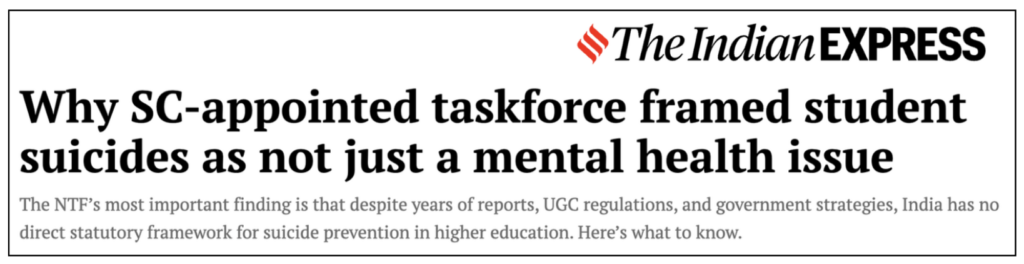
The Indian Express reported on the recommendations of the Supreme Court-mandated National Task Force (NTF) on student mental health, whose findings have reframed the debate on student suicides.
The 12-member body, chaired by former apex-court judge Justice S. Ravindra Bhat, was set up to look beyond individual tragedy and locate the problem in how India runs its schools, colleges and coaching ecosystem.
Acting on the NTF’s work, the Court issued time-bound Article 142 directions to Higher Education Institutions in early 2026, treating student suicides as an ‘iceberg of student distress’ rooted in systemic and institutional failure rather than only in private illness.
- The NTF was constituted following a March 2025 order in a case over two IIT Delhi student deaths, where families alleged caste-based discrimination by faculty and staff.
- NCRB‘s Accidental Deaths and Suicides in India report records over 13,000 student suicides in 2022, roughly 7.6% of all suicides — a figure the Court called the visible tip of a much larger problem.
- The bench issued time-bound directions under Article 142, covering scholarship-backlog clearance, vacancy-filling, confidentiality protocols and well-being audits.
- The Court directed NCRB to separately record school and college student suicides and to strengthen centralised data collection.
- Coaching clusters in Kota, Chennai and elsewhere were flagged as concentrated zones of academic-pressure distress.
The development matters in the context of:
- The order shifts accountability from the grieving student to the institution, the regulator and the State.
- It links campus mental health to Article 21 (life and dignity) and Article 15 (non-discrimination).
- Why this matters now: it lands alongside UGC draft regulations on ragging, harassment and caste/gender/disability discrimination.
UPSC Relevance
Prelims Relevance
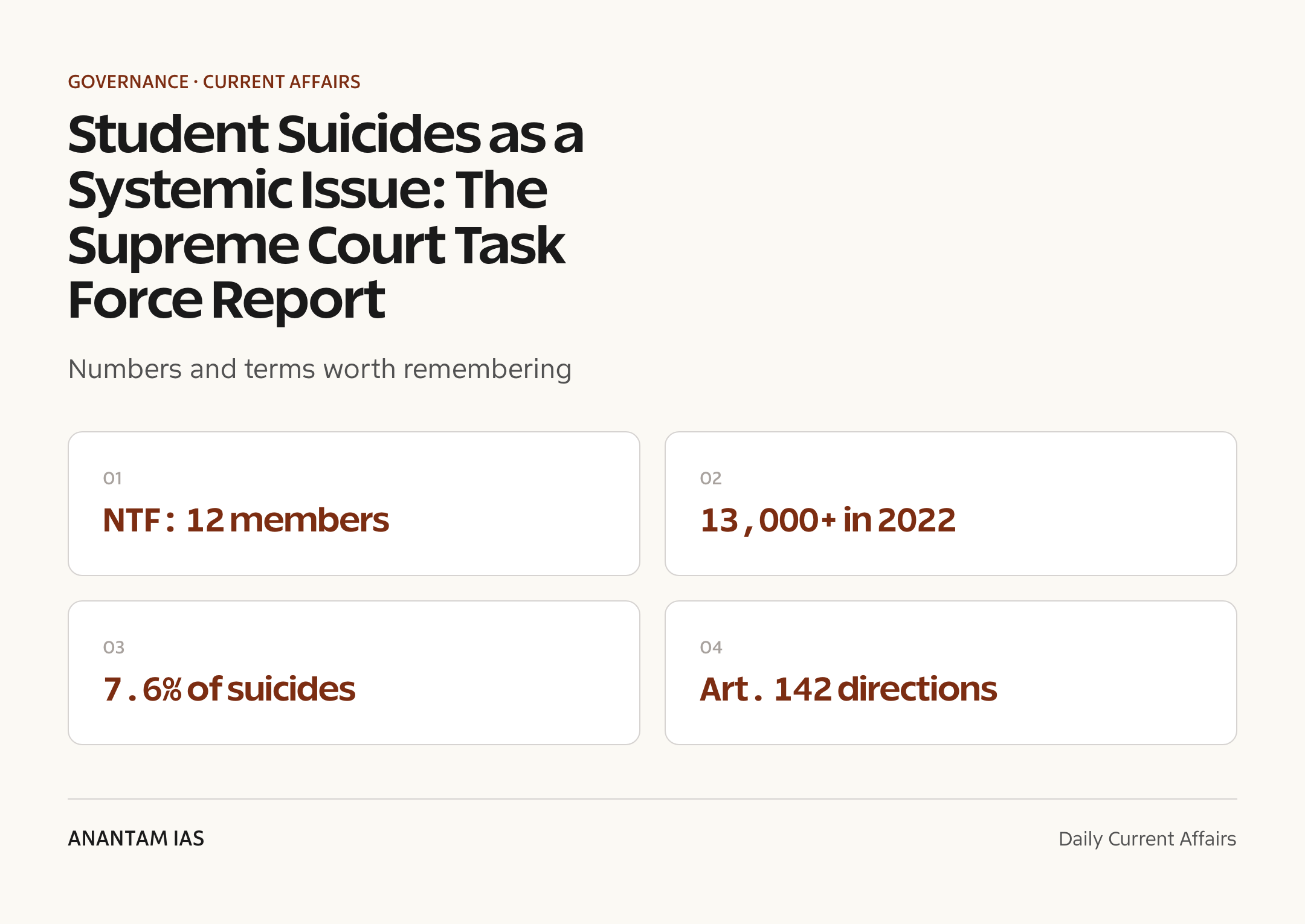
- National Task Force (NTF) on student mental health — Supreme Court-constituted, chaired by Justice S. Ravindra Bhat (former SC judge), 12 members.
- Article 142 — Supreme Court’s power to pass any order necessary for ‘complete justice’.
- NCRB — National Crime Records Bureau; publishes the Accidental Deaths and Suicides in India (ADSI) report.
- ADSI 2022: student suicides crossed 13,000, about 7.6% of total suicides.
- Mental Healthcare Act, 2017 — decriminalised attempt to suicide (Section 115); recognises right to mental healthcare.
- Article 21 right to life and dignity; Article 15 bar on caste/sex/place discrimination.
- UGC draft regulations on prevention of ragging, sexual harassment and discrimination.
- NEP 2020 emphasises on counsellors, reduced exam pressure and socio-emotional learning.
Mains Relevance
GS Paper 2
- Role of the judiciary in directing executive action on welfare via Article 142; accountability of regulators (UGC/AICTE) and institutions.
- Governance of the coaching industry and the regulatory gap in student-welfare standards.
GS Paper 1
- Social issue: how academic competition, caste and exclusion shape vulnerability among the young.
GS Paper 4
- Institutional ethics — duty of care of teachers and administrators towards students.
Essay
- ‘Education without empathy is mere instruction’ — the human cost of an over-competitive system.
- When success is measured only by ranks, what do we lose?
Background and Context
From private tragedy to systemic failure
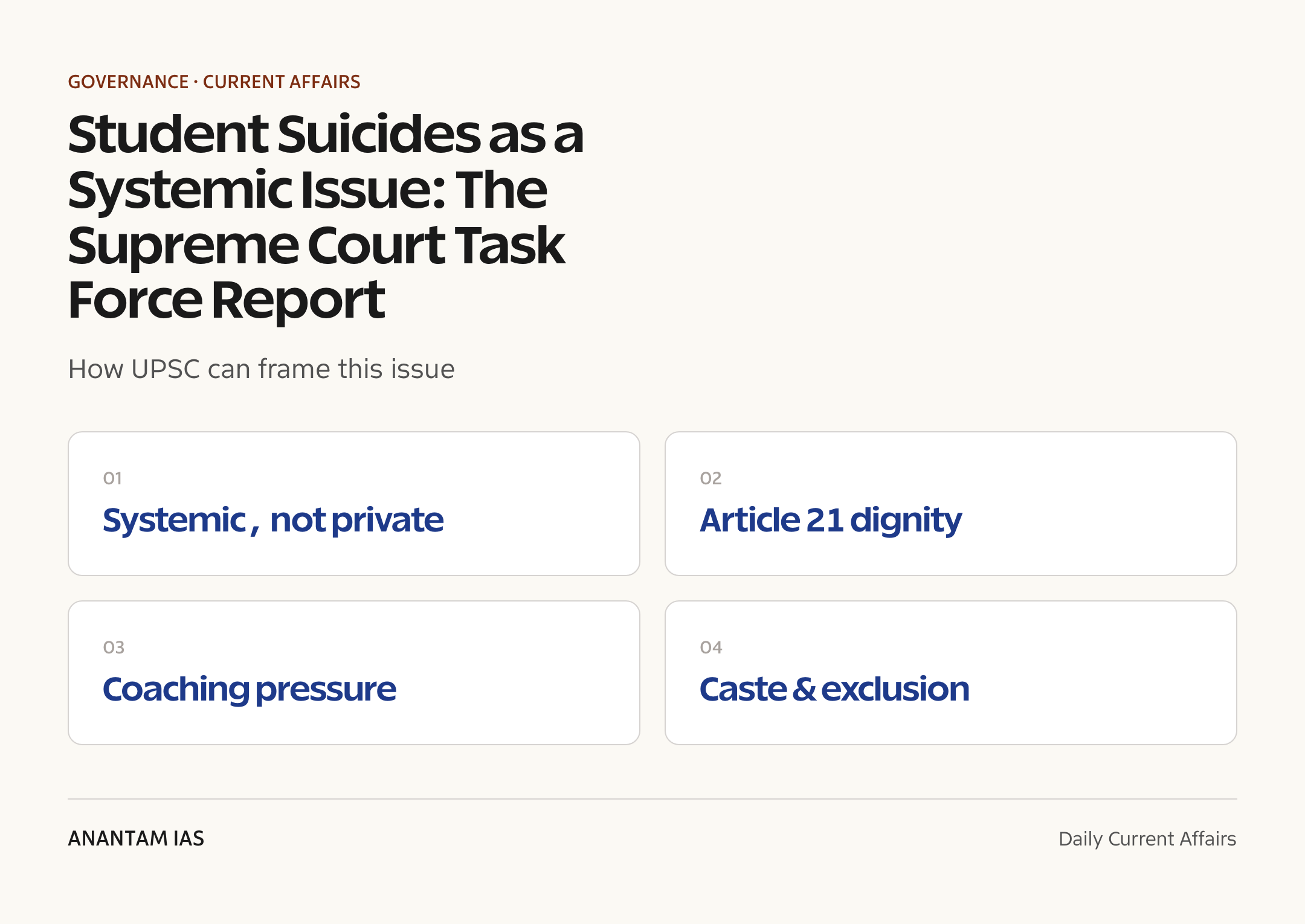
The core shift in the report is conceptual — it moves the lens from the individual to the institution.
- Earlier framing treated each death as a personal mental-health crisis to be managed clinically and quietly.
- The NTF instead locates causes in structural pressure — relentless ranking, fee burdens, discrimination and weak grievance redress (building on the earlier National Task Force on student mental health).
- The Court’s ‘iceberg of distress’ metaphor signals that recorded deaths are a fraction of a wider crisis of anxiety, dropout and self-harm.
- Responsibility is placed on the State, regulators and institutions — not on the student or family alone.
Why the Task Force was set up
The trigger was litigation over campus deaths, where discrimination was alleged.
- In early 2025, the Supreme Court directed Delhi Police to register FIRs in the deaths of two IIT Delhi students whose families alleged caste-based discrimination.
- The Court constituted the National Task Force under Justice S. Ravindra Bhat to study and prevent suicides in Higher Educational Institutions.
- It marks a continuation of the apex court’s Article 21 jurisprudence — reading dignity and a supportive environment into the right to life.
- The proceedings drew submissions from students, NGOs, regulators and institutions across the country.
The data behind the alarm
The Court leaned heavily on the official suicide record to establish scale.
- NCRB‘s ADSI 2022 recorded over 13,000 student suicides — about 7.6% of all suicides that year.
- Existing data does not distinguish school from college students, blurring policy targeting — the Court ordered this gap fixed.
- Coaching hubs such as Kota draw lakhs of aspirants for JEE and NEET and have seen repeated suicide clusters.
- Under-reporting and stigma mean the true burden is widely held to exceed the recorded numbers, mirroring India’s wider mental-health treatment gap.
Coaching, competition and exclusion
Three intertwined drivers run through the findings.
- Coaching-industry pressure — long hours, hostel isolation and a high-stakes single-exam culture concentrate stress in young aspirants.
- Academic competition — rank-obsessed evaluation and parental expectation turn ordinary setbacks into perceived life failures.
- Caste and identity-based discrimination — exclusion, slurs and unequal treatment of marginalised students are recognised as direct stressors.
- Financial stress from fees, loans and delayed scholarships compounds the burden, especially for first-generation learners.
What did the Court direct?
The bench translated findings into enforceable, time-bound directions under Article 142.
- Clear scholarship backlogs and fill critical vacancies (counsellors, faculty) within set deadlines.
- Build campus mental-health services with confidentiality SOPs and student-feedback systems.
- Mandate faculty sensitisation on academic, financial, social and discrimination-related stressors.
- Improve data — NCRB to separate school/college figures and strengthen centralised tracking.
- Conduct periodic institutional well-being audits as a standard of accountability.
The regulatory backdrop
The directions intersect with parallel policy and law.
- UGC draft regulations target ragging, sexual harassment and discrimination on caste, gender and disability grounds.
- The Mental Healthcare Act, 2017, already decriminalised attempt to suicide and guarantees a right to mental healthcare.
- NEP 2020 calls for trained counsellors, socio-emotional learning and reduced rote-exam pressure.
- Consumer-protection action against misleading coaching advertisements reflects a wider push to regulate the coaching market.
Significance and the criticism
The report is praised as a paradigm shift, but it faces real limits.
- It constitutionalises student well-being, tying it to dignity and non-discrimination rather than charity.
- Critics note the Court has been cautious in naming caste squarely as a cause, risking a dilution of the discrimination angle.
- Enforcement depends on under-resourced regulators and institutions with thin counselling capacity.
- Directions risk becoming box-ticking compliance unless backed by funding, trained staff and culture change.
Way Forward
Regulate the coaching ecosystem
- Enforce welfare standards — counsellor ratios, cooling-off periods and limits on punitive ranking displays.
- Operationalise the Guidelines for Regulation of Coaching Centres with state-level monitoring.
Build real campus capacity
- Fill counsellor and faculty vacancies; fund a confidential, stigma-free mental-health service in every institution.
- Replace one-off awareness drives with embedded socio-emotional support under NEP 2020.
Tackle discrimination head-on
- Make anti-discrimination cells effective and time-bound; act on caste and identity-based complaints.
- Publish anonymised well-being audit findings to drive accountability.
Fix the evidence base: disaggregated, timely NCRB data and a dedicated registry would let policy target the highest-risk groups instead of treating distress as a uniform clinical condition.
Conclusion
The National Task Force report matters because it changes the question. The issue is no longer only why a particular student could not cope, but why so many institutions, regulators and an entire coaching economy keep producing the conditions for despair.
Whether the Article 142 directions translate into safer campuses will depend on funding, trained counsellors and the will to name discrimination plainly. For UPSC, the case is a clean illustration of judicial governance meeting social justice — and of the limits of court orders without administrative follow-through.
UPSC Practice Questions
Prelims MCQ 1
With reference to the Supreme Court’s National Task Force on student mental health, consider the following statements:
- It was constituted by the Supreme Court and is chaired by a former judge of the Court.
- It was set up following a case involving alleged caste-based discrimination at an IIT.
- Its directions were issued by the Court under Article 142 of the Constitution.
How many of the above statements are correct?
(a) Only one (b) Only two (c) All three (d) None
Answer: (c) All three
Explanation:
The NTF is Supreme Court-constituted and chaired by former SC judge Justice S. Ravindra Bhat; it followed a case over alleged caste discrimination in IIT Delhi student deaths, and the Court issued time-bound directions under Article 142.
Prelims MCQ 2
The ‘Accidental Deaths and Suicides in India’ (ADSI) report, cited by the Court on student suicides, is published by which body?
(a) Ministry of Health and Family Welfare
(b) National Crime Records Bureau (
c) National Statistical Office
(d) University Grants Commission
Answer: (b) National Crime Records Bureau
Explanation:
The ADSI report is published annually by the National Crime Records Bureau (NCRB) under the Ministry of Home Affairs; its 2022 edition recorded over 13,000 student suicides.
UPSC Mains Questions
- The Supreme Court’s National Task Force reframes student suicides as a systemic rather than purely individual problem. Examine the structural drivers it identifies and assess whether Article 142 directions can deliver meaningful change.
- Discuss the regulatory gaps in India’s coaching industry and higher-education institutions that contribute to student distress. What governance reforms would you recommend?
- ‘Student well-being is a constitutional concern, not a matter of charity.’ In the light of recent judicial intervention, critically analyse the link between campus mental health, Article 21 and Article 15.
Sources: Indian Express (Explained) and Supreme Court Observer.
Frequently Asked Questions
What is the Supreme Court’s National Task Force on student suicides?
It is a 12-member body the Supreme Court constituted to study and prevent suicides in higher educational institutions. Chaired by former apex-court judge Justice S. Ravindra Bhat, it examines causes beyond individual mental illness and recommends institutional, regulatory and data reforms, which the Court has converted into enforceable directions.
Why is the report called a paradigm shift?
Because it reframes student suicides as a systemic and structural failure rather than a private mental-health crisis. It places responsibility on coaching ecosystems, institutions, regulators and the State, and links student well-being to constitutional dignity under Article 21 instead of treating each death as an isolated personal tragedy.
What does the NCRB data show on student suicides?
The National Crime Records Bureau’s Accidental Deaths and Suicides in India report for 2022 recorded over 13,000 student suicides, about 7.6% of all suicides that year. The Court treated this as the visible tip of a wider crisis and asked the NCRB to record school and college students separately.
What is Article 142 and why does it matter here?
Article 142 lets the Supreme Court pass any order needed to do ‘complete justice’ in a case. The Court used it to issue time-bound, binding directions to institutions and regulators — covering scholarships, vacancies, counselling services, faculty sensitisation and well-being audits — without waiting for fresh legislation.
How does caste discrimination feature in the issue?
The Task Force was prompted by deaths of IIT Delhi students whose families alleged caste-based discrimination. The findings recognise exclusion, bias and unequal treatment of marginalised students as direct stressors, though critics argue the Court has been cautious about naming caste squarely as a cause.
What reforms are needed beyond the court order?
Enforceable coaching-centre welfare standards, filled counsellor and faculty vacancies, funded and confidential campus mental-health services, effective anti-discrimination cells, and disaggregated NCRB data. Without funding, trained staff and culture change, the directions risk becoming compliance box-ticking rather than real protection.