On 10 December 2025, the government told the Rajya Sabha that Tele-MANAS, the national mental-health helpline, had taken close to 30 lakh calls since it launched in October 2022. That’s nearly two calls a minute, in 20 languages, for three years straight. Read one way, it’s a success story. Read the other way, it’s an alarm. Because a helpline doesn’t ring two times a minute in a country whose care system is healthy. It rings like that when millions have nowhere else to turn.
That’s the whole topic in one number. India has built rights, programmes, and a national front door for mental health. And it sits on top of a treatment gap so wide that most people who need care never get it. The mark-scoring question for an aspirant isn’t whether India cares about mental health on paper. It’s why the help so rarely reaches the person who needs it.
The Issue, Framed
Let’s fix the vocabulary first, because this is a topic where loose words hide the real problem.
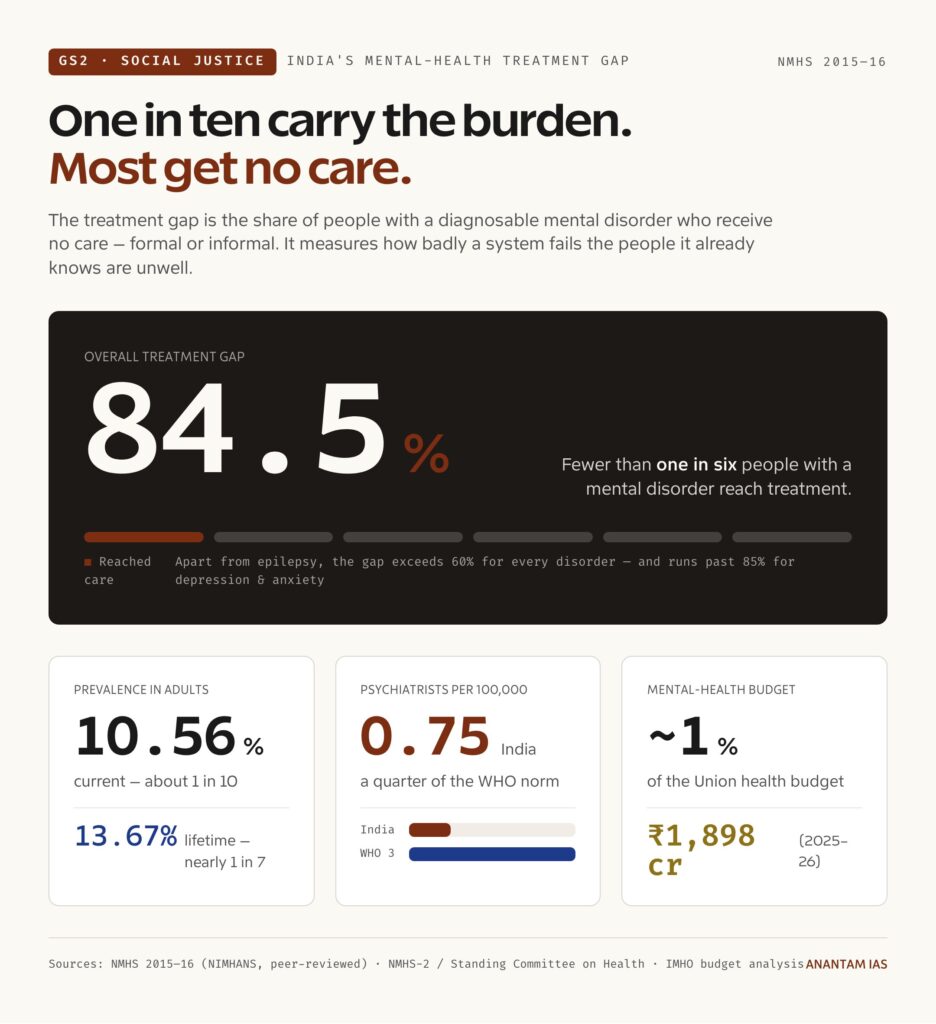
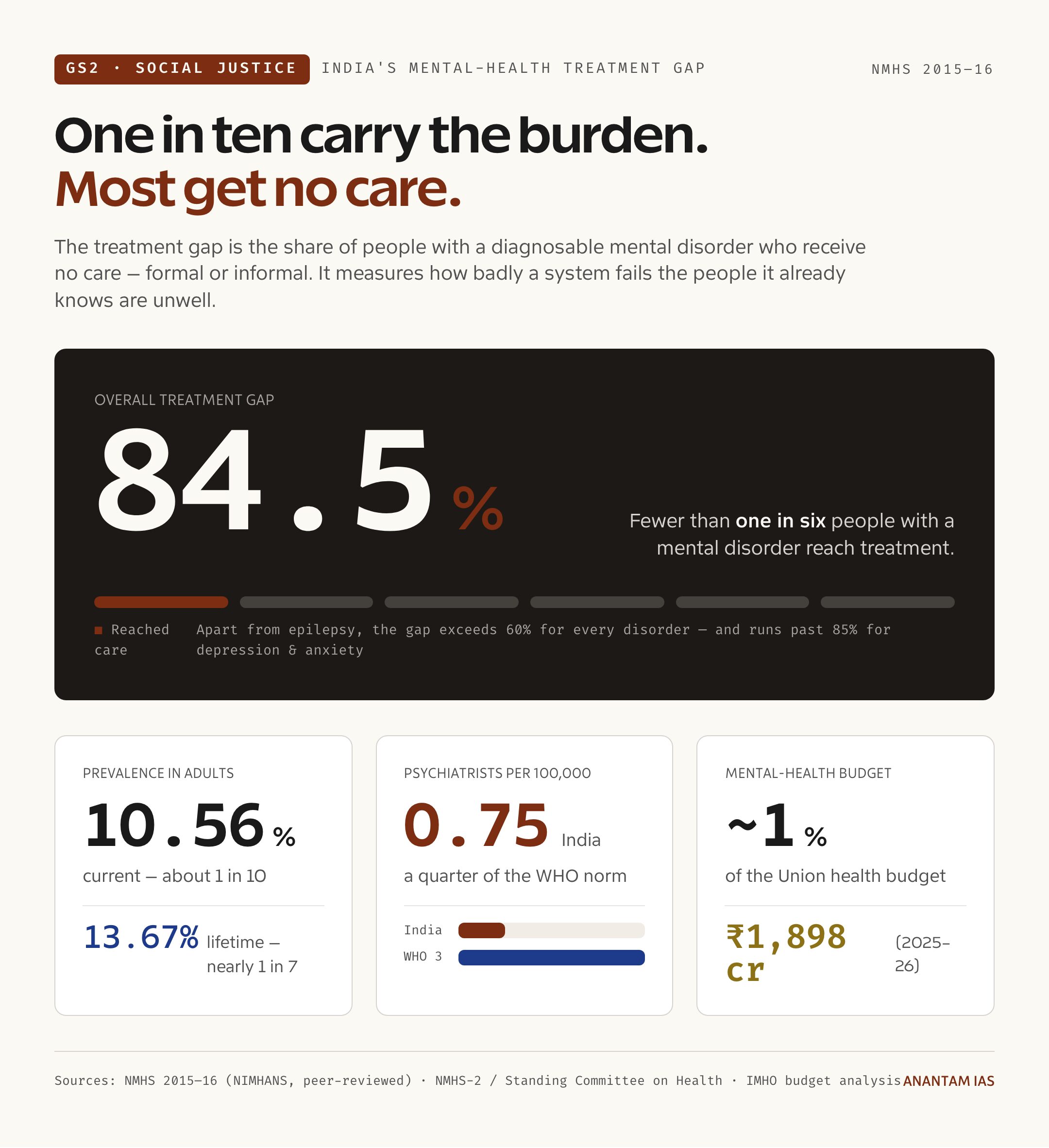
The phrase that does the heaviest lifting here is the treatment gap. It’s the share of people with a diagnosable mental disorder who get no care at all, formal or informal. So it’s not a measure of how sick a population is. It’s a measure of how badly a health system is failing the people it already knows are unwell. A treatment gap of 84.5% doesn’t mean 84.5% are ill. It means that of those who are ill, fewer than one in six reach treatment.
The number itself comes from the National Mental Health Survey (NMHS), the country’s only completed nationwide mental-health survey, run by NIMHANS across 12 states and nearly 35,000 adults in 2015-16. It’s the baseline every serious discussion still leans on. And it’s nine years old, which matters, so treat its prevalence figures as a floor rather than today’s exact reality. A second survey, NMHS-2, has since been done, and its workforce numbers are now in circulation.
Two more terms you’ll need, because the solutions hinge on them. Task-sharing is the practice of training non-specialists – counsellors, community health workers, ASHAs, nurses – to deliver basic mental-health care under a specialist’s supervision, instead of waiting for a psychiatrist to do everything. It’s how you stretch a thin workforce across a huge population. And an advance directive is a written instruction, allowed under the Mental Healthcare Act, 2017, in which a person sets out in advance how they want to be treated if a future mental-health crisis leaves them unable to decide. It puts the patient, not the institution, in charge of their own care.
So the frame is simple. The illness is common, the law is progressive, the access is broken. Hold those three facts together and the topic snaps into focus.
What the Data Says
Start with how common this is, because the scale is the thing most answers underplay. NMHS 2015-16 found a current prevalence of mental disorders of 10.56% among adults, with lifetime prevalence at 13.67%. In plain terms, roughly 1 in 10 adults had a mental disorder at the time of the survey, and nearly 1 in 7 had lived through one at some point. That’s not a fringe problem. That’s a population-scale one.
Now the gap, which is the heart of this topic. The NMHS investigators put the overall treatment gap at 84.5%. So fewer than one in six people with a mental disorder received care. And the gap isn’t uniform – apart from epilepsy, it exceeds 60% for every disorder, and for common mental disorders like depression and anxiety it runs past 85%. You’ll see a higher “92%” figure floating around in secondary write-ups; the defensible headline to quote is the overall 84.5%, with “60%-plus across disorders.” Lead with the number you can stand behind.
The supply side explains a lot of that gap. India has about 0.75 psychiatrists per 100,000 people, against a WHO-recommended norm of at least 3 per 100,000. That’s a quarter of the benchmark density. Put it in absolute terms and it bites harder: roughly 9,000 working psychiatrists, when around 36,000 more are needed to hit the norm – a figure traced to the 2023 Parliamentary Standing Committee on Health. At the current training rate of about a thousand new psychiatrists a year, and assuming nobody ever retires, closing that gap takes the better part of three decades. You can’t out-train a shortage that deep in time to matter. So the workforce isn’t a side issue. It’s the constraint.
Then there’s the money, and it’s the quietest scandal in the file. India’s mental-health budget for 2025-26 is about ₹1,898 crore – roughly 1% of the Union health budget. WHO’s September 2025 report notes that even the global median government spend sits at just 2% of health budgets, unchanged since 2017, so India is below an already-low world bar. And most of India’s slice concentrates in two institutions, NIMHANS and LGBRIMH, while Tele-MANAS’s own allocation was trimmed to ₹80 crore. A 1% budget is a statement of priority, whatever the policy documents say.
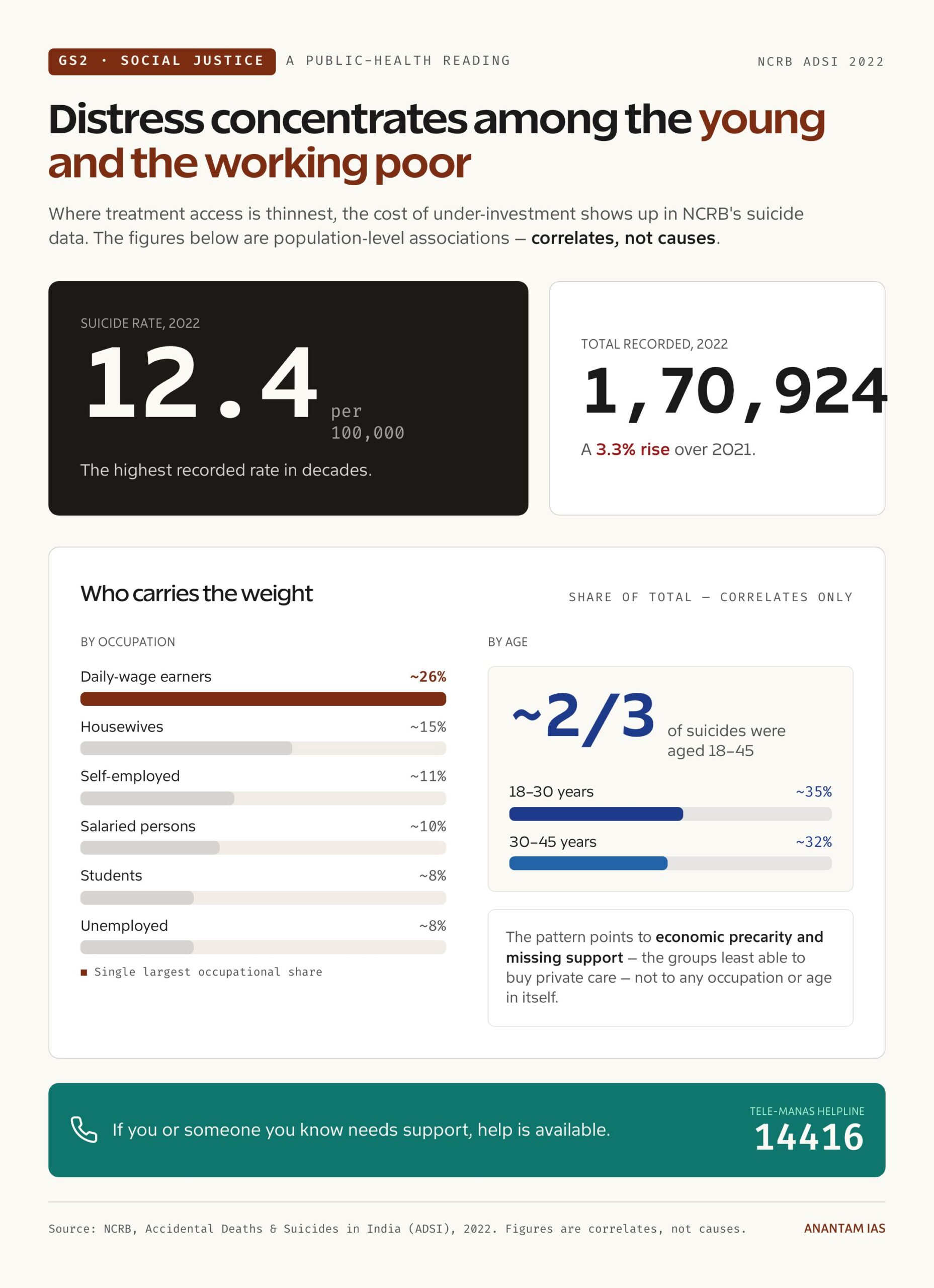
The cost of that under-investment shows up most starkly in suicide data, which we have to handle carefully and as a public-health issue. The NCRB’s Accidental Deaths and Suicides in India report for 2022 recorded 1,70,924 suicides, a rate of 12.4 per 100,000 – the highest in decades. And the profile tells you who carries the weight. Daily-wage earners accounted for roughly 26% of these deaths, the single largest occupational share, and people aged 18 to 45 made up about two-thirds. Treat those as correlates, not causes – being a daily-wage worker doesn’t cause anything; economic precarity and missing support do. The point is that distress concentrates among the young and the working poor, exactly the groups least able to buy private care.
If you doubt this is solvable, look at the economics. WHO’s 2025 report estimates depression and anxiety alone cost the global economy about US$1 trillion a year in lost productivity, while a long-standing WHO and UN finding holds that every US$1 invested in scaling up treatment for those conditions returns roughly US$4 in better health and output. So this isn’t charity that competes with growth. Underfunding mental health is the expensive choice.
The Case For
The case that India is genuinely acting is real, and a lazy answer that calls the state indifferent would miss marks. So let’s state it at full strength.
It built a rights-based law, and a good one. The Mental Healthcare Act, 2017 reframed mental illness around patient rights instead of custody. Its Section 115 presumes that a person who attempts suicide is under severe stress, so they aren’t to be tried or punished under the old IPC Section 309 – effectively decriminalising the attempt – and it puts a duty on government to provide that person care and rehabilitation. The Act also guarantees the right to access affordable care, lets every adult make an advance directive and appoint a nominated representative to act for them, and sets up Mental Health Review Boards to hear complaints. On paper, that’s one of the more progressive mental-health statutes anywhere.
It built a national digital front door, and people are using it. Tele-MANAS went from launch in October 2022 to close to 30 lakh calls by December 2025, added a mobile app and video consultation, and now runs across 53 cells in 36 States and UTs in 20 languages. That’s a genuinely national, multilingual access channel that didn’t exist three years ago. The two-calls-a-minute figure cuts both ways, but the channel itself is a real achievement.
It pushed mental health down to the district level. The District Mental Health Programme (DMHP), running under the National Mental Health Programme since 1996, now covers roughly 767 districts – about 90% of the country. So the architecture to embed mental health inside the ordinary district health system already exists, at least on the approval sheet.
And it went back for fresh evidence. The original NMHS data are nine years old, and the government has carried out NMHS-2 to refresh them, which is the right instinct – you can’t target what you haven’t measured recently. So the intent and the scaffolding are there. The argument isn’t that India did nothing. It’s that what it built hasn’t reached the person on the other end of the helpline.
The Case Against
Here’s what the optimistic reading walks past. A law you don’t fund and a programme you don’t staff is a promise, not a service. On that test, the gaps are severe.
The treatment gap itself is the headline indictment. An 84.5% overall gap means the system, even after all the laws and programmes, still fails the large majority of people it has diagnosed as unwell. A helpline taking two calls a minute isn’t proof the system works. It’s proof of how much demand has nowhere else to go.
The workforce is a fraction of the need, and no amount of policy language fixes that quickly. At 0.75 psychiatrists per 100,000 against a norm of 3, with 36,000 more needed and a pipeline that would take decades to deliver them, the bottleneck is people. And it’s worse for the allied workforce – psychiatric social workers and clinical psychologists are in even shorter supply relative to need. A Review Board you can’t staff and an advance directive nobody is trained to honour are rights that exist only in the gazette.
The funding tells you the real priority. About 1% of the health budget, concentrated in two institutions, with Tele-MANAS’s allocation cut and the scheme due to shift onto state budgets under the National Health Mission. That last move is the one to watch. When a national programme moves to state budgets, the better-off states protect it and the poorer ones can’t – so a service meant to be universal risks becoming uneven, exactly where need is highest.
The access is sharply unequal by geography. Most professionals cluster in cities, so rural and non-metro India faces the widest gaps. For schizophrenia-spectrum disorders, the NMHS treatment gap was 72% overall but rose to 83.3% in urban non-metro areas, and rural specialist access is thinner still. So the national average already hides a worse story for the people furthest from a teaching hospital.
And stigma keeps demand from converting into care even where care exists. NMHS documented persistent stigma and low help-seeking as drivers of the gap. So this isn’t only a supply problem. Even if you trained 36,000 psychiatrists tomorrow, a person who believes their distress is a personal failing, or who fears what the neighbours will say, still doesn’t walk in. The rising suicide rate – 12.4 per 100,000 in 2022 – is the clearest signal that the care-and-rehabilitation duty the law promised is, in practice, far from met. (And help does exist now: Tele-MANAS can be reached at 14416.)
The Deeper Structural Read
Step back from the individual numbers and a pattern shows up. The treatment gap isn’t one failure. It’s the product of three failures stacked on top of each other, and they reinforce one another.
The first is a model failure. India built its mental-health system around scarce specialists in tertiary institutions – psychiatrists in big hospitals – for a problem that is population-scale and lives mostly in homes and villages. You can’t deliver a 1-in-10 problem through a 0.75-per-100,000 workforce concentrated in cities. The arithmetic never closes. So the gap isn’t a temporary shortfall waiting for more medical seats. It’s baked into the design, which is precisely why task-sharing – pushing first-line care out to trained non-specialists under supervision – isn’t a nice-to-have. It’s the only model that fits the maths.
The second is a fiscal failure that mirrors how we think about health itself. Mental health gets 1% of the health budget because the system still treats the mind as separate from, and lesser than, the body. But the WHO US$1-trillion productivity cost and the 4-to-1 return on investment say the opposite – untreated mental illness is one of the most expensive things a society can ignore. So the under-funding isn’t a saving. It’s a deferred bill, paid in lost work, lost years, and the suicide rate.
The third is a federal and governance failure waiting to happen. Health is largely a state subject, and the proposed shift of Tele-MANAS and similar schemes onto state NHM budgets means the quality of your mental-health safety net could soon depend on which state you were born in. A right guaranteed by a central Act, delivered through uneven state budgets, is a right that exists differently for different citizens. That tension between a national promise and sub-national delivery is the structural fault line a thoughtful answer should name.
And underneath all three sits the oldest barrier – stigma. It’s the reason demand stays latent, the reason families hide illness until it becomes a crisis, and the reason a person reaches for an anonymous helpline before a clinic. So even a perfectly funded, fully staffed, evenly distributed system would still under-perform until the culture around mental illness shifts. The structural read, then, is that this gap is supply, money, federal design, and culture failing together – which is also why no single fix closes it.
What Should Be Done
So what actually narrows the gap? Not a vague call for “more awareness,” but a set of moves with a clear actor behind each. Seven of them, ordered roughly by leverage.
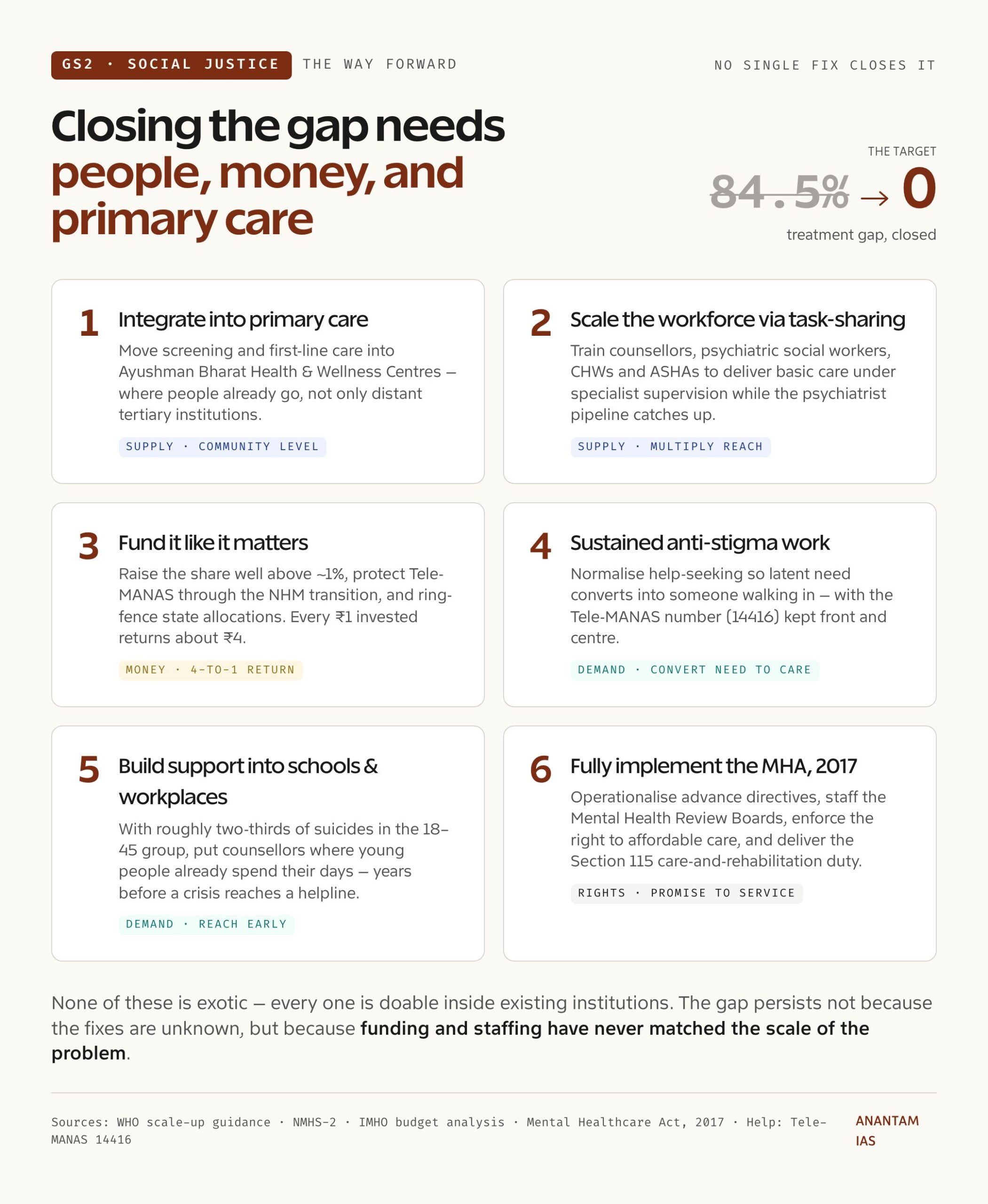
- Move first-line care into primary care and Ayushman Bharat Health and Wellness Centres. Screening and basic treatment should happen where people already go, at the community level, not only in distant tertiary institutions. This is the core of WHO’s scale-up logic, and it’s the only way a 1-in-10 problem meets a thin specialist workforce. Read it alongside India’s wider health policy and Ayushman Bharat architecture, because mental health has to ride that existing rail rather than build a parallel one.
- Scale the workforce through task-sharing. Train and deploy counsellors, psychiatric social workers, community health workers and ASHAs to deliver basic care under specialist supervision, while the psychiatrist pipeline catches up over its decades-long timeline. One supervising psychiatrist backing many trained non-specialists multiplies reach in a way that medical-seat expansion alone never can.
- Fund it like it matters. Raise the share well above 1%, protect Tele-MANAS funding through the National Health Mission transition, and ring-fence state allocations so the budget can’t be quietly raided for other heads. The 4-to-1 return on investment is the argument to make to a finance ministry – this is spending that pays for itself.
- Do the anti-stigma and demand-side work, sustained. Supply without demand-creation leaves clinics half-empty while people suffer at home. Steady public campaigns that normalise help-seeking, with the Tele-MANAS number (14416) front and centre, are what convert latent need into someone actually walking in.
- Build mental-health support into schools, colleges and workplaces. With roughly two-thirds of suicides in the 18-to-45 group and students a recognised vulnerable cohort, the places young people already spend their days are where support should live. Counsellors in institutions reach people years before a crisis reaches a helpline.
- Actually implement the Mental Healthcare Act, 2017. Operationalise advance directives, staff the Mental Health Review Boards, enforce the right to affordable care, and deliver the Section 115 care-and-rehabilitation duty for suicide-attempt survivors. The link between this and broader welfare and social-justice delivery is direct – a right that isn’t operationalised is a right that doesn’t exist for the person who needs it.
- Refresh the data and target equity. Use NMHS-2 to direct money and people toward the rural and underserved districts where the gap is widest, instead of spreading thin or defaulting to the cities that already have hospitals. You can’t close a gap you measure once a decade.
None of these is exotic. Every one of them is doable inside existing institutions. The gap persists not because the fixes are unknown, but because funding and staffing have never matched the scale of the problem.
For Your Mains Answer
This is a clean GS2 question. It sits squarely in government policies for the social sector, welfare for vulnerable sections, and health-system governance, with a natural bridge to GS1 society through stigma.
GS paper mapping: GS2 – government policies and interventions for development in the social sector; issues in their design and implementation; welfare schemes for vulnerable sections; development and management of the health sector. Cross-link to GS1 on social attitudes and stigma.
Likely question frames:
- “India has a rights-based mental-health law but a vast treatment gap. Examine the structural reasons and suggest a way forward.” (GS2)
- “Mental health is the most under-funded component of India’s health system. Critically analyse, with reference to recent data and the Mental Healthcare Act, 2017.” (GS2)
- “Task-sharing and primary-care integration are central to closing India’s mental-health treatment gap. Discuss.” (GS2)
Quotable data points:
- 10.56% current and 13.67% lifetime prevalence of mental disorders among adults.
- 84.5% overall treatment gap – fewer than one in six get care; over 60% for all disorders except epilepsy.
- 0.75 psychiatrists per 100,000 against a WHO norm of 3; about 9,000 working, ~36,000 more needed.
- ~1% of the health budget on mental health (about ₹1,898 crore, 2025-26); Tele-MANAS cut to ₹80 crore.
- ~30 lakh Tele-MANAS calls since October 2022, nearly two a minute, 53 cells, 36 States/UTs, 20 languages.
- 1,70,924 suicides in 2022, rate 12.4 per 100,000, the highest in decades; daily-wage earners ~26%, ages 18-45 ~two-thirds.
- US$1 trillion/year global cost of depression and anxiety; every US$1 invested returns ~US$4.
Keywords to use: treatment gap, point and lifetime prevalence, workforce shortage, task-sharing, advance directive, nominated representative, decriminalisation of attempted suicide, stigma, help-seeking, primary-care integration, rights-based care.
Syllabus linkages: social-sector policy design and implementation; welfare of vulnerable sections; health-sector governance and financing; centre-state fiscal devolution; transparency and data; social attitudes and stigma (GS1).
Balanced conclusion line: India has written the right to mental healthcare into law and built a national helpline to match – but a right funded at 1% and staffed at a quarter of the norm reaches the page long before it reaches the patient, and closing that distance is the unfinished work.
How to Build the Answer
Open with the tension, not a definition. The sharp opening here is that the Tele-MANAS milestone reads as both a success and an alarm, because a helpline rings two times a minute only when the rest of the system has failed. That single framing tells the examiner you’ve seen past the headline. Define the treatment gap in the second sentence, once the hook has landed.
Bring data in early but ration it. A strong first body paragraph can carry three figures and no more: 10.56% prevalence, an 84.5% treatment gap, and 0.75 psychiatrists per 100,000. Then say what they prove together – a population-scale illness met by a fraction of the needed care. UPSC rewards the move from fact to inference, so the “this means” sentence matters as much as the number.
Steelman the state before you criticise it. Give the Mental Healthcare Act 2017, Tele-MANAS, and the DMHP their due in two or three lines, then pivot to why the promise hasn’t reached the person. An answer that only attacks reads as one-sided; an answer that credits the architecture and then dissects the delivery reads as judgment.
Group the way forward, don’t scatter it. Cluster the reforms into supply, money, demand, and rights: primary-care integration and task-sharing for supply, raising the share above 1% for money, anti-stigma work for demand, and full implementation of the 2017 Act for rights. Naming the actor behind each – government, NHM, schools, Review Boards – turns a wish list into a plan.
Close on the syllabus link and on judgment, not summary. The last line should show you understand the gap between a right on paper and a service in practice, and it should not echo your introduction.
Common Mistakes to Avoid
- Don’t treat prevalence and the treatment gap as the same thing. 10.56% are ill; 84.5% of the ill get no care. Confusing the two is the single most common error on this topic.
- Don’t quote the “92%” gap. Lead with the defensible 84.5% overall figure; the higher number lives only in secondary summaries.
- Don’t write suicide as a personal or moral failing. Frame it as a public-health and treatment-access issue, attribute every figure to NCRB, and present occupation and age as correlates, never causes. No method detail, ever.
- Don’t stop at “spread awareness.” Stigma is real, but a serious answer pairs demand-side work with the supply-side fixes – workforce, funding, primary-care integration.
- Don’t forget the federal angle. The shift of mental-health schemes to state budgets is exactly the governance point a GS2 examiner is looking for.
A Compact Answer Spine
- Introduction: Open on the Tele-MANAS milestone as success-and-alarm; define the treatment gap in one line.
- Evidence: 10.56% prevalence, 84.5% gap, 0.75 psychiatrists/100,000, ~1% budget – each tied to an implication.
- Arguments: The case that India is acting (MHA 2017, Tele-MANAS, DMHP), then the case on the gap (workforce, funding, equity, stigma).
- Structural diagnosis: A model built on scarce specialists, funded at 1%, delivered through uneven state budgets, on top of cultural stigma.
- Way forward: Grouped reforms – primary-care integration, task-sharing, funding, anti-stigma, schools/workplaces, full MHA implementation, equity-targeted data.
- Conclusion: Adapt the balanced conclusion line to the exact wording of the question.
Diagram or Flowchart Idea
For a 15-marker, draw one causal chain rather than a decorative mind map: high prevalence (1 in 10) → thin, urban-clustered workforce (0.75/100,000) + 1% funding → wide treatment gap (84.5%) → distress concentrated among young and working poor → fix via primary-care integration + task-sharing + funding + anti-stigma. The examiner reads that logic in seconds.
For a 10-marker, skip the diagram and use a two-column table instead: “What India built” (MHA 2017, Tele-MANAS, DMHP) against “What’s missing” (workforce, funding, equity, implementation). It does more analytical work and is faster to evaluate.
Ethics and Governance Angle
Add one ethical line even in a policy answer. The treatment gap isn’t an abstraction – it’s a daily-wage earner who can’t afford a private psychiatrist, a rural patient three districts from the nearest specialist, a student whose distress meets silence. Naming who bears the cost sharpens the answer and shows you see the citizen behind the statistic.
Then convert empathy into governance design. Don’t say “be compassionate”; say how – accept that care has to come to the community through primary centres, that non-specialists must be trusted to deliver it under supervision, that the Section 115 duty toward suicide-attempt survivors is a legal obligation and not a courtesy. A useful travelling sentence: “The State has recognised the right; legitimacy now depends on funding it, staffing it, and delivering it evenly.” It credits the intent without handing the State a blank cheque.
How to Use Data Without Sounding Mechanical
Use fewer numbers than you know. Three explained figures beat ten listed ones. Lead with one scale figure (1 in 10 adults), one gap figure (84.5%), and one supply figure (0.75 psychiatrists per 100,000), then tie each to a consequence. One prevalence, one gap, one constraint is usually enough for a body paragraph.
Never leave a statistic standing alone. Follow each with “this means” or “the implication is.” That tiny move turns a fact sheet into analysis, which is the difference between an answer that recites and one that reasons.
Handle the suicide data with visible care. State it as a public-health figure, attribute it to NCRB, present the occupational and age patterns as correlates, and skip any detail of method entirely. An examiner notices restraint, and on a sensitive topic restraint reads as maturity. Finish by asking whether a tired evaluator could follow your answer in a single pass – if it needs rereading, simplify the structure, because for UPSC clarity is how depth becomes visible.
FAQ
What is the mental-health treatment gap in India?
The treatment gap is the share of people with a diagnosable mental disorder who receive no care. India’s National Mental Health Survey 2015-16 put the overall treatment gap at 84.5%, meaning fewer than one in six people with a mental disorder got treatment. The gap exceeds 60% for every disorder except epilepsy and runs past 85% for common conditions like depression and anxiety.
How many psychiatrists does India have compared to what it needs?
India has about 0.75 psychiatrists per 100,000 people, roughly a quarter of the WHO-recommended norm of at least 3 per 100,000. In absolute terms that’s around 9,000 working psychiatrists, with an estimated 36,000 more needed to meet the benchmark. At current training rates, closing that gap would take the better part of three decades, which is why task-sharing with trained non-specialists is central to any realistic plan.
What does the Mental Healthcare Act, 2017 do?
It reframes mental illness around patient rights. Section 115 presumes a person who attempts suicide is under severe stress, effectively decriminalising the attempt, and obliges the government to provide care and rehabilitation. The Act guarantees a right to affordable care, lets adults make advance directives and appoint nominated representatives, and sets up Mental Health Review Boards. The gap is between these rights on paper and their uneven implementation in practice.
Is Tele-MANAS enough to close the gap?
No, though it’s a real achievement. Tele-MANAS handled close to 30 lakh calls in three years across 53 cells and 20 languages, which shows how much latent demand exists. But a helpline is a front door, not a full care system. Closing the gap needs the workforce, the funding above 1% of the health budget, primary-care integration, and anti-stigma work to sit behind that door. Help is available at Tele-MANAS 14416.
Tell Google you want more of this.
Add Anantam IAS as a preferred sourceOne tap, and this site shows up more often in your own Top Stories, AI Overviews and AI Mode. Remove it any time.