SIR Deletions: Supreme Court Separates Voter Rolls from Citizenship and Welfare
Why in News?
On 17 July 2026, a three-judge Supreme Court Bench led by Chief Justice Surya Kant issued notice to the Election Commission of India, the West Bengal government and the State Chief Electoral Officer on a plea concerning the wider consequences of deletions during the Special Intensive Revision (SIR) of electoral rolls.
The Court’s oral observations stressed a critical institutional boundary: the Election Commission of India (ECI) may examine citizenship only to decide electoral-roll eligibility, but its deletion decision isn’t a conclusive determination of citizenship for every legal purpose. The Hindu and Indian Express reported that the Court would examine allegations that exclusion from the roll was also being used to withdraw welfare benefits and re-verify caste certificates.
- The petitioner alleged that West Bengal orders linked SIR deletion to the Annapurna Yojana, the Public Distribution System (PDS) and re-verification of caste certificates.
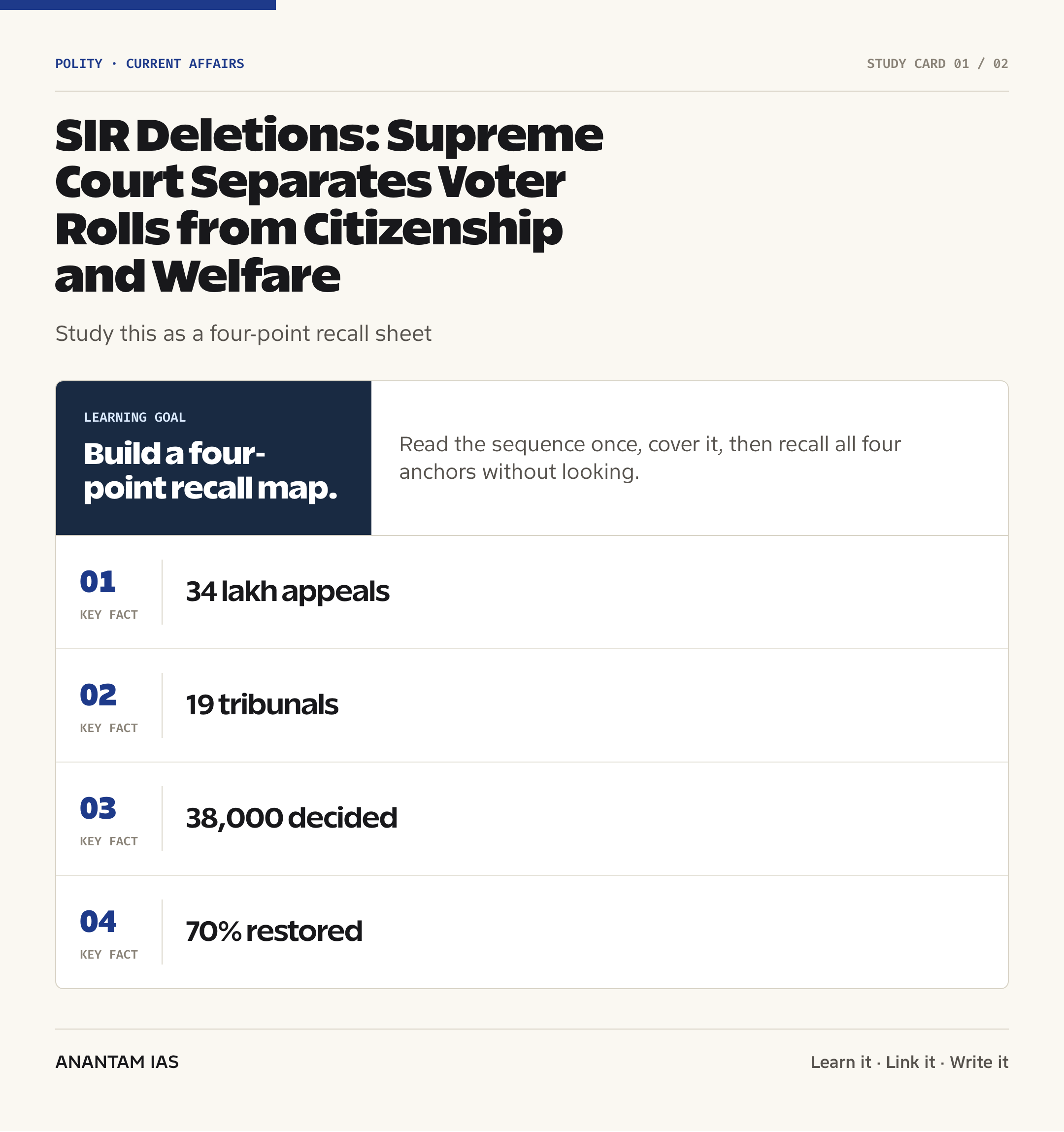
- Counsel told the Court that only about 38,000 of 34 lakh appeals had been decided by 19 appellate tribunals, leaving roughly 33.5 lakh pending.
- The petitioner also stated that about 70% of decided appeals resulted in restoration to the electoral roll; this was a submission before the Court, not a judicial finding on the figures.
- The Bench linked its observations to the 27 May 2026 Bihar SIR judgment, which distinguished the ECI’s limited electoral inquiry from formal citizenship adjudication.
- The Court issued notice and agreed to hear the matter with other West Bengal SIR cases; it did not finally decide the legality of the State’s contested welfare-related actions at this hearing.
The development matters in the context of:
- This matters in the context of institutional competence: electoral administration, citizenship adjudication and welfare eligibility arise under different constitutional and statutory frameworks.
- It also tests procedural fairness because a slow or inaccessible appeal process can turn a provisional electoral exclusion into prolonged loss of voting opportunity and essential services.
- The dispute connects electoral integrity with inclusion: accurate rolls are necessary, but error correction must not create disproportionate burdens for poor, rural, elderly or less literate residents.
UPSC Relevance
Prelims Relevance
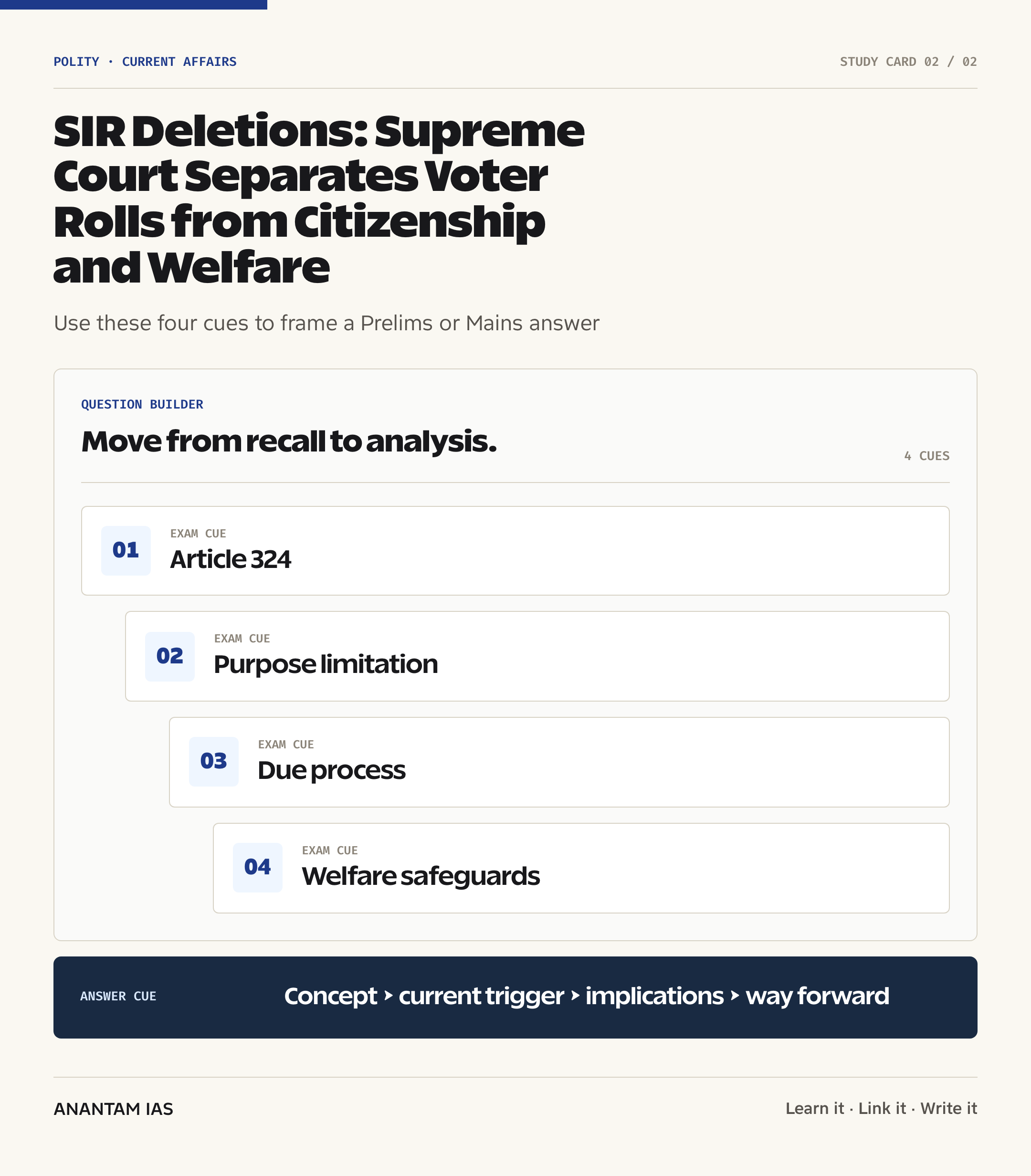
- Article 324 vests the superintendence, direction and control of elections and electoral rolls in the ECI.
- Article 326 provides for elections to the Lok Sabha and State Assemblies on the basis of adult suffrage, subject to constitutional and statutory disqualifications.
- Part II of the Constitution, covering Articles 5-11, deals with citizenship at the commencement of the Constitution and Parliament’s power to regulate citizenship.
- Section 16 of the Representation of the People Act, 1950 disqualifies a person from electoral-roll registration if the person isn’t an Indian citizen, among other specified grounds.
- Sections 19 and 20 of the 1950 Act connect registration to age and ordinary residence in a constituency.
- Section 21 governs preparation and revision of electoral rolls, while Sections 22 and 23 concern correction and inclusion.
- Section 24 of the 1950 Act provides an appeal against specified electoral-registration orders, subject to the prescribed procedure.
- Under the Citizenship Act, 1955, renunciation, termination and deprivation of citizenship follow separate legal routes; an electoral-roll deletion isn’t listed as a mode of citizenship loss.
- Aadhaar may establish identity for electoral purposes under the statutory framework, but it isn’t proof of citizenship.
Mains Relevance
GS Paper 2
- Separation of functions among the ECI, the Central Government’s competent citizenship authority, courts and welfare departments.
- Constitutional limits on administrative spillover from an electoral eligibility decision to citizenship status and civil entitlements.
- Need for transparent, accessible and time-bound electoral-roll appeals as part of free and fair elections.
GS Paper 2
- Welfare exclusion, Article 14, procedural fairness and protection of vulnerable groups.
- Design of interoperable public databases without allowing one database’s error or limited-purpose decision to become a universal exclusion trigger.
- Balancing roll accuracy with the democratic principle of universal adult suffrage.
Essay
- A database can improve governance only when its purpose, evidentiary value and correction process are clearly limited.
- Democracy is tested not only by the integrity of the ballot but also by how institutions correct wrongful exclusion.
Background and Context
What SIR Does and Does Not Decide
A Special Intensive Revision is an electoral-roll exercise, not a general census of citizenship or a universal eligibility audit.
- The ECI conducts revision to identify eligible electors, remove dead, shifted, duplicate or otherwise ineligible entries, and add persons who satisfy the law.
- The Supreme Court’s Bihar SIR judgment upheld the Commission’s power under Article 324 read with Section 21(3) of the 1950 Act to undertake a special revision when roll conditions justify it.
- The judgment recognised that citizenship is a condition for enrolment, so the ECI can undertake a limited inquiry into whether that condition is met.
- But the inquiry is purpose-limited: it determines whether a name should remain on the electoral roll and does not replace formal adjudication under the Citizenship Act.
- A person deleted as dead, shifted, duplicated or not ordinarily resident may face an electoral consequence even when citizenship itself is not in dispute.
Electoral Eligibility and Citizenship Are Different Legal Questions
Citizenship may be necessary for enrolment, but enrolment isn’t the source of citizenship.
- Article 326 and Section 16 of the 1950 Act make citizenship relevant to voter registration, while the Citizenship Act, 1955 governs acquisition and loss of citizenship.
- The Act recognises renunciation under Section 8, termination on voluntary acquisition of foreign citizenship under Section 9, and deprivation by a Central Government order in specified cases under Section 10.
- None of these statutory routes says that deletion by an Electoral Registration Officer automatically ends citizenship.
- The Supreme Court’s May judgment required the ECI to refer cases involving its adverse citizenship assessment to the competent Central Government authority for lawful adjudication.
- If that authority later holds that the person is a citizen, the judgment directs electoral inclusion, subject to the legal requirements.
Why Welfare Linkage Raises Constitutional Concerns
A limited-purpose electoral record shouldn’t become a shortcut for deciding unrelated entitlements without an independent legal basis.
- The petition alleged that orders dated 14 May, 19 May and 4 June connected SIR exclusion with caste-certificate re-verification, the Annapurna Yojana and PDS benefits respectively.
- These allegations are still under judicial examination, so the exact scope and legality of the State orders must be distinguished from the Court’s settled statement about the ECI’s limited role.
- Many welfare schemes turn on criteria such as residence, income, age, gender, disability or food-security status; electoral enrolment may not be a statutory condition at all.
- Automatic cross-use can violate Article 14 if persons in unlike legal situations are treated as a single excluded class without rational classification or fair procedure.
- Where food support or subsistence benefits are involved, abrupt exclusion can also implicate Article 21 concerns and the State’s obligations under welfare legislation.
- A welfare department must identify its own statutory authority, issue notice where required, examine relevant evidence and provide a remedy before stopping a benefit.
Due Process in Electoral-Roll Deletion
Accuracy and inclusion can coexist only when the process offers notice, reasons, assistance and an effective remedy.
- The 1950 Act and the Registration of Electors Rules, 1960 structure claims, objections, corrections and appeals; administrative convenience cannot displace the prescribed safeguards.
- A person facing adverse action should know the ground of proposed deletion, the documents relied on, the response deadline and the authority deciding the case.
- A reasoned order matters because it enables a meaningful statutory appeal and, where necessary, judicial review.
- The petitioner asked for public standard operating procedures, disclosure of data, local-language guidance, legal help and time-bound disposal by the 19 tribunals.
- A high restoration rate among decided appeals, if the submitted figure is verified, would be a strong signal to improve first-instance decision quality and simplify correction.
- Read this issue with Anantam IAS notes on Special Intensive Revision and electoral-roll integrity and inclusion.
Institutional Roles in the Dispute
The constitutional answer depends on keeping each authority within its assigned function.
- The ECI supervises electoral rolls and may decide enrolment eligibility through the statutory machinery.
- The Electoral Registration Officer deals with entries at the constituency level, while appellate authorities examine challenges under the applicable framework.
- The Central Government’s competent authority formally adjudicates citizenship questions under the Citizenship Act and rules where such adjudication is required.
- A State welfare department administers benefits under the scheme’s own law, guidelines and eligibility criteria; it cannot simply inherit another authority’s conclusion beyond its legal purpose.
- The Supreme Court reviews legality, institutional competence, proportionality and procedural safeguards without itself becoming the primary roll-revision authority.
- For the wider constitutional framework, revise Article 324 and the Election Commission and citizenship in India.
Database Federalism and Function Creep
The case illustrates function creep: data collected or assessed for one purpose begins controlling decisions in another domain.
- Electoral rolls, ration databases, caste-certificate records and scheme beneficiary lists have different legal purposes, evidence standards and correction pathways.
- Interoperability can reduce duplication, but a negative flag should not become an irrebuttable presumption across systems.
- A wrong deletion can cascade when databases are linked, multiplying one error into loss of vote, food support, cash assistance and documentary recognition.
- Good data governance requires purpose limitation, data minimisation, audit trails, human review and clear responsibility for correcting downstream effects.
- Departments should record whether a data point is verified, provisional, disputed or under appeal instead of treating every status as final.
- The governance lesson is wider than SIR: digital public infrastructure needs a right to correction that works across connected databases.
Way Forward
Protect Rights During Pending Appeals
- Treat SIR deletion as an electoral-status decision unless a competent authority independently decides citizenship or scheme eligibility under the relevant law.
- Avoid automatic welfare suspension while a timely appeal or citizenship reference is pending, especially for food and subsistence benefits.
- Where immediate action is legally unavoidable, provide notice, a speaking order and a fast restoration process with arrears.
Make Appeals Usable
- Publish tribunal jurisdiction, filing steps, acceptable documents, hearing dates, anonymised orders and disposal data on a common portal.
- Provide forms and guidance in Bengali and other locally used languages, along with offline filing and receipt facilities.
- Deploy legal-services institutions, trained facilitation desks and mobile camps for poor, elderly, rural and digitally excluded appellants.
- Set case-management timelines while preserving a real opportunity to present evidence.
Build Safer Data-Linkage Rules
- Require each department to document the legal basis and necessity before importing electoral-roll status into a welfare decision.
- Use warning flags rather than automatic deletion, with mandatory human verification for adverse cross-database action.
- Create a correction protocol that propagates a successful appeal to every department that received the earlier exclusion signal.
- Commission independent audits for exclusion errors, social-group impact and grievance-resolution time.
Improve Roll Accuracy at Source
- Give clear pre-deletion notice, disclose reasons and accept a practical range of reliable documents.
- Track errors by ground such as death, migration, duplication, ordinary residence and citizenship doubt so systemic weaknesses become visible.
- Use Booth Level Officers and recognised political-party agents for outreach without shifting the legal burden entirely onto vulnerable electors.
Conclusion
The constitutional distinction is straightforward but consequential: the ECI can decide whether a person qualifies for an electoral roll, yet it doesn’t possess a free-standing power to terminate citizenship. A roll deletion must remain tied to its electoral purpose unless another competent authority acts under the governing law.
The pending West Bengal case will test whether that boundary is being respected in practice. The durable policy response is not to weaken roll verification, but to pair accurate rolls with fair notice, accessible appeals, purpose-limited data use and protection against cascading exclusion.
UPSC Practice Questions
Prelims MCQ 1
With reference to electoral rolls and citizenship in India, consider the following statements:
- Article 324 vests the superintendence, direction and control of electoral rolls in the Election Commission of India.
- Deletion from an electoral roll is itself a mode of termination of citizenship under the Citizenship Act, 1955.
- Section 24 of the Representation of the People Act, 1950 provides for appeals against specified electoral-registration orders.
How many of the above statements are correct?
(a) Only one (b) Only two (c) All three (d) None
Answer: (b) Only two
Explanation:
Statements 1 and 3 are correct. Electoral-roll deletion isn’t a statutory mode of citizenship loss; the Citizenship Act separately regulates renunciation, termination and deprivation.
Prelims MCQ 2
Which one of the following best describes the Election Commission’s citizenship inquiry during electoral-roll revision?
(a) A final adjudication binding on every government department (b) A limited inquiry into eligibility for electoral enrolment (c) A criminal trial for unlawful migration (d) A process that automatically cancels all residence-based benefits
Answer: (b) A limited inquiry into eligibility for electoral enrolment
Explanation:
The Supreme Court distinguishes the ECI’s limited electoral inquiry from formal citizenship adjudication by the competent authority under the Citizenship Act.
UPSC Mains Questions
- The integrity of electoral rolls and protection against wrongful exclusion are complementary democratic duties, not competing goals. Examine this statement with reference to the Election Commission’s powers, procedural safeguards and the need for effective appellate remedies.
- Automatic use of electoral-roll deletion to withdraw welfare benefits risks turning a limited-purpose administrative decision into a system-wide civil disability. Discuss the constitutional concerns and propose safeguards for responsible inter-departmental data sharing.
Sources: Supreme Court of India and The Hindu and Indian Express.
Frequently Asked Questions
What is Special Intensive Revision?
Special Intensive Revision is a detailed exercise to prepare or revise electoral rolls by checking whether entries meet statutory requirements. It may involve house-to-house verification, documents, claims and objections. Its purpose is electoral-roll accuracy. It is not, by itself, a nationwide citizenship adjudication or a universal audit of welfare eligibility.
Does voter deletion cancel citizenship?
No. Electoral-roll deletion can remove a person’s eligibility to vote from that roll, but citizenship loss follows the Constitution, the Citizenship Act, 1955 and prescribed adjudication. The Supreme Court has said the ECI’s citizenship inquiry is limited to electoral purposes and does not become a final citizenship ruling for every other purpose.
Can ECI examine citizenship?
Yes, in a limited sense. Citizenship is a condition for electoral registration, so the ECI may examine whether an applicant or elector satisfies that requirement. But formal citizenship adjudication lies with the competent authority under the Citizenship Act. The ECI must refer an adverse citizenship case rather than treat its electoral assessment as universally conclusive.
Why are welfare benefits involved?
The West Bengal petitioner alleged that State orders used SIR exclusion to affect Annapurna Yojana payments, PDS benefits and caste-certificate verification. The Court has issued notice and will examine the matter. The key issue is whether an electoral decision can lawfully control benefits governed by separate eligibility rules without independent notice and adjudication.
What safeguards should deletion include?
A fair process should disclose the proposed ground, give reasonable notice, accept relevant evidence, provide a reasoned order and offer an accessible appeal. Local-language guidance, offline filing, legal assistance, published procedures and time-bound hearings are especially important because wrongful exclusion often burdens poor, rural, elderly and less literate electors.
What did the Court finally decide?
At the 17 July hearing, the Supreme Court issued notice and made oral observations; it did not finally decide the challenge to the West Bengal actions. Its May 2026 Bihar SIR judgment had already established the durable distinction between the ECI’s limited electoral inquiry and formal citizenship adjudication by the competent authority.