A clean electoral roll is essential to democracy, but a clean-up exercise can damage democracy if it becomes difficult for eligible citizens to remain on the roll. The Bihar SIR judgment validates the Election Commission’s powers. The real UPSC question is narrower and deeper: how do we protect roll integrity without turning citizenship, poverty or weak paperwork into voter friction?
The Issue, Framed
The issue is not whether electoral rolls should be accurate. They must be. Dead voters, duplicate entries, shifted voters and ineligible names weaken electoral trust. But an electoral roll is also the gateway through which universal adult franchise becomes real. If the gateway becomes intimidating, the poorest and most mobile citizens bear the cost first.
This is why the Bihar Special Intensive Revision matters beyond Bihar. It tests the relationship between Article 324, the Representation of the People Act, administrative discretion, procedural fairness and the constitutional value of political equality. In a Mains answer, this is not a simple pro-ECI or anti-ECI debate. It is a design problem.
My position is that electoral roll integrity is necessary, but inclusion must be the default ethic. The Election Commission should have power to purify rolls, but the exercise must be citizen-facing, transparent, appealable and especially gentle on documentation-poor voters.
What the Data Says
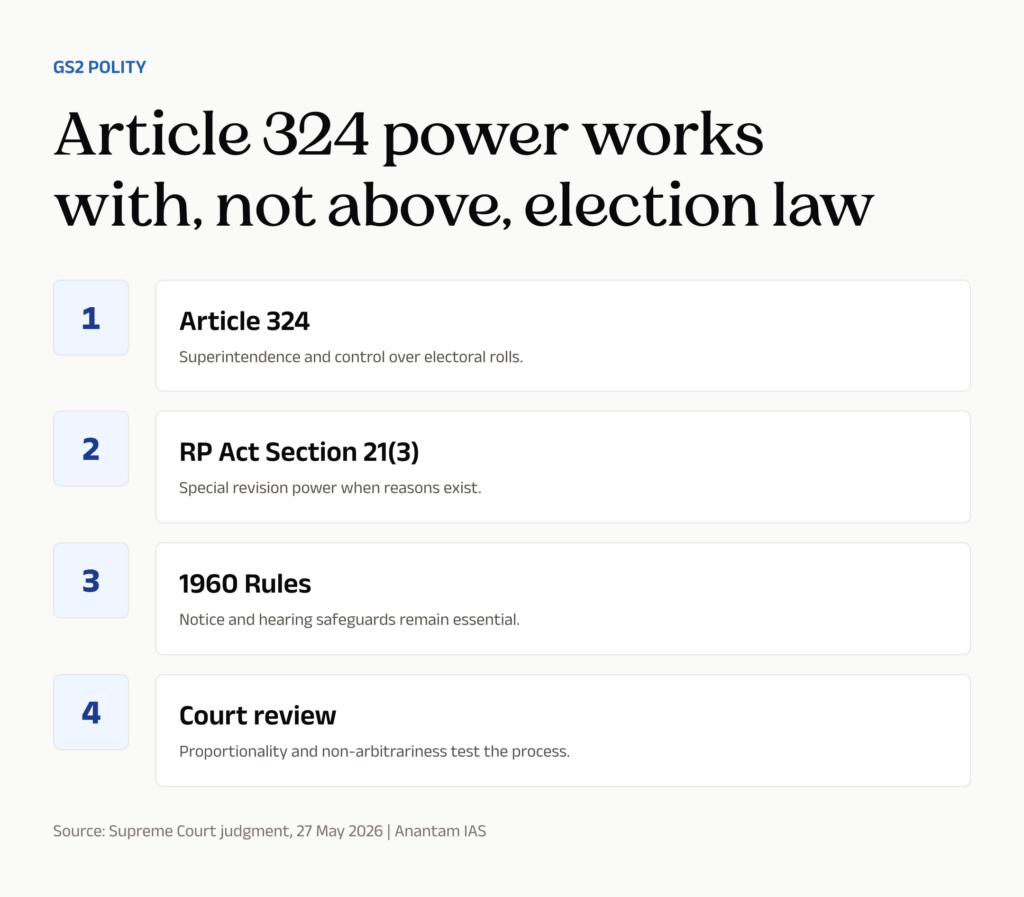
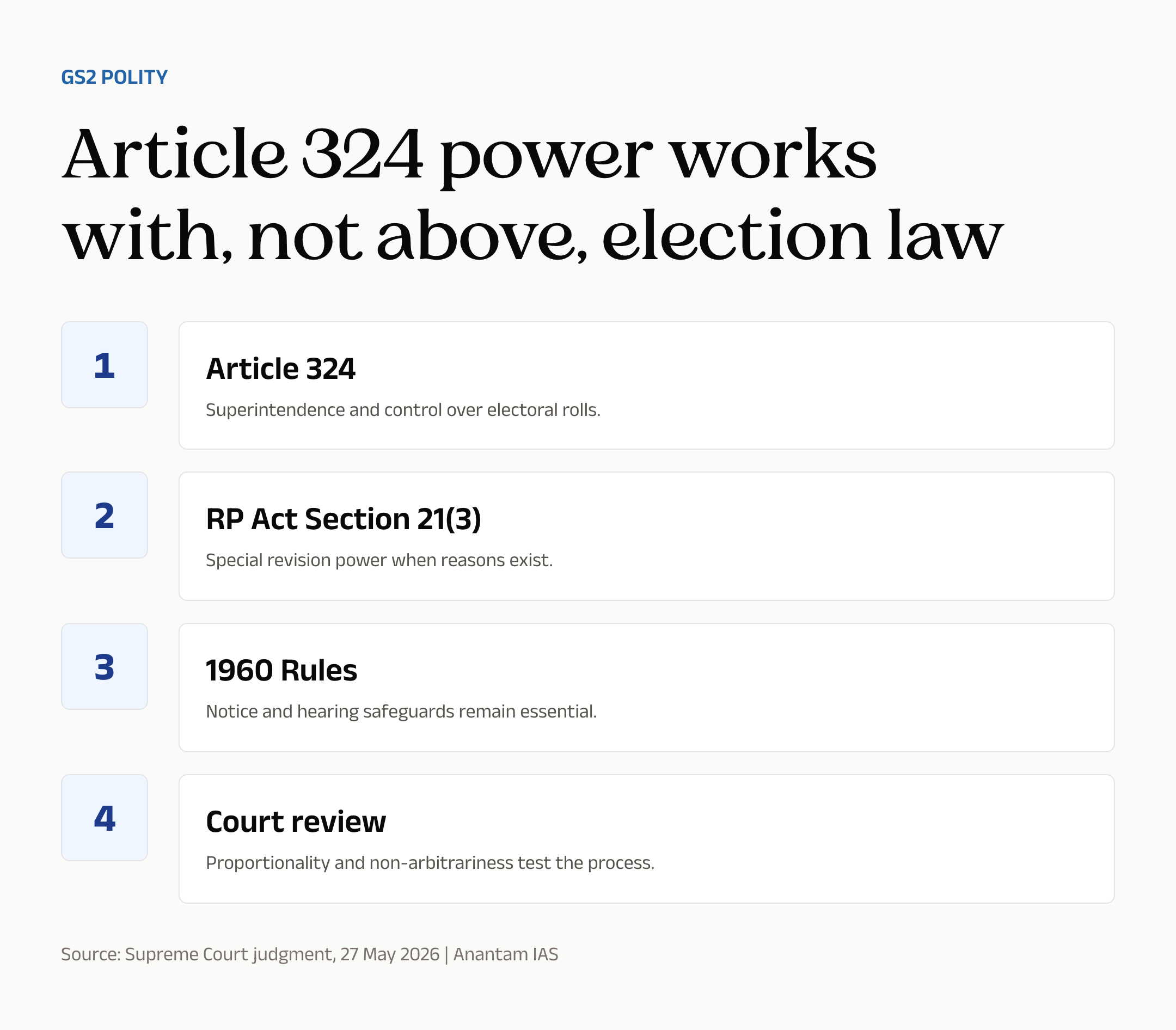
The Supreme Court judgment dated 27 May 2026 upheld the impugned SIR as traceable to Section 21(3) of the Representation of the People Act, 1950 read with Article 324 of the Constitution. That is the legal core of the decision.
The Court held that the exercise did not directly conflict with the RP Act or the Registration of Electors Rules, 1960. It also found the measure proportionate, saying it pursued a constitutionally grounded purpose: restoring accuracy, completeness and integrity of electoral rolls.
The numbers are large enough to justify serious scrutiny. The judgment records that Bihar had 7.89 crore electors on 24 June 2025, while the final roll published on 30 September 2025 contained 7.42 crore electors. It also records that 21.53 lakh eligible electors were added and 3.66 lakh names were deleted after the draft roll.
The Court drew an important boundary on citizenship. It said the ECI may undertake a limited enquiry into citizenship for electoral-roll eligibility, but that does not amount to final determination of citizenship. Cases where citizenship is disputed must go to the competent authority under the Citizenship Act, 1955.
The Case For
The case for the SIR is straightforward. Electoral democracy depends on accurate rolls. If rolls contain ineligible, dead, duplicate or shifted names, the value of each legitimate vote is diluted. The Election Commission cannot wait passively when it believes roll integrity is compromised.
Article 324 exists precisely because elections involve situations that cannot be micro-managed by statute. The Court’s reasoning that Article 324 works in harmony with election law, rather than becoming dead once Parliament legislates, is institutionally sensible. Election management needs administrative flexibility.
There is also a trust argument. Public confidence in election outcomes depends not only on polling day, but on the roll before polling day. If citizens believe rolls are bloated or manipulated, the legitimacy of results suffers.
The Case Against
The case against aggressive roll revision is equally serious. Documentation burdens do not fall equally. Migrant workers, the homeless, the elderly, women after marriage, marginal communities and people in informal settlements are more likely to face friction. A technically neutral form can produce socially unequal exclusion.
There is also a citizenship danger. The electoral roll is about eligibility to vote, not a citizenship tribunal. If roll officers begin to behave like citizenship authorities, the process may exceed its democratic purpose. The Supreme Court’s insistence on referral to the competent authority is important for this reason.
Finally, timing matters. Intensive revision close to an election can create anxiety and reduce the practical ability to correct errors. Even when the law allows it, administrative design should avoid making voters feel that the franchise is conditional on navigating a maze.
The Deeper Structural Read
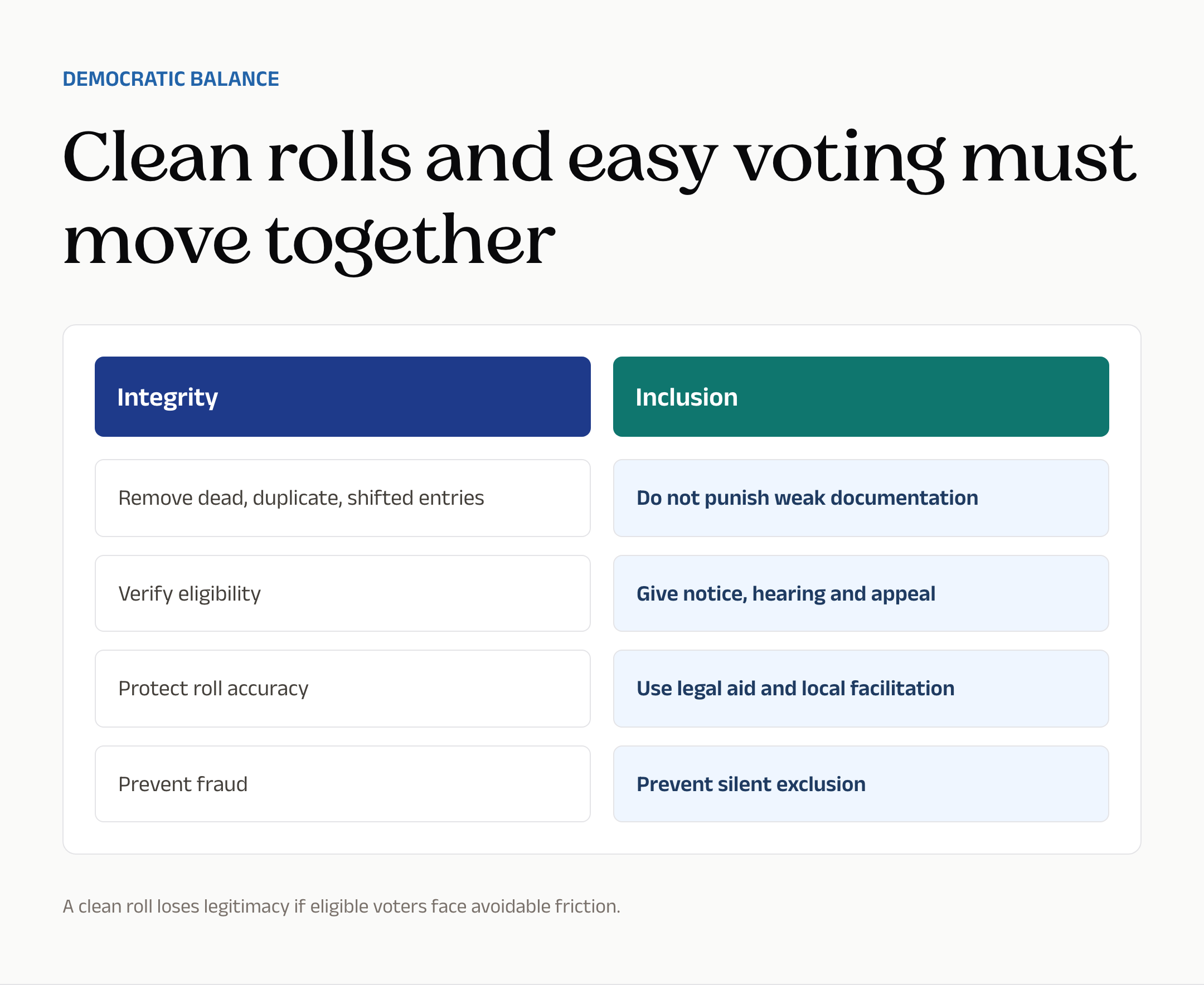
The deeper structural read is that democratic integrity has two faces. One face is purity of the roll. The other is ease of inclusion. Democracies often remember the first when fraud is alleged and forget the second when poor citizens struggle with documents.
Aspirants should be careful here. The right to vote is not a free-floating fundamental right in the same manner as free speech. But universal adult franchise is a basic democratic commitment. That means procedures around the roll must be judged not only by legality but by their effect on political equality.
The strongest version of the ECI’s case is that it is protecting free and fair elections. The strongest critique is that free and fair elections also require every eligible citizen to have a realistic path to remain registered. Both are true. Good governance lies in making them compatible.
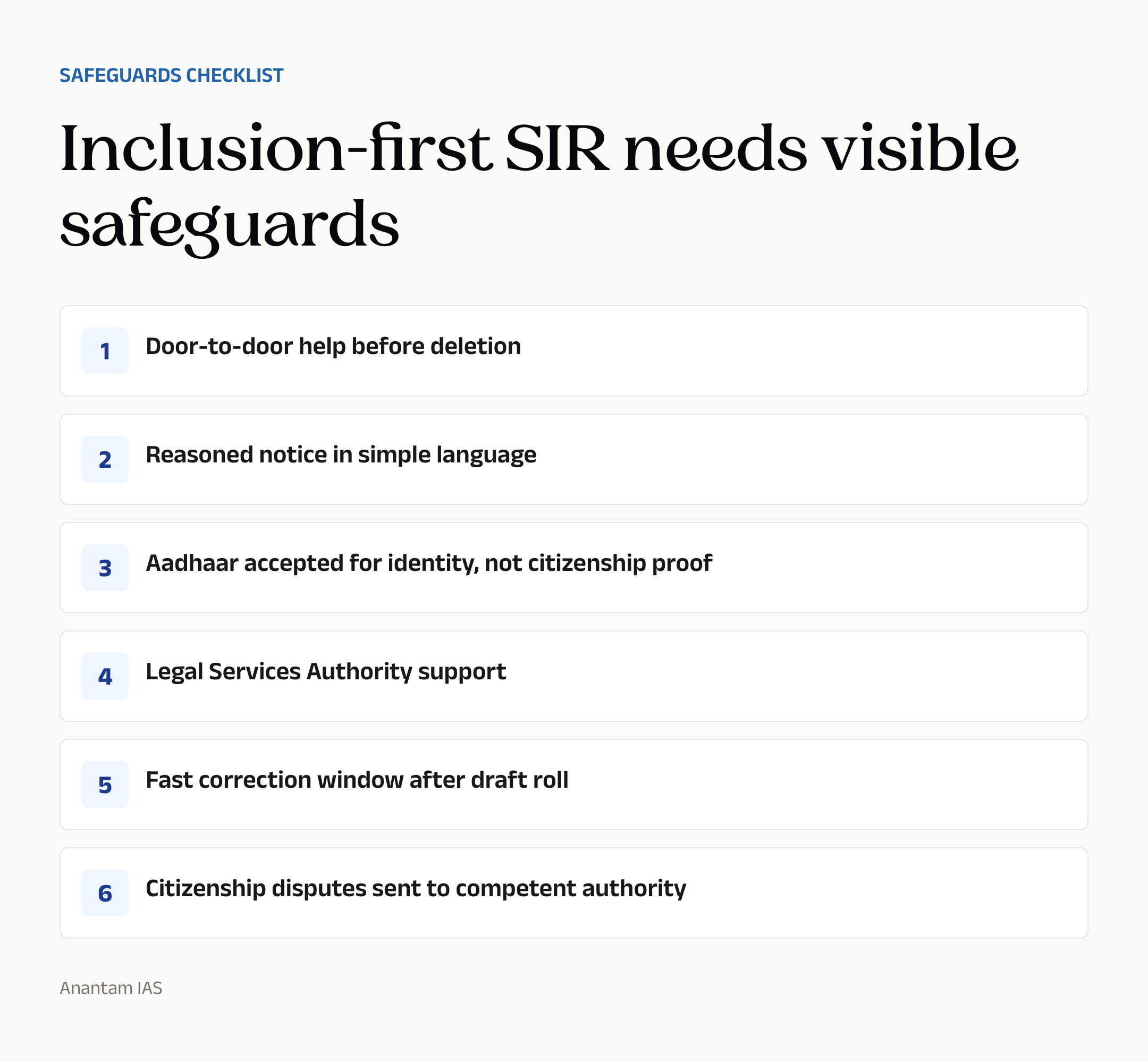
This is why legal services, public notices, local language communication, door-to-door facilitation, disability access and fast appeals are not decorative safeguards. They are the democratic infrastructure of roll revision.
A useful administrative test is this: does the process create more verified voters, or merely more frightened voters? A revision that removes ineligible names and restores eligible names quickly strengthens democracy. A revision that produces long queues, unclear notices and dependence on middlemen weakens trust even if its legal foundation is sound. In UPSC language, the legitimacy of election management comes from legality, proportionality and citizen usability together.
What Should Be Done
First, every intensive revision should begin with an inclusion protocol. The first question should not be how to delete doubtful names. It should be how to help eligible voters prove and correct their status with minimum burden. That principle should sit inside the institutional powers of the Election Commission of India and the operational logic of Special Intensive Revision.
Second, documentation rules should distinguish identity, residence, age and citizenship. Aadhaar may help establish identity, but it is not citizenship proof. The Court’s treatment of limited citizenship enquiry should be converted into clear field guidelines.
Third, deletion must require reasoned notice and meaningful hearing. A voter should know the exact ground: dead, shifted, duplicate, absent, age, residence or citizenship doubt. Vague doubt is not enough.
Fourth, ECI data should be publicly auditable in aggregate. District-level additions, deletions, objections, appeals and restorations should be placed in machine-readable dashboards. Transparency protects both the Commission and voters.
Finally, the Election Commission should treat the poorest voter as the design user. If a migrant woman with weak paperwork can navigate the process, the system is democratic. If only the well-documented can, the roll may be clean on paper and exclusionary in practice.
For Your Mains Answer
GS paper mapping: GS2: Constitution, statutory bodies, elections, governance and rights.
Likely question frames: – Electoral roll integrity and voter inclusion are not competing goals. Discuss in the light of the Bihar SIR judgment. – Examine the constitutional and statutory basis of the Election Commission’s power to revise electoral rolls. – How can India design voter-roll revision that prevents fraud without excluding vulnerable citizens?
Quotable data points: – SIR upheld under Article 324 read with Section 21(3) of the RP Act, 1950. – Bihar final roll: 7.42 crore electors on 30 September 2025. – Earlier roll: 7.89 crore electors on 24 June 2025. – 21.53 lakh eligible electors added during the exercise. – 3.66 lakh names deleted after draft publication. – Citizenship enquiry by ECI is limited to electoral eligibility, not final citizenship determination.
Keywords to use: Article 324, universal adult franchise, procedural fairness, proportionality, roll integrity, inclusion-first governance.
Syllabus linkages: Salient features of the Constitution, Election Commission, Statutory and regulatory bodies, Governance and transparency.
Balanced conclusion line: The test of electoral administration is not only a clean roll, but a clean roll that every eligible citizen can enter and remain on without fear.
How to Build the Answer
Start with the central tension, not a textbook definition. For this topic, the tension is: Electoral roll integrity and voter inclusion are not competing goals. Discuss in the light of the Bihar SIR judgment. That opening immediately tells the examiner that you understand both the policy problem and the value conflict. A definition can come in the second or third sentence. The first sentence should frame the debate.
Use data early, but do not dump data. A good first body paragraph can carry three numbers: SIR upheld under Article 324 read with Section 21(3) of the RP Act, 1950. Bihar final roll: 7.42 crore electors on 30 September 2025. Earlier roll: 7.89 crore electors on 24 June 2025. Then explain what those numbers prove. UPSC rewards the move from fact to inference. The number is the anchor; the inference is the mark-scoring part.
The second body paragraph should handle the other side fairly. If your stance supports reform, first admit why the existing approach has a rationale. If your stance criticises a policy, first say what problem the policy was trying to solve. This is how an answer becomes balanced without becoming vague.
The way forward should be grouped, not scattered. Use headings such as institutional reform, fiscal design, citizen impact, federal coordination and technology. Use the topic’s own vocabulary: Article 324, universal adult franchise, procedural fairness, proportionality, roll integrity. These words help the answer sound like governance analysis rather than a newspaper summary.
Close by returning to the syllabus link: Salient features of the Constitution, Election Commission, Statutory and regulatory bodies. The last line should not repeat the introduction. It should show judgment. One useful pattern is: ‘The goal is not X alone, but X with Y.’ That pattern lets you balance reform with rights, growth with equity, and security with liberty.
Common Mistakes to Avoid
- Do not write only the newspaper argument. Editorials are starting points. Mains answers need constitutional, economic, administrative or ethical structure.
- Do not overuse adjectives. Words like serious, grave, historic and transformative do not earn marks unless tied to evidence.
- Do not make the answer one-sided. Every topic in this batch has a real counter-argument. Steelman it in two or three lines before giving your final view.
- Do not end with a slogan. End with an implementable principle, a measurable reform, or a constitutional value.
- Do not forget the citizen. UPSC likes policy, but it rewards policy that names who gains, who loses and who needs protection.
A Compact Answer Spine
- Introduction: Open with the conflict in one sentence and define the key term in the next sentence.
- Evidence: Use two or three data points from the dossier and connect each to a policy implication.
- Arguments: Present the case for the current policy or trend, then the case against it. Keep both fair.
- Structural diagnosis: Explain the deeper administrative, economic, social or constitutional reason the issue persists.
- Way forward: Give four to five grouped reforms with clear actors: Union government, state government, regulator, court, market, municipality or citizen.
- Conclusion: Use the balanced conclusion line from this section and adapt it to the question wording.
Diagram or Flowchart Idea
Use one small diagram if the question is a 15-marker. Do not draw a decorative mind map. Draw a causal chain. The cleanest format is: problem trigger -> institutional gap -> citizen impact -> reform response. This works because the examiner can read the logic in five seconds.
For a 10-marker, skip the diagram unless it is genuinely simple. A table with two columns, ‘case for’ and ‘case against’, usually works better. The aim is not to show artistic effort. The aim is to make the answer easy to evaluate under time pressure.
Ethics and Governance Angle
Add one ethical line even in a GS2 or GS3 answer. Most current-affairs editorials are not only about efficiency. They also ask who bears the cost of policy failure. A migrant voter, an undertrial, an outdoor worker, a small exporter, a low-income commuter or an elderly citizen is often sitting silently inside the issue. Naming that citizen makes the answer sharper.
The governance angle should then convert empathy into design. Do not merely say ‘protect vulnerable groups’. Say how: targeted transfers, legal aid, local health surveillance, simplified compliance, public transport, transparent dashboards, or periodic judicial review. This is where many answers move from moral language to administrative maturity.
A useful sentence pattern is: ‘The policy is legitimate in aim, but its legitimacy depends on procedure, proportionality and capacity.’ This line works across many topics because it accepts the state’s objective without giving the state a blank cheque. It is especially useful for questions where the examiner expects balance.
How to Use Data Without Sounding Mechanical
Use fewer numbers than you know. Three well-explained data points beat ten scattered facts. Put the most important number near the beginning, use the second number to show contrast, and use the third number to justify the way forward. For example, one national number, one state or sector contrast, and one implementation gap is usually enough.
Never leave a statistic alone. Follow it with a sentence beginning with ‘This means…’ or ‘The policy implication is…’ That tiny move turns data into analysis. It also keeps the answer from reading like a fact sheet. In Mains, facts are raw material. Judgment is the finished answer.
End revision by asking one question: can this answer be understood by a tired examiner in one pass? If the answer needs rereading, simplify the structure. Keep the introduction short, give the data early, mark the two sides cleanly, and place the way forward in grouped points. Clarity is not a lower standard than depth. For UPSC writing, clarity is how depth becomes visible.
One final check: remove any line that sounds impressive but does no work. Replace it with a fact, a cause, a consequence or a reform. That habit is small, but it is the difference between an answer that feels informed and an answer that feels memorised.
Write for marks, not for noise. Every sentence should earn its place. Always be specific.
FAQ
What did the Supreme Court hold?
It upheld the Bihar SIR as legally traceable to Article 324 and Section 21(3) of the RP Act, with safeguards against arbitrary exclusion.
Can ECI decide citizenship?
The ECI can make a limited enquiry for electoral-roll eligibility, but final citizenship determination belongs to the competent authority under the Citizenship Act.
Why is inclusion important?
Because universal adult franchise becomes real only when eligible citizens can remain on the roll without disproportionate documentation or procedural burden.
What is the Mains keyword?
Use ‘inclusion-first roll integrity’ to capture the balance between clean electoral rolls and accessible voting rights.
Tell Google you want more of this.
Add Anantam IAS as a preferred sourceOne tap, and this site shows up more often in your own Top Stories, AI Overviews and AI Mode. Remove it any time.