Solid Waste Management Rules 2026: A Reset for Urban Waste Governance
Why in News?
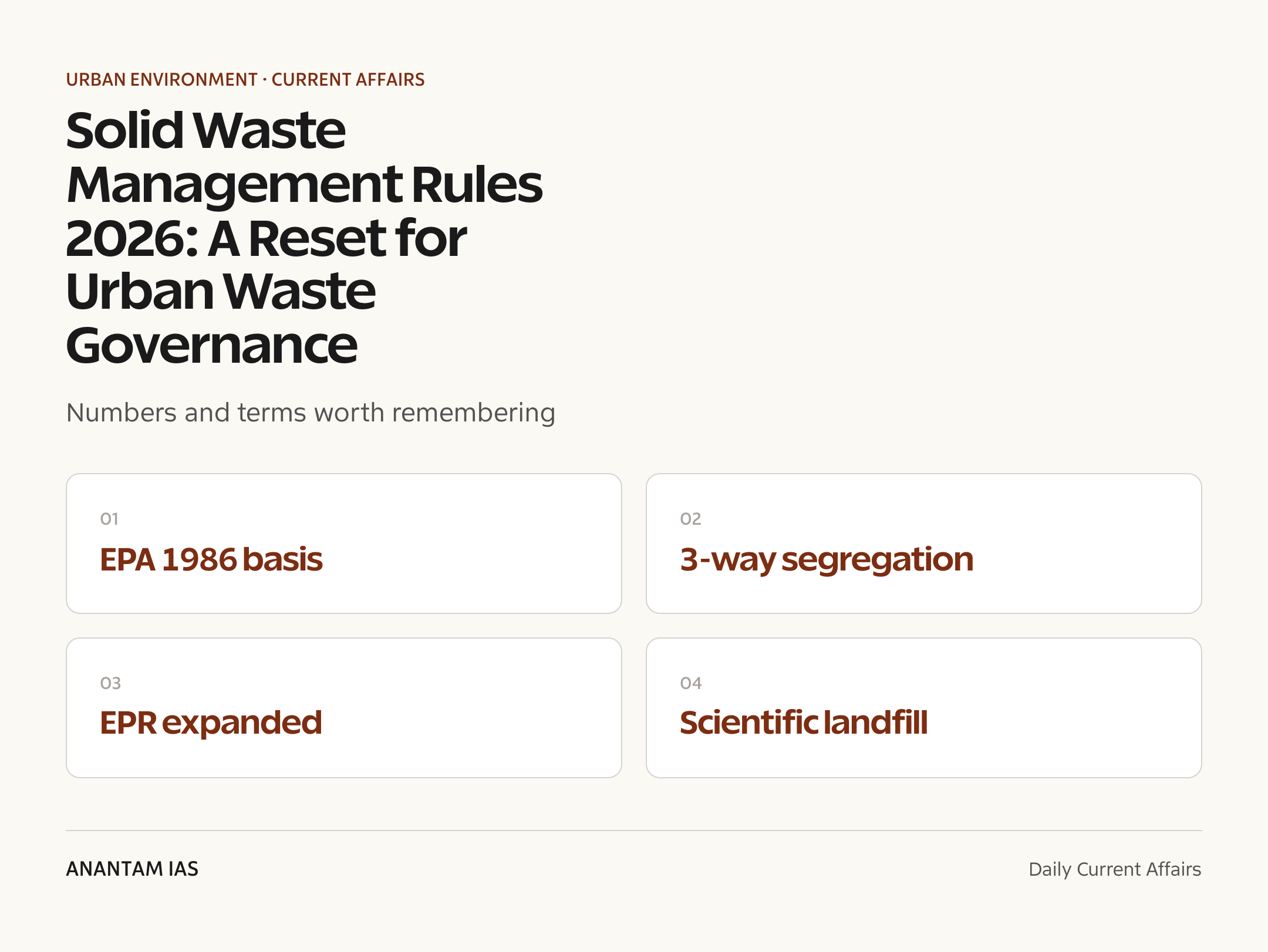
The Ministry of Environment, Forest and Climate Change (MoEFCC) has notified the Solid Waste Management Rules 2026 under the Environment (Protection) Act, 1986, replacing the decade-old SWM Rules 2016. The reset tightens segregation, expands Extended Producer Responsibility (EPR) and sets time-bound processing and scientific-landfill targets for urban local bodies (ULBs).
The new rules dovetail with the Swachh Bharat Mission-Urban 2.0 push on garbage-free cities and the government’s circular economy agenda, treating waste as a recoverable resource rather than a disposal problem.
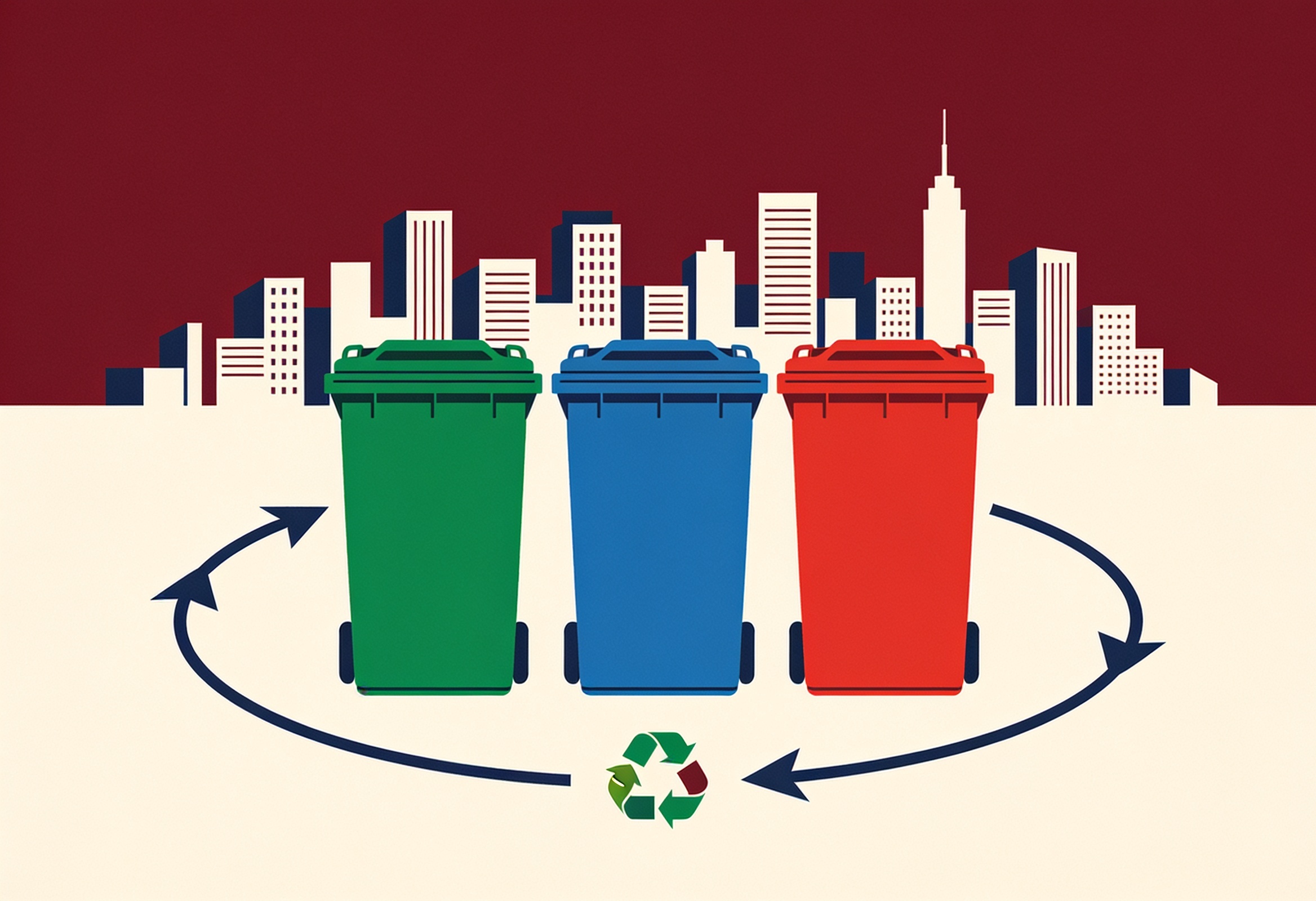
- Mandate source segregation into three streams — wet (biodegradable), dry (recyclable) and domestic hazardous/sanitary waste.
- Extend EPR obligations onto producers, importers and brand-owners for packaging and harder-to-recycle waste streams.
- Set time-bound targets for 100% scientific processing of fresh waste and remediation of legacy dumpsites via biomining and bio-capping.
- Sharpen duties of bulk waste generators — bodies generating above the notified threshold must process wet waste on-site.
- Align city sanitation with SBM-Urban 2.0 star-rating and the Garbage-Free City certification system.
The development matters in the context of:
- India’s cities generate roughly 1.7 lakh tonnes of municipal solid waste a day, and a large share is still dumped unscientifically.
- The SWM Rules 2016 were never fully enforced — segregation at source and landfill remediation lagged across most ULBs.
- Mounting legacy waste at sites like Delhi’s Ghazipur and Bhalswa made dumpsite remediation a political and public-health priority.
UPSC Relevance
Prelims Relevance
- Solid Waste Management Rules 2026 notified under the Environment (Protection) Act, 1986 — a Central rule-making power.
- SWM Rules 2016 superseded the Municipal Solid Wastes (Management and Handling) Rules, 2000.
- Extended Producer Responsibility (EPR) — producer/brand-owner bears post-consumer waste responsibility.
- Central Pollution Control Board (CPCB) — statutory body under the Water Act 1974, the apex monitoring authority.
- Waste-to-energy (WtE) — incineration/RDF and biomethanation routes for non-recyclable residue.
- Biomining and bio-capping — techniques used to remediate legacy waste dumpsites.
- Swachh Bharat Mission-Urban 2.0 — aims at garbage-free cities; launched 2021.
- 74th Constitutional Amendment Act, 1992 — sanitation/solid waste is a Twelfth Schedule function of urban local bodies.
Mains Relevance
GS Paper 3
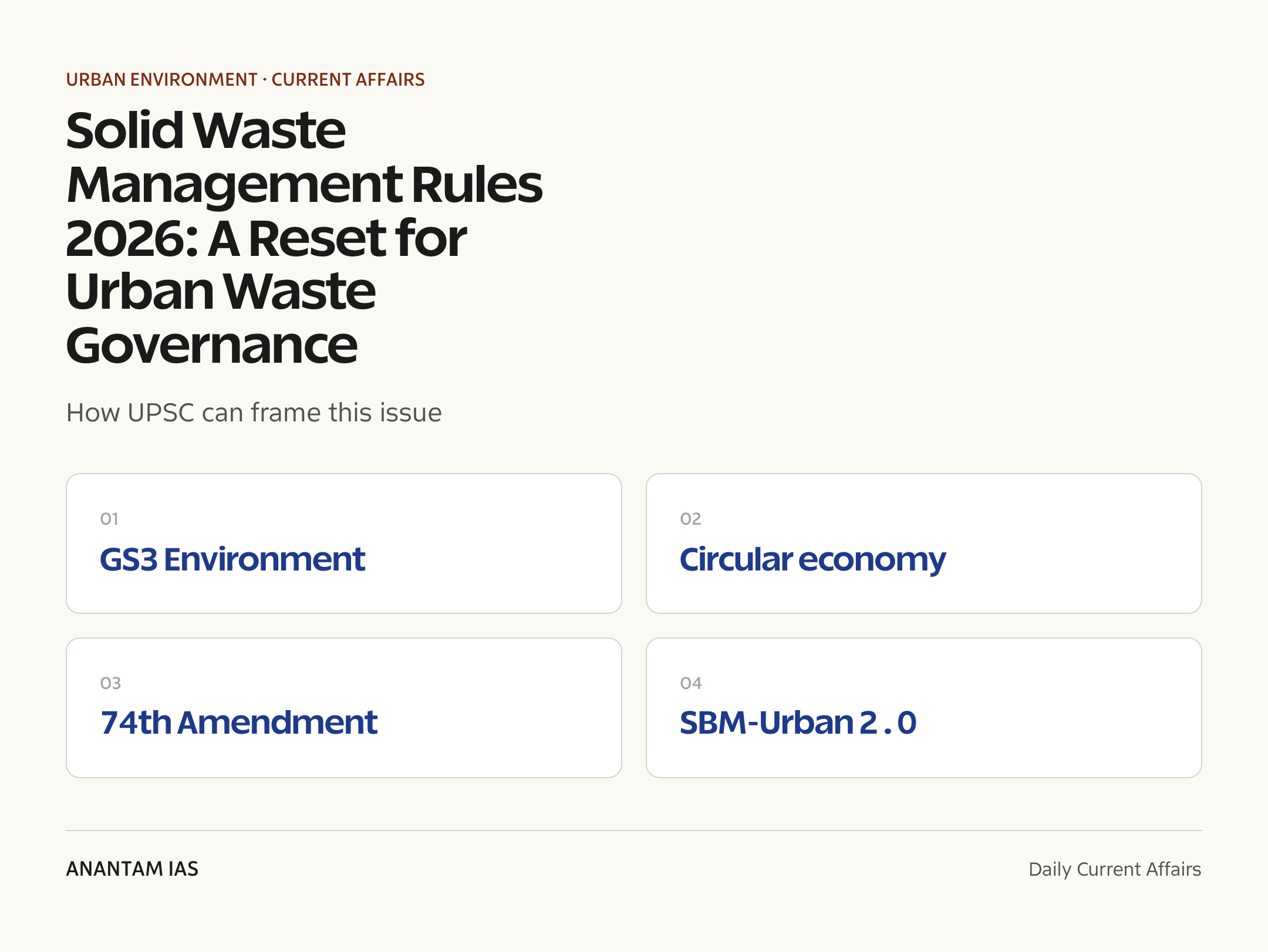
- Examine how the SWM Rules 2026 advance a circular economy by treating waste as a resource.
- Assess Extended Producer Responsibility as an instrument for managing packaging and plastic waste.
GS Paper 2
- Evaluate the capacity of urban local bodies under the 74th Amendment to deliver time-bound waste targets.
Essay
- Waste is not what we discard but what we have failed to value — the circular economy as a development idea.
- Clean cities, the unfinished promise of urbanisation.
Background and Context
From 2016 to 2026: what the reset changes
The 2026 rules keep the architecture of the 2016 regime but close its biggest enforcement gaps.
- Reaffirm and tighten source segregation into wet, dry and domestic hazardous/sanitary streams, with collection penalties for mixed waste.
- Convert aspirational 2016 timelines into time-bound, monitorable targets for processing and dumpsite remediation.
- Broaden EPR beyond plastics toward packaging, multi-layered and harder-to-recover materials.
- Strengthen reporting and audit duties so CPCB and state boards can track ULB performance.
Duties of generators and urban local bodies
The rules distribute clear obligations across households, bulk generators and the municipal machinery.
- Households must hand over segregated waste; no co-mingling at the doorstep.
- Bulk waste generators — large housing societies, hotels, hospitals, campuses above a notified threshold — must compost or process wet waste on-site.
- Urban local bodies handle door-to-door collection, secondary transport, processing infrastructure and scientific landfilling.
- Sanitation is a Twelfth Schedule subject under the 74th Amendment, so the rules effectively operationalise a constitutional municipal function.
EPR and the circular-economy logic
Extended Producer Responsibility shifts the cost of end-of-life waste onto those who put products on the market.
- EPR makes producers, importers and brand-owners responsible for collecting back and recycling post-consumer packaging.
- It feeds the circular economy goal of designing out waste and keeping materials in use.
- Recovered dry waste re-enters manufacturing as recyclate, cutting demand for virgin material.
- Better source segregation raises the quality and value of the recyclable stream.
Processing, waste-to-energy and scientific landfills
The rules push residue up the waste hierarchy and shrink the role of open dumping.
- Wet waste is routed to composting and biomethanation; dry waste to material-recovery facilities.
- Non-recyclable, high-calorific residue can go to waste-to-energy plants or be processed as refuse-derived fuel.
- Only inert, non-processable residue should reach a scientific landfill — engineered with liners and leachate control.
- CPCB sets standards and monitors emissions, leachate and processing compliance.
Legacy waste, dumpsites and remediation
Decades of unscientific dumping created mountains of legacy waste that the rules want cleared on a deadline.
- Legacy waste at old dumpsites is to be remediated through biomining — excavating, screening and recovering material — and bio-capping.
- Remediation reclaims valuable urban land and cuts methane and fire hazards.
- Funding and execution are tied to Swachh Bharat Mission-Urban 2.0 support to states and ULBs.
- Iconic sites such as Delhi’s Ghazipur and Bhalswa are the test cases for the new timelines.
Convergence with SBM-Urban 2.0 and the law
The rules sit inside a wider statutory and mission framework rather than standing alone.
- Notified under the Environment (Protection) Act, 1986, giving them pan-India statutory force.
- Operationally tied to SBM-Urban 2.0 outcomes — Garbage-Free City star ratings and the Swachh Survekshan survey.
- Reinforce the role of state pollution control boards and CPCB in monitoring and enforcement.
- Complement the separate Plastic Waste and E-Waste Management Rules within India’s waste-governance stack.
Way Forward
Make segregation stick
- Pair penalties for mixed waste with reliable separate collection, so citizens trust that sorted waste stays sorted.
- Run sustained behaviour-change and ward-level monitoring rather than one-off campaigns.
Fund and build ULB capacity
- Strengthen municipal finances and technical staffing so urban local bodies can actually meet time-bound targets.
- Use viability-gap funding and user charges to sustain processing plants beyond the grant period.
Close the loop on EPR
- Build transparent, audited EPR registries so producer credits map to real recycling, not paper compliance.
- Integrate the informal waste-picker economy with dignity, training and fair prices.
Conclusion
The Solid Waste Management Rules 2026 matter less for inventing new ideas than for converting the half-kept promises of 2016 into deadlines, duties and audited targets. Their real test is enforcement at the ward and dumpsite level, not the elegance of the notification.
If segregation, EPR and dumpsite remediation move together — and if cash-strapped urban local bodies get the money and people to deliver — the rules could turn India’s waste burden into a genuine circular economy opportunity. If not, they risk joining the long list of well-drafted environmental rules that the country never fully implemented.
UPSC Practice Questions
Prelims MCQ 1
With reference to the Solid Waste Management Rules 2026, consider the following statements:
- They are notified under the Environment (Protection) Act, 1986.
- They mandate segregation of waste at source into wet, dry and domestic hazardous streams.
- They abolish the principle of Extended Producer Responsibility introduced earlier.
How many of the above statements are correct?
(a) Only one (b) Only two (c) All three (d) None
Answer: (b) Only two
Explanation:
Statements 1 and 2 are correct — the rules are issued under the EPA 1986 and require three-way source segregation. Statement 3 is wrong: the rules expand, not abolish, Extended Producer Responsibility.
Prelims MCQ 2
In the context of municipal waste governance in India, the recovery of material from old dumpsites by excavating and screening accumulated legacy waste is best described as:
(a) Biomethanation (b) Biomining (c) Incineration (d) Leachate treatment
Answer: (b) Biomining
Explanation:
Biomining excavates and screens legacy waste to recover recyclables, soil and combustible fractions, reclaiming the dumpsite land. Biomethanation digests wet waste, while incineration burns residue for energy.
UPSC Mains Questions
- The Solid Waste Management Rules 2026 reframe municipal waste as a resource rather than a disposal problem. Examine how the rules advance a circular economy and the institutional bottlenecks that could hold them back.
- Extended Producer Responsibility shifts the burden of post-consumer waste onto producers. Critically evaluate its design and enforcement challenges in the Indian context.
- Sanitation and solid-waste management are constitutional functions of urban local bodies. Discuss why time-bound waste targets remain hard to deliver and suggest a way forward.
Sources: Ministry of Environment, Forest and Climate Change and Central Pollution Control Board.
Frequently Asked Questions
What are the Solid Waste Management Rules 2026?
They are central rules notified under the Environment (Protection) Act, 1986 that overhaul the 2016 framework for managing municipal solid waste. They tighten source segregation, expand Extended Producer Responsibility, and set time-bound targets for waste processing and scientific landfilling across India’s urban local bodies.
How do the 2026 rules differ from the SWM Rules 2016?
The 2016 rules introduced source segregation and EPR but were weakly enforced. The 2026 reset keeps that architecture while converting aspirational timelines into monitorable, time-bound targets, broadening EPR to more waste streams, and sharpening the duties of bulk generators and municipalities.
What is Extended Producer Responsibility in this context?
Extended Producer Responsibility, or EPR, makes producers, importers and brand-owners responsible for collecting back and recycling the post-consumer waste their products generate, especially packaging. It internalises the cost of waste and supports a circular economy by keeping materials in productive use.
What is the three-way segregation the rules require?
Households and generators must separate waste into three streams: wet or biodegradable waste for composting and biomethanation, dry recyclable waste for material recovery, and domestic hazardous and sanitary waste for safe handling. Mixed waste defeats downstream processing and attracts penalties.
How do the rules deal with legacy waste at old dumpsites?
They require remediation of legacy waste through biomining and bio-capping, where accumulated waste is excavated, screened and recovered, reclaiming land and cutting methane and fire risks. This work is tied to support under the Swachh Bharat Mission-Urban 2.0.
How are the rules linked to Swachh Bharat Mission-Urban 2.0?
The rules provide the statutory backbone for SBM-Urban 2.0’s garbage-free city goal. Compliance feeds into the Garbage-Free City star ratings and the Swachh Survekshan survey, while the mission channels funds and technical support to states and urban local bodies for processing and remediation.