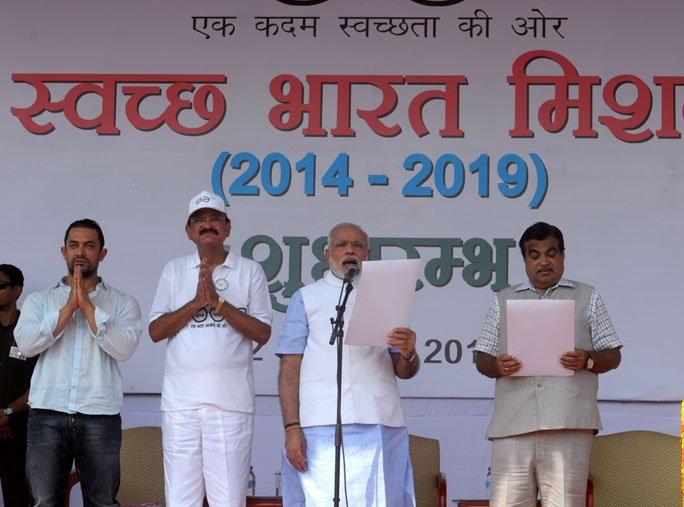
Swachh Bharat Mission is independent India’s most ambitious sanitation programme — a behaviour-change campaign that re-engineered access to toilets, solid waste management, and the public health discourse around open defecation. Launched on 2 October 2014 on the 145th birth anniversary of Mahatma Gandhi, the Swachh Bharat Mission set a five-year deadline of 2 October 2019 to make India open-defecation-free (ODF) and to mainstream scientific solid waste management. The Government of India declared rural India ODF on the 150th Gandhi Jayanti in 2019, having built more than 10 crore individual household latrines (IHHLs) in five years.
The Swachh Bharat Mission runs as two parallel sub-missions — SBM-Gramin under the Department of Drinking Water and Sanitation (Ministry of Jal Shakti) and SBM-Urban under the Ministry of Housing and Urban Affairs. Phase-II, branded SBM 2.0, was launched on 1 October 2021 with an outlay of ₹1.41 lakh crore for rural areas and ₹1.41 lakh crore for urban areas through 2025-26, shifting focus from access to outcomes — ODF Plus villages, Garbage Free Cities, faecal sludge and septage management, and waste-to-wealth. This explainer covers the architecture, financing, ODF progression, key components, and the contemporary debates around the Swachh Bharat Mission for the UPSC governance and social justice syllabus.
Genesis: From Nirmal Bharat to Swachh Bharat
The Swachh Bharat Mission did not appear in a vacuum. India had been running sanitation programmes since 1986, when the Central Rural Sanitation Programme (CRSP) was launched as a supply-driven, subsidy-led scheme to construct latrines for households below the poverty line. CRSP was restructured in 1999 as the Total Sanitation Campaign (TSC) — the first programme to emphasise community participation and Information, Education and Communication (IEC) over toilet hardware.
The Nirmal Bharat Abhiyan Phase
In 2012, TSC was renamed the Nirmal Bharat Abhiyan (NBA), the immediate ancestor of the Swachh Bharat Mission. NBA introduced the convergence with MGNREGA for IHHL construction and raised the unit cost of a toilet to ₹10,000. But NBA continued to suffer from the same flaws that plagued earlier campaigns — focus on counting toilets, weak behaviour change, and ghost construction. Independent surveys, notably the SQUAT study by Diane Coffey and Dean Spears, showed that even where toilets existed, many rural households continued to defecate in the open out of preference.
The Intellectual Architects
Two figures shaped the design of the Swachh Bharat Mission. M.S. Swaminathan, in his capacity as chair of the National Commission on Farmers, had repeatedly highlighted that sanitation was a precondition for rural productivity and child nutrition. Bindeshwar Pathak of Sulabh International had spent four decades demonstrating that low-cost twin-pit toilets, paired with caste-sensitive behaviour change, could break the link between manual scavenging and dry latrines. The Swachh Bharat Mission absorbed both lessons — engineering simplicity from Sulabh, and the public health framing from Swaminathan’s writings.
Architecture of the Swachh Bharat Mission
The Swachh Bharat Mission is structured as two parallel verticals with separate funding lines, implementing ministries, and review mechanisms. The Prime Minister chairs an overarching Swachh Bharat Mission high-level committee, while the two sub-missions are run by their respective ministries.
SBM-Gramin
SBM-Gramin (SBM-G) covers India’s 6.4 lakh villages. The Ministry of Jal Shakti is the nodal ministry, with implementation devolved to State Water and Sanitation Missions and Gram Panchayats. The unit cost of an Individual Household Latrine under SBM-G is ₹12,000 — shared 60:40 between the Centre and most states, and 90:10 for North Eastern, hilly, and Himalayan states. By 2019, SBM-G had funded more than 10.28 crore IHHLs and certified all 6.03 lakh villages as ODF on self-declaration.
SBM-Urban
SBM-Urban (SBM-U) covers 4,378 statutory towns. The Ministry of Housing and Urban Affairs is the nodal ministry. SBM-U has six components — household toilets, community toilets, public toilets, municipal solid waste management, IEC, and capacity building. The Centre provides ₹4,000 per household toilet, ₹20,000 per community toilet seat, and 35 per cent viability gap funding for solid waste processing plants, with the remainder coming from state, urban local body, and beneficiary contributions.
The ODF Progression: ODF, ODF+, ODF++ and Water+
A defining feature of the Swachh Bharat Mission has been the staged certification protocol, which converts a binary “toilet built / not built” metric into a multi-tier sanitation outcomes framework.
ODF Definition
A village or city is declared Open Defecation Free when no visible faeces are found in the environment and every household, institution, and public place has access to a toilet. ODF status requires verification by the District Collector, validation by an external agency, and re-validation after six months. The Swachh Bharat Mission ODF protocol borrowed from Community-Led Total Sanitation (CLTS), which originated in Bangladesh in 1999.
ODF Plus and ODF Plus Plus
ODF+ status, introduced in 2018 for urban areas and 2020 for rural areas under the Swachh Bharat Mission, requires that all community and public toilets remain functional and well-maintained. ODF++ adds the requirement that all faecal sludge and septage is safely managed — collected, transported, and treated — and that no untreated sewage flows into water bodies or open drains. The most advanced tier, Water+, certifies that all used water is treated and reused, with zero discharge into the environment.
Current ODF+ Coverage
As of early 2026, more than 5.07 lakh villages have declared themselves ODF Plus model villages under SBM-G Phase-II — meaning they have both sustained ODF status and put in place solid and liquid waste management arrangements. In urban India, 4,372 cities have declared themselves ODF, 3,929 ODF+, 1,449 ODF++, and 14 Water+ — although third-party validation continues to be uneven across states.
SBM 2.0: The 2021-26 Phase
The Swachh Bharat Mission Phase-II, popularly called SBM 2.0, was launched on 1 October 2021. The rationale was simple — ODF status was a precondition, not the destination. Sustaining toilet use, managing faecal sludge, processing solid waste, and converting waste streams into economic value were the pending agenda.
SBM-G Phase II
SBM-G Phase-II runs from 2020-21 to 2024-25 (extended to 2025-26) with a total outlay of ₹1,40,881 crore. Its primary deliverable is the ODF Plus Model village. Funding is shared 60:40 between Centre and states, with 70 per cent of the outlay earmarked for solid and liquid waste management infrastructure. Specific interventions include plastic waste management units in every block, faecal sludge treatment plants serving clusters of villages, GOBARdhan biogas plants converting cattle dung into compressed biogas, and greywater management through soak pits and waste stabilisation ponds.
SBM-U 2.0
SBM-U 2.0 runs concurrently with an outlay of ₹1,41,600 crore. Its central goal is the Garbage Free City, certified through the Star Rating Protocol on a 7-star scale. SBM-U 2.0 emphasises 100 per cent source segregation, door-to-door collection, scientific processing of municipal solid waste, legacy dumpsite remediation, faecal sludge and septage management in all towns under one lakh population, and used water management. The mission is the engine of India’s circular economy push, complementing the Plastic Waste Management Rules and the Extended Producer Responsibility framework.
Waste-to-Wealth: The Economic Logic
The Swachh Bharat Mission Phase-II has reframed waste from a public health nuisance into a feedstock for energy, organic agriculture, and construction. The waste-to-wealth proposition has three pillars.
GOBARdhan and Biogas
The Galvanising Organic Bio-Agro Resources Dhan (GOBARdhan) scheme, launched in 2018 and absorbed into SBM-G Phase-II, supports community and cluster biogas plants that convert cattle dung and agricultural residues into compressed biogas (CBG) and bio-slurry. As of 2026, more than 1,000 community biogas plants and 670 CBG units have been commissioned, with off-take agreements under the SATAT initiative for transport fuel.
Solid Waste Processing
Under SBM-U 2.0, processing capacity for municipal solid waste has risen from 18 per cent in 2014 to over 78 per cent in 2025, through 1,800-plus material recovery facilities, 200-plus waste-to-energy plants, and 23,000 composting units. Refuse-derived fuel from urban waste now supplies cement kilns under a Standard Operating Procedure jointly framed with the Cement Manufacturers’ Association.
Legacy Dumpsite Remediation
SBM-U 2.0 finances the bioremediation and biomining of legacy dumpsites — the towering open dumps that scar Indian cities. The target is to remediate 16 crore tonnes of legacy waste across 2,400 dumpsites, freeing up valuable urban land. Mumbai’s Mulund, Delhi’s Bhalswa and Ghazipur, and Chennai’s Kodungaiyur are the high-visibility sites under remediation.
Convergence with Other Missions
The Swachh Bharat Mission does not operate in isolation. It is one of the four pillars of the urban transformation push along with the Smart Cities Mission, AMRUT, and PMAY-Urban. It draws labour from MGNREGA 2005 for IHHL construction and pond rejuvenation. The Jal Jeevan Mission provides the piped water that makes flush toilets functional. Health benefits from reduced diarrhoeal disease feed into the broader Ayushman Bharat Digital Mission public health architecture. Income-support schemes such as PM Kisan Samman Nidhi and credit access through MUDRA Yojana enable rural households to afford toilet upkeep and waste management charges.
Criticism and Course Corrections
The Swachh Bharat Mission has attracted three strands of criticism worth examining at the UPSC ethics and governance level.
The Counting Problem
Independent surveys, including the National Annual Rural Sanitation Survey commissioned by the Mission itself, have flagged gaps between self-declared ODF status and on-ground usage. The 2019 NARSS-3 found 96.5 per cent household toilet access in rural India but only 90.7 per cent usage, indicating that behaviour change lags infrastructure.
Manual Scavenging
While the Swachh Bharat Mission has reduced the demand for dry latrines, India still records deaths from manual cleaning of sewers and septic tanks every year. The Prohibition of Employment as Manual Scavengers Act 2013 and the SBM IEC content have raised awareness, but mechanised sludge tankers and Safai Mitra Suraksha Challenge interventions remain unevenly deployed across cities.
Financing Local Bodies
Sustaining the Swachh Bharat Mission outcomes depends on Urban Local Bodies and Gram Panchayats having the fiscal capacity to operate and maintain sanitation infrastructure. The 15th Finance Commission earmarked ₹70,051 crore for water and sanitation grants to rural local bodies and ₹38,196 crore to urban local bodies over 2021-26 to plug this gap — a recognition that capital investment without recurrent finance leads to broken toilets and idle treatment plants.
Frequently Asked Questions
When was the Swachh Bharat Mission launched and by whom?
The Swachh Bharat Mission was launched by Prime Minister Narendra Modi on 2 October 2014 — the 145th birth anniversary of Mahatma Gandhi — from Rajghat in New Delhi. The mission set a five-year deadline of 2 October 2019 to make India open-defecation-free.
What is the difference between SBM-Gramin and SBM-Urban?
SBM-Gramin covers India’s 6.4 lakh villages and is run by the Department of Drinking Water and Sanitation under the Ministry of Jal Shakti. SBM-Urban covers 4,378 statutory towns and is run by the Ministry of Housing and Urban Affairs. They have separate funding lines but follow the same ODF certification protocol.
What does ODF, ODF+ and ODF++ mean under the Swachh Bharat Mission?
ODF means no visible open defecation and every household having toilet access. ODF+ adds that community and public toilets are functional. ODF++ requires that all faecal sludge and septage is safely treated. Water+ is the highest tier — all used water is treated and reused, with zero environmental discharge.
What is SBM 2.0 and how is it different from Phase-I?
SBM 2.0 is the second phase of the Swachh Bharat Mission, launched on 1 October 2021 with a combined outlay of ₹2.82 lakh crore for 2021-26. Phase-I focused on toilet access and ODF declaration. SBM 2.0 focuses on sustaining ODF, building Garbage Free Cities, faecal sludge management, plastic and used-water management, and waste-to-wealth conversion.
How many toilets has the Swachh Bharat Mission built?
SBM-Gramin funded over 10.28 crore Individual Household Latrines between 2014 and 2019, taking rural sanitation coverage from around 39 per cent to over 100 per cent of unserved households. SBM-Urban has funded more than 73 lakh individual household toilets and around 6.5 lakh community and public toilet seats in cities.
What is the GOBARdhan scheme under the Swachh Bharat Mission?
GOBARdhan, launched in 2018 and absorbed into SBM-G Phase-II, finances community biogas plants that convert cattle dung and agricultural residues into compressed biogas and organic slurry. It feeds into the SATAT initiative for transport-grade compressed biogas and supports the circular economy in rural areas.
Who designed the Swachh Bharat Mission’s behavioural framework?
The behavioural change framework drew on the work of Bindeshwar Pathak of Sulabh International (low-cost twin-pit toilets, caste-sensitive sanitation) and M.S. Swaminathan (sanitation as a precondition for nutrition). Implementation methodology was adapted from Community-Led Total Sanitation, originally developed by Kamal Kar in Bangladesh in 1999.
What is the status of the Swachh Bharat Mission today?
As of 2026, more than 5.07 lakh villages have been declared ODF Plus model villages, and 4,372 cities have declared ODF status. SBM 2.0 runs through 2025-26 with a combined outlay of ₹2.82 lakh crore, focusing on Garbage Free Cities, ODF Plus model villages, faecal sludge management, and legacy dumpsite remediation across 2,400 sites.
Tell Google you want more of this.
Add Anantam IAS as a preferred sourceOne tap, and this site shows up more often in your own Top Stories, AI Overviews and AI Mode. Remove it any time.