SPROUT and SpeedSeed: Testing Crop Traits and Accelerating Breeding
Why in News?
The SPROUT crop-phenotyping facility was inaugurated at BRIC-National Institute of Plant Genome Research in New Delhi on 15 September 2026, alongside attention to its separate SpeedSeed technology.
- SPROUT supports controlled-environment phenotyping and precision stress screening, with a major focus on chickpea.
- SpeedSeed accelerates generation advancement; optimized chickpea protocols can shorten a generation cycle to approximately 40 days.
- SpeedSeed can operate within SPROUT or other suitable controlled-environment facilities; the technology and the facility are distinct.
- Climate-resilient agriculture needs reliable evaluation of useful traits as well as faster breeding; shortening a cycle alone does not establish field performance.
- Research infrastructure can connect gene discovery with crop improvement, but farmers benefit only when promising results survive practical testing and reach usable seed systems.
UPSC Relevance
Prelims Relevance
- SPROUT: controlled-environment phenotyping facility at BRIC-NIPGR, New Delhi.
- Phenotyping: measurement of observable plant characteristics.
- SpeedSeed: separate technology for accelerated generation advancement.
- Approximately 40 days: optimized chickpea generation cycle, not a universal field-harvest claim.
- Germplasm: plant genetic material used in research and breeding.
Mains Relevance
GS Paper 3
- How phenotyping and faster generation advancement address different crop-breeding bottlenecks.
- Why climate-resilient agriculture requires field validation, seed access and locally relevant selection.
Essay
- Scientific speed is useful when paired with reliable evidence and practical access.
Background and Context
What SPROUT actually measures
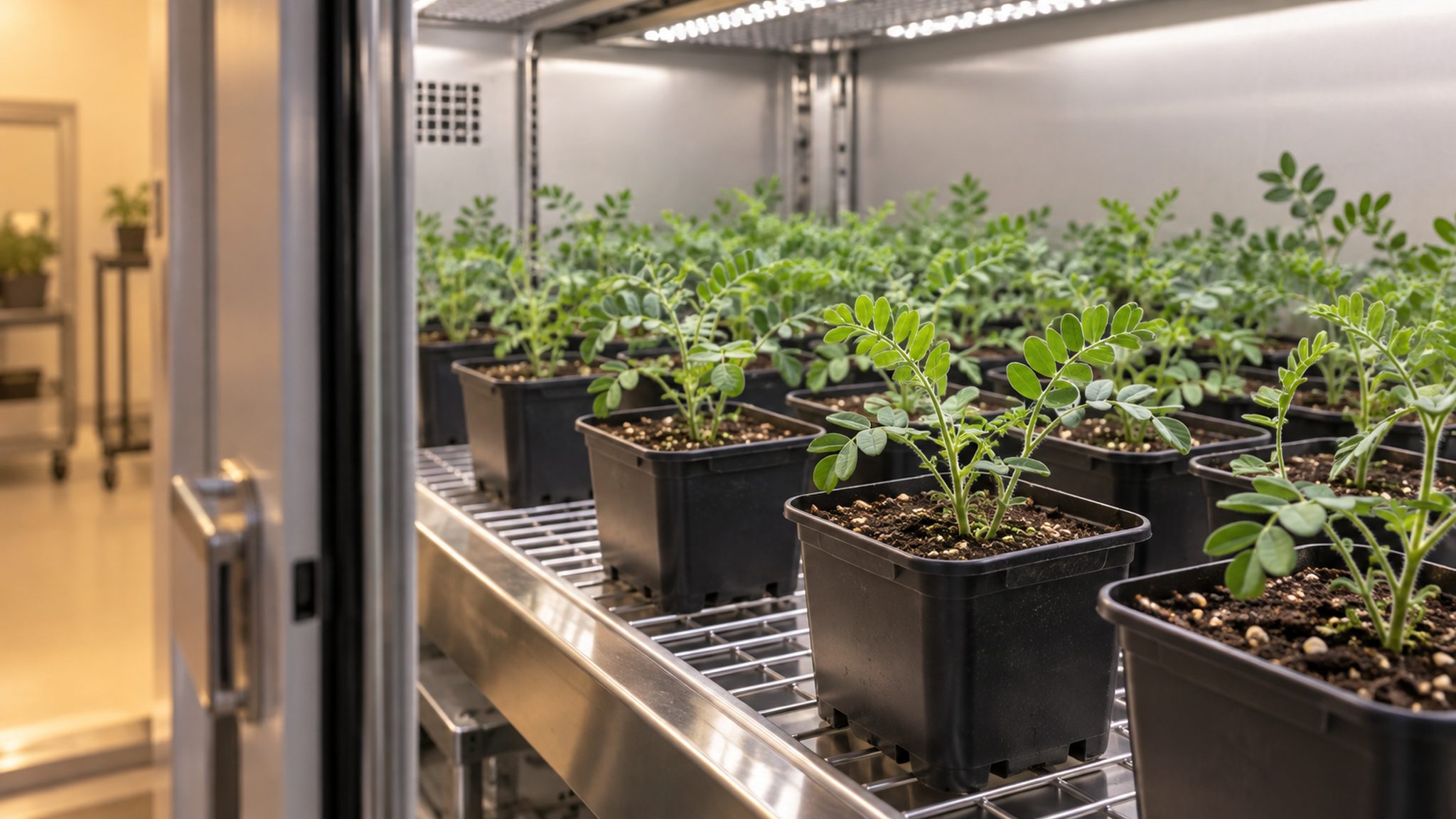
SPROUT helps researchers test whether promising plant material expresses useful characteristics under selected environmental conditions, connecting genetic research with observable crop performance.
- Phenotyping measures observable characteristics rather than merely identifying DNA differences. A candidate gene becomes useful for breeding when researchers can connect it with a relevant, repeatable plant response under clearly described conditions.
- Controlled environments make selected conditions more consistent across comparisons. This helps researchers examine plant responses without relying entirely on the arrival of a particular outdoor season, while keeping the experiment distinct from farming.
- Precision stress screening evaluates responses to specified stresses. Comparing plant lines under defined conditions helps identify promising material, but the meaning of a result depends on the stress actually tested and measured.
- High-throughput phenotyping enables evaluation of many plants or lines. Its value lies in making trait comparisons more systematic, helping researchers decide which candidates deserve further investigation rather than declaring every candidate an improved variety.
- SPROUT evaluates diverse material, including germplasm, breeding populations, mutants, transgenic plants and genome-edited lines. These are categories of research material; their presence in the facility does not establish commercial release or farmer availability.
Why SpeedSeed is a separate breeding tool
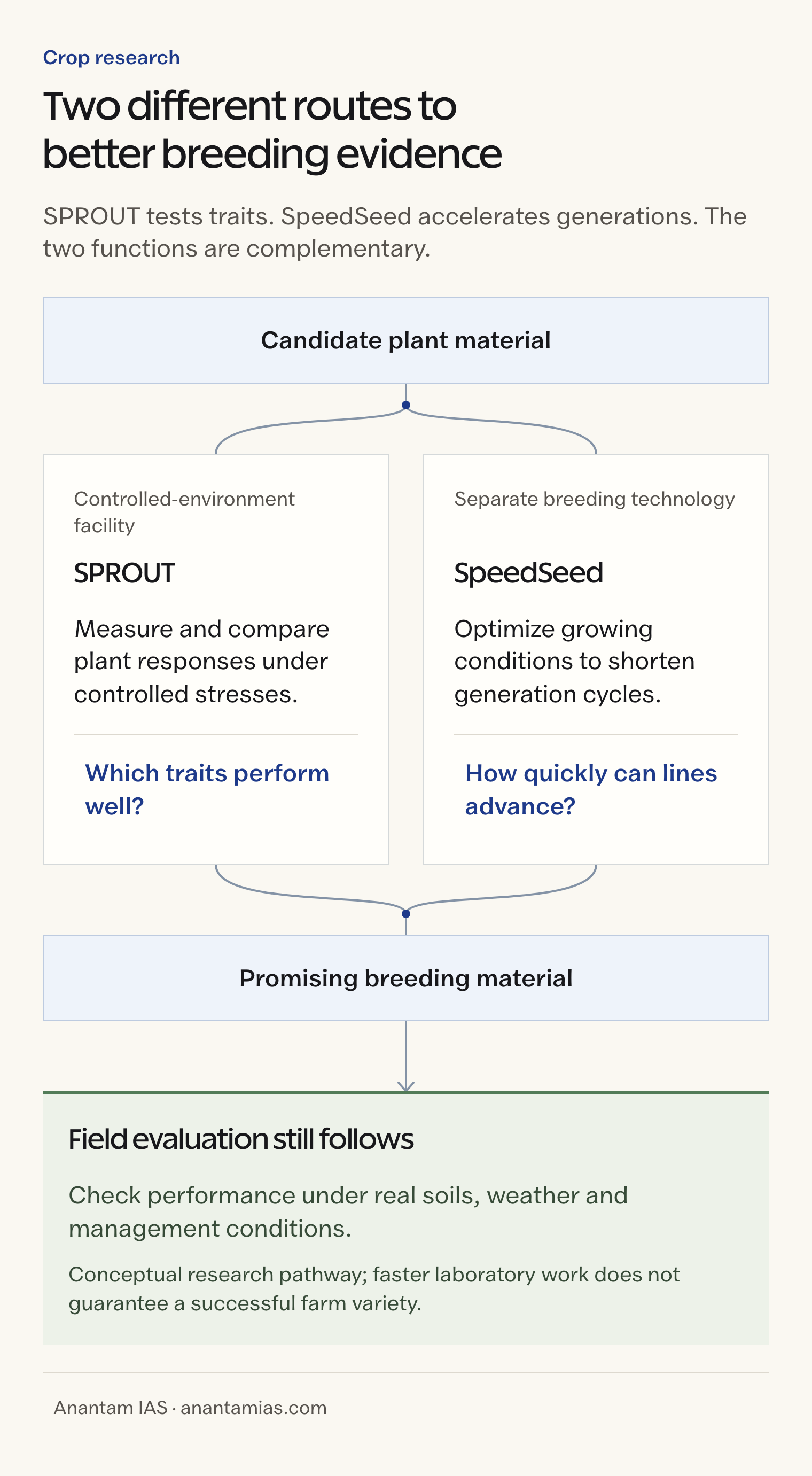
SpeedSeed addresses the time between generations; SPROUT addresses the quality of trait evaluation. Combining them can help breeding, but their functions should remain separate.
- Generation advancement moves breeding material through successive plant generations. Shortening that interval can reduce waiting time within a research programme, allowing breeders to advance promising material sooner while continuing to assess its useful characteristics.
- Approximately 40 days refers to an optimized chickpea generation cycle reported for SpeedSeed. It is not a claim that farmers can harvest every chickpea variety within that period under ordinary field conditions.
- Protocols matter: the reported result belongs to chickpea under optimized conditions. Applying the same number to other crops, different facilities or all breeding material would extend the claim beyond the official announcement.
- The facility and technology are separable. SpeedSeed can be used within SPROUT or adapted to other suitable controlled-environment facilities, so neither the name nor the location should be mistaken for the entire breeding method.
- Different interventions solve different bottlenecks. Compare this with mustard self-incompatibility in hybrid breeding: controlling reproduction, advancing generations and measuring useful traits are related tasks, but they are not interchangeable scientific operations.
Why laboratory success still needs field evidence
The announcement describes research capability. Translating that capability into dependable varieties requires evidence about performance across the conditions farmers actually face.
- Trait validation asks whether a promising characteristic is reliably expressed. A line selected under controlled conditions must still be assessed for relevant agricultural performance before a laboratory result becomes a defensible recommendation to farmers.
- Field conditions combine multiple influences, including weather, soils and management. A controlled experiment can isolate a useful response, but it cannot by itself represent every combination encountered across different production environments and growing seasons.
- Climate resilience is context-dependent. A useful response under one tested stress does not automatically prove tolerance to every stress, dependable yield everywhere or suitability for every farming system in which the crop is grown.
- Participatory testing can connect scientific selection with farmers’ priorities. The Delhi Drylands Declaration discussion on living laboratories offers a related lens: bringing research into real production settings helps test whether innovations address practical needs.
- Announcement versus outcome is the central evidence distinction. The inauguration establishes that a facility has been introduced; it does not establish that all evaluated lines are released varieties or that future benefits have already occurred.
Way Forward
Measure progress from screening to usable seed
- Report experimental conditions alongside generation times and trait results so users can distinguish demonstrated findings from possible applications.
- Connect screening with field evaluation, comparing promising material across relevant locations and farming conditions before making broad performance claims.
- Include farmer priorities in selection and testing, and plan seed multiplication and access when material becomes suitable for deployment.
Conclusion
- SPROUT strengthens trait evaluation; SpeedSeed accelerates generation advancement. Their combined value lies in improving different stages of crop research, with the reported chickpea cycle remaining conditional on optimized protocols.
- Faster breeding needs trustworthy selection. In an answer on climate-resilient agriculture, connect controlled research with field evidence and farmer access, and distinguish promising research material from an already released variety.
UPSC Practice Questions
Prelims MCQ 1
With reference to SPROUT and SpeedSeed, consider the following statements:
- SPROUT is a controlled-environment facility for crop phenotyping.
- SpeedSeed can be adapted to suitable facilities other than SPROUT.
- The reported 40-day cycle guarantees field harvest of every chickpea variety within 40 days.
How many of the above statements are correct?
(a) Only one (b) Only two (c) All three (d) None
Answer: (b) Only two
Explanation:
Statements 1 and 2 are correct. Approximately 40 days refers to a chickpea generation cycle under optimized SpeedSeed protocols, not a universal field-harvest guarantee.
Prelims MCQ 2
Which activity most directly describes crop phenotyping?
(a) Measuring observable plant traits under specified conditions (b) Approving all experimental lines for sale (c) Replacing field testing with DNA sequencing (d) Distributing certified seed to every farmer
Answer: (a) Measuring observable plant traits under specified conditions
Explanation:
Phenotyping measures observable characteristics and responses. It supports selection but does not itself release varieties, distribute seeds or eliminate field evaluation.
UPSC Mains Questions
- Explain how controlled-environment phenotyping and accelerated generation advancement address different bottlenecks in developing climate-resilient crops. (150 words)
- Faster laboratory research does not automatically produce dependable agricultural outcomes. Discuss with reference to trait validation, field testing and farmer access. (250 words)
Source: PIB, Ministry of Science & Technology.
Frequently Asked Questions
What is SPROUT?
SPROUT is a season-independent, controlled-environment crop-phenotyping facility at BRIC-NIPGR in New Delhi. It supports precision stress screening and evaluation of diverse plant research material, with a major focus on chickpea.
How is SpeedSeed different from SPROUT?
SpeedSeed is a separate technology for accelerated generation advancement. SPROUT is a facility for trait evaluation. SpeedSeed can operate within SPROUT or be adapted to other suitable controlled-environment facilities.
Does the 40-day claim mean chickpea can always be harvested that quickly?
No. The official announcement reports approximately 40 days for a chickpea generation cycle under optimized SpeedSeed protocols. It does not promise the same field-harvest duration for every variety or environment.
Does successful screening mean a variety is ready for farmers?
No. Screening identifies promising plant material under tested conditions. Practical suitability requires further evaluation, including relevant field performance; research lines should not be described as released varieties merely because they were studied.