Why in News?
An IIT Gandhinagar and ICAR-DRMR study reported on 31 August 2026 that four genes help regulate self-pollen rejection in toria and yellow sarson mustard.
- The researchers characterised SRK, FER1, MLPK and ARC1 in two cultivated forms of Brassica rapa using sequencing, structural prediction, pollination tests and temporary gene suppression.
- Toria behaved as self-incompatible, largely blocking its own pollen, while yellow sarson was self-compatible; crosses between the varieties could still produce germinating seed.
- Temporarily suppressing SRK, FER1 or ARC1 allowed strong self-pollen tube growth in toria; suppressing MLPK weakened rejection only partly, suggesting a secondary or redundant role.
- The finding supplies a molecular breeding foundation. It does not establish that a commercial high-yield hybrid has been released or that India’s edible-oil import dependence has been solved.
- Hybrid seed production requires the maternal line to receive pollen from the selected parent without fertilising itself first; self-incompatibility can enforce that crossing step biologically.
- Crossing genetically different parents can express heterosis, but yield, oil quality, stress tolerance and seed-production reliability must still be tested across environments and generations.
- India imports more than half of its edible-oil requirement, yet laboratory insight becomes economic resilience only after breeding, field evaluation, seed multiplication and farmer adoption.
UPSC Relevance
Prelims Relevance
- Self-incompatibility is a genetic pollen-pistil recognition system that prevents self-fertilisation and promotes outcrossing.
- Brassicaceae generally exhibits sporophytic self-incompatibility, where the pollen rejection phenotype reflects the diploid pollen parent’s genotype.
- The stigma is the receptive female surface where pollen recognition and early rejection occur before successful fertilisation.
- SRK is a stigma receptor kinase; MLPK and FER1 participate in signalling, while ARC1 helps remove cellular compatibility factors.
- Reactive oxygen species can act as local signalling molecules; in this response, their accumulation helps arrest incompatible pollen germination.
- Heterosis means superior performance of a hybrid relative to its parents for selected traits; it is an outcome to test, not an automatic result of every cross.
Mains Relevance
GS Paper 3
- Molecular control of pollination as an enabling tool for oilseed hybrid breeding
- Translation gap between gene characterisation, stable breeding lines and field-validated cultivars
GS Paper 3
- Domestic oilseed productivity, seed-system capacity and exposure to global edible-oil price shocks
- Need to combine biotechnology with agronomy, biosafety, public breeding and farmer access
Essay
- Scientific self-reliance is built through patient translation from molecular understanding to dependable seed, field performance and affordable access.
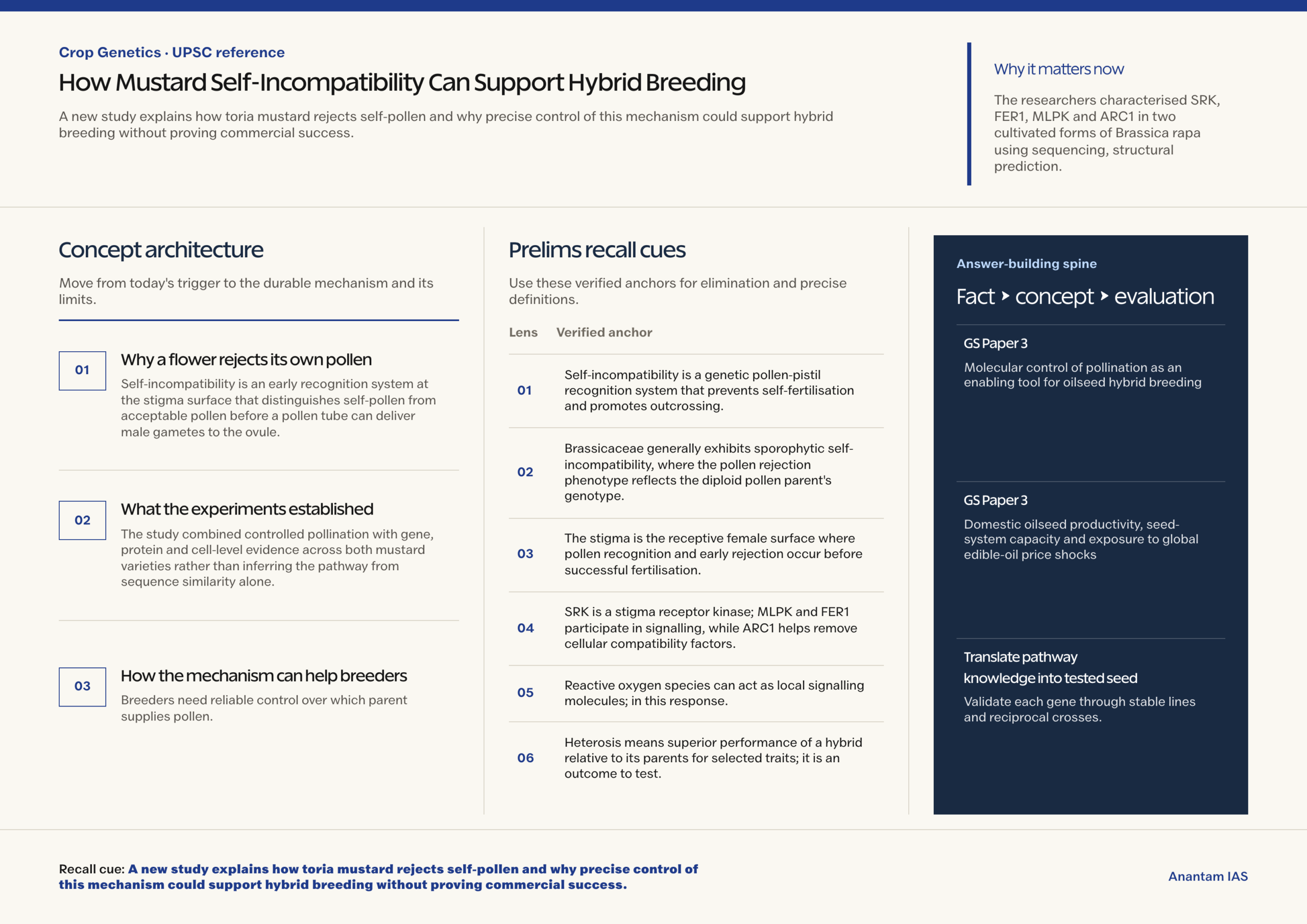
Background and Context
Why a flower rejects its own pollen
Self-incompatibility is an early recognition system at the stigma surface that distinguishes self-pollen from acceptable pollen before a pollen tube can deliver male gametes to the ovule.
- A pollen grain first lands on the stigma, where hydration, germination and entry are regulated; only after these early checks can a pollen tube grow toward the ovule.
- In Brassica, a matching self-pollen signal activates the stigma’s S-locus receptor kinase, or SRK, at the papilla-cell membrane, like a receptor recognising a molecular identity tag.
- Activated receptors recruit downstream signalling components, including FER1 and MLPK, converting recognition at the surface into a rapid intracellular rejection response within minutes of pollination.
- One branch produces a local reactive oxygen species burst; these reactive molecules function here as signals that make the stigma hostile before incompatible pollen can establish a tube.
- A parallel ARC1 pathway, involving an E3 ubiquitin ligase, targets cellular compatibility factors for degradation and helps prevent hydration, tube penetration and eventual self-fertilisation.
What the experiments established
The study combined controlled pollination with gene, protein and cell-level evidence across both mustard varieties rather than inferring the pathway from sequence similarity alone.
- Pollination assays tracked pollen attachment, pollen-tube growth and seed formation, confirming strong rejection after toria self-pollination and compatibility in reciprocal crosses involving toria and yellow sarson.
- The team cloned and sequenced SRK, FER1, MLPK and ARC1, compared them across related plants, and used AlphaFold3 to test whether predicted proteins retained expected functional domains.
- Short antisense oligonucleotides temporarily reduced each gene’s instructions on the stigma; this transient suppression tested function directly without creating or evaluating a permanent edited plant.
- Suppressing SRK, FER1 or ARC1 broke the self-incompatibility barrier strongly, while MLPK suppression increased attachment but did not significantly restore pollen-tube penetration, marking an important pathway difference.
- ROS fell after suppressing SRK, FER1 or MLPK but not ARC1, supporting two interacting rejection branches: a FER-linked ROS response and an ARC1-linked protein-degradation pathway.
How the mechanism can help breeders
Breeders need reliable control over which parent supplies pollen, because accidental selfing contaminates hybrid seed while indiscriminate rejection can also block the intended cross at scale.
- A stable self-incompatible maternal line can reduce manual emasculation, the labour-intensive removal of pollen-producing anthers before controlled crossing across thousands of flowers in a seed-production plot.
- Crossing distinct parents may capture hybrid vigour for yield, oil traits or resilience, but each combination must be selected, replicated and tested rather than assumed superior.
- Knowing pathway genes can support molecular markers, parent-line selection and future editing strategies that switch compatibility on for line maintenance and off during controlled hybrid seed production.
- The toria-yellow sarson crosses show biological compatibility, yet a usable hybrid also needs stable trait inheritance, seed purity, multi-location performance, regulatory clearance where applicable and economical multiplication.
- The study narrows a breeding bottleneck; it does not by itself raise national production, release a cultivar or replace imports without coordinated progress across genetics, agronomy, regulation and seed systems.
Way Forward
Translate pathway knowledge into tested seed
- Validate each gene through stable lines and reciprocal crosses, distinguishing temporary laboratory suppression from heritable control of pollen acceptance under field conditions.
- Develop molecular markers for dependable self-incompatible and maintainer lines, then measure hybrid seed purity, restoration, fertility and multiplication efficiency before scale-up.
- Test candidate hybrids across agro-climatic zones for yield stability, oil quality, disease resistance, heat tolerance and farmer-relevant input requirements rather than relying on controlled-environment results.
- Link public research with transparent biosafety assessment, breeder-seed capacity and affordable distribution so any successful hybrid becomes an accessible production technology, not only a laboratory achievement.
Conclusion
- Mustard self-incompatibility is a pollen-recognition and signalling system: SRK detects self identity, FER1 and MLPK shape signalling, and ROS and ARC1-linked pathways stop pollen acceptance before fertilisation through partly separable cellular routes.
- For Mains, connect this mechanism to hybrid breeding through a chain: control pollination, preserve parent identity, test heterosis, validate performance, multiply pure seed and deliver it affordably to farmers.
- Present the 2026 study as foundational evidence, not a commercial breakthrough: permanent validation, stable breeding lines, multi-location trials and seed-system execution still separate gene knowledge from sustained import reduction across the wider oilseed economy.
UPSC Practice Questions
Prelims MCQ 1
With reference to self-incompatibility in Brassica crops, consider the following statements:
- It can prevent self-fertilisation by rejecting pollen at the stigma.
- Reactive oxygen species may participate in the rejection response.
- Every cross between self-incompatible and self-compatible parents necessarily produces a superior hybrid.
How many of the above statements are correct?
(a) Only one (b) Only two (c) All three (d) None
Answer: (b) Only two
Explanation:
Statements 1 and 2 are correct. Self-incompatibility can block self-pollen and involves signalling that includes ROS. Heterosis must be demonstrated for a particular cross; it is not guaranteed.
Prelims MCQ 2
What is the most accurate breeding relevance of a self-incompatible maternal line?
(a) It guarantees that all offspring outperform both parents (b) It can reduce accidental selfing while enabling controlled cross-pollination (c) It permanently edits the genome of every pollen donor (d) It removes the need for field testing and seed-purity checks
Answer: (b) It can reduce accidental selfing while enabling controlled cross-pollination
Explanation:
A self-incompatible line can help enforce crossing with the selected pollen parent. Hybrid performance, genetic stability and seed purity still require breeding and field validation.
UPSC Mains Questions
- Explain the molecular basis of self-pollen rejection in mustard. How can controlled self-incompatibility support hybrid seed production?
- Gene characterisation is only the first step from agricultural biotechnology to economic self-reliance. Discuss with reference to oilseed breeding and India’s edible-oil challenge.
Sources: PIB Ahmedabad, Ministry of Education and Frontiers in Plant Science.
Frequently Asked Questions
What is self-incompatibility in mustard?
It is a genetic recognition system in which the stigma identifies related self-pollen and blocks its acceptance, promoting cross-pollination and helping maintain genetic diversity.
Why is toria useful for studying self-incompatibility?
Toria is a cultivated Brassica rapa form that strongly rejects its own pollen, allowing researchers to test the genes and cellular signals controlling that barrier.
What roles do SRK, FER1, MLPK and ARC1 play?
SRK detects self-pollen identity; FER1 and MLPK contribute to signalling; ARC1 supports a parallel degradation pathway that removes factors required for compatible pollen growth.
How can self-incompatibility aid hybrid breeding?
It can reduce accidental self-fertilisation in the maternal parent, helping breeders enforce crossing with a selected pollen donor and maintain hybrid-seed purity.
Has this study produced a commercial mustard hybrid?
No. It characterised and temporarily suppressed pathway genes. Stable breeding lines, field trials, seed multiplication and formal release would still be needed for a commercial hybrid.
Tell Google you want more of this.
Add Anantam IAS as a preferred sourceOne tap, and this site shows up more often in your own Top Stories, AI Overviews and AI Mode. Remove it any time.