State of India’s Environment 2026: Seven Planetary Boundaries Breached, GDP Bleeds 4-6%
The Centre for Science and Environment released its State of India’s Environment 2026 in late April 2026, and the verdict is sobering. The State of India’s Environment 2026 reports that seven of the nine planetary boundaries are now breached, India is losing roughly 4% to 6% of GDP annually to heat stress, and almost every environmental indicator the report tracks has worsened over the last 12 months. This is the 32nd edition of CSE’s flagship publication and the bluntest one in years.
For UPSC, the State of India’s Environment 2026 is a single source that lets you cite specific data on air, water, land, biodiversity, climate, and urbanisation in any GS-III environment answer. It also weaves the planetary boundaries framework, which is now a recurring theme in mains, into Indian context. Every aspirant should know what the report says, and more importantly, why certain numbers are likely to be tested.
The headline isn’t just that things are bad. It’s that the cost of inaction is now showing up in GDP figures, in monsoon volatility, and in farmer income data. Environment is no longer a side issue. It is sitting inside the macro story.
Quick Facts at a Glance
- Publishing organisation: Centre for Science and Environment (CSE), New Delhi
- Edition: 32nd annual
- Director General: Sunita Narain
- Release window: April 24-28, 2026
- Headline finding: Seven of nine planetary boundaries breached globally
- India-specific climate-economy variable: 4-6% of GDP eroded by heat stress
- Forest cover trend: marginal increase on paper, decline in dense forest
- Air quality: PM2.5 above WHO guideline in 95%+ of districts measured
- Water stress: 50% of India’s groundwater blocks classified semi-critical, critical, or over-exploited
- Linked publication: Down To Earth magazine
What Just Happened
CSE released the State of India’s Environment 2026 report and Down To Earth’s annual data dossier in a media briefing chaired by Sunita Narain on April 24, 2026. The release was followed by sectoral data drops over the next four days, covering air, water, biodiversity, climate finance, and urban environment.
The report’s structure follows CSE’s tradition. Section one tracks global environment (planetary boundaries, climate finance, biodiversity targets). Section two carries India-specific assessments across air, water, land, forests, biodiversity, urban environment, and climate. Section three provides a state-wise environmental performance dashboard. Section four lays out a “way forward” with policy recommendations.
The 2026 edition’s distinctive contribution is a granular climate-economy chapter that translates physical climate stress into labour productivity loss, agricultural output loss, and infrastructure repair cost. This is the chapter that produced the 4-6% GDP erosion estimate, which has already become the most-quoted number from the report.
Background and Historical Context
CSE was founded in 1980 by Anil Agarwal. The first State of India’s Environment report came out in 1982 as a citizen’s report, blending journalism, ground reporting, and quantitative assessment. CSE pioneered the idea of an independent, civil-society environmental audit when most environment reporting in India was government-issued. The annual SOE has tracked indicators continuously since then.
Sunita Narain took over as Director General after Anil Agarwal’s death in 2002. Under her leadership, CSE expanded its remit to include climate, urban transport, food safety, and corporate accountability. The SOE evolved with that expansion, adding climate change as a permanent section in 2007 and digital data portals in the 2010s.
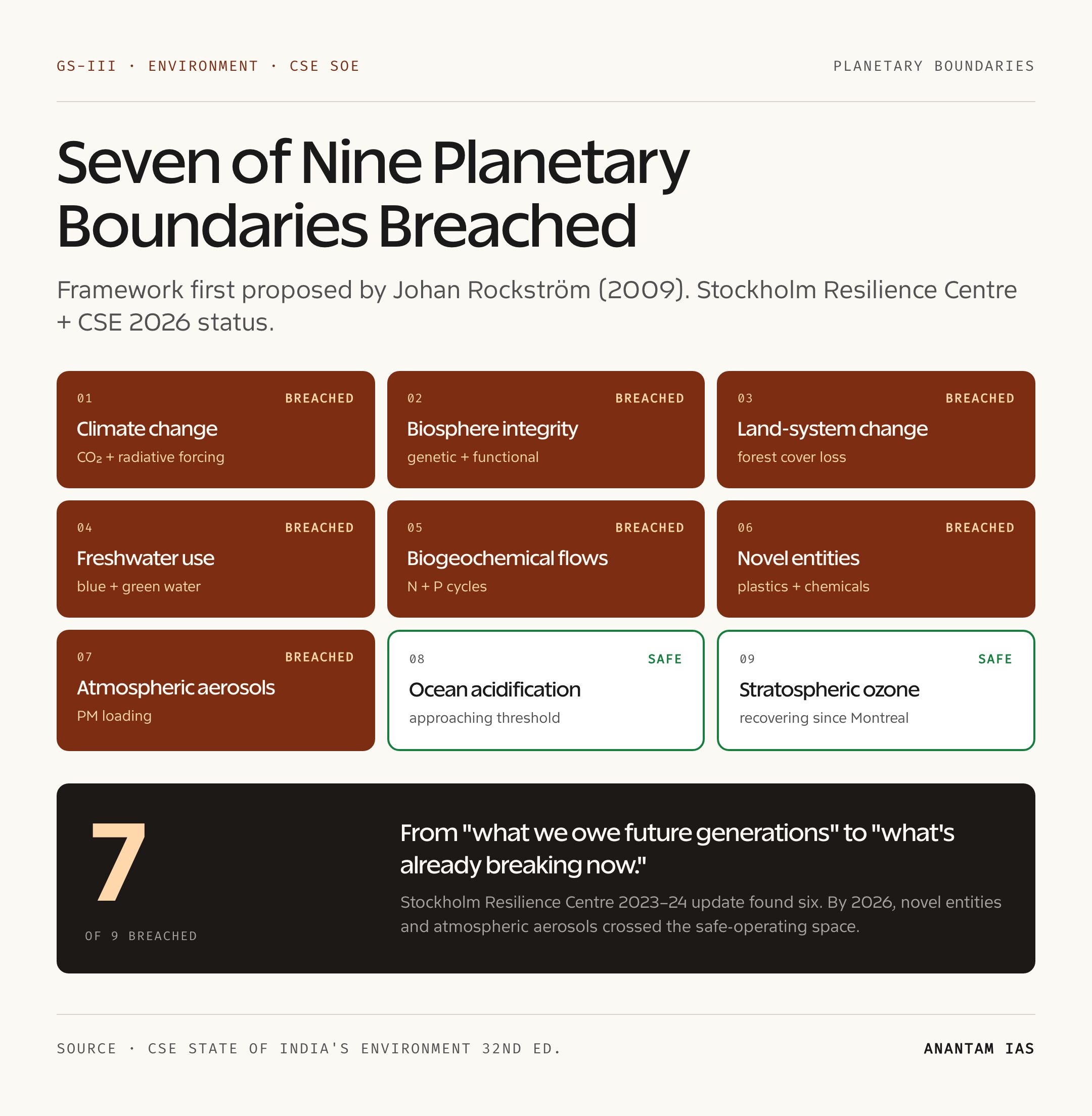
The planetary boundaries framework that the 2026 report leans on is not CSE’s invention. It was first proposed by Johan Rockström and colleagues in a 2009 Nature paper, identifying nine Earth-system processes (climate, biosphere integrity, land use, freshwater use, biogeochemical flows, ocean acidification, atmospheric aerosol loading, stratospheric ozone, and novel entities) where breaching the safe operating space risks abrupt, non-linear damage. The 2023-2024 update of the framework, by Stockholm Resilience Centre, found six boundaries breached. By 2026, the count is seven, with novel entities (synthetic chemicals, plastics) and atmospheric aerosols moving into the danger zone.
For India, the planetary boundaries lens reframes climate adaptation conversations from “what we owe future generations” to “what’s already breaking now.”
Key Findings of State of India’s Environment 2026
The headline findings span six tracks.
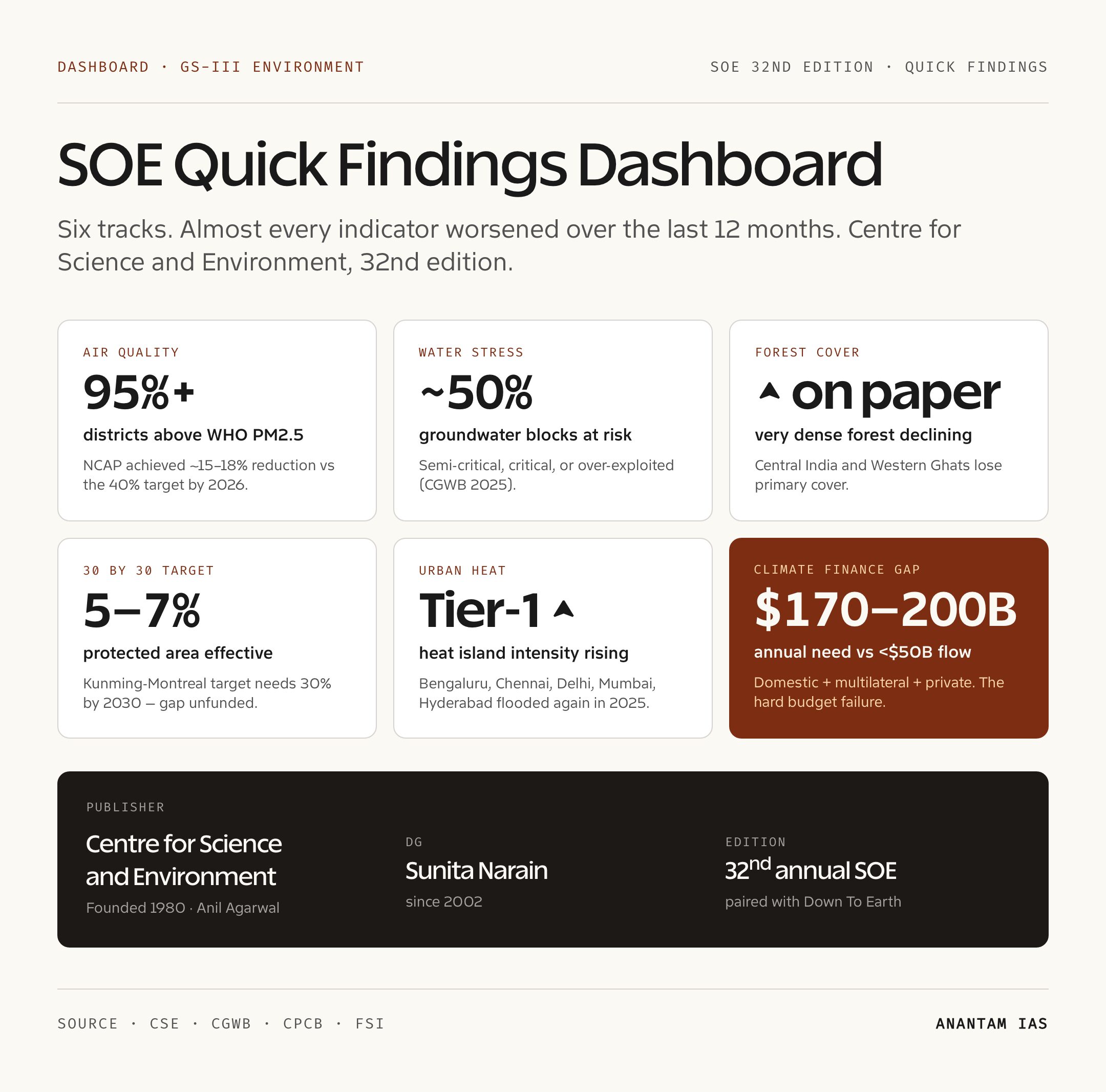
Climate. 2025 was India’s warmest year on record by surface temperature, narrowly beating 2024. Monsoon rainfall was within long-period average but with sharply increased intra-seasonal variability. Heatwave days in northern India crossed 30 in many districts. Cyclone frequency in the Bay of Bengal stayed above the long-term average for the seventh consecutive year.
Air. Particulate concentration (PM2.5) in 95%+ of monitored districts exceeded WHO 2021 guidelines. The Indo-Gangetic plain remains the worst-affected region. Vehicular and biomass-burning sources continue to dominate urban PM2.5 chemistry.
Water. Roughly half of India’s groundwater assessment blocks are now semi-critical, critical, or over-exploited as per CGWB 2025 data. Rivers in five out of six major basins show declining lean-season flows. The Kaleshwaram-style large lift schemes have widened access but at high environmental and fiscal cost.
Forests and biodiversity. ISFR data shows marginal increase in total forest cover, but very dense forest is declining in central India and the Western Ghats. Bird and mammal monitoring data show continued decline in habitat-specialist species. India’s seventh national biodiversity report submission listed 30 by 30 commitments that the SOE 2026 calls “unlikely to be met without substantial new finance.”
Urban environment. Urban heat island intensities have risen across Tier-1 cities. Monsoon flooding in Bengaluru, Chennai, Delhi, Mumbai, and Hyderabad recurred in 2025. Solid waste segregation rates remain below 30% in most municipalities. The report flags that urban metrics are themselves being breached by climate stress.
Climate finance. India’s annual climate finance need is estimated at $170-200 billion. Actual flows, including domestic budget, multilateral, and private, totalled less than $50 billion in 2024-25.
Why It Matters: The 4-6% GDP Number
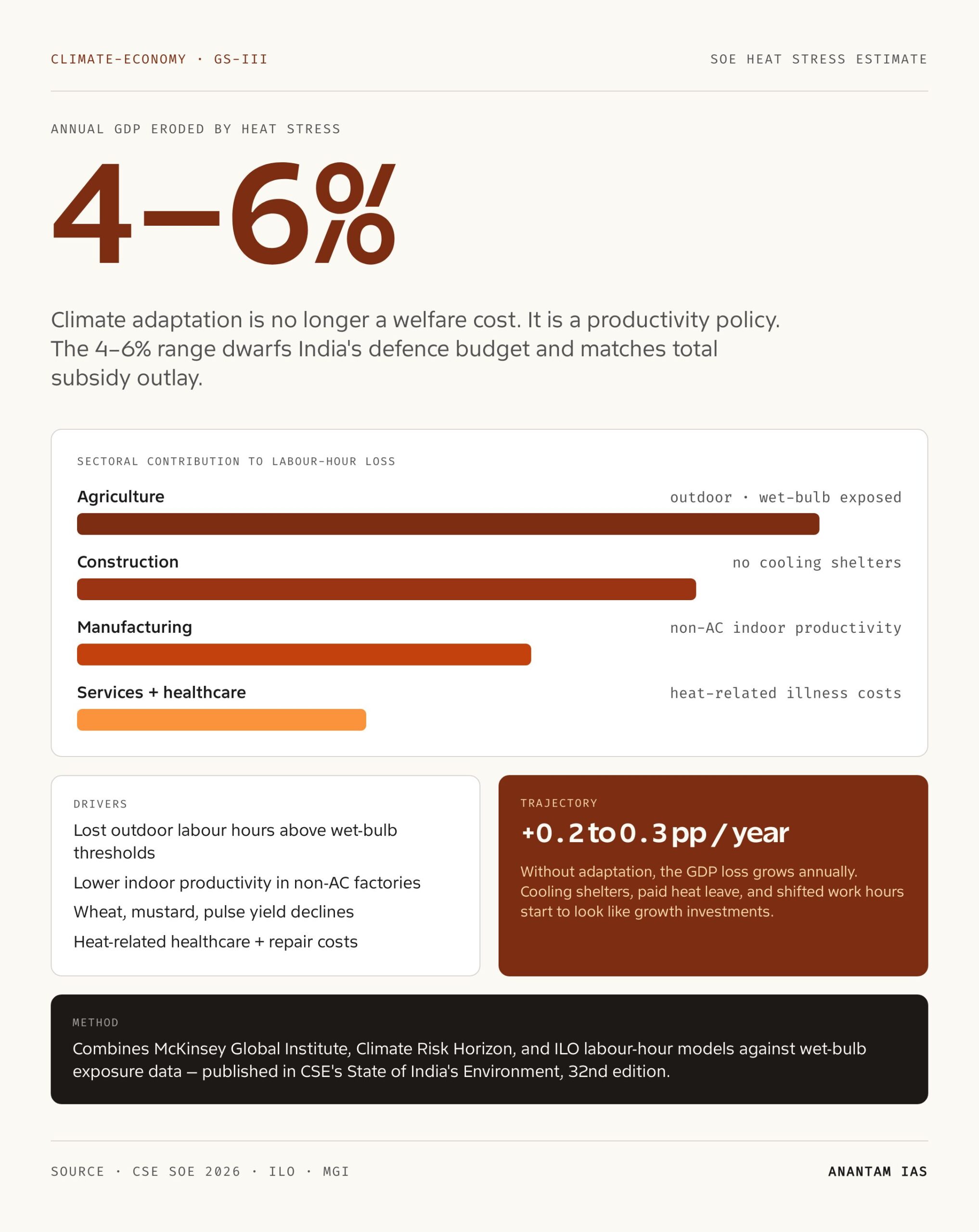
The single most important finding in the State of India’s Environment 2026 is the 4-6% of GDP annual erosion from heat stress. The methodology builds on McKinsey Global Institute, Climate Risk Horizon, and ILO labour-hour models. The estimate combines:
- Lost labour hours in outdoor sectors (agriculture, construction, fisheries, mining) when wet-bulb temperatures cross safe thresholds.
- Lower indoor productivity in non-air-conditioned manufacturing and services.
- Crop yield declines in heat-sensitive crops (wheat, mustard, certain pulses).
- Higher healthcare costs and infrastructure repair from heat-related damage.
The 4-6% range matters because it dwarfs most other macro-level concerns India debates. It is larger than India’s defence budget. It is comparable to total subsidy outlay. And it grows roughly 0.2-0.3 percentage points annually if no adaptation happens.
The implication is straightforward. Climate adaptation is not a CSR add-on. It is a productivity policy. Cooling shelters at construction sites, paid heat leave for outdoor workers, climate-resilient infrastructure standards, and shifted work hours all start to look like growth investments rather than welfare costs.
Detailed Analysis
Air Pollution: The Stuck Crisis
Air remains India’s most measurable environmental crisis and the one where regulation has visibly under-delivered. The National Clean Air Programme set a 40% reduction in PM2.5 by 2026 from 2017 baseline. SOE 2026 data shows the average reduction at around 15-18%, well short. Cities like Patna, Lucknow, Delhi, Ghaziabad, and Faridabad have seen smaller declines, while smaller Tier-2 cities have actually deteriorated due to construction expansion and biomass burning.
The report argues the NCAP framework needs binding emission caps on point sources, not just ambient concentration targets, because the latter respond too slowly to localised action.
Water: The Slow Emergency
Groundwater is where the hard limit is. CGWB 2025 data confirms that Punjab, Haryana, western UP, and parts of Tamil Nadu, Karnataka, and Telangana are running structural deficits. The report endorses paid groundwater entitlement schemes, crop diversification away from paddy in over-exploited regions, and an explicit re-pricing of agricultural electricity in deficit blocks.
Surface water is healthier but spatially uneven. Major rivers continue to receive untreated sewage. The Namami Gange programme has expanded sewage treatment capacity but utilisation gaps remain at the operations level.
Biodiversity: The Soft Budget Failure
India’s commitments to the Kunming-Montreal Global Biodiversity Framework target 30% protected land and seascape by 2030. Current protected area network covers around 5% strict and another 2-3% effective. Closing the gap needs both more area and stronger management of existing area, neither of which is funded at the required scale.
Climate Finance: The Hard Budget Failure
The $170-200 billion annual need versus $50 billion actual flow is the SOE 2026’s blunt criticism of India’s climate finance architecture. Domestic budget allocations have grown but private capital is still cautious, partly because of regulatory uncertainty in renewable contracts and partly because of forex risk in international green bond issuances. The report endorses a domestic green taxonomy and a sovereign green bond framework with predictable issuance.
Comparative Perspective
Globally, similar SOE-style reports include the UN Environment’s Global Environment Outlook (GEO), the OECD Environment at a Glance, and the Worldwatch Institute’s State of the World series. CSE’s SOE is more granular at the sub-national level than any of these for India, which is why courts, parliamentary committees, and academic researchers cite it heavily.
China’s State Environmental Status Report is government-issued and tracks similar themes, though with weaker civil-society scrutiny. The European Environment Agency’s annual SOE is the gold standard for jurisdictional environment reporting and is roughly comparable to CSE’s output in depth, though backed by formal statutory mandate.
Challenges and Critiques
Three legitimate critiques of the State of India’s Environment 2026 framework exist.
One, methodological transparency on the heat-stress GDP loss. The 4-6% range depends on assumed wet-bulb thresholds and labour productivity functions that vary across literature. CSE has published methodology, but the range is wide enough to generate legitimate debate.
Two, the planetary boundaries framework, while powerful, has been contested for assigning quantitative thresholds to processes (like biosphere integrity) that resist clean numbers. The headline “seven of nine breached” is rhetorically sharp but compresses substantial scientific uncertainty.
Three, the report leans heavily on government data sources (FSI, CGWB, CPCB) for measurement while critiquing the same data systems for incomplete coverage. That is unavoidable but produces some internal tension.
None of these critiques diminish the report’s central conclusions. They sharpen the conversation around them.
UPSC Prelims Pointers
- State of India’s Environment 2026 published by Centre for Science and Environment (CSE).
- CSE founded 1980 by Anil Agarwal; current DG Sunita Narain.
- Down To Earth magazine is CSE’s environmental publication.
- 32nd annual SOE edition.
- Planetary boundaries framework: nine Earth-system processes, originally proposed by Johan Rockström (2009).
- 2026 status: seven of nine boundaries breached.
- India’s heat stress GDP loss estimate (SOE 2026): 4-6% annually.
- NCAP target: 40% PM2.5 reduction by 2026 from 2017 baseline; actual achievement around 15-18%.
- 30 by 30 target: Kunming-Montreal Global Biodiversity Framework.
- Indian climate finance need (SOE 2026 estimate): $170-200 billion annually; actual flows under $50 billion.
Mains Practice Questions
- “Climate adaptation is no longer a welfare cost. It is a productivity policy.” Critically examine in light of the State of India’s Environment 2026 finding that heat stress erodes 4-6% of GDP annually. (GS-III, 250 words)
- Discuss the planetary boundaries framework and its relevance to India’s environmental and developmental policy. (GS-III, 250 words)
- The National Clean Air Programme has under-delivered against its 2026 target. Identify the structural reasons and suggest reforms. (GS-III, 150 words)
- Examine the gap between India’s climate finance need and actual flows. What domestic and international reforms could close it? (GS-III / GS-II, 250 words)
Way Forward
Three priorities follow naturally from the State of India’s Environment 2026 findings.
First, treat heat stress as a productivity emergency, not a humanitarian one. State governments should mandate paid heat leave for outdoor workers above wet-bulb thresholds, fund cooling infrastructure at construction sites, and shift outdoor work hours during summer months in heat-prone districts.
Second, move from ambient air quality targets to source-level emission caps in the NCAP framework, with district-level enforcement and citizen-accessible monitoring data.
Third, build a sovereign green taxonomy and predictable green bond issuance calendar to crowd in private climate finance. India’s climate goals under NDC 3.0 for 2031-2035 cannot be financed entirely from the union budget.
The State of India’s Environment 2026 is a clinical document. It does not panic and it does not soften. That is precisely what makes it useful for both UPSC preparation and policy debate. Read it once for facts, again for arguments, and a third time for the silences. The silences are where the next year’s environmental story will start.
Frequently Asked Questions
What is the State of India’s Environment 2026 report?
It is the 32nd annual flagship environmental assessment published by the Centre for Science and Environment (CSE), New Delhi, covering global and India-specific environmental indicators across climate, air, water, land, forests, biodiversity, urban environment, and climate finance.
Who publishes the State of India’s Environment report?
CSE, founded in 1980 by Anil Agarwal. Current Director General is Sunita Narain. The associated magazine is Down To Earth.
What are planetary boundaries?
A scientific framework proposed by Johan Rockström and colleagues in 2009 identifying nine Earth-system processes (climate, biosphere integrity, land use, freshwater, biogeochemical flows, ocean acidification, atmospheric aerosols, stratospheric ozone, novel entities) with safe-operating-space thresholds. SOE 2026 reports seven of nine breached.
How much GDP does India lose to heat stress?
The State of India’s Environment 2026 estimates 4% to 6% of GDP annually due to heat-induced labour productivity loss, agricultural yield loss, and infrastructure repair costs. The estimate combines wet-bulb temperature exposure with sectoral labour-hour models.
How is India performing on the National Clean Air Programme?
NCAP set a 40% PM2.5 reduction by 2026 from the 2017 baseline. SOE 2026 data shows actual achievement at roughly 15-18%, well short of target. The Indo-Gangetic plain remains worst-affected.
What is India’s climate finance gap?
SOE 2026 estimates an annual climate finance need of $170-200 billion. Actual flows in 2024-25, including domestic budget, multilateral, and private capital, totalled less than $50 billion.
Why does the SOE matter for UPSC?
The report is a single citable source for current data on India’s environmental indicators. It connects directly to GS-III environment, GS-III economy (climate-economy), GS-II governance (regulatory architecture), and essay topics on sustainability.
How does SOE 2026 view India’s biodiversity targets?
The report calls India’s 30 by 30 commitments “unlikely to be met without substantial new finance,” noting that current protected-area coverage is roughly 5-7% effective versus the 30% target by 2030.