Stubble Burning

Why in news:
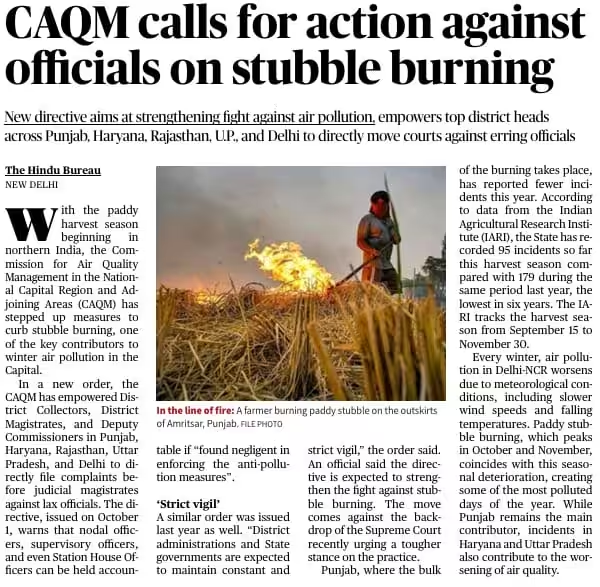
Commission for Air Quality Management (CAQM) has issued a new directive to curb stubble burning, which is one of the biggest contributors to air pollution in Delhi-NCR during winters. District Collectors, District Magistrates, and Deputy Commissioners in Punjab, Haryana, Rajasthan, Uttar Pradesh, and Delhi have been empowered to directly file complaints in court against officials who fail to control stubble burning.
UPSC Relevance:
Environmental pollution and degradation
UPSC PYQ
Q. What are the major factors responsible for making the rice-wheat system a success? In spite of this success, how has this system become bane in India? (2020)
What is stubble burning?
- Northern India, especially the states of Punjab and Haryana have two growing seasons: one from May to September and another from November to April.
- Many farmers rotate between crops, planting rice in May and wheat in November.
- In order to quickly prepare their fields for the wheat crop, many farmers simply burn leftover plant debris (stubble) after harvesting rice.
- This practice is known as paddy stubble burning.
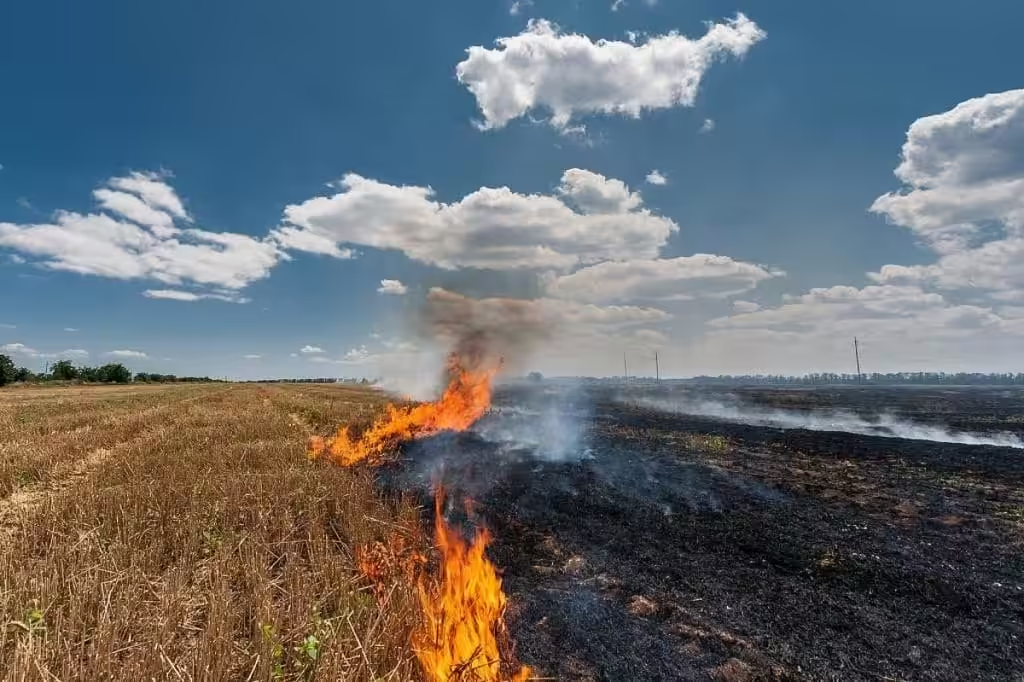
- Crop residue burning in Punjab, Haryana and western Uttar Pradesh has been known, but nowadays it’s spreading more frequently in other parts of country. According to an official report, more than 500 million tonnes of parali (crop residues) is produced annually in the country, cereal crops (rice, wheat, maize and millets) account for 70 per cent of the total crop residue.
- On December 10, 2015, the National Green Tribunal (NGT) had banned crop residue burning in the states of Rajasthan, Uttar Pradesh, Haryana and Punjab.
- Burning crop residue is a crime under Section 188 of the IPC and under the Air and Pollution Control Act of 1981.
Among the various crops cultivated, the main contributors of crop residual are rice (43%), wheat (21%), sugarcane (19%), and oil seed crops (5%) and the majority crop residues are burnt.
Why stubble burning is practised?
- Very short window between crops (Paddy → Wheat): Due to government law, Punjab farmers must plant paddy late (after 10 June) to save groundwater. Harvest happens around mid-October. Wheat must be sown within 15–20 days after that. Farmers have no time for manual or machine-based residue removal and therefore burning becomes the fastest option.
- High cost of residue management: Small and marginal farmers can’t afford machines like Happy Seeder, Super Straw Management System (SMS). Labor shortages for farm activities like manual harvesting has encouraged the use of mechanized combine harvesters that leave behind crop residue.
- Mechanized harvesting: Harvesters leave 7–10 inch stubble, impossible to plough easily and therefore burning becomes the cheapest and fastest solution.
- Government MSP policy has made farmers stuck in this wheat–paddy cycle, which causes residue every year.
- Lack of incentives & infrastructure: Very limited availability of biomass processing plants or ex-situ uses.
Green Revolution and Stubble Burning: Before the 1980s, farmers used to till the remaining debris back into the soil after harvesting the crops manually. The origin of stubble burning can be traced to the advent of the Green Revolution and mechanised harvesting, which utilised the combined harvesting technique. The Green Revolution increased greatly rice and wheat production, which simultaneously increased stubble post harvest. However, the popular combined harvesting technique was not efficacious, as machines left behind one-foot-tall stalks. This prompted stubble burning as a low-cost and speedy solution available to farmers due to the limited time period of 20-25 days between harvesting one crop and sowing another.”
What are the issues arising out of stubble burning?
- Air Pollution and Emission of Greenhouse Gases
- Burning rice straw is expected to release 70% of the carbon in the straw as CO2, 7% as CO, and 0.66% as CH4. However, 2.09% of the nitrogen in the straw is released as N2O directly in the atmosphere which leads to global warming.
- Nutritional Deficiencies
- Approximately 90% of the nitrogen, 50% of the sulphur, 25% of the phosphorus, and 20% of the potassium from crop leftovers are released into the atmosphere as gases and particulates when the residue is burned, along with other valuable nutrients
- Loss of Soil Fertility
- The majority of farmers believe that burning is a quick, simple, and affordable procedure as it destroys all undesirable plants, shrubs, and husks. Some people think that fire could replenish the soil’s nutrients. However, the soil becomes less productive when husks are burned on the ground as it destroys the nutrients.
- Smoke and Soot Particles
- The smoke released due to husk burning, pollutes the air and produces a haze of pollutants that induces a “toxic atmosphere” in Delhi.
- Harm on Health
- Burning residue can lead to health risks such as bronchial asthma, asthma, acute respiratory infections (ARI), and eye irritation. Due to the increase in smog, 84.5% of the people had heart difficulties, 76.8% suffered from eye irritation, 44.8% reported nose discomfort, 45.5% complained about throat irritation, wheezing issues increased by 18.0%, while cough issues increased by 41.6%.
What are the other technological alternatives to stubble burning?
Farmers can manage crop residues effectively by employing agricultural machines like:
● Happy Seeder(used for sowing of the crop in standing stubble)
● Zero till seed drill (used for land preparations directly sowing of seeds in the
previous crop stubble)
● Baler (used for the collection of straw and making bales of the paddy stubble)
● Rotavator (used for land preparation and incorporation of crop stubble in the soil)
● Paddy Straw Chopper (cutting of paddy stubble for easily mixing with the soil)
● Reaper Binder (used for harvesting paddy stubble and making into bundles)
Diversified Uses of Crop Residue:
- Decomposing stubble in the farm field and turning it into useful manure.
- Use in Power Generation, production of cellulosic ethanol in PPP mode.
- Use of Crop Residue for paper/board/panel and packing material.
- Promotion of collection of crop residue for feed bricks making and its transport to
fodder deficient areas.
Summary:
| Aspect | Key Points |
| What is it? | Burning leftover paddy/wheat stubble to quickly clear fields before next crop. |
| Why Practiced? | • Very short 15–20 day crop window (Paddy→Wheat) • High cost of machines, labour shortage • Mechanized harvesters leave 7–10 inch residue • MSP-driven rice–wheat cycle • No incentives / weak biomass infrastructure • Green Revolution + combine harvester legacy |
| Changing trends? | Earlier limited to Punjab–Haryana–W.UP, now spreading across India due to mechanisation |
| Legal Status? | • NGT banned in 2015 • IPC Sec 188 + Air Act 1981 = punishable offence |
| Major contributors? | Rice (43%), wheat (21%), sugarcane (19%), oilseeds (5%) |
| Environmental Issues? | • Massive air pollution + smog in NCR • Emits CO₂, CO, CH₄, N₂O → GHG emissions • Smoke + soot → toxic haze |
| Impact on Soil? | • Loss of N (90%), S (50%), P (25%), K (20%) nutrients • Kills soil microbes + organic carbon → long-term fertility loss |
| Impact on health? | • Asthma, bronchitis, ARI, eye irritation • High spike in smog-linked hospital cases |
| Technological alternatives? | • Zero-Till Drill, Rotavator, Straw Chopper • Baler, Reaper Binder |
| Non-Tech alternatives? | • In-situ decomposition → manure • Biomass power / ethanol (PPP) • Paper, packaging, fodder briquettes |