Complete guide to global warming covering greenhouse gases, effects on climate, Paris Agreement, IPCC reports, India's NDCs, and mitigation strategies for UPSC Environment paper.
Global warming refers to the long-term increase in Earth’s average surface temperature due to rising concentrations of greenhouse gases (GHGs) in the atmosphere. Since pre-industrial times, the global mean temperature has risen by approximately 1.1 degrees Celsius. The Intergovernmental Panel on Climate Change (IPCC)Sixth Assessment Report (AR6) warns that without drastic emission cuts, warming could exceed 1.5 degrees Celsius by the early 2030s. For UPSC, global warming is a cross-cutting theme spanning Environment, Geography, Economy, and International Relations.
What Causes Global Warming?
The Greenhouse Effect
The Earth's atmosphere naturally traps some of the Sun's heat through the greenhouse effect — a process essential for life. However, human activities have enhanced this effect by dramatically increasing the concentration of GHGs.
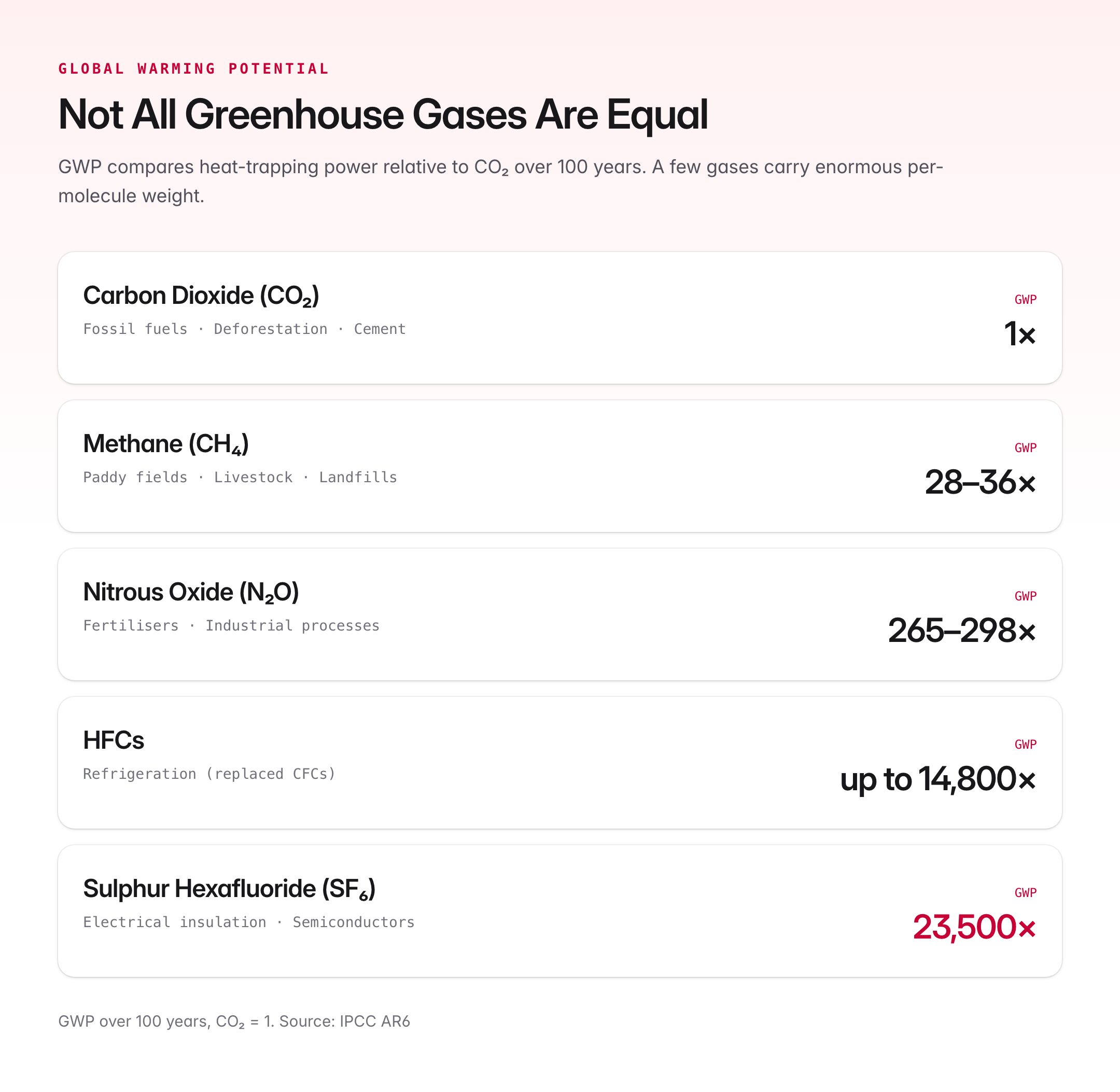
Major Greenhouse Gases
Gas
Chemical Formula
Primary Source
Global Warming Potential (GWP) over 100 years
Carbon dioxide
CO2
Fossil fuel combustion, deforestation, cement production
1 (reference)
Methane
CH4
Paddy fields, livestock, landfills, natural gas systems
Evaporation (amplifies warming as a feedback mechanism)
Not assigned
Key Emission Sectors
Sector
Share of Global GHG Emissions
Energy (electricity and heat)
~25%
Agriculture, forestry, land use
~24%
Industry
~21%
Transport
~14%
Buildings
~6%
Other energy
~10%
Effects of Global Warming
Physical Effects
Effect
Description
Rising sea levels
Thermal expansion of oceans and melting of glaciers and ice sheets; sea levels have risen ~20 cm since 1900 and could rise 0.3-1.0 m by 2100
Melting glaciers
Himalayan glaciers are retreating at an accelerated rate, threatening water security for over a billion people
Extreme weather events
More frequent and intense heatwaves, cyclones, droughts, and floods
Ocean acidification
CO2 absorption by oceans lowers pH, threatening coral reefs and marine ecosystems
Permafrost thawing
Releases trapped methane, creating a dangerous positive feedback loop
Biological Effects
Effect
Description
Biodiversity loss
Species unable to adapt or migrate face extinction; coral bleaching events have increased dramatically
Shifting ecosystems
Treelines moving to higher altitudes; tropical diseases spreading to temperate zones
Agricultural disruption
Altered monsoon patterns, increased pest incidence, reduced crop yields in tropical regions
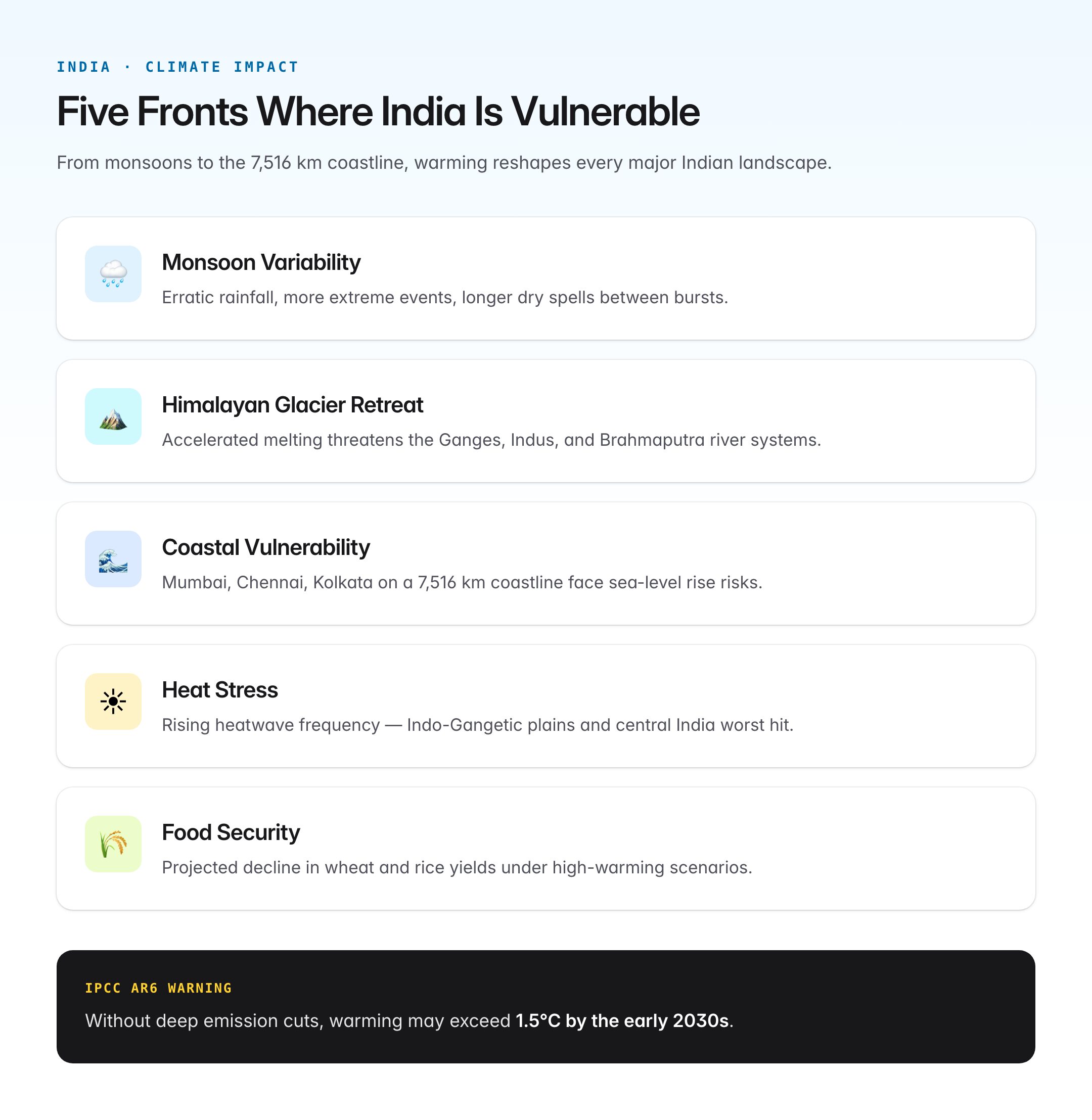
Effects on India
Impact Area
Specific Concern
Monsoon variability
Erratic rainfall patterns; more extreme rainfall events with longer dry spells
Himalayan glaciers
Accelerated melting threatens Ganges, Indus, and Brahmaputra river systems
Coastal vulnerability
7,516 km coastline with densely populated cities (Mumbai, Chennai, Kolkata) at risk from sea level rise
Heat stress
Increasing frequency of heatwaves, particularly in Indo-Gangetic plains and central India
Food security
Projected decline in wheat and rice yields under high-warming scenarios
International Framework
United Nations Framework Convention on Climate Change (UNFCCC)
Adopted in 1992 at the Rio Earth Summit, the UNFCCC is the parent treaty for all international climate negotiations. Key principle: Common But Differentiated Responsibilities and Respective Capabilities (CBDR-RC).
Kyoto Protocol (1997)
Feature
Detail
Commitment periods
First (2008-2012), Second (2013-2020)
Binding targets
Only for Annex I (developed) countries
Mechanisms
Clean Development Mechanism (CDM), Joint Implementation, Emissions Trading
India's status
Non-Annex I; no binding reduction obligation
Paris Agreement (2015)
Feature
Detail
Goal
Limit warming to well below 2 degrees Celsius, preferably 1.5 degrees Celsius, above pre-industrial levels
Mechanism
Nationally Determined Contributions (NDCs) — each country sets its own targets
Every 5 years to assess collective progress (first in 2023)
Finance
Developed nations to mobilise $100 billion/year (later revised to $300 billion/year at COP29) for developing nations
Loss and Damage Fund
Established at COP27 (2022) for climate-vulnerable countries
IPCC Reports
The IPCC produces Assessment Reports that synthesise climate science.
Report
Year
Key Finding
AR5
2014
Human influence on climate is "extremely likely" (>95% probability)
Special Report on 1.5C
2018
Achieving 1.5C requires 45% CO2 reduction by 2030 and net-zero by 2050
AR6
2021-2023
Every region of the world is experiencing climate change; some changes already irreversible
India's Climate Action
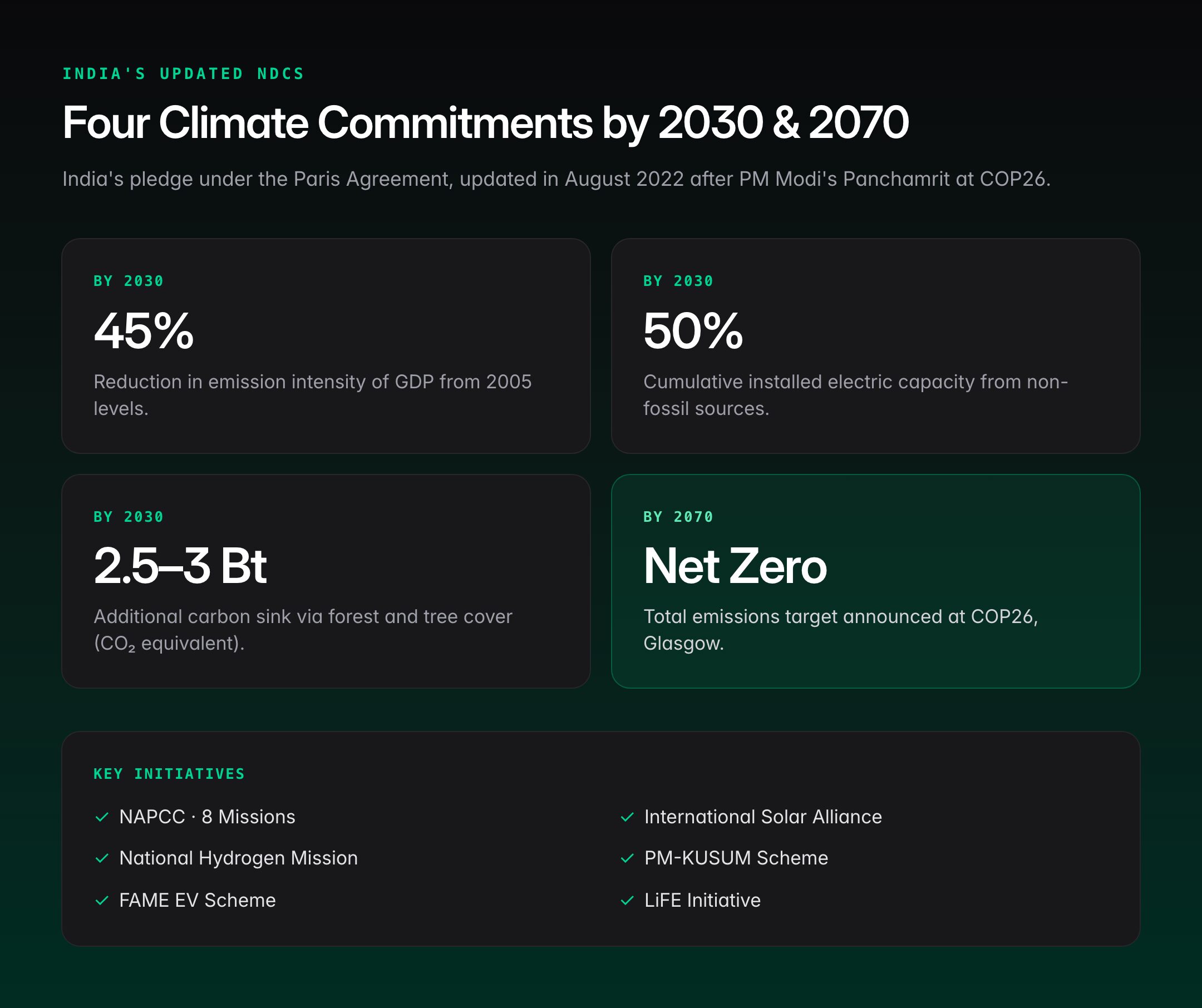
India's Updated NDCs (August 2022)
Target
Commitment
Emission intensity reduction
Reduce emission intensity of GDP by 45% by 2030 (from 2005 levels)
Non-fossil energy capacity
Achieve 50% cumulative installed electric power from non-fossil sources by 2030
Net-zero target
Achieve net-zero emissions by 2070 (announced at COP26, Glasgow)
Carbon sink
Create additional carbon sink of 2.5-3 billion tonnes of CO2 equivalent through forest and tree cover by 2030
Key Indian Initiatives
Initiative
Focus
National Action Plan on Climate Change (NAPCC)
8 national missions (Solar, Enhanced Energy Efficiency, Sustainable Habitat, Water, Sustaining Himalayan Ecosystem, Green India, Sustainable Agriculture, Strategic Knowledge)
International Solar Alliance (ISA)
India-led coalition for solar energy deployment in tropical countries
Panchamrit pledges (COP26)
Five climate commitments by PM Modi at Glasgow
PM-KUSUM Scheme
Solar pumps and grid-connected solar for farmers
National Hydrogen Mission
Green hydrogen production target of 5 million tonnes per annum by 2030
FAME Scheme
Faster Adoption and Manufacturing of Electric Vehicles
Mitigation Strategies
Strategy
Examples
Transition to renewable energy
Solar, wind, nuclear, hydropower
Energy efficiency
LED lighting, efficient appliances, green buildings
Carbon pricing
Carbon tax, emissions trading systems (ETS)
Afforestation and reforestation
REDD+ (Reducing Emissions from Deforestation and Forest Degradation)
Sustainable agriculture
Zero-till farming, system of rice intensification, biochar
Carbon capture and storage (CCS)
Technology to capture CO2 from point sources and store underground
Lifestyle changes
LiFE (Lifestyle for Environment) initiative launched by India
UPSC Relevance
Paper
How It Appears
Prelims (GS)
GHGs and their GWP, Paris Agreement provisions, IPCC findings, India's NDCs
Mains GS-I (Geography)
Impact on monsoons, Himalayan glaciers, sea level rise
Mains GS-III (Environment)
Mitigation strategies, India's climate policy, international frameworks
Mains GS-II (International Relations)
Climate diplomacy, CBDR, climate finance
Essay
Climate justice, development vs environment, intergenerational equity
Key terms to remember: greenhouse effect, IPCC AR6, Paris Agreement, NDCs, CBDR-RC, net-zero, carbon sink, emission intensity, ISA, NAPCC, loss and damage, 1.5 degree target.
Global warming is not a distant threat — it is a present reality reshaping economies, ecosystems, and geopolitics. India's position as the world's third-largest emitter (but with low per-capita emissions) places it at the centre of global climate negotiations, balancing development imperatives with environmental responsibility.
Rahul Puri is the Director & Mentor at Anantam IAS. He leads the institution's teaching philosophy — focused not on syllabus completion but on the thinking, clarity and consistency that actually crack UPSC. A long-time mentor to hundreds of civil services aspirants and interview toppers (including AIR 28, 48, 56, 73, 96, 106, 116, 143 in CSE 2025), he anchors Anantam's flagship Interview Guidance Programme.
Specialises in · Institutional leadership, mentoring and programme designExperience · 10+ yearsVisit website ↗