Subhas Chandra Bose: the paradox of a revolutionary’s theory and praxis

Why in News?
The articles highlight the “paradox” in Subhas Chandra Bose’s thought and action:
- He combined idealism (spiritual + moral philosophy)
- with hard pragmatism (authoritarian state, militarism, planning)
A moral philosopher who justified strong, even authoritarian, political methods for national reconstruction.
UPSC Relevance:
GS-I: Role in freedom struggle, Differences with Gandhi
GS – IV (Ethics): Ethical pragmatism, Ends vs Means debate, Moral justification of violence
I. Philosophical Foundations
1. Shift from Idealism to Pragmatism
- Initially influenced by Adi Shankaracharya’s Vedanta
- Believed in Maya (world is illusion)
- Later rejected it because:
- A revolutionary needs action, not illusion
- Bose represents practical idealism
- “What is not workable should be discarded” → Ethics + practicality balance
2. The Spirit of Reality (Love & Evolution)
Unlike Marxists, Bose rejected pure materialism. He believed the universe was driven by a Spiritual Force:
- The World is Real: He dismissed the idea that the world is an illusion (Maya). For him, it is an evolving reality that demands active participation.
- Love as a Force: He identified Love (the urge to unite) as the fundamental creative principle.
- Moral Politics: Because reality is spiritual, politics cannot be a “dirty game” of power. It must have a moral foundation, aiming for the upliftment of humanity.
3. Hegelian Dialectics: The Logic of Struggle
Bose adapted G.W.F. Hegel’s “Thesis-Antithesis-Synthesis” to justify his revolutionary path:
- Progress through Conflict: He believed history doesn’t move in a straight line; it moves through the clash of opposing forces.
- Justification for War: To Bose, Armed Struggle was the “Antithesis” required to break the “Thesis” of British Colonialism. This friction was the only way to achieve the “Synthesis”—a Free India.
- Revolution as Necessity: While Gandhi saw non-violence as a moral absolute, Bose saw violence and war as a “historical necessity” for progress. You cannot have the synthesis (freedom) without the struggle (conflict).
The Synthesis
This mindset allowed Bose to be both a spiritualist and a warrior. He believed that fighting for independence was a moral duty because it aligned with the “Spirit of History” moving toward justice.
II. Doctrine of Samyavada
Meaning
- From Sanskrit:
- Samya = equality/harmony
- Vada = doctrine
It is Doctrine of Harmonious Equality
Key Features
- Synthesis of ideologies
- Between:
- Fascism (discipline, nationalism)
- Communism (equality, socialism)
- Between:
- Not blind imitation of West
- Indigenous Indian model
- Dynamic and evolving
- No ideology is final
Bose argued that India should not blindly adopt Western models like orthodox communism or capitalism. Instead, he proposed blending the economic planning and social equality of Socialism/Communism with the nationalistic discipline found in strong-state systems, specifically adapted for India’s unique social context
- Similar to:
- “Third Way” politics
- Indian model of development
III. Economic & Political Vision
1. Socialist Economy
Bose supported:
- State control of economy
- Industrialisation
- Heavy industries
- Abolition of landlordism
2. National Planning
- Set up National Planning Committee (1938)
Shows: Early vision of planned development
3. Social Justice Vision
He wanted:
- Equality (rich–poor)
- Gender equality
- End of caste system
- Religious freedom
- Inclusive nationalism
- Social democracy
IV. Authoritarianism Debate
Bose’s Position
- Supported temporary authoritarian state
- Reason:
- India was:
- Poor
- Divided
- Backward
- India was:
- Democracy may be too slow for:
- Rapid economic transformation
Strong central authority needed for reconstruction, but only temporarily
Contextual Understanding
- Influenced by global trends:
- Nazi Germany
- Soviet Union
- Imperial Japan
- Kemalist Turkey
These states achieved rapid modernization under centralised rule
Critical Evaluation
✔ Strengths:
- Fast decision-making
- Strong national unity
- Effective economic planning
❌ Weaknesses:
- Risk of dictatorship
- Suppression of rights
- Against modern democratic values
Bose’s model reflects the tension between efficiency and liberty, still relevant in developing countries.
V. “Paradox” Explained
Why is Bose called paradoxical?
| Idealism | Pragmatism |
| Belief in morality, love, spirituality | Supported war & armed struggle |
| Equality & justice | Supported authoritarian rule |
| Democratic end goal | Temporary dictatorship |
This contradiction = Theory vs Praxis
Conclusion
Subhas Chandra Bose represents a unique synthesis of spiritual idealism and political realism, where moral purpose coexisted with strategic pragmatism. His vision highlights the enduring dilemma in governance: whether rapid progress justifies strong, even coercive, state power.
This Part-2 shows how Subhas Chandra Bose translated his philosophy (Samyavada + dialectics) into real-world action (praxis)—in society, military organisation, and international politics.
From ideas → implementation → contradictions → legacy
UPSC Relevance:
GS-I: INA as tool of Unity, Social reform
GS Paper IV (Ethics): Ends vs Means debate, Ethical pragmatism, Moral courage vs political compromise
VI. Equality in Action (Praxis)
1. Anti-Caste & Social Reform
- Early advocate of:
- Abolition of caste system
- Removal of superstition
- Mobilised:
- Workers
- Peasants
- Women
- Social transformation + political freedom linked
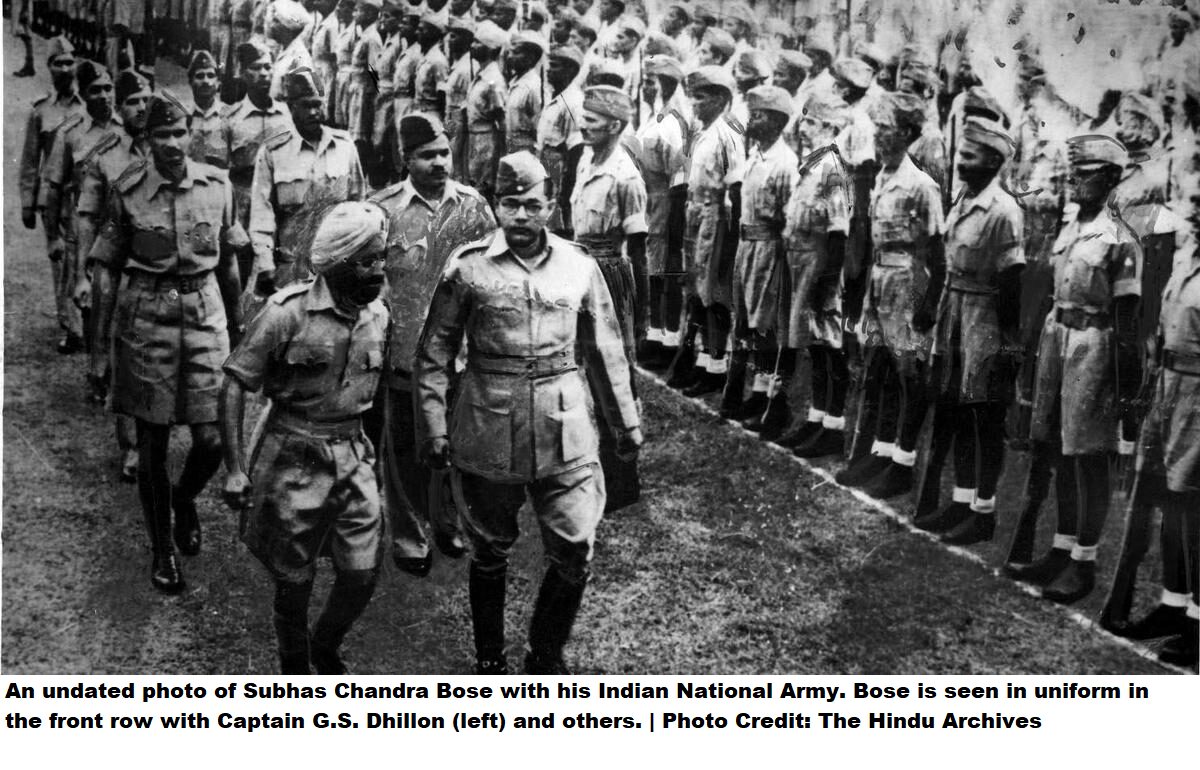
2. Military as Social Laboratory (INA Reforms)
- Abolished caste/ethnic divisions in army
- Promoted national unity over identity
Army used as a tool for nation-building
Example:
- Soldiers ate together (breaking caste taboos)
- No “martial race” concept (British policy rejected)
3. Communal Harmony
- Promoted:
- “Jai Hind” as inclusive slogan
- Hindustani language
- Formation of Rani of Jhansi Regiment
- Encouraged active participation of women in combat
- Thi is the Early example of gender equality in military roles
5. Labour & Socialist Commitment
- Supported:
- Living wages
- Workers’ dignity
Positioned himself:
- Between:
- Soviet-style communism
- Moderate reformism
- Indigenous socialism
VII. Pragmatism in Foreign Policy (Most Controversial Part)
Bose’s foreign policy is often misunderstood as ideological, but it was actually a masterclass in radical pragmatism. Here is the breakdown:
1. The “Enemy’s Enemy” Strategy
Bose partnered with Germany and Japan not out of love for their systems, but because they were the only powers capable of militarily challenging the British Empire. To him, the liberation of 380 million Indians outweighed the optics of the alliance.
2. Moral Independence
Despite the alliance, Bose maintained his ethical boundaries:
- Anti-Nazi: He openly criticized Hitler’s racial theories and warned that Nazi “Nordic supremacy” was a threat to Asians.
- Pro-China: Even while receiving Japanese aid, he expressed deep sympathy for China, famously sending a medical mission (Dr. Kotnis) to help them against Japanese aggression. This proved his Ethical Internationalism.
3. Exposing Allied Hypocrisy
Bose viewed the “Atlantic Charter” and Allied claims of fighting for “democracy” as hollow. He argued that if Britain truly cared about freedom, they would start by decolonizing India. This critique remains a cornerstone of Third World anti-colonialism.
4. The Takeaway
Bose’s approach was Realpolitik with a Conscience:
- National Interest First: Independence was the non-negotiable goal.
- Ideological Neutrality: He refused to let European “isms” (Fascism vs. Liberalism) dictate India’s path.
- Sovereignty: He proved that a colonized leader could deal with superpowers as an equal, not a puppet.
5. Key Interpretation
Bose’s foreign policy =
Realpolitik + National Interest > Ideology
VIII. The “Higher Synthesis” (Philosophical Vision)
1. India’s Global Role
- India to combine:
- Western material progress
- Eastern spiritual wisdom
Civilisational leadership
2. Role of Youth
- Youth as agents of:
- Nation-building
- Social transformation
3. Moral Nationalism
- Moral Nationalism is a political and ethical framework that treats the nation as a moral agent capable of holding responsibilities, expressing virtues, and being held accountable for its actions.
Ethical dimension:
- This framework serves as a direct rebuttal to Cynical Realism (or Realpolitik), which dominates much of international relations theory.
4. Faith in Destiny
Subhash Chandra Bose’s Faith in Destiny, specifically during the collapse of the INA in 1945, is a masterclass in psychological and political resilience. It moves beyond simple “positive thinking” into the realm of Dialectical Optimism.
- Defiance of Defeat (1945): Even as the INA collapsed and Japan surrendered, Bose remained certain of India’s freedom. He viewed military failure as a temporary setback, not a final outcome.
- Dialectical Optimism: This was his “logic of progress.” He believed history moves through struggle: the thesis (Indian resistance) and antithesis (British suppression) would inevitably result in the synthesis (Independence).
- The Moral Catalyst: He believed that the INA’s “sacrifice” would spark a psychological revolution within India. To him, the spirit of the struggle was more important than the immediate military result.
- The Result: His optimism was proven right; the subsequent INA trials unified Indians and signaled the end of British rule, turning a military defeat into a political victory.
IX. Final Evaluation: “Eternal Rebel”
Bose’s Core Contradictions
| Dimension | Position |
| Spiritual | Believed in moral universe |
| Political | Supported authoritarian state |
| Economic | Socialist planning |
| Military | Violent struggle |
| Global | Human unity |
Significance:
1. Alternative Nationalism
- Different from Mahatma Gandhi:
- Gandhi → Non-violence, decentralisation
- Bose → Militarism, centralisation
2. Influence on Modern India
- Planning → Influenced post-independence policies
- Secularism → Practical (not just constitutional)
- Equality → Social + economic
3. Key Debate
Can authoritarianism be justified for development?
- Bose → Yes (temporarily)
- Modern view → Risky, rights must prevail
Conclusion
Subhas Chandra Bose’s life represents the fusion of radical idealism with uncompromising pragmatism, where equality, unity, and national liberation were pursued through bold and sometimes controversial means. His vision of a “higher synthesis” continues to challenge India to balance power, morality, and inclusivity in its journey as a modern nation.