Mohandas Karamchand Gandhi (1869-1948) did two things that place him permanently at the centre of UPSC GS IV. He built a mass-movement method — satyagraha — that mobilised a colonial population without arming it. And he developed a moral framework that insisted means and ends be judged together, that wealth be treated as trust, that education be tied to character, and that the well-being of the antyodaya — the last person in the line — be the test of every public decision.
This guide reads Gandhi as a moral system designed for public life, not only a political leader in a freedom struggle. That is the angle GS IV rewards.
The Core Axis: Satya and Ahimsa
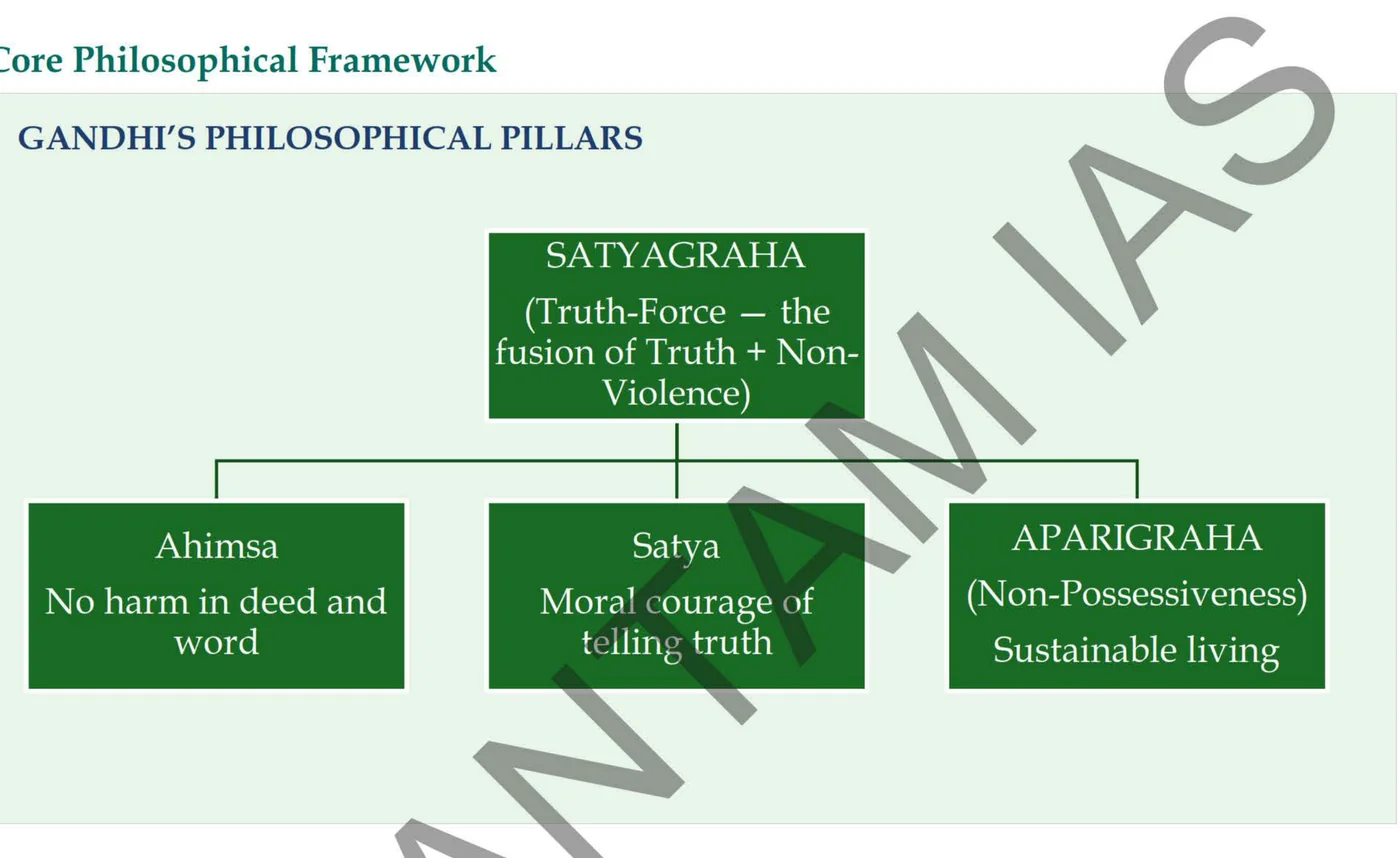
Satya — Truth as a way of life
For Gandhi, Satya was not merely factual accuracy; it was fidelity to the real in thought, word and act. Satya was also a metaphysical commitment — he used "Truth" and "God" interchangeably. A civil servant's file-note that falsifies a figure, however small, is — in Gandhian terms — an ontological failure, not a clerical one.
Ahimsa — Non-violence as method
Ahimsa meant much more than refraining from physical violence. It meant the refusal to harm in thought, word, policy, or economic arrangement. The means, Gandhi insisted, are as sacred as the end. You cannot purchase a just society with unjust instruments. That is why the most morally demanding GS-IV dilemmas — ends vs means, order vs conscience, law vs justice — are most usefully read through Gandhi.
"The means may be likened to a seed, the end to a tree; and there is just the same inviolable connection between the means and the end as there is between the seed and the tree." — M. K. Gandhi
Satyagraha — Truth-Force as Political Practice
Satyagraha combined satya (truth) and agraha (firm holding). It was disciplined, non-violent, public resistance to injustice. South Africa (1893-1915), Champaran (1917), Kheda (1918), Ahmedabad mill strike (1918), the Non-Cooperation Movement (1920-22), the Salt March and Civil Disobedience (1930-34), and the Quit India Movement (1942) are all variants of a single method.
For a civil servant, satyagraha's disciplines — self-purification, public accountability, refusal to humiliate the opponent, willingness to absorb suffering — are transferable to every situation where reform must be pursued against vested interest.
Seven Social Sins — Gandhi's Diagnostic Checklist
In Young India (1925), Gandhi listed the seven social sins, each a pairing of a public good and its ethical discount.
- Politics without principle — power divorced from purpose.
- Wealth without work — prosperity extracted rather than created.
- Commerce without morality — exchange indifferent to its human cost.
- Education without character — skills without the will to use them well.
- Pleasure without conscience — enjoyment indifferent to those excluded from it.
- Science without humanity — knowledge that has forgotten whom it serves.
- Worship without sacrifice — ritual without lived ethical effort.
The list reads like a district-level dashboard. A civil servant who uses it can diagnose what is wrong with a policy, a procurement, or a personnel culture.
Harmony and Religious Plurality
Gandhi's commitment to communal harmony was not tactical. He insisted that an unbreakable bond among India's religions was a national requirement, and that harmony must rest on equal respect for all faiths. His axiom: every scripture points in the same moral direction — goodwill, openness and understanding among human beings.
Application. For the modern Indian civil servant in a plural polity, Gandhi's harmony doctrine authorises a strong form of secularism — not religion excluded from public life, but all religions accorded equal public respect.
Education — Light of Life and Seed of Harmony
Gandhi regarded education as the "light of life" and the very source of the awareness of oneness. He believed that universality of ethics could be realised best through universal education. Nai Talim, his educational philosophy, integrated handwork, craft, and moral instruction with literacy.
The compass text captures his conviction with unusual clarity: "a nation built on the ethical foundation of non-violence would be able to withstand attacks on its integrity from within and without."
Application. An education policy that produces technically capable graduates with weak moral formation produces a labour market for corruption. Gandhi's position gives a GS-IV aspirant a principled argument for values-integrated education — in schools, police academies, the National Academy of Administration.
Trusteeship and Economic Ethics
Gandhi's theory of trusteeship held that the wealthy are stewards of capital on behalf of society. Private property is not abolished; it is re-purposed. The trustee may enjoy reasonable maintenance; the surplus must be directed to the public good. This is the moral middle path he sought between predatory capitalism and coercive socialism.
Application. CSR regulation, progressive taxation, inheritance thinking, and public-private philanthropy all borrow elements from the trusteeship concept, whether or not they acknowledge the debt.
Dignity of Labour and Antyodaya
Gandhi taught that all honest labour is dignified and that a society committed to harmony must bridge the gulf between the well-off and the rest. His most famous practical rule — the Gandhian Talisman — is the single most useful paragraph a GS-IV candidate can memorise.
"Whenever you are in doubt, or when the self becomes too much with you, apply the following test. Recall the face of the poorest and the weakest man whom you may have seen, and ask yourself, if the step you contemplate is going to be of any use to him. Will he gain anything by it? Will it restore him to a control over his own life and destiny? In other words, will it lead to Swaraj for the hungry and spiritually starving millions? Then you will find your doubts and your self melting away." — M. K. Gandhi
Antyodaya — reaching the last person in the line — is the operational translation of the Talisman, and it has become a formal principle of Indian welfare administration.
Gandhi's Influence Beyond India
The Gandhian method travelled. Martin Luther King Jr. read Gandhi and built the American civil-rights movement on satyagraha. Nelson Mandela — and later F. W. de Klerk — acknowledged Gandhian influence in shaping South Africa's path to reconciliation. Lech Wałęsa's Solidarity movement used non-violent labour organisation against a repressive regime. Gandhi demonstrated that adherence to truth and non-violence is not only an individual ethics; it is usable in global affairs.
Case Study Prompts
Case 1: The Polluting Industry in a Poor District
A large textile cluster in your district provides livelihoods to thousands but discharges toxic effluents into a river that flows through tribal villages downstream. Closure will cause unemployment; continuation will cause disease.
Resolution framework — Gandhian reading.
- The Talisman. Recall the face of a child in the downstream tribal hamlet drinking contaminated water. That face overrides the ledger.
- Means and ends. Employment is a legitimate end. Poisoning downstream citizens is an illegitimate means. The means here must be fixed.
- Course of action. Issue a time-bound notice for effluent-treatment plant installation. Arrange transitional wage support. Pair enforcement with skills-retraining for displaced workers. Close only as last resort. Ahimsa in policy — no harm to either worker or downstream villager.
Case 2: The Communal Rally
You are the District Magistrate. A political group announces a rally that local intelligence says is likely to include inflammatory speech against a minority community. Outright prohibition may radicalise; permitting may inflame.
Resolution framework — Gandhian reading.
- Harmony. The duty is not only to prevent a riot but to build the social fabric that makes riots unthinkable.
- Means and ends. Suppression is a means Gandhi would have resisted; dialogue is the means he would have urged.
- Course of action. Permit the rally with clear, written conduct conditions and liability notice; increase police deployment discreetly; convene a preceding peace committee of religious leaders of both sides; pre-record and broadcast clear statements that hate speech will be prosecuted; ensure visible protection to the minority community's places of worship. Truth through transparency, non-violence through restraint.
UPSC Relevance
GS IV mapping. Gandhi is the most frequently invoked thinker in UPSC GS IV. He features in ethics and human interface, human values, attitude, ethics in public administration, and integrity — and in quotations that open case studies in almost every year.
Keywords for answers. Satya, Ahimsa, Satyagraha, Sarvodaya, Antyodaya, Gandhian Talisman, Trusteeship, Nai Talim, seven social sins, Hind Swaraj, constructive programme, Ram Rajya.
Real-life examples.
- Swachh Bharat Abhiyan — invoked Gandhi's emphasis on sanitation and dignity of labour.
- Khadi and Village Industries Commission — institutional legacy of trusteeship and swadeshi.
- Public Interest Litigation (PIL) — a legal form of the citizen's Gandhian claim on the state.
- The 2015 Indian Administrative Service ethics curriculum — formally references Gandhian values.
"Be the change you wish to see in the world." — M. K. Gandhi
Mahatma Gandhi's ethical system is not a period piece. It is a toolkit for any public servant whose work touches power, money, identity or violence — which is to say, for every public servant. Carry the Talisman in the front of your notebook. Read the seven social sins each year on 2 October. Let satya and ahimsa set the floor of conduct, and let the rest of administration be built upon it.
Tell Google you want more of this.
Add Anantam IAS as a preferred sourceOne tap, and this site shows up more often in your own Top Stories, AI Overviews and AI Mode. Remove it any time.