Article 32 and Social-Media Regulation: Supreme Court Stresses the Proper Legal Route
Why in News?
On 15 July 2026, the Supreme Court refused to entertain a writ petition seeking curbs on podcasts and social-media reels carrying allegedly derogatory religious comments. The Hindu reported that a Bench of Justices P.S. Narasimha and Alok Aradhe said the freedom to approach the Court under Article 32 couldn’t become a route for politicising an issue.
The Bench treated the dispute as one requiring the ordinary legal process, not direct constitutional intervention. It advised the petitioner to pursue a complaint and FIR where an offence was alleged, act under the applicable law, or approach the competent authority under the 2009 IT interception rules.
- The petition was filed by Mohd. Anas Chaudhary over the online circulation of allegedly derogatory comments about Prophet Muhammed.
- The petitioner sought broader regulation of reels and podcasts, arguing that communally hurtful comments were circulating online.
- The Bench said the grievance didn’t present a fit case for a direct petition under Article 32.
- The Court pointed to remedies before the police and competent statutory authority instead of creating an immediate pan-India restriction.
- An earlier Vacation Bench had also declined to short-circuit standard procedure when the controversy was mentioned for urgent hearing in early July.
The development matters in the context of:
- The episode tests the boundary between the Supreme Court’s role as guardian of fundamental rights and the need to respect ordinary investigative and regulatory processes.
- It separates a genuine constitutional-remedy question from a request that effectively asks the Court to design platform-wide content policy in the first instance.
- It also shows why online-speech disputes must distinguish unpopular or offensive expression from speech that crosses a restriction recognised by law.
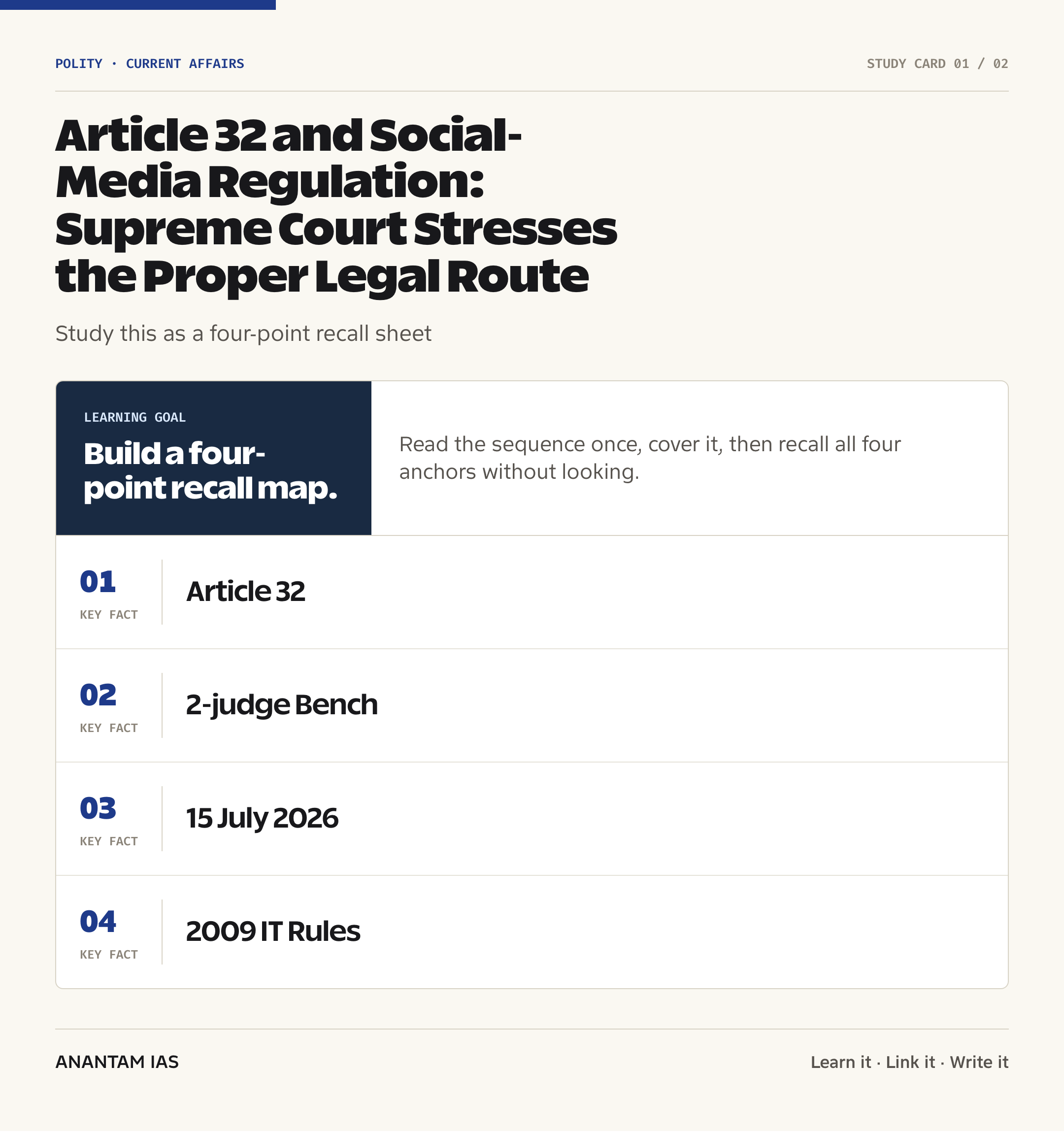
UPSC Relevance
Prelims Relevance
- Article 32 guarantees the right to move the Supreme Court for enforcement of fundamental rights.
- The Supreme Court may issue the writs of habeas corpus, mandamus, prohibition, certiorari and quo warranto under Article 32.
- Article 226 gives High Courts a wider writ jurisdiction: for fundamental rights and for other legal rights.
- Article 19(1)(a) protects freedom of speech and expression, subject to reasonable restrictions under Article 19(2).
- Public interest litigation relaxed the traditional rule of standing, but it isn’t a separate constitutional jurisdiction.
- Section 69 of the Information Technology Act concerns interception, monitoring and decryption, while Section 69A concerns blocking public access to information.
- The 2009 interception rules and the 2009 blocking rules serve different legal functions and shouldn’t be conflated.
- A court’s oral observation during a hearing must be distinguished from the binding ratio of a reasoned judicial decision.
Mains Relevance
GS Paper 2
- Scope of Article 32, constitutional remedies and judicial review
- Evolution, democratic value and possible misuse of public interest litigation
- Judicial restraint, institutional competence and separation of powers
- Accountability of digital platforms and the design of grievance-redress mechanisms
GS Paper 1
- Communal harmony, responsible public discourse and the social impact of viral content
- Interaction between technological change, social institutions and freedom of expression
Essay
- A constitutional remedy is strongest when used with constitutional discipline.
- Digital freedom and social responsibility aren’t opposites; each gives the other democratic legitimacy.
- Courts protect rights best when every institution performs its assigned role.
Background and Context
Article 32: The Guaranteed Constitutional Remedy
Article 32 is both a fundamental right and the constitutional gateway for enforcing other fundamental rights before the Supreme Court.
- Clause (1) guarantees the right to move the Supreme Court through appropriate proceedings for enforcement of rights in Part III of the Constitution.
- Clause (2) empowers the Court to issue directions, orders or the five named constitutional writs needed to enforce those rights.
- The remedy is available when a fundamental right is infringed; Article 32 isn’t the general forum for every illegality, policy disagreement or criminal allegation.
- The Constitution permits suspension of this right only as constitutionally provided. During an Emergency, Article 359 can suspend the right to move a court for specified Part III rights, but Articles 20 and 21 are protected from such suspension.
- Dr. B.R. Ambedkar famously described Article 32 as the Constitution’s heart and soul, yet that importance doesn’t erase thresholds of standing, evidence, alternative process and institutional competence.
- The official Constitution of India should be read with Supreme Court doctrine on judicial review and access to justice.
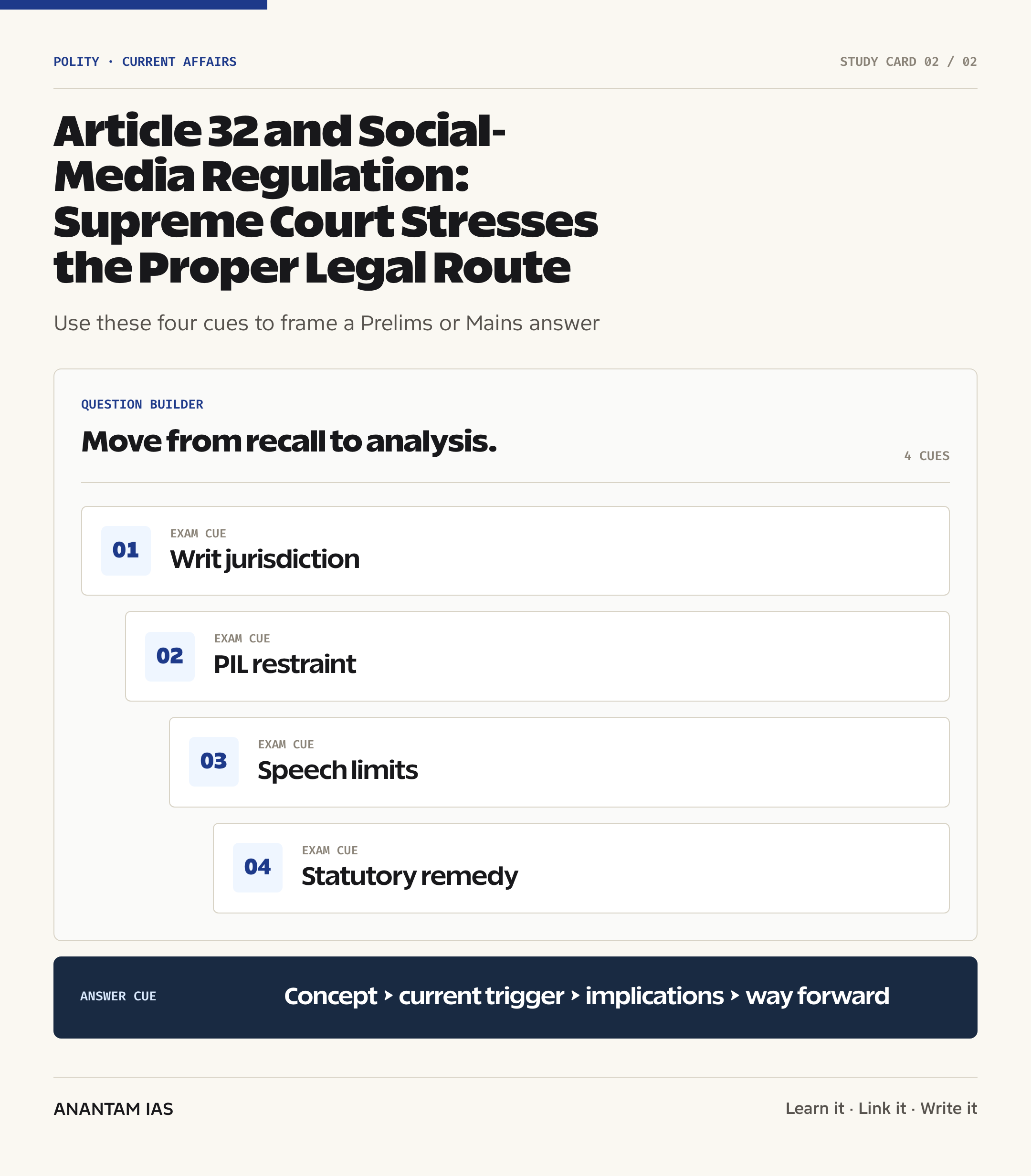
Writ Jurisdiction and the Choice of Forum
India’s constitutional design distributes public-law remedies across the Supreme Court and the High Courts rather than treating every grievance as a first-instance Supreme Court case.
- A petition under Article 32 directly invokes the Supreme Court’s original jurisdiction to enforce a fundamental right.
- A petition under Article 226 may enforce fundamental rights as well as other legal rights, making the High Court’s substantive writ reach wider.
- The existence of another remedy doesn’t automatically extinguish Article 32, but the Court may examine whether the case really requires direct constitutional intervention.
- When facts require a complaint, collection of evidence and identification of an offence, the investigative process is normally better placed to begin the inquiry.
- When a specialist statute creates a regulator or designated authority, using that statutory channel first builds a factual record and respects the scheme enacted by Parliament.
- The larger issue of when the Court acts on its own motion is explained in Anantam IAS’s note on Supreme Court suo motu cognisance.
Public Interest Litigation: Access with Safeguards
PIL widened access to constitutional justice, especially for people unable to reach courts themselves, but it also requires judicial screening against private, publicity-driven or political claims.
- Traditional locus standi required the person directly affected to approach the court; PIL relaxed that rule for diffuse public injury and disadvantaged groups.
- The innovation helped courts address bonded labour, custodial abuse, environmental harm and failures affecting groups with weak access to legal representation.
- Relaxed standing doesn’t remove the need to show a justiciable injury, credible facts, a proper respondent and relief a court can lawfully supervise.
- Courts guard against publicity-interest, private-interest and politically motivated litigation because weak petitions consume scarce judicial time and can distort democratic debate.
- A request for nationwide control of speech demands close scrutiny: an overbroad judicial direction can burden lawful expression without the definitions, safeguards and review mechanisms expected of a valid restriction.
- The Bench’s warning in this case was about preserving Article 32’s remedial purpose, not reducing its status as a guaranteed constitutional right.
Free Speech and Lawful Restrictions Online
The Constitution protects speech across media, while Article 19(2) permits only reasonable restrictions connected to its listed grounds.
- Article 19(1)(a) covers the freedom to express and receive ideas; the protection isn’t lost merely because expression travels through a podcast, reel or platform.
- Article 19(2) lists grounds such as sovereignty and integrity of India, security of the State, public order, decency or morality, defamation, contempt of court and incitement to an offence.
- A restriction must have legal authority, a rational connection with a listed ground and safeguards against arbitrary or disproportionate action.
- In Shreya Singhal v. Union of India, the Supreme Court struck down Section 66A of the IT Act for vagueness and overbreadth, while upholding Section 69A’s blocking framework with procedural safeguards.
- Offence, annoyance and disagreement can’t by themselves become open-ended standards for silencing speech. The constitutional focus is on the specific legal threshold and the speech’s connection to the prohibited harm.
- Related distinctions appear in the notes on the Supreme Court’s hate-speech test and its ruling that vulgarity alone isn’t obscenity.
Which Legal Route Applies to Harmful Online Content?
Online-speech disputes can engage several legal pathways, and each pathway has a distinct trigger, authority and safeguard.
- A person alleging a cognisable offence may approach the police; investigation establishes authorship, context, circulation and the applicable penal provision.
- Platform-level complaints can use the intermediary’s grievance officer mechanism under the Information Technology (Intermediary Guidelines and Digital Media Ethics Code) Rules, 2021.
- Section 69 of the IT Act and the 2009 interception rules concern authorised interception, monitoring or decryption for specified statutory grounds and subject to safeguards.
- Section 69A and its separate 2009 blocking rules govern government directions to block public access to information on listed grounds; they aren’t the same as the interception framework.
- Criminal-law provisions relating to promoting enmity, deliberate religious insult, public mischief, threats or defamation may apply depending on the exact words, intent, context and evidence.
- Policy responses to children and platforms require a different evidence base, discussed in India’s approach to children’s social-media use.
What the Bench's Response Does and Does Not Mean
For exam answers, the safest reading is procedural and institution-specific, not a sweeping verdict on all social-media regulation.
- The Bench refused to entertain this Article 32 petition; it didn’t declare that harmful online speech is beyond legal control.
- It directed attention to ordinary remedies, including the complaint process and the authority operating under the applicable IT-law framework.
- It didn’t create a new pan-India ban on podcasts or reels, and it didn’t author a comprehensive code for permissible platform speech.
- The reported remarks were made during a hearing. Students should distinguish oral observations from a signed judgment’s binding ratio decidendi.
- The Court’s procedural stance also prevents the highest constitutional forum from becoming the first factual investigator in every viral-content dispute.
- At the same time, the State remains bound to investigate legally cognisable complaints and protect public order and equal citizenship without selective enforcement.
Constitutional and Governance Significance
The episode illustrates how rights protection depends on both judicial access and a functioning chain of ordinary institutions.
- Judicial restraint can preserve institutional legitimacy when a requested remedy needs legislative definitions, executive fact-finding or technical regulatory design.
- Access to justice suffers if police and regulators fail, because citizens then treat constitutional courts as the only credible point of entry.
- Rule of law requires content restrictions to be viewpoint-neutral, traceable to enacted law and reviewable by an independent court.
- Platform accountability should combine prompt grievance handling, transparent decisions, preservation of evidence and protection against automated over-removal.
- Communal harmony can’t rest on indiscriminate censorship; it needs targeted enforcement against legally defined harm alongside counterspeech and digital literacy.
- For a balanced Mains answer, connect rights, remedies, procedure and institutional capacity instead of presenting free speech and regulation as an all-or-nothing choice.
Way Forward
Use the Correct First Forum
- File a specific police complaint where facts disclose an offence, preserve URLs and timestamps, and allow lawful investigation of authorship and context.
- Use the platform and statutory grievance mechanisms before seeking a judicial command, unless urgent fundamental-rights injury makes immediate court protection necessary.
Apply Narrow, Rights-Compatible Standards
- Tie every restriction to Article 19(2), a valid law and a clearly identified harm rather than vague claims that speech is merely hurtful.
- Prefer content-specific and proportionate measures over blanket controls on an entire medium such as podcasts or reels.
Strengthen Institutional Capacity
- Train police and regulators in digital evidence, speech doctrine and communal-sensitivity assessment so complaints don’t fail through delay or overreach.
- Require platforms to publish meaningful data on complaints, response times, removals, appeals and restoration while protecting user privacy.
Protect the Integrity of PIL
- Screen petitions for bona fides, affected rights, factual foundation and workable relief at an early stage.
- Keep Article 32 readily available for genuine rights violations while discouraging attempts to make the Court a political or publicity forum.
Conclusion
The Supreme Court’s response places constitutional discipline beside constitutional access. Article 32 remains a guaranteed remedy, but its purpose is enforcement of fundamental rights, not substitution for every complaint, investigation or regulatory decision.
A durable digital-speech framework needs precise law, capable institutions, proportionate remedies and judicial review. That combination can protect public order and dignity without converting every controversial reel or podcast into a case for blanket censorship.
UPSC Practice Questions
Prelims MCQ 1
With reference to writ jurisdiction in India, consider the following statements:
- Article 32 guarantees the right to move the Supreme Court for enforcement of fundamental rights.
- High Courts may issue writs under Article 226 only for enforcement of fundamental rights.
- The Supreme Court and High Courts can both issue the writ of quo warranto.
How many of the above statements are correct?
(a) Only one (b) Only two (c) All three (d) None
Answer: (b) Only two
Explanation:
Statements 1 and 3 are correct. Article 226 is wider than Article 32 because High Courts may issue writs for fundamental rights and for other legal purposes.
Prelims MCQ 2
Which one of the following correctly distinguishes Sections 69 and 69A of the Information Technology Act, 2000?
(a) Section 69 concerns intermediary safe harbour, while Section 69A concerns cybercrime investigation (b) Section 69 concerns interception, monitoring or decryption, while Section 69A concerns blocking public access to information (c) Section 69 concerns data protection, while Section 69A concerns digital signatures (d) Both provisions deal only with private platform moderation
Answer: (b) Section 69 concerns interception, monitoring or decryption, while Section 69A concerns blocking public access to information
Explanation:
The provisions have different objects and operate through separate safeguards and rules. They shouldn’t be treated as one generic power to regulate online content.
UPSC Mains Questions
- Article 32 is a guaranteed constitutional remedy, but direct access to the Supreme Court doesn’t make it the first forum for every public grievance. Discuss this proposition with reference to PIL, alternative statutory remedies, judicial restraint and the institutional role of investigation.
- India’s response to harmful social-media content must protect public order without creating vague or disproportionate speech controls. Examine the constitutional test under Article 19(2), the distinct statutory routes under the IT Act, and the safeguards needed for platform accountability.
Sources: The Hindu and Constitution of India, Legislative Department.
Frequently Asked Questions
What does Article 32 guarantee?
Article 32 guarantees the right to move the Supreme Court for enforcement of fundamental rights. It also empowers the Court to issue directions, orders and constitutional writs. The provision doesn’t convert the Supreme Court into a general first forum for every statutory, criminal or policy grievance.
Did the Court ban reels or podcasts?
No. The reported hearing ended with the Court declining to entertain a petition seeking broad curbs. The Bench pointed the petitioner toward ordinary complaint and statutory routes. It didn’t impose a nationwide ban or formulate a general code governing all reels and podcasts.
Why did the Court mention politicisation?
The Bench cautioned that Article 32’s direct constitutional access shouldn’t be used as a device to politicise an issue. The point concerned the suitability and bona fides of the chosen remedy, not a reduction in Article 32’s importance as a fundamental-rights guarantee.
How is Article 226 different?
Article 32 lets the Supreme Court enforce fundamental rights. Article 226 authorises High Courts to issue writs for fundamental rights and for other legal purposes. So Article 226 has a wider substantive scope, though each court’s territorial and institutional setting also shapes the remedy.
Can harmful online speech be prosecuted?
Yes, when the facts satisfy a legally defined offence. Police and courts must examine the exact words, intent, context, likely harm and evidence. Merely offensive or unpopular speech can’t be punished through vague standards; any restriction must follow valid law and constitutional safeguards.
Are oral observations binding precedent?
Ordinarily, no. A court’s oral remarks help conduct a hearing but must be distinguished from the ratio in a signed, reasoned decision. For exam answers, describe this episode as a reported procedural stance unless an authoritative order supplies a binding legal proposition.